
JPMorgan’s Jamie Dimon Predicts ‘Crack in the Bond Market,’ Citing U.S. Fiscal Mess – WSJ | May 30, 2025 – Excerpt:
Without substantial changes, the U.S. is headed for a reckoning, Dimon said. “And I tell this to my regulators…it’s going to happen, and you’re going to panic,” he said. “I just don’t know if it’s going to be a crisis in six months or six years.”
……………………….
Interest Paid on the US Debt Soars
06/18/2025 • Mises Wire • Ryan McMaken – Excerpt:
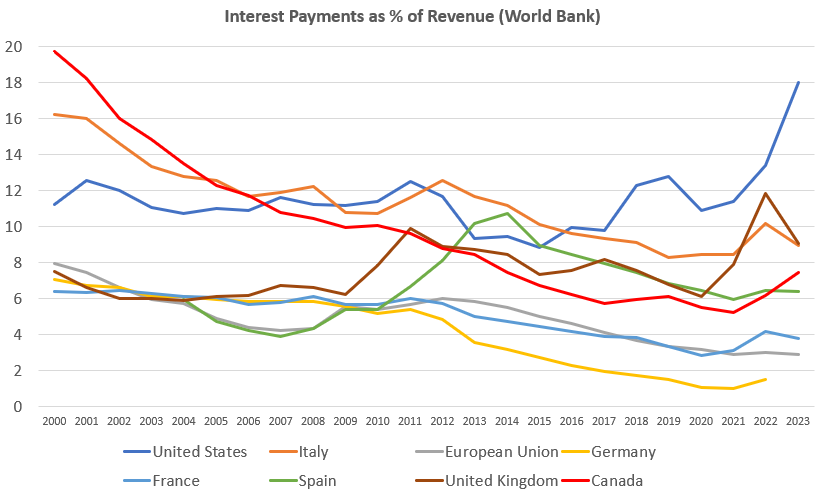
[The] United States has in recent years outpaced other major developed economies to become the country with the largest debt-service burden. For example, when compared to Canada and major European economies, the US pays, by far, the largest amount of interest as a percentage of revenue. The trend in the US has been clearly upward since 2012, but surged well above peer countries after 2021. As of 2023, the US debt service amounts to 18 percent of total revenue.
……………………………………………..
“Average Interest Rate on the Debt” – Update on an Ugly Situation
By Wolf Richter, May 29, 2025 – Excerpt:
The debt has ballooned by $13 trillion (by 56%) in just five years, from $23.2 trillion in Q1 2020 to $36.2 trillion in Q1 2025, including by $2.2 trillion in 2024 despite above-average real GDP growth.
The ballooning of the debt is temporarily on hold due to the debt ceiling, but to make up for it, because there are no free lunches, it will spike by $1 trillion within months of the debt ceiling getting lifted, and will continue to balloon with renewed vigor afterwards.
Interest rates are much higher than the historic lows five years ago.
Short-term interest rates had been at near-0% in 2020 and 2021, but started rising in 2022 and reached about 5.4% in mid-2023 and then stayed there for a year. Last fall, the Fed cut its policy rates by 100 basis points, which has pushed down the interest rate at which the government can sell T-bills to about 4.3%. The $6 trillion in T-bills are constantly getting rolled over as they mature, and new T-bills are sold at lower interest costs for the government, which contributed to the dip in interest expenses.
However, the interest rates at which the government can sell long-term Treasury securities have not changed much over the past two years. For example, the 10-year yield lurched up and down over those two years, sometimes violently, but has mostly remained in a range between 3.7% and 4.7%, and is now about where it was a year ago (4.4%). And those rates are far higher than where they’d been.
For instance, the 10-year Treasury issue that matured this month was sold in May 2015 at a yield of 2.24%. The government replaced it this month with new 10-year notes that it sold with a yield of 4.34%, nearly double the interest cost for the government.
In addition, the size of the issue has doubled, from $24 billion in 2015 to $42 billion in this Month.
But the process is slow. Long-term securities by definition are slow to cycle out of the debt, so changes in long-term interest rates filter only slowly into the debt as old maturing debt is replaced with new debt that comes with the new interest rates.
These dynamics form the average interest rate that the government pays on its total outstanding debt. That average interest more than doubled from 1.55% in 2022 to 3.35% August 2024. Since then, it has eased a hair. In April, it inched up to 3.29%, according to data from the Treasury Department…
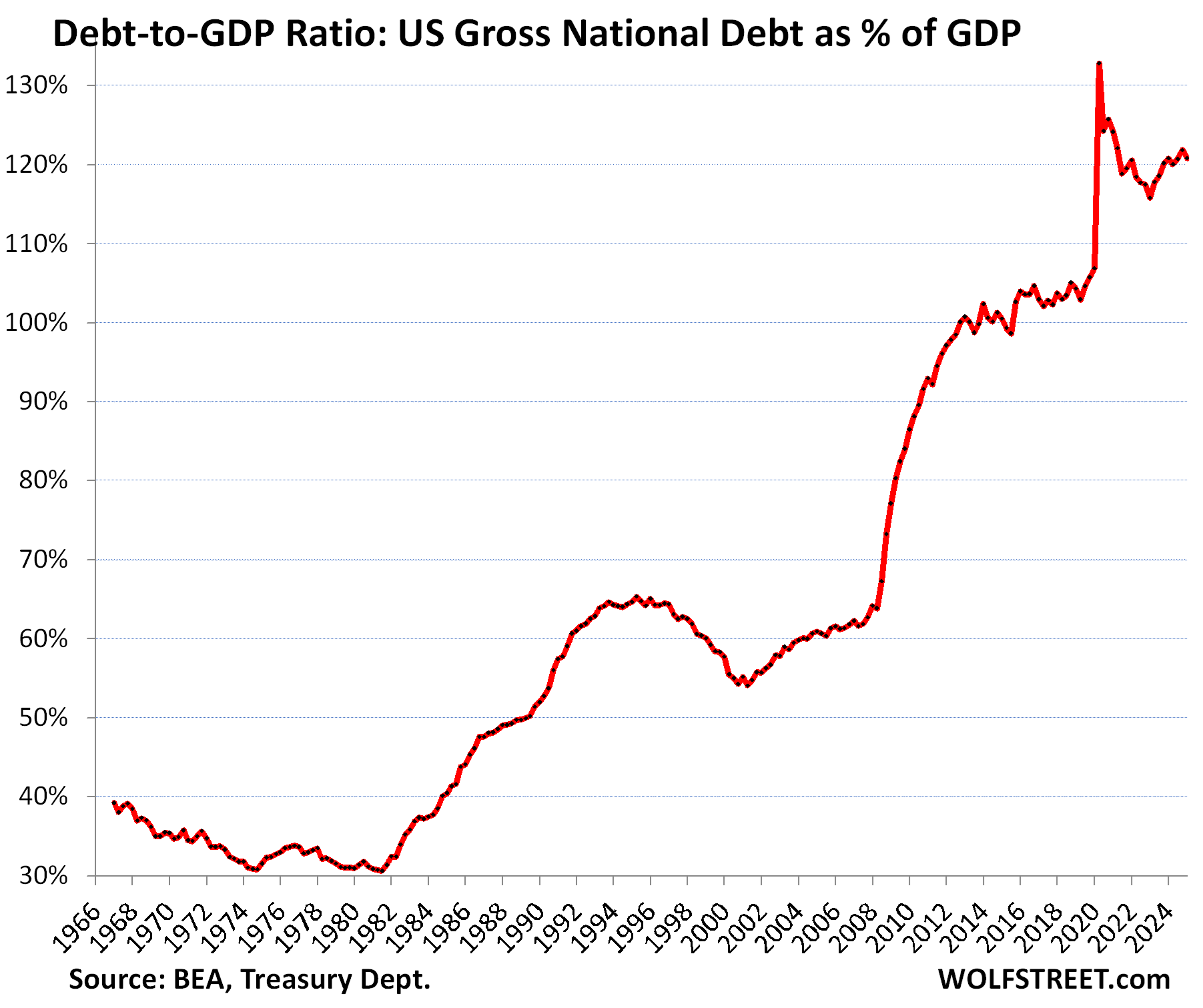
The ugly Debt-to-GDP ratio: Total debt as percent of GDP eased in Q1 to 120.8%, based on the second estimate of Q1 “current dollar” GDP released by the BEA today. It dipped because the debt ceiling temporarily blocked the debt from growing.
The Debt-to-GDP ratio = total debt (not adjusted for inflation) divided by “current dollar” GDP (not adjusted for inflation). Inflation cancels out because the inflation factor affects both the numerator and the denominator equally.
________________________________________
Washington Republicans and Democrats have no plan, and the U.S. Treasury Department has no plan, and the Federal Reserve has no plan – to get America’s burgeoning federal budget deficits back under control.
Main Street America Republicans do have a plan.
The Leviticus 25 Plan will produce (conservatively) $36.568 billion federal budget surpluses during each year of its first five years of activation (2026-2030) – and pay for itself entirely over the next 10-15 years.
It will also rebalance fiscal balance sheets for state and local governments, restore financial security for millions of American families, and rejuvenate a long-term economic growth cycle (not driven by debt issuance).
“He who will not apply new remedies must expect new evils.” – Sir Francis Bacon
The Leviticus 25 Plan is a dynamic economic initiative providing direct liquidity benefits for American families, while at the same time scaling back the role of government in managing and controlling the affairs of citizens. It is a comprehensive plan with long-term economic and social benefits for citizens and government.
The inspiration for this plan is based upon Biblical principles set forth in the Book of Leviticus, principles tendering direct economic liberties to the people.
The Leviticus 25 Plan – An Economic Acceleration Plan for America
$95,000 per U.S. citizen – Leviticus 25 Plan 2026 (31184 downloads )