
The KBW Index – large national money center banks have been faring very well, in what is otherwise a burdensome and stifling economic climate for businesses, working-class citizens, states, and student loan borrowers.
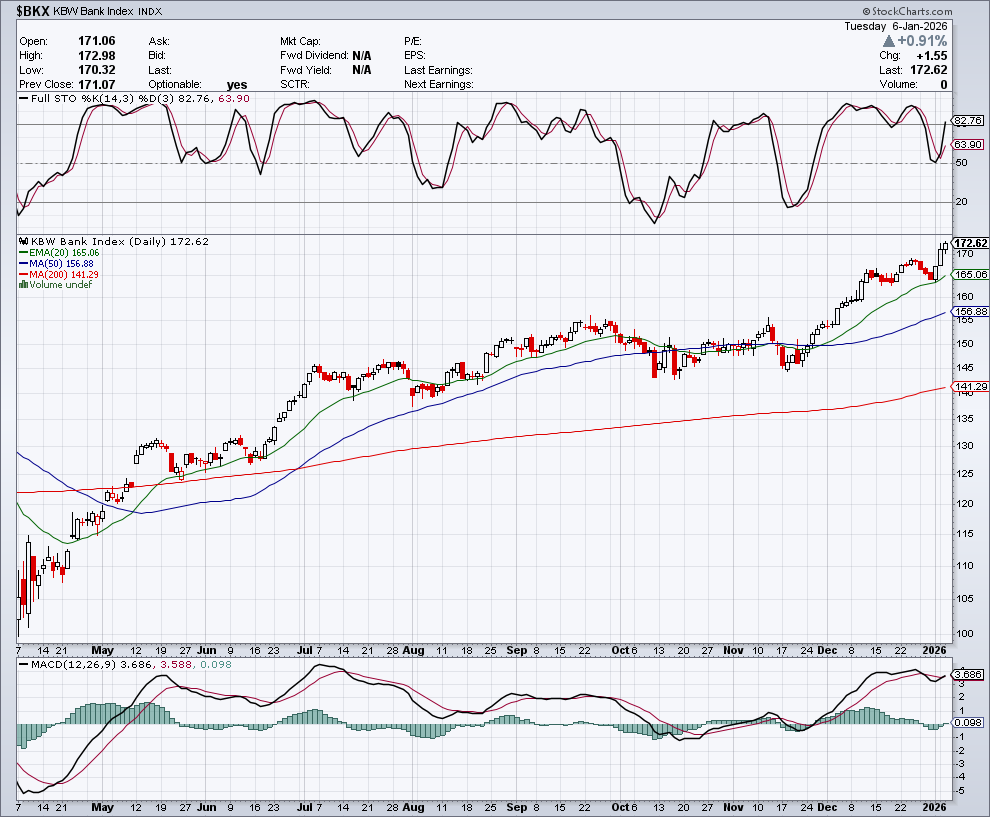
The KBW Index includes 24 banking stocks representing the large U.S. national money centers, regional banks and thrift institutions. The largest banks in the Index include:
JP Morgan Chase & Co.
Bank of America Corporation.
Wells Fargo & Company.
Morgan Stanley.
Goldman Sachs Group, Inc. ( The)
Citigroup
Capital One Financial Corporation.
U.S. Bancorp.
________________________________
Meanwhile across America: Businesses, working-class citizens, states, and student loan borrowers are not faring well…
Bankruptcies are exploding across the economy, hitting small businesses and households. Few industries are immune. – Business Insider
By Natalie Musumeci | Dec 27, 2025
- From corporate giants to mom-and-pop shops, bankruptcies are piling up across the US this year.
- Large corporate bankruptcies have hit their highest level in 15 years.
- “Bankruptcies seem to be kind of all over the place,” one veteran bankruptcy attorney said.
Bankruptcies aren’t just rising — they’re suddenly everywhere.
From billion-dollar giants to mom-and-pop shops to everyday individuals, bankruptcies are piling up across the US this year, with large corporate bankruptcies already hitting their highest level in 15 years.
The surge in bankruptcies highlights the growing financial pressures facing consumers and companies as costs climb amid a tougher borrowing environment….
Personal bankruptcies – In addition to big and small businesses, individual bankruptcies have also increased amid rising costs. Individual bankruptcy filings saw an 8% jump to 40,973 in November 2025, up from the 37,814 filings in November 2024, the data cited by ABI shows.
Full article: https://www.businessinsider.com/bankruptcies-across-economy-small-business-households-corporate-2025-12
__________________________________
Credit Card Interest Rates
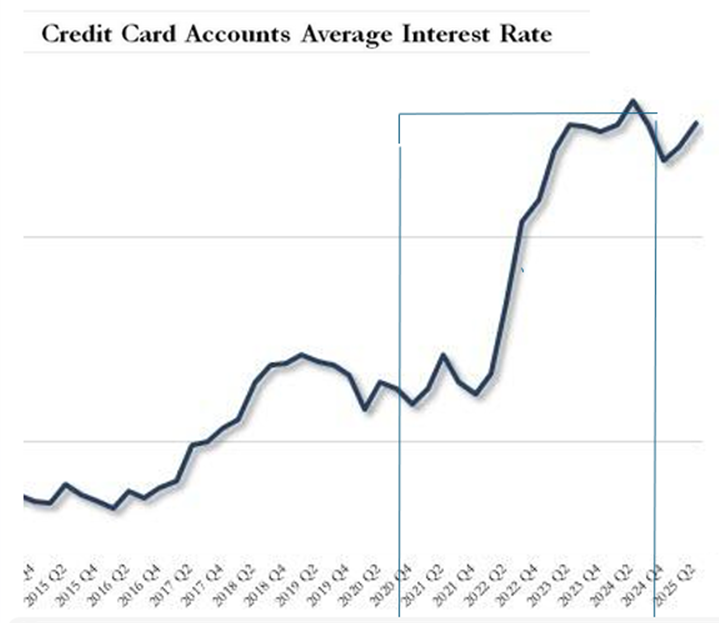
Federal Reserve’s latest consumer credit report (G.19): “Despite the 1.50% in rate cuts since last September, we can now confirm that rates on credit cards have gone… higher, as banks continue to bleed US consumers dry: at the start of 2025 the average rate on credit card accounts was 22.80%… and on Sept 30 the number was higher at 22.83%, just barely below the all time high of 23.37% set one year ago” (ZeroHedge).
______________________________________
States’ Recession Risk
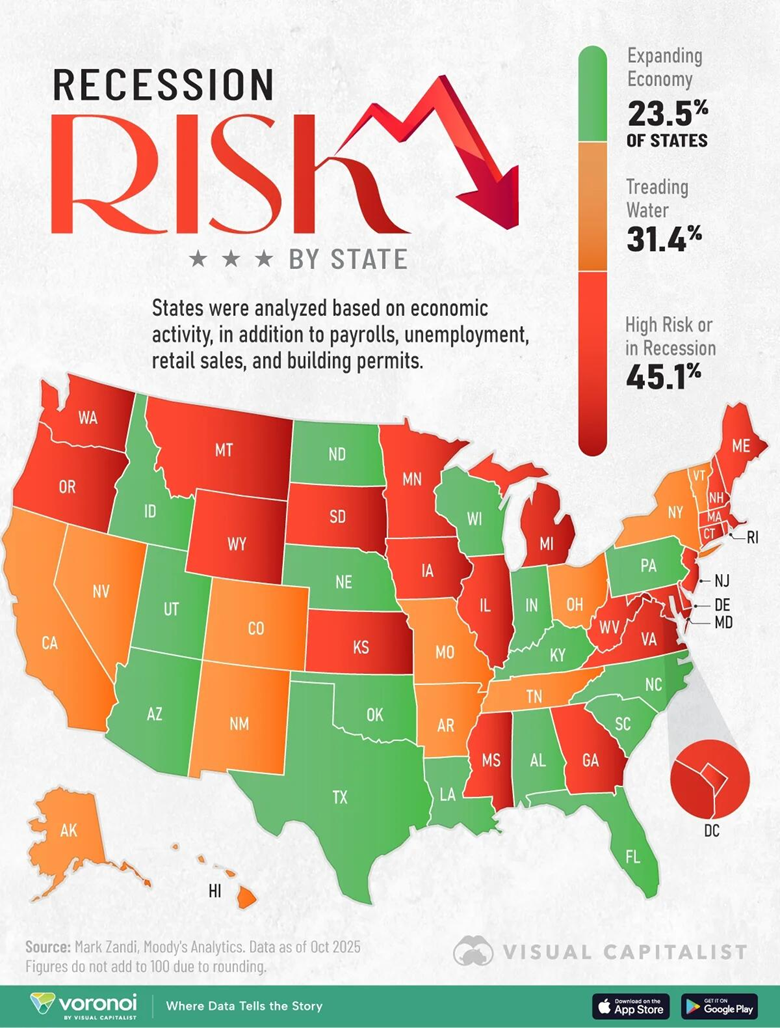
23 US States Are At High Risk Of (Or In) Recession Currently
ZeroHedge, Dec 22, 2025 – Excerpt:
In 2025, states responsible for about a third of U.S. GDP are in recession, or face high recession risk. Another third are expanding, including Florida and Utah, based on payrolls, employment, and other key economic data.
This graphic, via Visual Capitalist’s Dorothy Neufeld, shows recession risk by state in 2025, based on analysis from Mark Zandi, chief economist at Moody’s Analytics.
______________________________
Student Loan Stress
Education Department Has Rejected Over 300,000 Requests For Lower Student Loan Repayments
ZeroHedge, Dec 28, 2025 – Authored by Aaron Gifford via The Epoch Times, – Excerpt:
The U.S. Department of Education has so far denied requests from more than 300,000 existing student loan recipients seeking new repayment terms, according to documents filed in a federal court earlier this month.
The total debt carried by 43 million student loan borrowers currently totals about $1.62 trillion.
……………………..
By Michelle Zampini, Dec 6, 2025 – Excerpt:
Beyond affordability, borrowers report mixed experience with servicers: more than half (61%) of borrowers report having communicated with their servicer to resolve an issue with their account; of those borrowers, three-quarters (75%) said they were able to work with their servicer to resolve the issue. However, nearly half of those borrowers (48%) reported facing long wait times to access help, one quarter (24%) said their servicer provided them with inaccurate information, and one in ten borrowers (11%) believe the balance shown on their account is incorrect.
These findings align with the limited data that ED has released so far this year. At the start of the pandemic pause in March 2020, 8.6 million borrowers were in default. While a portion of those borrowers resolved their default during the pause—either through the “Fresh Start” program or via having their debt discharged—new ED data released in November show that as of October 2025, more than 5.5 million borrowers with over $140 billion in outstanding federal student loans were in default.2 In addition, 1.17 million borrowers were 30-89 days delinquent, 1.56 million were 90-269 days delinquent, and 3.68 million were 270+ days delinquent.
____________________________
The Leviticus 25 Plan impartially grants U.S. citizens the same direct liquidity extensions that were provided to major U.S. and foreign banking concerns during the economic credit crisis of 2008-2010 and the Covid crisis of 2021-2022.
The Leviticus 25 Plan will cleanly and evenly eliminate massive amounts of public and private debt (mortgage debt, consumer debt, student loan debt). It will dramatically and powerfully restore financial security for millions of American families and small businesses.
Large money center banks, rather than receiving ‘hand-out’ liquidity flows direct from the Federal Reserve, will receive massive liquidity infusions that flow from the Fed direct to U.S. citizens, and then on into the banking system through opportunistic debt-elimination.
Excess cash reserves may then be directed by banks into the Treasury market to competitively lower interest rates.
The Leviticus 25 Plan is the most comprehensive, powerful economic acceleration plan anywhere on the planet.
The Leviticus 25 Plan is a dynamic economic initiative providing direct liquidity benefits for American families, while at the same time scaling back the role of government in managing and controlling the affairs of citizens. It is a comprehensive plan with long-term economic and social benefits for citizens and government.
The inspiration for this plan is based upon Biblical principles set forth in the Book of Leviticus, principles tendering direct economic liberties to the people.
The Leviticus 25 Plan – An Economic Acceleration Plan for America
$95,000 per U.S. citizen – Leviticus 25 Plan 2026 (42435 downloads )