
Note: The ‘Free Money” giveaways referenced in this report are but a ‘blip’ on the radar screen, compared to the massive liquidity flows pumped out to major Wall Street financial institutions (foreign and domestic) through various Fed-initiated ‘credit facilities’ (‘Secret Liquidity Lifelines’) during the 2008-2010 financial meltdown.
……………………………………….
How Much Free Money is the Fed Giving Banks and Financial Institutions?
July 29, 2023, MishTalk – Economics
Excerpts:
The Fed pays interest to banks on all reserves… How much free money is that?
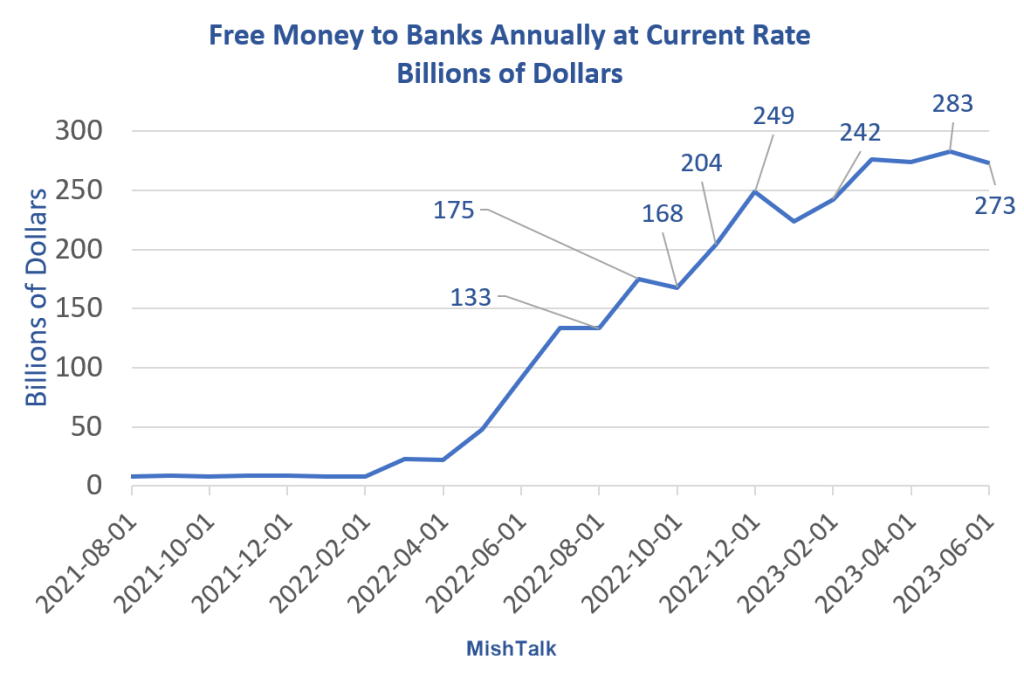
Free money to banks based on reserves, reverse repos, and current interest rate paid by the Fed. Chart and calculation by Mish.
Understanding Reserves – The Fed used to pay banks interest on “excess reserves”. Excess reserves are total reserves minus required reserves.
As announced on March 15, 2020, the Board of Governors reduced reserve requirement ratios on net transaction accounts to 0 percent, effective March 26, 2020. This action eliminated reserve requirements for all depository institutions.
Since there are no reserve requirements on either checking or savings deposits, all reserves are effectively excess reserves, and the Fed pay banks interest on everything. That includes free money crammed down banks throats via QE.
Reverse Repos – The Fed also pay interest on reverse repos. A reverse repurchase agreement (RRP, or reverse repo) is a short-term agreement to sell securities in order to buy them back at a slightly higher price. The primary recipient of reverse repo interest are the money market funds….
Target Fed Funds Rate – The New York Fed explains: The New York Fed conducts repo and reverse repo operations each day as a means to help keep the federal funds rate in the target range set by the Federal Open Market Committee (FOMC).
In order to suppress a free market in interest rates and to help control the mess the Fed created via Quantitative Easing (QE), now Quantitative Tightening (QT), the Fed is handing out free money left and right.
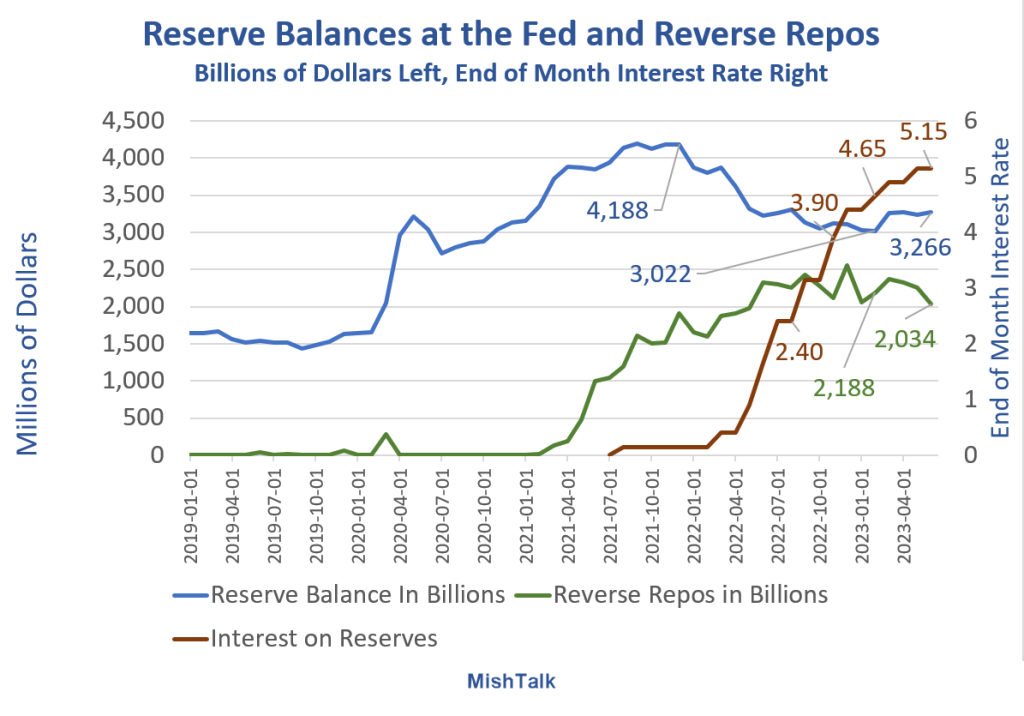
To calculate free money, we need to watch three things: Interest rates, reserves, and reverse repos.
Reserve Balances at the Fed, Reverse Repos, Interest Rate
Understanding the Free Money Forces
- In isolation, rising interest rates add to the free money given to financial institutions.
- QT reduces bank reserves and thus free money.
- Reverse Repos are now slowly declining. This also reduces free money payouts.
The net impact of these forces has been pretty stable for about six months, roughly between $250 billion and $280 billion in free money given to banks at an annual rate.
Free Money at Taxpayer Expense – My numbers are approximate, using end of month interest rates and monthly average balances. In practice, this is all calculated daily. But within a few billion dollars, the Fed is giving banks about $273 billion annually at the current rate.
It’s important to note that free money that should be going to taxpayers. Instead the Fed gives it to banks because its QE/QT programs made a huge mess out of monetary policy.
_________________________________
These ‘free money’ Fed giveaways to financial institutions can be easily balanced back out with a properly incentivized, comprehensive economic acceleration plan that retargets liquidity extensions – to include U.S. citizens.
The Leviticus 25 Plan is a dynamic economic initiative providing direct liquidity benefits for American families, while at the same time scaling back the role of government in managing and controlling the affairs of citizens. It is a comprehensive plan with long-term economic and social benefits for citizens and government.
The inspiration for this plan is based upon Biblical principles set forth in the Book of Leviticus, principles tendering direct economic liberties to the people.
The Leviticus 25 Plan – An Economic Acceleration Plan for America
$95,000 per U.S. citizen – Leviticus 25 Plan 2026 (35017 downloads )