
Main Street America Republicans have the plan to end America’s mushrooming budget deficits, restore financial security for millions of American families, and rejuvenate free market dynamics and reignite a legitimate long-term economic growth cycle.
It is a plan which will put an end, once and for all, to Congress’ divisive budget charades and debt-exploding, economy-ravaging outcomes.
“You never change things by fighting the existing reality. To change something, build a new model that makes the existing model obsolete. –R. Buckminster Fuller
…………………………………………
Politico: The next shutdown threat is around the corner
Most of the federal government will continue running on autopilot through Jan. 30, setting up another showdown.
By Jennifer Scholtes, Katherine Tully-McManus and Jordain Carney
Published Nov 13, 2025 – Excerpts:
The longest shutdown in U.S. history is ending. Yet Congress’ most onerous government funding work remains unfinished — setting up a potential repeat early next year.
The bipartisan deal to end the funding lapse includes a long-term agreement on just three of the dozen bills lawmakers need to finish each year to keep cash flowing to federal programs. And those three measures are some of the easiest to rally around — including money for veterans programs, food aid, assistance for farmers and the operations of Congress itself.
Together, they represent only about 10 percent of the roughly $1.8 trillion Congress doles out each year to federal agencies. Under the deal, everything else is funded on a temporary basis through Jan. 30 at levels first set by Congress in March 2024, when Joe Biden was president.
That leaves behind major open decisions about the vast majority of discretionary dollars — including for the military and public health programs — along with the stickiest policy issues. It doesn’t help that House and Senate leaders still haven’t agreed on an overall total for fiscal 2026 spending, amid GOP divisions over how deeply to cut.
House Majority Leader Steve Scalise acknowledged this month that the hardest part of the funding negotiations is ahead after President Donald Trump signs the current deal to end the shutdown.
“We’ve got to just find a resolution to get the lights back on,” Scalise said. “But the real negotiation is going to be: Can we get an agreement on how to properly fund the government with individual appropriations bills, packages of appropriations bills?”
If lawmakers don’t figure it all out by the new January deadline, Congress risks another partial shutdown or running most of the federal government on what are essentially two-year-old budgets. Some Democrats are already hinting they are willing to shut down the government again without a deal on Affordable Care Act insurance subsidies that expire at the end of this year.
Compounding the challenge are fears that partisan strife during the six-week shutdown will only complicate the already-grueling task of striking a cross-party compromise.
In the Senate, leaders have committed to quickly advancing more funding measures. Majority Leader John Thune said senators would be “off to the races” on a second package of spending measures when the chamber gavels back in Tuesday.
Up to five bills are under consideration for inclusion in that package, covering funding for the military and the departments of Education, Commerce, Labor, Health and Human Services, Justice, Transportation, Interior and Housing and Urban Development.
Getting that done will be hard enough. All 100 senators would have to consent to quickly assemble the bills on the floor, likely followed by weeks of debate before a vote on passage. Then top Senate appropriators would need to strike a compromise with their House counterparts.
But the remaining spending bills will be even tougher. Four are so divisive that Senate appropriators didn’t even approve them in committee this summer. Lawmakers in both parties agree it is likely that agencies covered under that slate — among them the departments of Energy, Homeland Security, State and Treasury, including the IRS — will eventually be funded through a stopgap that spans through next September.
Democrats warn that any partisan demands from Trump or hard-liners in the House could deadlock the effort to reach agreements on the nine bills left….
____________________________________
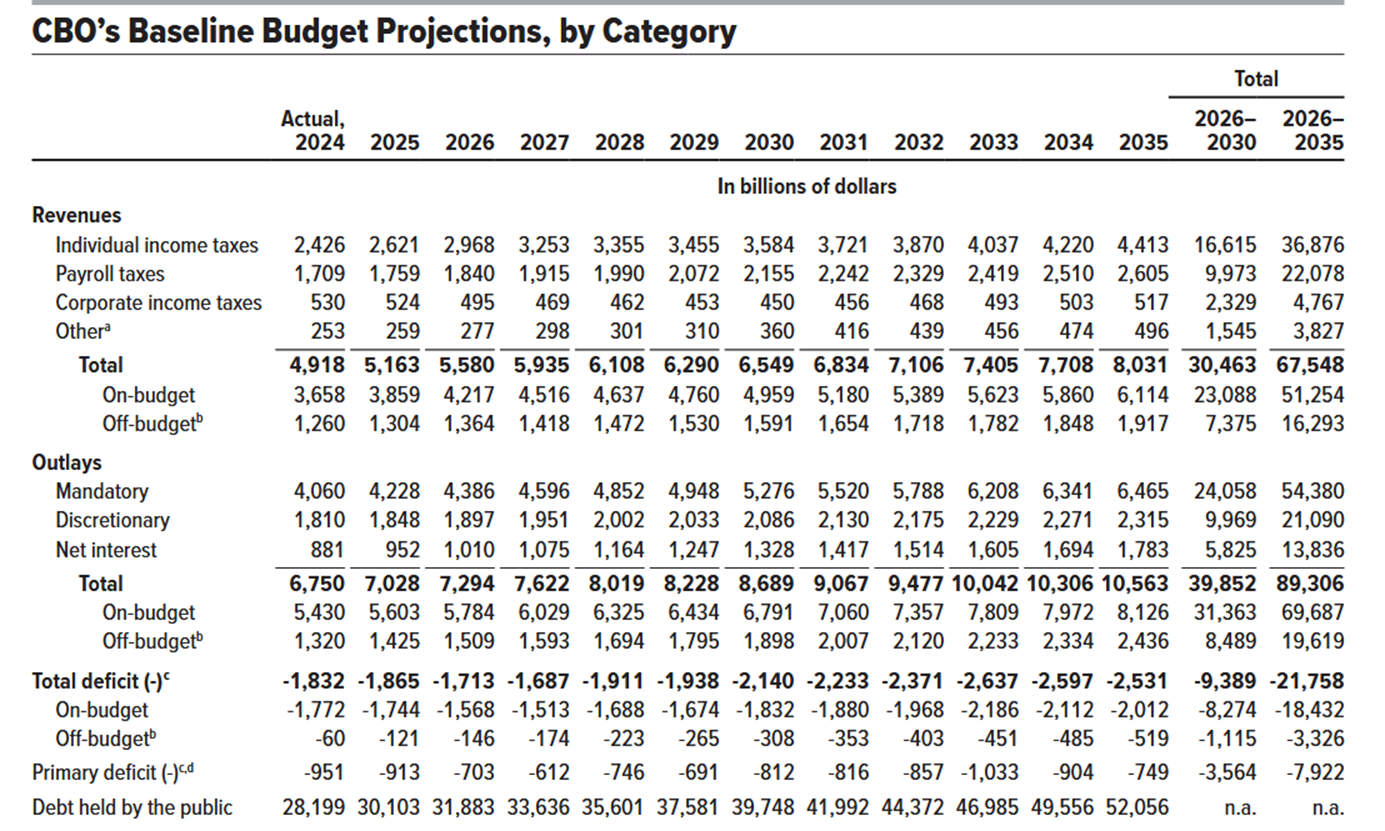
One thing is for certain as January 30th approaches: contentious and toxic political wrangling over the budget bills. And budget deficits ranging from $1.713 trillion (2026) to $2.531 trillion (2035).
The Leviticus 25 Plan has the vision and the power to overturn the “existing reality” and replace it with “a new model that makes the existing model obsolete.”
The Leviticus 25 Plan is a dynamic economic initiative providing direct liquidity benefits for American families, while at the same time scaling back the role of government in managing and controlling the affairs of citizens. It is a comprehensive plan with long-term economic and social benefits for citizens and government.
The inspiration for this plan is based upon Biblical principles set forth in the Book of Leviticus, principles tendering direct economic liberties to the people.
The Leviticus 25 Plan – An Economic Acceleration Plan for America
$95,000 per U.S. citizen – Leviticus 25 Plan 2026 (41119 downloads )