
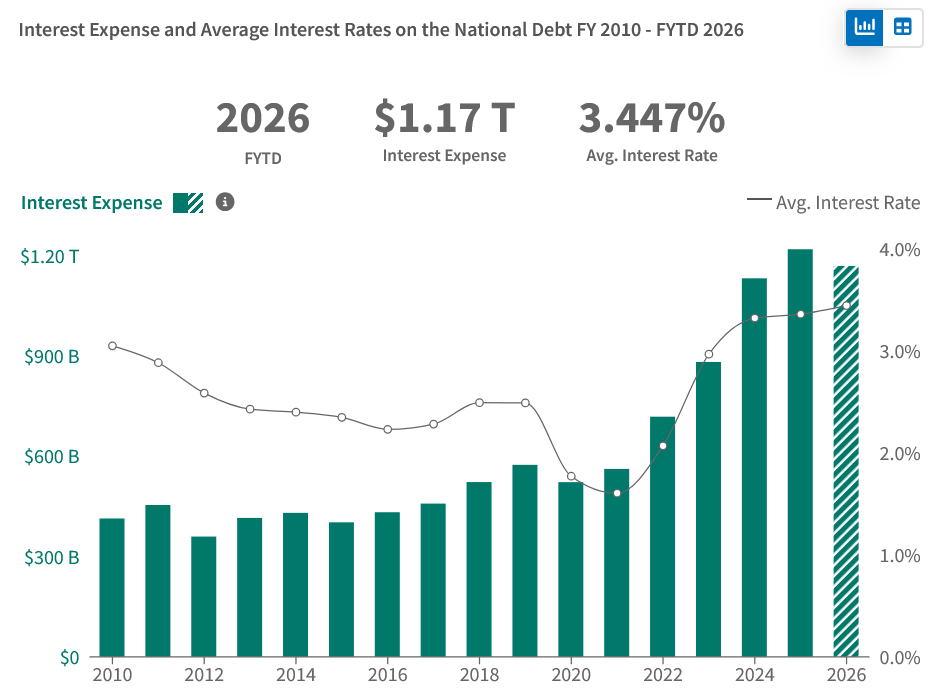
Report: “As the debt grows, so does the average interest rate the government is paying. That rate jumped from 2.378% five years ago to 3.447% now. Since one of the key drivers of U.S. debt growth is interest on the debt, a vicious spending cycle has been created, one that lawmakers in the U.S. House Committee on the Budget recently called ‘completely unsustainable.’”
…………………………………..

Interest Expense and Average Interest Rates on the National Debt FY 2010 – FYTD 2026
Last Updated: July 31, 2026
………………………………………….
Breaking Down the Debt – Fiscal Data | Treasury.gov
The national debt is composed of distinct types of debt, similar to an individual whose debt consists of a mortgage, car loan, and credit cards. The national debt can be broken down by whether it is non-marketable or marketable and whether it is debt held by the public or debt held by the government itself (known as intragovernmental). The national debt does not include debts carried by state and local governments, such as debt used to pay state-funded programs; nor does it include debts carried by individuals, such as personal credit card debt or mortgages.
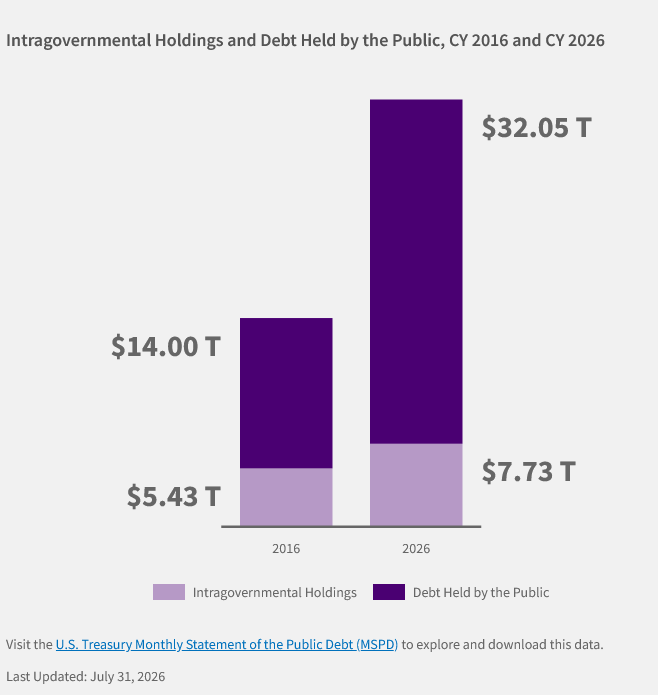
The visual below comparing calendar year 2016 and 2026 displays the difference in growth between debt held by the public and intragovernmental debt. While both types of debt combine to make up the national debt, they have increased by different amounts in the past several years. One of the main causes of the jump in public debt can be attributed to increased funding of programs and services during the COVID-19 pandemic. Intragovernmental debt has not increased by quite as much since it is primarily composed of debt owed on agencies’ excess revenue invested with the Treasury. The revenue of the largest investor in Treasury securities, the Social Security Administration, has not increased significantly in recent years, resulting in this slower intragovernmental holding increase.
The Debt Ceiling
The debt ceiling, or debt limit, is a restriction imposed by Congress on the amount of outstanding national debt that the federal government can have. The debt ceiling is the amount that the Treasury can borrow to pay the bills that have become due and pay for future investments. Once the debt ceiling is reached, the federal government cannot increase the amount of outstanding debt, losing the ability to pay bills and fund programs and services. However, the Treasury can use extraordinary measures authorized by Congress to temporarily suspend certain intragovernmental debt allowing it to borrow to fund programs or services for a limited amount of time after it has reached the ceiling.
Since the United States has never defaulted on its obligations, the scope of the negative repercussions related to a default are unknown but would likely have catastrophic repercussions in the United States and in markets across the globe.
………………………………
Current Debt: $40.03 trillion.
Current Debt Limit: Congress set the debt limit at $41.1 trillion in 2025 via reconciliation.
____________________________
There is precisely one plan, one dynamic, comprehensive economic acceleration plan in America with the power to resolve this looming fiscal inferno. Economically viable, politically feasible…
The Leviticus 25 Plan is a dynamic economic initiative providing direct liquidity benefits for American families, while at the same time scaling back the role of government in managing and controlling the affairs of citizens. It is a comprehensive plan with long-term economic and social benefits for citizens and government.
The inspiration for this plan is based upon Biblical principles set forth in the Book of Leviticus, principles tendering direct economic liberties to the people.
The Leviticus 25 Plan – An Economic Acceleration Plan for America
$95,000 per U.S. citizen – Leviticus 25 Plan 2027 (66960 downloads )