
No Secretary Bessent, We Aren’t Magically Growing Our Way Out Of Debt
ZeroHedge, Sep 12, 2026 – Authored by Vincent Cook via The Mises Institute,

The most basic objection to Bessent’s argument (and indeed to the older versions of “supply-side” voodoo as well) is that it doesn’t make any fundamental difference in the physical quantity of capital goods if private savings are consumed by higher deficits instead of being consumed by higher taxes….Giving a tax break to encourage greater investment without corresponding decreases in government spending is self-defeating, since increased deficits divert the additional savings away from private businesses towards the government and its clients and minions.
………….
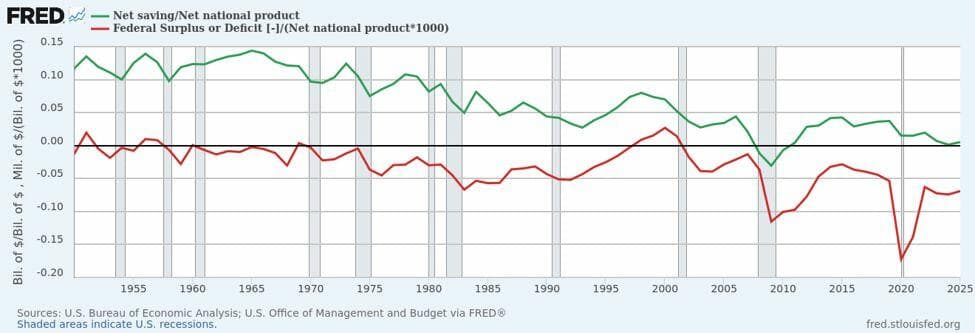
Figure 1 shows these amounts as fractions of net national product (NNP, a measure of what was actually earned by Americans at home and abroad) over the past seventy-five years, with the green line representing net saving and the red line representing federal surpluses and deficits.
Figure 1: Net saving, federal surpluses/deficits as fractions of net national product, 1950-2025
Source: BEA and OMB via FRED®

During the first twenty-four years, net saving varied between ten percent to fifteen percent of NNP, while the federal budget was close to being balanced. However, net saving peaked in 1965, and has since declined to very nearly zero percent in the 2020s. This sixty-year decline in net saving coincides with the emergence of steadily worsening federal deficits, which started becoming particularly acute in the 1980s and early 1990s at around 5 percent of NNP (roughly comparable to the New Deal deficits of the 1930s).
…………..
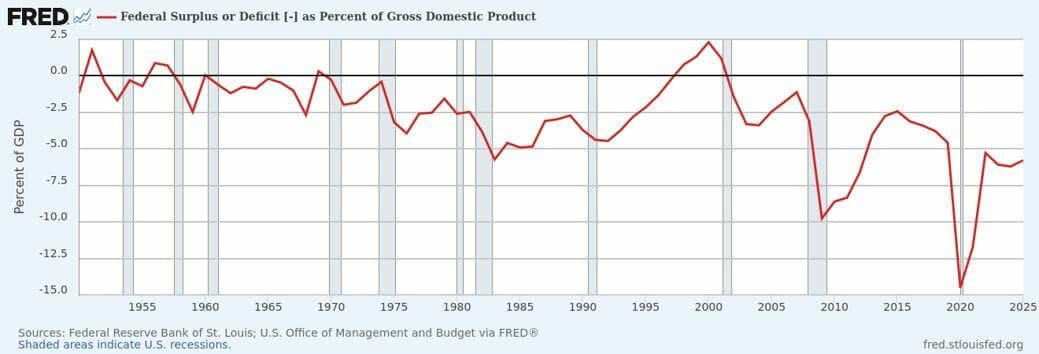
So what are we to make of Bessent’s contention that everything is fine because GDP is growing faster than deficits are? The deficit/GDP ratio referenced by Bessent (figure 2) did decrease from 6.2 percent in 2024 to 5.8 percent in 2025, but such a tiny improvement is barely noticeable when viewed over a seventy-five year perspective.
Figure 2: Federal surpluses/deficits as a fraction of GDP, 1950-2025
Source: BEA via FRED®

The deficit-GDP ratio in figure 2 looks very similar to the red line of figure 1, the main difference being that GDP is somewhat larger than NNP because it includes capital depreciation expenses (which makes “gross” metrics bigger than “net” metrics), offset slightly by the overseas earnings of Americans (which makes “national” metrics smaller than “domestic” metrics). GDP has grown slightly faster than NNP over this period, but it is NNP that is the better proxy of the income tax base, since depreciation expenses are not taxable while overseas income is taxable.
……………
The accelerating creation of fiat dollars out of thin air by the Federal Reserve and the creation of fractional reserve dollar deposits and other dollar-denominated substitutes out of thin air by the banking system – that is, accelerating inflation and faster inflation-caused price increases – are what temporarily boost GDP, what permanently increase trust fund obligations via statutory cost-of-living adjustments, and what fuel wasteful boom-bust cycles characterized during the bust phase by burgeoning deficits, severe declines of net saving due to intensified government interventions, and the writing off of massive quantities of malinvested capital.
This sort of monetary hocus-pocus never makes tax revenues catch up with soaring expenditures over the long run; inflation can “solve” the federal liabilities problem only by utterly destroying the purchasing power of the dollar and thereby making all dollar-denominated obligations worthless. Whatever one may think about the efficacy of the central bank’s monetary wizardry and the Treasury’s fiscal sorcery, none of their spell-casting, witchery’s brews, or prestidigitations are equivalent to private restraint of present consumption by Americans making more labor and natural resource inputs available for growing the physical quantities of sustainably-productive factories, equipment, and farm structures in America. The green line in figure 1 demonstrates that such growth has virtually halted; over the decades Republicans and Democrats alike have put a bipartisan hex on growth.
_______________________________
The Leviticus 25 Plan – The most powerful economic acceleration plan in the world:
* $37.303 billion federal budget surpluses annually, 2027-2031;
* State and local budgets – positive rebalance dynamics;
* Real economic growth – long term cycle;
* Enhanced savings, restored financial security for millions of American families.
The Leviticus 25 Plan is a dynamic economic initiative providing direct liquidity benefits for American families, while at the same time scaling back the role of government in managing and controlling the affairs of citizens. It is a comprehensive plan with long-term economic and social benefits for citizens and government.
The inspiration for this plan is based upon Biblical principles set forth in the Book of Leviticus, principles tendering direct economic liberties to the people.
The Leviticus 25 Plan – An Economic Acceleration Plan for America
$95,000 per U.S. citizen – Leviticus 25 Plan 2027 (68879 downloads )