GAO Report: $162 Billion Federal Government Improper Payments in Fiscal Year 2024

GAO Reports an Estimated $162 billion in Improper Payments Across the Federal Government in Fiscal Year 2024

WASHINGTON (March 11, 2025) GAO today issued its report on federal agencies’ improper payments estimates for fiscal year 2024, reporting that agencies identified $162 billion in payment errors. Improper payments are those that should not have been made or were made in the incorrect amount. A longstanding, government-wide issue, improper payments are a result of overpayments, inaccurate recordkeeping, fraud, or other causes. $135 billion of this year’s improper payments estimate, or roughly 84 percent, were due to overpayments. While today’s report shows a $74 billion decrease in improper payments from the previous fiscal year, GAO continues to make recommendations aimed at reducing these payment errors and safeguarding federal funds.

“Federal agencies need to tackle the massive problem of improper payments to be responsible stewards of taxpayer dollars,” said Gene L. Dodaro, Comptroller General of the United States and head of the GAO. “This issue needs heightened attention and additional actions by federal departments and agencies as well as strong Congressional oversight.”

The fiscal year 2024 improper payments estimate is based on reporting from 68 federal programs across 16 federal agencies, though 75 percent of improper payments recorded were concentrated in just five program areas. Those include Medicare, Medicaid, the Earned Income Tax Credit, Supplemental Nutrition Assistance Program, and the Restaurant Revitalization Fund. Eighteen programs reported improper payment rates of over 10 percent and six programs reported rates of over 20 percent.

The $74 billion decrease in improper payments from fiscal year 2023 is attributed to terminating or winding down certain programs, such as those specific to the COVID-19 pandemic. Eight program areas saw substantial declines in improper payments this past year. For example, payment errors under the Department of Labor’s Pandemic Unemployment Assistance program decreased by $44 billion because of the program’s termination.

Improper payments are different than fraud because they can be the result of payments made in error or for the wrong amount. Payments that are considered fraudulent involve an actor, or “fraudster,” who willfully misrepresents themselves to unfairly benefit from a government program. All fraudulent payments are considered improper, though not all improper payments are the result of fraudulent activity.

GAO has made numerous recommendations to federal agencies to help reduce payment errors, calling for better monitoring of federal programs and planning that would help identify improper payments. We’ve also raised matters for Congress to help agencies better identify susceptible programs, develop reliable methods for estimating errors, and implement effective corrective action. These include designating all new federal programs making more than $100 million in payments in any one fiscal year as susceptible to improper payments and establishing a permanent data analytics center of excellence to aid the oversight community in identifying improper payments and fraud.

The full report is available on GAO’s website.

_____________________________________

The Leviticus 25 Plan will eliminate literally billions of the claims filed each year for reimbursement from Medicare, Medicaid, Earned Income Tax Credit, Supplemental Nutrition Assistance Program. It will make fraud detection in these programs and others far simpler, and by orders of magnitude, more efficient, and potentially save federal, state, and local government agencies hundreds of billions of dollars annually.

The Leviticus 25 Plan – An Economic Acceleration Plan for America

$90,000 per U.S. citizen – Leviticus 25 Plan 2026 (28046 downloads )

CEOs from Three Failed Banks, First Republic, Silicon Valley, Signature Bank, Rake in Millions Prior to Bailout. Taxpayers Foot the Bill.

Waste Of The Day: Bank CEOs Earned Millions Before Government Bailout

ZeroHedge, Mar 06, 2025 – Authored by Jeremy Portnoy via RealClearInvestigations,

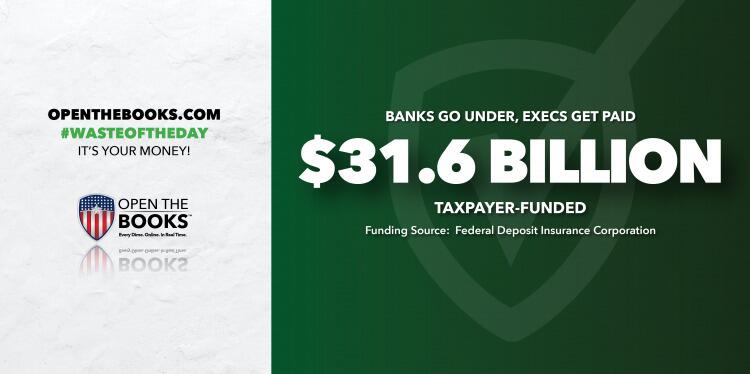
Topline: The Federal Deposit Insurance Corporation was forced to spend $31.6 billion to protect customers at three failed banks in early 2023. While taxpayers footed the bill, the CEOs of the three banks made out nicely, each collecting millions in compensation right before their banks folded, according to a Feb. 20 report from the Government Accountability Office.

Key facts: First Republic Bank gave CEO James Herbert II $17.8 million in compensation in 2021, according to the GAO. Silicon Valley Bank awarded CEO Greg Becker $9.9 million in 2022 and Signature Bank paid $8.7 million to Joseph DePaolo the same year. 

All three CEOs had base salaries below $1.2 million but multiplied their earnings with performance-based incentives, mostly paid out as stock in the bank.

All three sold off large portions of their stock in the two years leading up to their banks’ failures, the GAO found. Between 2021 and 2023, Herbert II sold $52.9 million of his stock, DePaolo sold $39.8 million and Becker sold $30.7 million.

Herbert II and Becker were still selling stock in the first quarter of 2023, just weeks before their banks closed down. They collected $5.5 million and $3.6 million, respectively, the GAO said.

Each bank had at least four other executives earning more than $1 million per year, the GAO reported.

Background: The bank failures were the three largest in U.S. history aside from Washington Mutual’s closure in 2008. 

The FDIC had to spend $31.6 billion of taxpayer money to reimburse depositors for their losses: $16.1 billion for Silicon Valley, $13 billion for First Republic and $2.5 billion for Signature.

The FDIC also reimbursed several foreign businesses. Former vice president Mike Pence wrote in an op-ed for the Daily Mail that “Americans will also be paying to guarantee the deposits of many Chinese companies that were Silicon Valley customers. We have to stop the insanity of bailing out failing businesses.”

Search all federal, state and local government salaries and vendor spending with the AI search bot, Benjamin, at OpenTheBooks.com

Critical quote: “You were paying out bonuses until literally hours before regulators seized your assets,” Sen. Sherrod Brown told Becker during a 2023 Congressional hearing. “Workers face consequences, executives ride off into the sunset. Only in corporate boardrooms can you run your business into the ground, take the whole economy along with you and come out ahead.”

Summary: Something is amiss when a business closure hurts the government’s finances more than it does the executives running the business.

The #WasteOfTheDay is brought to you by the forensic auditors at OpenTheBooks.com

_________________________________

America’s hard-working, tax-paying U.S. citizens have been called upon repeatedly to fund these such bailouts, along with the TARP bailout during the GFC, and the massive direct and indirect support that major banks received during the Covid crisis years.

It is time now for America’s hard-working, tax-paying U.S. citizens to receive the same direct liquidity extensions that major banking concerns have been receiving for the past several decades.

The Leviticus 25 Plan is a dynamic economic initiative providing direct liquidity benefits for American families, while at the same time scaling back the role of government in managing and controlling the affairs of citizens.  It is a comprehensive plan with long-term economic and social benefits for citizens and government.

The inspiration for this plan is based upon Biblical principles set forth in the Book of Leviticus, principles tendering direct economic liberties to the people.

The Leviticus 25 Plan – An Economic Acceleration Plan for America

$90,000 per U.S. citizen – Leviticus 25 Plan 2026 (28046 downloads )
Alexis de Tocqueville: Democracy vs Socialism

“Democracy extends the sphere of individual freedom, socialism restricts it. Democracy attaches all possible value to each man; socialism makes each man a mere agent, a mere number. Democracy and socialism have nothing in common but one word: equality. But notice the difference: while democracy seeks equality in liberty, socialism seeks equality in restraint and servitude.”   ― Alexis de Tocqueville

WSJ: ObamaCare Subsidies Explode from $55 Billion to $470 Billion.

Behind the ObamaCare Boom – WSJ

Sweetened subsidies are attracting more takers, at taxpayer expense.

By The Editorial Board | Jan. 28, 2024 5:30 pm ET

Excerpts:

Government entitlements and subsidies invariably cost more than politicians advertise. Take the ObamaCare premium tax credits, which Democrats during the pandemic turned into a de facto public option for health insurance.

President Biden took a victory lap last week after the Health and Human Services Department reported that a record 21.3 million Americans had signed up for coverage on the ObamaCare exchanges. That’s nearly five million more than last year and nearly double as many as in 2020. “It’s no accident,” the President tooted. He’s right, but not in a good way.

The March 2021 American Rescue Plan Act sweetened the premium tax credits to make insurance on the exchanges free or nearly free for many middle-class Americans for two years. The Inflation Reduction Act extended the bigger subsidies through 2025, while his Administration rewrote ObamaCare rules to enable more families to qualify.

Because the enhanced subsidies make the plans cheaper than employer coverage, many more Americans are signing up on the ObamaCare exchanges. The pandemic Medicaid expansion also ended last spring, enabling states to remove people who no longer qualify. HHS says many who left Medicaid signed up for ObamaCare plans.

Recall that Democrats claimed that extending the sweetened subsidies for three years would cost a mere $64 billion. But a conservative back-of-the-envelope calculation based on enrollment and the average tax credit indicates that the subsidy boost this year alone will cost some $70 billion—meaning it could end up costing three times what the politicians claimed.

When the government creates an open-ended subsidy, more people than predicted always show up to the buffet. The pandemic Medicaid expansion cost more than six times the original $50 billion estimate. The Covid-era Employee Retention Credit was initially estimated to cost $55 billion, but the final price tag may be upward of $470 billion as tens of thousands of businesses continue to claim it.

The truth is that you can’t trust Congress’s budget estimates. The bipartisan tax deal now moving through the House to boost the child tax credit and renew some business tax breaks is estimated to cost $78 billion. The smart money will take the over.

______________________________________

And on we go… more people dependent on government programs, more price distortion in private markets, ongoing ‘projected cost’ blowouts, ballooning federal budget deficits.

Washington Democrats (and Republicans) have America on track for credit market chaos.

There is currently one plan (and only one plan) on the table with the power to: 1) Revive free-market efficiencies and economic viability in the U.S. healthcare system; 2) Restore order and stability to credit markets, and; 3) Get America back on track for federal budget surpluses, sound money, and financial security for millions of hard-working, tax-paying U.S. citizens.

The Leviticus 25 Plan – An Economic Acceleration Plan for America

$90,000 per U.S. citizen – Leviticus 25 Plan 2026 (27486 downloads )

The Impossible Dream: Federal Budget Surpluses, Citizen-Centered Healthcare, Financial Security for Millions of American Families. The Leviticus 25 Plan.

Washington-based Democrats and Republicans have a long-standing record of growing government, creating greater dependence on government among the citizenry, dreaming up new spending programs riddled with inefficiencies, waste and outright fraud. 

Washington political policy initiatives over the past two decades have impoverished millions of Americans, created record Household Debt burdens, stymied economic growth, and generated soaring, nightmarish federal budget deficits, massive enough to now constitute a national security issue.

Now imagine a future America where millions of U.S. citizens were to be granted equal access to direct liquidity extensions to those which were so generously provided to major Wall Street financial institutions during the great financial crisis (2007-2010) and the Covid economic crisis (2020-2022), including: Morgan Stanley, Citigroup, Bank of America, State Street Corp, Goldman Sachs, Merrill Lynch, JPMorgan Chase, Wachovia, Lehman Brothers, Wells Fargo, Bear Stearns) and major foreign financial institutions (Royal Bank of Scotland, UBS AG, Deutsche Bank AG, Barclays, Credit Suisse. Dexia, BNP Paribas).

Imagine a future America where millions of hard-working, tax-paying U.S. citizens have eliminated massive sums of mortgage debt, paid off auto loans and installment debt, paid off student loans (or were fully reimbursed for previously paid off student loans), and are able to improve their current quality of life and save considerable sums of money toward future plans and dreams. 

Imagine a future America where millions of ‘below-the-poverty-line’ families did not need ongoing government support to cover life’s basic necessities (food, housing, and primary health care expenditures). 

Imagine a future where families did not need two incomes, or additional government assistance to barely cover family-specific expenses like child-care, private education, and federal, state, and local tax burdens.

And now visualize a future America where government spending has dropped precipitously, tax revenues have risen dramatically (without raising taxes), federal (and state) budget surpluses have become an ongoing reality. 

America’s economy – surging into a new, long-term, revitalized, free market growth cycle.

And citizen-centered healthcare largely replacing the current big government / big corporation market-dominating partnerships.

That future is here.

The Leviticus 25 Plan – loaded up and ready to launch.

…………………..

The Leviticus 25 Plan is a dynamic economic initiative providing direct liquidity benefits for American families, while at the same time scaling back the role of government in managing and controlling the affairs of citizens.  It is a comprehensive plan with long-term economic and social benefits for citizens and government.

The inspiration for this plan is based upon Biblical principles set forth in the Book of Leviticus, principles tendering direct economic liberties to the people.

The Leviticus 25 Plan – An Economic Acceleration Plan for America

$90,000 per U.S. citizen – Leviticus 25 Plan 2026 (27484 downloads )

GAO: America’s “Unsustainable Fiscal Path”

THE NATION’S UNSUSTAINABLE FISCAL PATH – Government Accountability Office

Excerpt:

The federal government faces an unsustainable fiscal future. In February 2025, we released our annual report on the nation’s fiscal health, highlighting both short-term and long-term risks. 

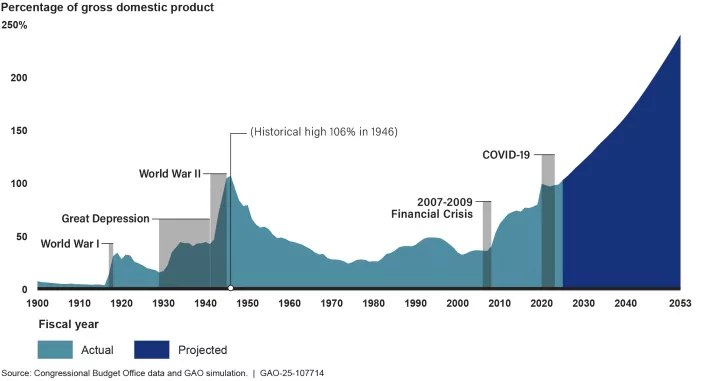
Federal debt held by the public (that is, the total amount of money that the federal government owes to its investors) will continue to grow faster than the economy, which is unsustainable.

Federal debt held by the publicpast, present, and future

Federal debt is growing faster than GDP.

Historically, debt has decreased during peacetime and economic expansions. But this pattern has changed in recent decades. Unless current revenue and spending policies change, by 2027 debt will reach its historical high of 106 percent of GDP, according to our simulation. If unaddressed, it will grow more than twice as fast as the economy and reach 200 percent of GDP by 2047.

…………………………………………..

The U.S. Congress’ latest response to resolving the fiscal crisis:

A little or a lot? Conflicting targets for cuts leave budget in limbo

The House of Representatives this week narrowly approved a budget resolution after the Senate did so previously.

By Ben Whedon  |  JusttheNews  |  Apr 11, 2025

While President Donald Trump has suggested he may sign a balanced budget plan during his term, competing estimates and promises on cuts from interested parties appear to signal the government could either come close to achieving its goal or largely fail to make meaningful cuts, with little room for a moderate option.

The House of Representatives this week narrowly approved a budget resolution after the Senate did so previously. Both chambers committed to the basic framework of “one big, beautiful bill” favored by Trump to address both his tax cuts and his border proposals in the same legislation. The reconciliation process, however, will see competing parties quibble over the depth of cuts and what to target.

The Congressional Budget Office projected that the federal government would run a $1.9 trillion budget deficit in Fiscal Year 2025 and the Elon Musk-led Department of Government Efficiency (DOGE) had previously vowed to cut $2 trillion in spending to balance the budget. But Musk’s projections have dwindled of late and budget hawks in the House aim to hold Speaker Mike Johnson to his promises of major cuts, setting up a potential leadership change should he fail.

_____________________________________

The most powerful economic acceleration plan in the world is loaded up and ready to launch – and solve America’s debt crisis, once and for all.

The Leviticus 25 Plan – An Economic Acceleration Plan for America

$90,000 per U.S. citizen – Leviticus 25 Plan 2026 (26881 downloads )

Treasury Secretary Bessent: “It’s Main Street’s Turn to Restore The American Dream.”

“It’s Main Street’s Turn To Restore The American Dream” – US Treasury Secretary Warns Wall Street

ZeroHedge, Apr 09, 2025 | Via American Greatness,Excerpts:

U.S. Secretary of the Treasury Scott Bessent laid out President Trump’s financial policy priorities for the American Bankers Association (ABA) on Wednesday, saying that Main Street America will now take priority.

Bessent speaking at the ABA’s Washington Summit, said, “For too long, financial policy has served large financial institutions at the expense of smaller ones— no more.”

The Treasury Secretary stated that, “It’s Main Street’s turn to hire workers, it’s Main Street’s turn to drive investment and it’s Main Street’s turn to restore the American dream.”

Bessent announced the Trump administration’s shift to focusing on helping Main Street businesses and consumers thrive by giving all institutions a chance to succeed, adding, “For the last four decades, basically since I began my career in Wall Street, Wall Street has grown wealthier than ever before, and it can continue to grow and do well.”

Addressing fears of a looming recession, Bessent defended Trump’s agenda of tax cuts, deregulation and trade rebalancing and noting that, 

“We want to de-leverage the government sector, re-leverage the private sector …. we can’t do it all at once, or that will cause a recession.”

Bessent added, 

“What will keep us from having a recession is making sure that the tax bill doesn’t expire, adding back 100% depreciation and then adding some of President Trump’s agenda — no tax on tips, no tax on Social Security, no tax on overtime.”

___________________________________

There is one more step that America needs to take to “re-leverage” the debt-logged private sector and activate the powerful reset that millions of American families and small businesses need – a massive, public and private sector debt elimination plan.

The Leviticus 25 Plan is a dynamic economic initiative providing direct liquidity benefits for American families, while at the same time scaling back the role of government in managing and controlling the affairs of citizens.  It is a comprehensive plan with long-term economic and social benefits for citizens and government.

The inspiration for this plan is based upon Biblical principles set forth in the Book of Leviticus, principles tendering direct economic liberties to the people.

The Leviticus 25 Plan – An Economic Acceleration Plan for America

$90,000 per U.S. citizen – Leviticus 25 Plan 2026 (26840 downloads )

Federal Reserve Interest on Excess Reserves (IOER) vs The Leviticus 25 Plan

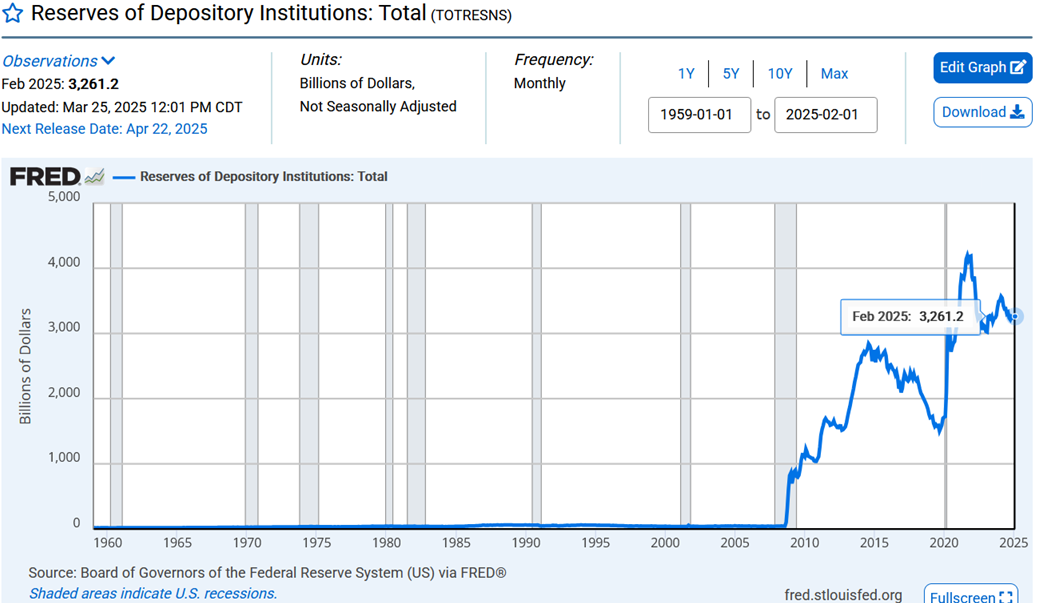
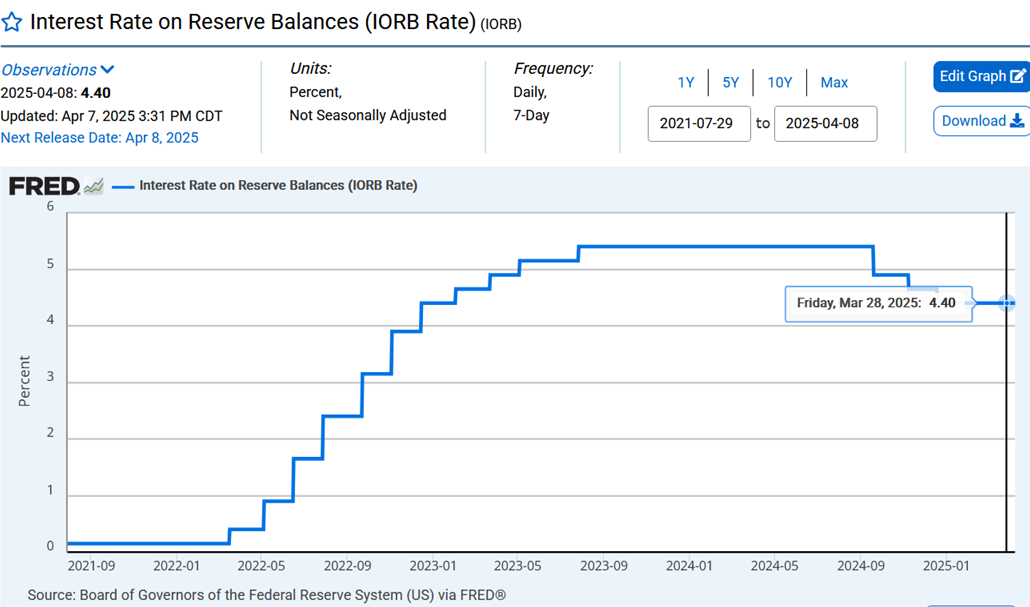
The U.S. Federal Reserve pays banks on the required and excess reserves they hold on deposit. The Fed is currently holding $3.262 trillion in the cash reserves.

And it is currently paying 4.40% in interest on that $3.261 trillion…

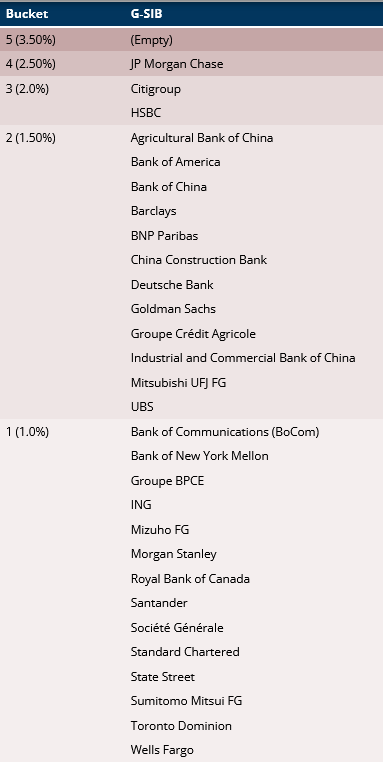
The current total annual interest payments to banks, therefore, come in at a cool $81.525 billion. And, it would be safe to assume that many or all of the ‘Systemically Important Banks’ listed below (foreign and domestic) are partakers of those generous Fed IOER payments:

_______________________________

Fed IOER payments were initiated in October 2008, “primarily to maintain control over the federal funds rate and facilitate credit market interventions during the financial crisis.”

This monetary tool does nothing, however, to reduce the soaring annual Federal budget deficits, nor does it do anything to insulate hard-working, tax-paying U.S. citizens from the catastrophic effects of future ‘financial crises’ – which are all but inevitable with with America’s snowballing public and private debt burdens.

The Leviticus 25 Plan corrects these imbalances – generating federal budget surpluses and financial security for millions of American families.

The Leviticus 25 Plan is a dynamic economic initiative providing direct liquidity benefits for American families, while at the same time scaling back the role of government in managing and controlling the affairs of citizens.  It is a comprehensive plan with long-term economic and social benefits for citizens and government.

The inspiration for this plan is based upon Biblical principles set forth in the Book of Leviticus, principles tendering direct economic liberties to the people.

The Leviticus 25 Plan – An Economic Acceleration Plan for America

$90,000 per U.S. citizen – Leviticus 25 Plan 2026 (26809 downloads )

Treasury Cash Balance Running Low. Default Issues Loom. America Needs a Powerful New Plan to End these Political Stand-offs.

US Treasury Could Default As Soon As August, CBO Warns

ZeroHedge, Mar 26, 2025 – Excerpt:

Earlier this week we pointed out the striking plunge in the Treasury’s cash balance which had averaged around $800 billion for the past 18 months, and which plunged by $480 billion in the past month.

Treasury cash down $480 billion in the past month. pic.twitter.com/uV4GDNGheO

— zerohedge (@zerohedge) March 25, 2025

Regular readers are aware of the reason for this plunge: ever since the US hit the debt ceiling in the last days of the Biden administration, the US Treasury has been unable to issue new debt and so has been forced to draw down its cash to fund day to day operations.

Obviously, there is a limit to how much longer this can continue: after all, once the cash balance hits 0, the Treasury will have to start prioritizing payments, and eventually, it may even have to delay payments of interest or repayments of principal… better known as default.

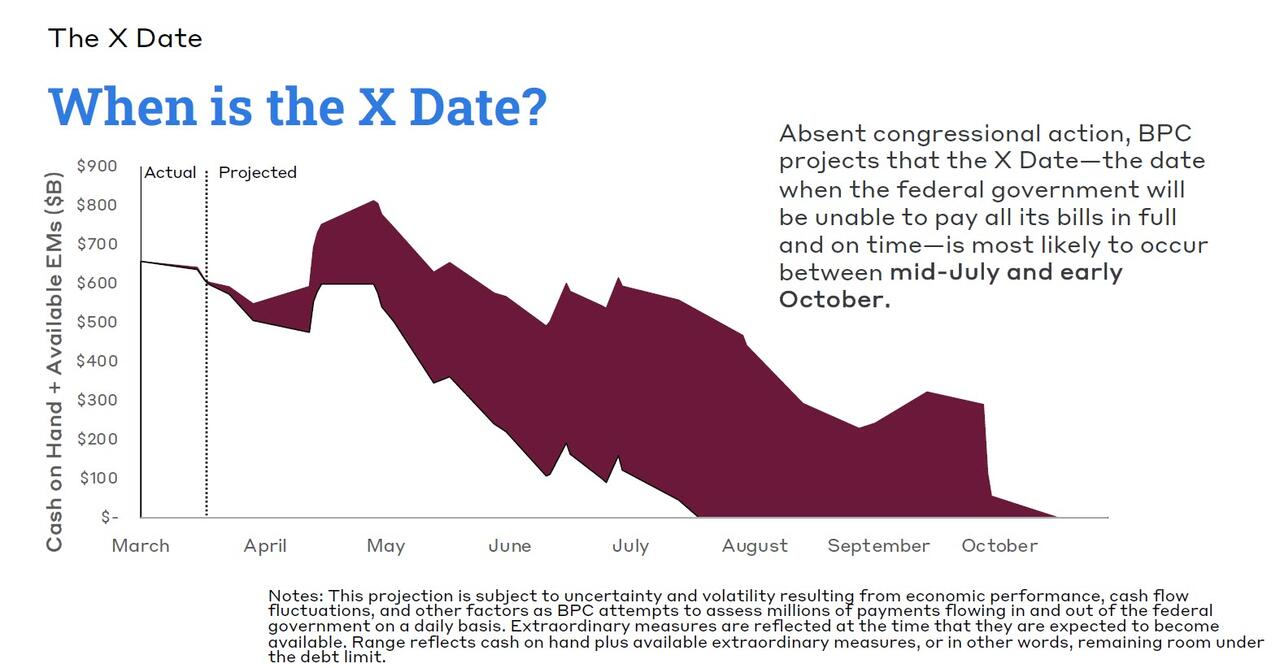
Which brings us to the latest report from the Congressional Budget Office published this morning which warned that the federal government could run out of enough money to pay all of its bills on time as soon as August if lawmakers fail to raise or suspend the debt limit, to wit:

The Congressional Budget Office estimates that if the debt limit remains unchanged, the government’s ability to borrow using extraordinary measures will probably be exhausted in August or September 2025. The projected exhaustion date is uncertain because the timing and amount of revenue collections and outlays over the intervening months could differ from CBO’s projections. (source)

On Monday, the Bipartisan Policy Center said that according to public data the Treasury will be forced to start defaulting on obligations sometime between mid-July and early October.

The CBO also cautioned that if the government’s borrowing needs are “significantly greater than CBO projects, the Treasury’s resources could be exhausted in late May or sometime in June, before tax payments due in mid-June are received or before additional extraordinary measures become available on June 30.”

The date is uncertain because of the unpredictable nature of tax receipts, and Rep. Jason Smith of Missouri, chair of the House Ways and Means Committee, said earlier this month that it could come as early as mid-May.

Henrietta Treyz, director of economic policy at Veda Partners, wrote in a Monday note to clients that an earlier “x date” would be beneficial to House Republicans and those rooting for the Trump tax plan to be initiated in a single piece of legislation as soon as possible.

The Treasury Department has been using special accounting maneuvers since Jan. 21 to avoid breaching the $36.1 trillion debt ceiling, which kicked in at the start of the year. But the department has yet to offer specific guidance on when those measures will be exhausted.

Full article: https://www.zerohedge.com/economics/cbo-warns-us-treasury-could-default-soon-august

___________________________

It is time to enact a massive debt-elimination budget clean-up operation. And there is one comprehensive plan with the raw power to make it happen.

The Leviticus 25 Plan is a dynamic economic initiative providing direct liquidity benefits for American families, while at the same time scaling back the role of government in managing and controlling the affairs of citizens.  It is a comprehensive plan with long-term economic and social benefits for citizens and government.

The inspiration for this plan is based upon Biblical principles set forth in the Book of Leviticus, principles tendering direct economic liberties to the people.

The Leviticus 25 Plan – An Economic Acceleration Plan for America

$60,000 per U.S. citizen – Leviticus 25 Plan 2026 (26221 downloads )

Fed Rate Cuts Not Needed to ‘Recharge’ the U.S. Debt-Soaked Economy…

The U.S. economy does not need Fed rate cuts – and no one should be pressuring the Fed to ease in our current economic situation – when there is a monumentally better, and more powerful economic acceleration plan loaded up and ready to launch.

What the U.S. needs more than anything is massive public and private debt elimination. The immediate and long-term benefits of a systematic, massive debt elimination plan would dwarf, by orders of magnitude, the limited benefits of any rate-lowering cycle the Fed could ever set in motion.

A rate cutting cycle would have little, if any effect on reducing the $35.5 trillion national debt or the projected $2.0 trillion annual deficits, or the $3.1 trillion of State and Local debt, or the current $18.04 trillion of Household Debt in the U.S..

A rate cutting cycle would do nothing to shrink entitlement spending and reduce the government’s ever-growing footprint across America’s private sector landscape.  It would do nothing to restore real financial security and rekindle the spirit of self-reliance for America’s hard-working, tax-paying U.S. citizens.

It would do nothing to spur a legitimate long-term economic growth cycle, stabilize the credit markets, and strengthen the U.S. Dollar.

A rate cutting cycle at this time would merely be an open door for additional debt accumulation and eventually lead into another rate-tightening phase. And it would penalize savers.

The Leviticus 25 Plan’s massive debt elimination plan, on the other hand, would immediately:  1) Generate a series of annual Federal budget surpluses, along with State and Local government surpluses;  2) Reduce fraud and waste across many of government’s social insurance sectors;  3) Restore real financial security for millions of American families, rekindle the spirit of self-reliance, and scale back out-of-control entitlement spending;  4) And generate a long-term economic growth cycle that would benefit all Americans, and especially the 33.2 million small businesses across the U.S..

Moreover, it is a plan that will pay for itself entirely over a 10-15 year period.

The Leviticus 25 Plan would allow the Fed to adjust interest rates a function as free market dynamics and price discovery dictated, rather than depending upon complex timing models amid political pressures.

Higher rates would allow savers to earn millions of dollars in additional interest. It would help curb interests in ‘fast money’ and speculation within the economy, and it would decrease the likelihood of new ‘bubbles’ popping up in financial markets.

The Leviticus 25 Plan – loaded up and ready to launch.

The Leviticus 25 Plan – An Economic Acceleration Plan for America

$90,000 per U.S. citizen – Leviticus 25 Plan 2026 (26168 downloads )