Debt-fueled GDP Growth – Dangerous, Unsustainable. Ready to Launch: America’s Powerful, Debt-busting Economic Acceleration Platform – The Leviticus 25 Plan

The GDP Number Was Great… There Is Just One Huge Problem

ZeroHedge, Jan 25, 2024
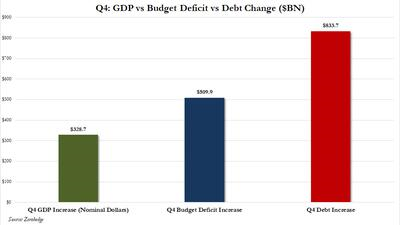
It now takes $1.55 in budget deficit to generate $1 of growth… and it takes over $2.50 in new debt to generate $1 of GDP growth! 

……………………………………….

The Great Growth Hoax – ZeroHedge, Jan 28, 2024

Excerpts / Insights – Q4 GDP Report:

Peter St Onge writes it up and it is a doozy: “Fresh GDP numbers came in and it was a blowout. The kind of blowout that only a $2.7 trillion government deficit can buy while the private economy crumbles around it. Another couple blowout GDP reports like this and Americans will be living under an overpass.”

The essential ruse comes down to unfathomable amounts of government spending that is being recorded as productivity and output, and interpreted by media as growth. “In the past 12 months the federal deficit increased by $1.3 trillion. Yet we only got half that in GDP—about $600 billion. In other words, everything else shrank. It’s even worse for that brave and stunning Q4—there we got just $300 billion in extra GDP for—wait for it—$834 billion of new federal debt.”

To put a fine point on it: “Essentially, [GDP is measuring] the pace at which we’re going Soviet, replacing private wealth with government waste.” In his interpretation of the data, we are destroying wealth at the fastest rate since 2008.

An analysis by ZeroHedge echoes the same thought.

“While Q4 GDP rose by $329 billion to $27.939 trillion, a respectable if made up number, what is much more disturbing is that over the same time period, the US budget deficit rose by more than 50 percent, or $510 billion. And the cherry on top: the increase in public US debt in the same three month period was a stunning $834 billion, or 154 percent more than the increase in GDP. In other words, it now takes $1.55 in budget deficit to generate $1 of growth… and it takes over $2.50 in new debt to generate $1 of GDP growth!”

To further the analysis, and doing the math: “[E]very dollar in GDP growth cost $1.69 in new debt, and also means that every new job cost future generations of Americans $957,100.48.”

To say this is unsustainable is more than obvious. It is a disaster and this is dragging American prosperity into the pits, if by prosperity you mean quality of life. No matter how many gizmos to which you have access, the resources for living a good life are depleting very fast. The idea of a one-income family is nearly extinct, whereas it was the norm three-quarters of a century ago…

The United States has been the world center of technological innovation during these years, and the historical home for free enterprise and entrepreneurship. We should have had the greatest boom times in our history! Instead, government stole all that energy for itself. It’s a tragedy…

On the good side, we are seeing the evaporation of trust in media, medicine, academia, and government. Large media organizations are laying off workers in droves just to survive, and the woke agenda generally seems on the ropes.

________________________________________

Again: “To say this is unsustainable is more than obvious. It is a disaster and this is dragging American prosperity into the pits, if by prosperity you mean quality of life. No matter how many gizmos to which you have access, the resources for living a good life are depleting very fast. The idea of a one-income family is nearly extinct, whereas it was the norm three-quarters of a century ago.”

Washington Democrats are feeding America’s debt-binged economic decline.

Washington Republicans have no credible counter-plan to get America’s mushrooming debt cycle back under control and get the U.S. economy back on track. This is one of the most shameful episodes in the history of the GOP.

Main Street America Republicans do have a plan…

The Leviticus 25 Plan will generate average annual budget surpluses of $112.6 billion in each of its first five years of activation (2025-2029) vs current CBO-projected average annual deficits of $1.795 trillion for the same period.

This represents an astounding $1.9 trillion positive budget gain annually (2025-2029) for the U.S. federal budget.

Summary Details:

·  The Leviticus 25 Plan 2025 Generates $112.6 Billion Federal Budget Surpluses Annually (2025-2029). Part 1: Overview, Deficit Projection

·  The Leviticus 25 Plan Generates $112.6 Billion Federal Budget Surpluses Annually (2025-2029). Part 2: Federal Income Tax Recapture; Economic Security / Means-Tested Welfare Recapture.

·  The Leviticus 25 Plan Generates $112.6 Billion Federal Budget Surpluses Annually (2025-2029). Part 3: Medicaid, Medicare, VA, TRICARE, FEHB, SSDI Recapture

·  The Leviticus 25 Plan Generates $112.6 Billion Federal Budget Surpluses Annually (2025-2029). Part 4: Interest Expense Recapture, Totals Summary

______________________________________ 

The Leviticus 25 Plan is a dynamic economic initiative providing direct liquidity benefits for American families, while at the same time scaling back the role of government in managing and controlling the affairs of citizens.  It is a comprehensive plan with long-term economic and social benefits for citizens and government.

The inspiration for this plan is based upon Biblical principles set forth in the Book of Leviticus, principles tendering direct economic liberties to the people.

The Leviticus 25 Plan – An Economic Acceleration Plan for America

$90,000 per U.S. citizen – Leviticus 25 Plan 2025 (11474 downloads )
The Leviticus 25 Plan Generates $112.6 Billion Federal Budget Surpluses Annually (2025-2029). Part 4: Interest Expense Recapture, Totals Summary

The Leviticus 25 Plan – the most powerful economic acceleration plan in the world: economic scoring summary.

Interest expense recapture on projected deficits 2025-2029

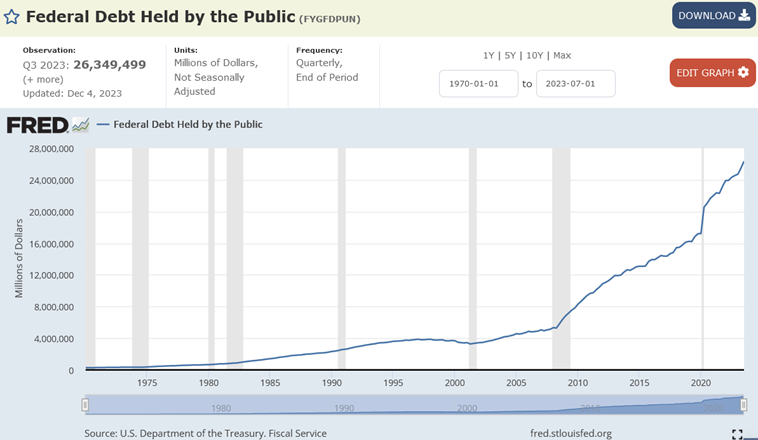
Federal debt has increased from $22.1 trillion in 2020 to $34.0 trillion as of December, 2023. Federal debt held by the public is reported to be $27.783 trillion, with the remainder, $6.216 trillion of intra-governmental debt outstanding, which arises when one part of the government borrows from another.  This intra-governmental debt interest expense will be omitted from this calculation, since those dollars are not expensed directly.

U.S. monthly interest rate on interest-bearing debt 2018-2023

Published by Statista Research Department, Jan 8, 2024

As of December 2023, the United States government has a monthly interest rate of 3.11 percent on its debt, continuing an upward trend in interest rates that began at the beginning of 2022. In March of 2023, U.S. debt reached 31.46 trillion U.S. dollars.

Interest expense on the public debt during FY 2024 is currently being expensed at a monthly interest rate of 3.11%.  Projections estimate monthly rate will decline to an approximate average of  2.3% – 2.4% over the next 5-6 years.

This projection will assume an average monthly interest rate of 3.10% for 2024, and an average monthly interest rate of 2.75% in calculating the interest expense to be eliminated during the budget surplus years of 2025-2029.

This projection also assumes that annual federal budget deficits will be funded through Treasury Issuance at an average of 79.0% rate fir Debt Held by the Public.

Year     Annual Deficit/2 X %Debt Held by Public X Interest Rate

2024:  $1.571 trillion/2 X .79 X .0310 = $19.237 billion

2025:  $1.761 trillion/2 X .79 X .0280 = $19.477 billion

2026:  $1.718 trillion/2 X .79 X .0270 = $18.322 billion

2027:  $1.709 trillion/2 X .79 X .0260 = $17.551 billion

2028:  $1.934 trillion/2 X .79 X .0250 = $19.098 billion

2029:  $1.855 trillion/2 X .79 X .0240 = $17.585 billion

Recapture:  Total interest expense eliminated by projected operating surpluses: $92.033 billion

Source(s): https://www.statista.com/statistics/1382455/monthly-interest-rate-us-debt/

https://www.crfb.org/papers/qa-gross-debt-versus-debt-held-public

https://www.wsj.com/articles/debt-not-the-debt-limit-is-the-real-fiscal-crisis-ceiling-federal-reserve-spending-interest-expense-11674164556l

________________________________ 

The Leviticus 25 Plan Budget Surplus Summary

Totals – 2025-2029:

5-year projected deficit: $8.977 trillion

5-year projected recapture (subtotal):  $9.448 trillion

5-year projected interest expense savings: $92.033 billion

Budget surplus (projected) 2025-2029: $9.448 trillion – $8.977 trillion = $471 billion

Budget surplus (projected) 2025-2029 with interest expense savings: $471 billion + $92.033 billion:  $563.033 billion

Average annual budget surplus (projected) 2025-2029: $563.033 billion / 5 years; $112.6 billion per year

___________________________________  

Note 1:  Projected budget surpluses for 2025-2029 do not factor in the additional government tax revenue gains that would accrue from the massive shift in capital away from debt service and into productive economic activity.

Note 2:  Projected budget surpluses for 2025-2029 do not factor in the additional government tax revenue gains that would accrue from significantly lower levels of debt deduction on individual income tax filings. 

Note 3:  Projected budget surpluses from the Medicaid / CHIP recapture do not take into account the likelihood of fewer citizens actually qualifying for Medicaid / CHIP benefits.

Note 4The Plan’s funding of individual Medical Savings Accounts (MSAs) with the $6,000 deductible provision per year would result in an enormous drop in the number of claims each year for Medicare reimbursement. Medicare payroll taxes would generate a growing revenue stream, due to stronger economic growth, while outlays would drop significantly from the reduced claims numbers – thereby providing the Fed with a powerful tool to recapitalize the Medicare Trust Fund, via the Citizen’s Credit Facility.

The Leviticus 25 Plan – Projection limitations

There can be no question that The Leviticus 25 Plan would generate healthy, broad-based economic growth from broad-based debt reduction and improved financial stability at the family level, the restoration of free market dynamics in commerce, and scaling back social program work disincentives.

The Leviticus 25 Plan does not attempt to project how much additional tax revenue and reduced cost of government will be realized, above and beyond the Recapture Provisions, over the course of the initial five years of the plan.  In that sense, The Plan understates the effect of additional dynamic economic benefits.

Robust funding of Medical Savings Accounts and the elimination of millions of insurance claims and claims resolutions for basic primary care and everyday healthcare purchases swill save millions of man-hours of health care cost on an annual basis.  Scaling back government involvement in basic primary care and everyday healthcare purchases for millions of Americans will also generate massive cost savings. 

The Plan makes no attempt to project the positive effects of the streamlined, consumer-driven efficiencies that will emerge, and the cost reduction and improvement in services.   

The Plan therefore understates the benefits.

The Plan projects an 80 percent participation rate by U.S. citizens.  It is assumed that a large number of wealthy Americans will not participate, because their tax refunds are larger than the annual Plan benefits.  And it is assumed that a large number of Americans receiving significant government benefits for extraordinary health or economic issues will also not participate.

Cost savings from the reductions in massive social welfare spending and other programs, like unemployment insurance, workman’s compensation, SSI and SSDI can be difficult to quantity, since state and federal funding mechanisms may both be involved in various ways. In that regard, The Plan may understate, or it may overstate, the benefits.

America’s Soaring Debt Profile and the Extraordinary Master Plan Solution…

America is on track for debt-fueled economic chaos in the years ahead – with an endgame conversion to a Central Bank Digital Currency system.

Thankfully, there is a pathway out of this tangled, intractable fiscal quandary….

…………………………………………………..

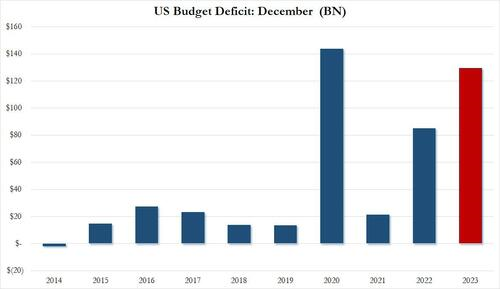
US Budget Deficit Soars By 50% In December As Fiscal Collapse Under Biden Accelerates – ZeroHedge, Jan 12, 2024 – Excerpt:

As for the final, and most shocking, data point, the December budget deficit of $129.4 billion was more than $40BN higher than the $87.5BN median estimate, and was more than 50% higher compared to the $85BN December deficit in fiscal 2022.

………………………………….

US National Debt:  $34.058 T

US Federal Debt to GDP Ratio: 122.29%

………………………………..

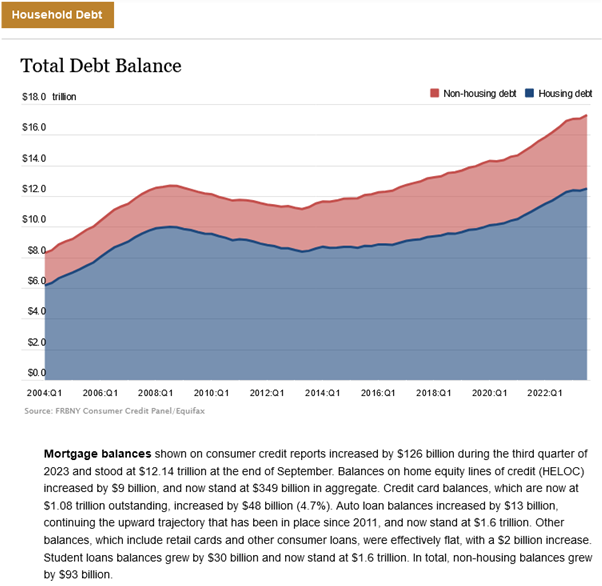
U.S. Household Debt – record high: $17.29 T

…………………………………..

Credit Card Debt Surged To Fresh Record High in November

By Diccon Hyatt | Investopedia | Published January 08, 2024

Key Takeaways

  • Consumer debt surged $23.8 billion in November, most of that due to a $19.1 billion increase in revolving debt, mainly credit cards.
  • The debt is increasingly burdensome for households, with interest rates on credit card debt averaging more than 21%, the highest in decades.
  • Some households are under increasing financial pressure and falling behind on their bills, with delinquencies for credit cards and car loans having recently surpassed pre-pandemic levels

____________________________

Washington Democrats’ Plan: Expand federal and state government-based social programs, expand federal bureaucracy. No plans of record to constrain spending, bring budget deficits back under control.

Washington Republicans’ Plan: No credible, politically feasible economic strategy to constrain spending enough to have any material effect on budget deficits. No plan to protect the purchasing power of the U.S. Dollar and maintain its status as the world’s reserve currency. No plan to address America’s long-term public and private debt leverage issues.

Washington Republicans have the opportunity of a lifetime to present a master plan to dig America out of its cavernous debt hole and restore the American dream – and they have nothing.

Main Street America Republicans do have a plan – an economic acceleration masterpiece that will: 1) Generate massive new tax revenue flows, cost savings, and multi-billion dollar budget surpluses each of the first five years of activation; 2) Set the U.S. Dollar back on track for long-term strength and stability; 3) Eliminate trillions of dollars in Household Debt and restore financial security for millions of American families; 4) Revitalize economic growth, strengthen the U.S. banking system; and 4) Restore economic liberty and free market economics in the United States.

The Leviticus 25 Plan is a dynamic economic initiative providing direct liquidity benefits for American families, while at the same time scaling back the role of government in managing and controlling the affairs of citizens.  It is a comprehensive plan with long-term economic and social benefits for citizens and government.

The inspiration for this plan is based upon Biblical principles set forth in the Book of Leviticus, principles tendering direct economic liberties to the people.

The Leviticus 25 Plan – An Economic Acceleration Plan for America

$90,000 per U.S. citizen – Leviticus 25 Plan 2023 (11268 downloads)

Americans “Ensnared” in the Welfare System.

America needs a new plan – one that offers a helping hand ‘up out of poverty,’ rather than the perpetuating the current system that “severely punish work effort,” promote continual dependence on government, and stifle the human spirit.

…………………………………………………………

Welfare Benefits and the ‘Disincentive Desert’ – WSJ

How Americans become ensnared in the system.

WSJ Letters – Dec. 11, 2023 – Excerpts:

Phil Gramm and John Early’s “Another Wrong Way to Measure Poverty” (op-ed, Dec. 6) is notable for revealing how poverty rates are artificially inflated by the Census Bureau by excluding most social-welfare benefits. When all the benefits are counted, the authors contend, “the percentage of Americans living in poverty falls to only 2.5%.”

…. While Americans may be more comfortable than census numbers suggest, the authors miss the poverty of opportunity that occurs once people become ensnared in the social-welfare system.

Consider a 2022 study by economist Ed Dolan. He gives the case of a hypothetical Boston family with one adult, two young children and an income of $22,000, which is at that group’s official poverty level. The family qualifies for around $66,000 in social-welfare benefits, which certainly brings it out of poverty.

But here’s the rub: Even if the family’s income doubles to $44,000, the social-welfare benefits collectively roll back $1.03 for every marginal dollar earned over this range, leaving the family worse off in total wages and benefits. Our research calls this phenomenon a “disincentive desert,” (as opposed to the much-studied “benefits cliff”), since this is equivalent to an extremely high and persistent tax on work effort, ranging from 90% to 110%, across long spans of income.

As a result, many low-income Americans are left comfortably numb in a social-welfare state that severely punishes work effort and stifles the imagination for what life might be. I contend that rather than focusing on living standards at a point in time, we should see that life without hope of economic progress is the ultimate definition of poverty. Policies that address this issue are the key to reviving downward trends in labor-force participation. –Prof. Craig J. Richardson, Winston-Salem State University

____________________________

The Leviticus 25 Plan is a dynamic economic initiative providing direct liquidity benefits for American families, while at the same time scaling back the role of government in managing and controlling the affairs of citizens.  It is a comprehensive plan with long-term economic and social benefits for citizens and government.

The inspiration for this plan is based upon Biblical principles set forth in the Book of Leviticus, principles tendering direct economic liberties to the people.

The Leviticus 25 Plan – An Economic Acceleration Plan for America

$90,000 per U.S. citizen – Leviticus 25 Plan 2023 (11262 downloads)