Food Stamp (SNAP) Clean Up Time – Lifting People Up Out of Poverty the Right Way, and Saving America Billions…

The Leviticus 25 Plan would lift millions of working-class, tax-paying American families up out of poverty – and eliminate the ever-growing dilemma of food lines and dependence upon government-based food handouts.

……………………………………………

Food Stamps To Be Paused For 42 Million Americans: What To Know…

ZeroHedge, Oct 29, 2025 – Excerpts:

Food stamps are set to be paused on Nov. 1 because of the government shutdown.

Some 42 million Americans will not receive benefits through the Supplemental Nutrition Assistance Program (SNAP) until Congress approves new funding, according to federal officials, although some states have taken steps to intervene.

As Ryan McMaken details below, via The Mises Institute, according to the Treasury Department’s report on federal spending for fiscal year 2025, total spending on food stamps—also known as the Supplemental Nutrition Assistance Program (SNAP)—was $106 billion for the twelve-month period ending September 30.

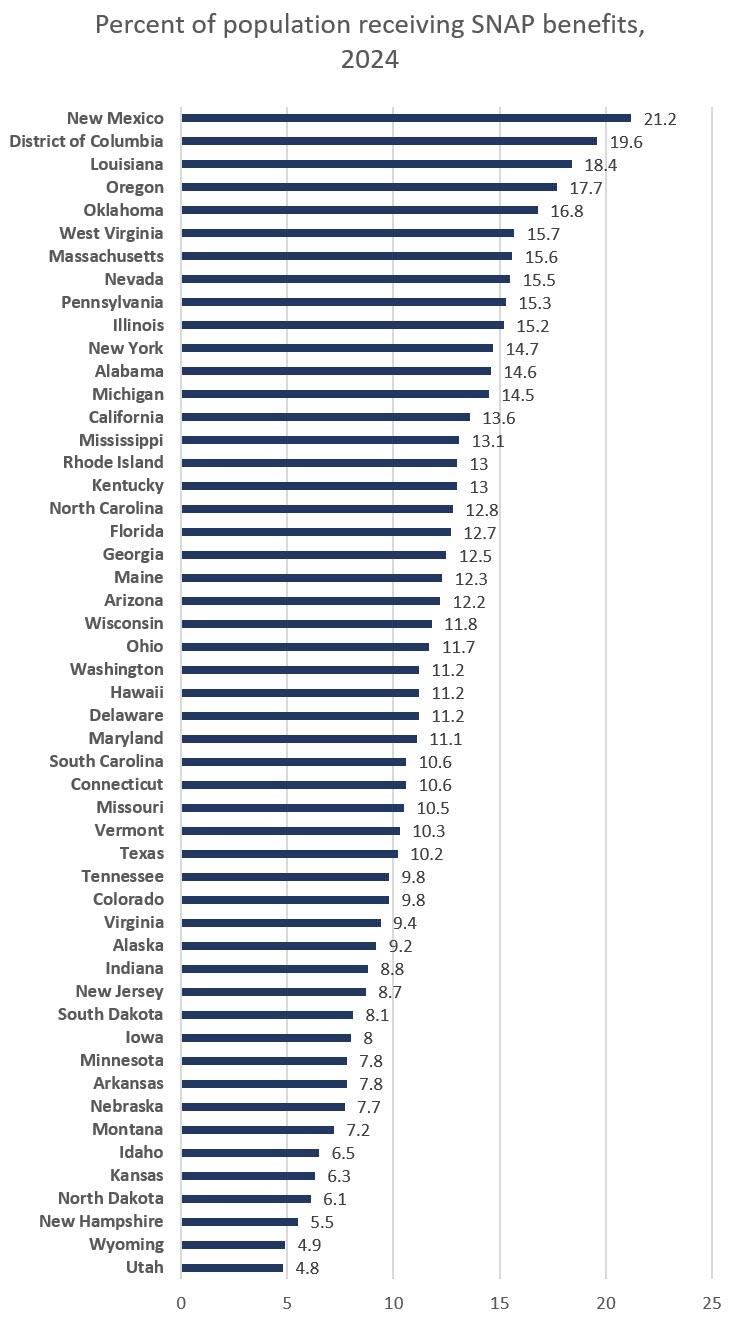
Nationwide, the total percentage of the population receiving food stamps can vary significantly by state, and region. Measured state-by-state, we find that more than one in five residents of New Mexico receive food stamps. In Utah, on the other hand, fewer than one in twenty receive food stamps. 

………………………………………………………………..…………………

Mercatus Center | George Mason University | May 13, 2025

Reducing Waste and Fraud in SNAP

Why SNAP fraud persists—and how to stop it

By Keith Hall
Excerpts:

By 2023, the pandemic had pushed the national SNAP program error rate to nearly 12 percent, with overpayments amounting to about 10 percent of that figure. At the state level, overpayment rates were as high as 57 percent for Alaska. Even before the increase in the pandemic-era rates, the national overpayment rate had been rising rapidly: While it was just a little over 2 percent in 2012, the national overpayment rate hit 6 percent in 2019, before the pandemic. In dollar terms, as of December 2024, SNAP overpayments are up to $10 billion per year, and much of this amount is from benefit trafficking, which now costs $1.3 billion annually.

Nonbenefit costs to the federal government

In addition to contributing to state administrative expenses, the federal government covers other, nonbenefit costs associated with SNAP. First, the FNS reviews the states’ administration of the program in accordance with federal requirements. The federal government also supports state expenses for nutrition education programs, employment and training programs, benefit and retailer redemption and monitoring, payment accuracy, electronic benefits transfer (EBT) systems, program evaluation and modernization, program access, and health and nutrition pilot projects.

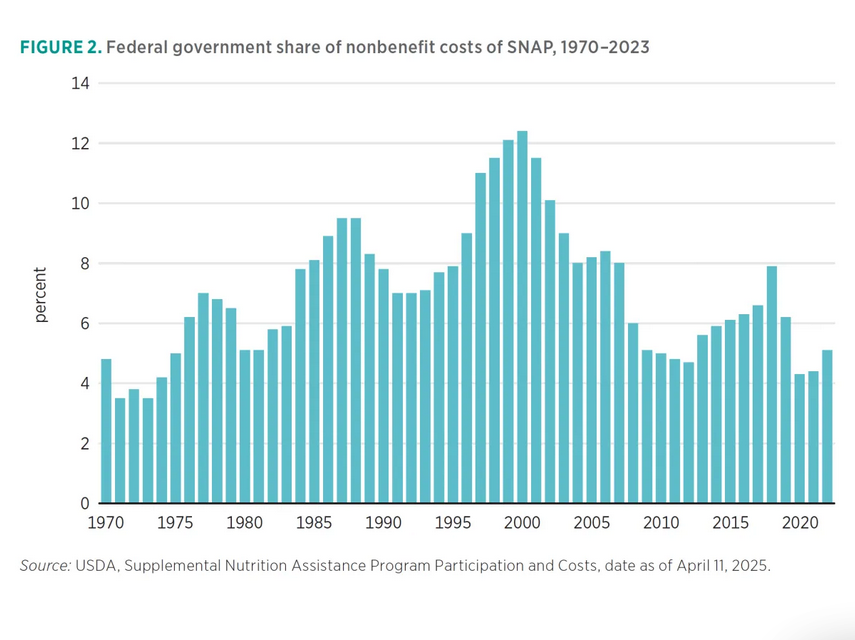
The share of total federal spending on nonbenefit costs was about $6 billion in FY 2023, or 5 percent of the total costs (see figure 2).[3] SNAP administrative expenses vary quite widely by state.[4] For example, in FY 2016 average administrative expenses varied from $89 per case in Florida to $848 per case in Wyoming. However, there is little understanding of these differences, as this variation does not seem to be explained by economic conditions or caseload levels.

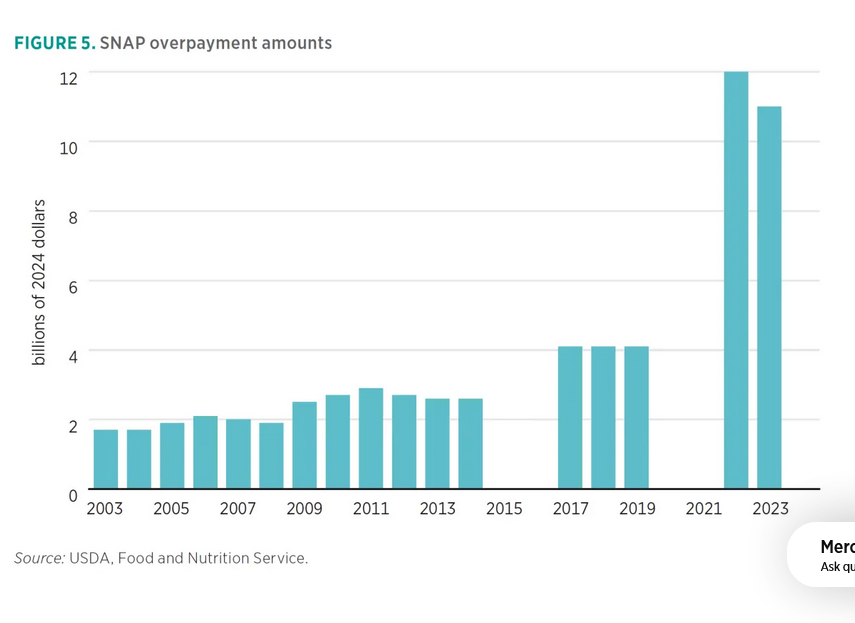
Overpayments have always dominated the program error rate. In 2023, for example, they outpaced underpayments six to one… in FY2023, SNAP overpayments totaled $10.7 billion, but recovery of overpayments was just $389 million, or less than 4 percent.[13]

Despite increased efforts to curtail waste, there has been no evidence of anything but increases in overpayments since FY 2013. Furthermore, there is no comprehensive measure of fraud in the program, but taxpayer dollars are lost whether overpayments are fraudulent or just errors. Because of the high cost of the program, these overpayment rates have certainly cost the government tens of billions of dollars (see figure 5).

SNAP Fraud
Trafficking of SNAP benefits
Problems specifically related to the use of EBT cards
Retailer application fraud
Errors and fraud by households
Errors and fraud by state agencies

__________________________________________

The vast majority of federal and state entitlement programs, SNAP and TANF in particular, are rife with waste and fraud.

There is one comprehensive economic plan in America with the raw power to wipe out hundreds of billions of dollars in these annual losses – while at the same time lifting millions of U.S. citizens up out of the ranks of poverty.

The Leviticus 25 Plan is a dynamic economic initiative providing direct liquidity benefits for American families, while at the same time scaling back the role of government in managing and controlling the affairs of citizens.  It is a comprehensive plan with long-term economic and social benefits for citizens and government.

The inspiration for this plan is based upon Biblical principles set forth in the Book of Leviticus, principles tendering direct economic liberties to the people.

The Leviticus 25 Plan – An Economic Acceleration Plan for America

$95,000 per U.S. citizen – Leviticus 25 Plan 2026 (38545 downloads )

Keenan: “The Hidden Architecture of Debt” – How Private Banks Captured the Global Economy.

There is one dynamic blueprint to rebalance the U.S. economy in favor ‘non-debt based’ money creation: The Leviticus 25 Plan.

…………………………………

The Hidden Architecture Of Debt: How Private Banks Captured The Global Economy

ZeroHedge, Oct 27, 2025 – Authored by Mark Keenan via RealityBooks.com,

Select Excerpts:

Introduction: Why Money Power Matters

A century of central banking and commercial credit has normalized a simple but profound fact: most new money is created when banks make loans. As former U.S. Treasury Secretary Robert B. Anderson put it in 1959, when a bank issues a loan, it credits a deposit that did not exist the moment before; the new deposit is “new money.” In practice, this means the money supply expands primarily through private lending, not public issuance.

That mechanism is turbocharged by fractional-reserve banking and today by capital-based banking rules: banks do not lend out pre-existing savings one-for-one; they expand deposits by creating credit. Interest is attached to that credit, meaning the system requires continual new borrowing to service past borrowing. If credit creation slows materially, defaults rise, asset prices wobble, and political pressure mounts to “stimulate” again. In short, we live inside a treadmill that is far more credit-driven than most civics textbooks admit.

…………………………..

Modern banking’s political leverage grew alongside institutions like the Bank of England and, later, the U.S. Federal Reserve (established in 1913). Whatever the intention of their founders, central banks now sit at the junction of state and finance: they are publicly mandated yet operationally insulated (and privately owned), coordinating liquidity to stabilize the system while commercial banks originate most money-like claims.

This hybrid design has real consequences. It allows a small circle of decision-makers to set the price of money (interest rates), backstop private balance sheets in crises, and influence fiscal choices by making some policies financially easy and others expensive. Former Fed Chair Alan Greenspan once emphasized the institution’s independence; the flip side of that independence is low democratic visibility over choices that shape every mortgage, job market, and public budget.

Beyond national central banks lies the Bank for International Settlements (BIS) in Basel — often called the “central bank of central banks.” Through standards (Basel accords) and coordination, it helps align global banking rules. Critics argue this produces a technocratic layer of control over national economies with little public oversight. Whether one views that as prudent stewardship or as democratic deficit, it underscores a theme: the architecture of money governance is largely opaque to the public it governs.

……………………..

Critics like Roy Madron, John Jopling, and John Scales Avery have argued that this growth-dependency crowds out other goals: equitable distribution, environmental stewardship, and cultural stability. It also explains why mainstream debates often avoid the root structure and instead focus on the speed of the treadmill…

………………….

When money is predominantly debt, interest is not a side note; it is a structural tax on all who need money to transact. Banks, by creating credit, collect streams of interest that compound through the system. Meanwhile, inflation — the dilution of purchasing power — often becomes a necessary byproduct of keeping debt-loads serviceable. In practice, inflation acts as a stealth transfer from savers and wage earners to those closer to the spigot of new money (large financial institutions and asset owners).

This is not an argument to abolish credit; modern economies need flexible financing. It is an argument to name the trade-offs honestly. When we call monetary loosening a “stimulus,” we should also disclose who absorbs the loss in purchasing power and who gains from asset inflation. When we raise rates to “fight inflation,” we should admit the cost in jobs, bankruptcies, and public budgets. Stability is never free; it is reallocated volatility.

…………………..

Beyond national systems lies a web of global coordination — standards, swap lines, and lender-of-last-resort arrangements that knit economies together. Institutions such as the BIS, the IMF, and development banks shape the terms of liquidity and restructuring. Supporters say this is necessary to prevent contagion; critics counter that it allows a transnational financial class to set conditions on democratic societies in moments of maximum vulnerability.

Both views can be true. But whichever side you take, the outcome is similar: creditors hold leverage, and policy follows balance-sheet realities. The deeper the debt and the tighter the markets, the narrower the options for governments and citizens. This is not a conspiracy; it is a design choice we rarely discuss.

………………

Conclusion: Seeing the Machine

If you remember only one thing, let it be this: money is not neutral. How it is created, who controls its issuance, and what claims attach to it determine the shape of our economies and the boundaries of our politics. We can disagree about the best reforms, but we can no longer afford civic illiteracy about the monetary plumbing that governs our lives.

In a healthy society, the architecture of money would be a public conversation, not a specialist’s secret. Until then, the treadmill will keep turning — and those closest to the controls will keep deciding how fast the rest of us must run.

Full article: https://www.zerohedge.com/geopolitical/hidden-architecture-debt-how-private-banks-captured-global-economy

*  *  *

Mark Keenan is a former United Nations technical expert and the author of The Debt Machine: How Private Banks Engineered Global Control and Climate CO₂ Hoax: How Bankers Hijacked the Environment Movement. His work examines how global finance and policy networks shape the modern world behind the scenes.

______________________________________

The Leviticus 25 Plan corrects the imbalances in America’s debt-based money creation by granting millions of hard-working, tax-paying U.S. citizens the same direct liquidity extensions that were so generously provided to major U.S. and foreign banking concerns during the 2008-2010 great financial crisis, and again during the 2021-2023 Covid crisis.

The Leviticus 25 Plan – An Economic Acceleration Plan for America

$95,000 per U.S. citizen – Leviticus 25 Plan 2026 (38442 downloads )

BIG Government and the Sovereign Debt Crisis

Big government means low growth, high taxes, weak real wages, and a persistent productivity drag..”

Solution: There is one economic plan with the raw firepower to reignite economic growth, reduce taxes, generate ‘real wage gains,’ and spur productivity — The Leviticus 25 Plan

………………………………………………………

The “Triumph Of Big Government” Created The Current Sovereign Debt Crisis

ZeroHedge, Oct 22, 2025 – Authored by Daniel Lacalle,

Excerpts:

A few years ago, The Economist published an issue called “The Triumph of Big Government,” highlighting the rise of government intervention as the main driver of economic recovery and growth. The years of budget and deficit control were over. Mainstream economists hailed the decisive action of governments in developed nations, committed to spending to boost growth and abandoning the old “austerity” principles.

Only a few years later, The Economist publishes an issue titled “The Coming Debt Emergency,” mentioning the enormous deficit and debt problems in France, the United Kingdom, Japan, and the United States.

What happened? How can long-term bond yields rise when central banks are cutting rates? How did government debt lose its place as a reserve asset? Easy. Developed economies’ governments of all colours, from Biden and Sunak to Macron and Ishiba, bought the MMT fallacy that “deficits do not matter” and “sovereign nations can issue all the debt they need without risk.” Virtually all international bodies hailed statism as the global solution. However, in 2022, global central banks and investors started abandoning sovereign debt as a reserve asset and decided to add gold.

Developed nations have surpassed the three limits of indebtedness: the economic, fiscal and inflationary limitations. When more public debt creates lower economic and productivity growth, the economic limit has been surpassed. When interest expenses and deficits continue to rise despite rate cuts and higher taxes, the fiscal limit collapses. Additionally, when governments become addicted to issuing more debt in any part of the cycle, with diminishing investor demand, inflation becomes persistent.

No one really believes developed nations’ governments will control their public finances, and constant tax hikes and excessive regulation have choked the productive economy.

Employment is showing the negative effect of the “triumph of big government”. Bloating government spending may disguise GDP but does not create jobs.

Even as government spending continues to artificially elevate headline GDP figures, global labour markets are showing weakness. According to S&P Global’s October 2025 PMI Bulletin, the global economy continues to show headline growth, but employment growth has stalled, and productivity improvement has declined sharply.

S&P Global’s global composite PMI stood at 52.4 in September, its lowest level in three months. Companies are attempting to manage high taxation and regulatory burdens, resulting in stagnant employment levels and output growth. Employment was broadly flat across both manufacturing and services sectors, a sign of declining confidence and cost-saving across advanced economies.

The eurozone is a key example of how big government destroys employment growth, real wage improvements and investment. The modest improvement in activity comes with a decline of hiring and investment. The United Kingdom’s tax hikes and net zero policies have decimated the industry and obliterated employment growth….

Government spending and persistent inflation bloat nominal growth, while real economic productivity and private labour opportunities deteriorate. The erosion of value-added generated by the productive economy is alarming. Considering that major governments are borrowing heavily to fund what they call stimulus measures, and they refuse to reduce current spending, GDP figures are being inflated by debt-financed public sector demand.

This labour market stagnation highlighted by S&P Global coincides with a significant slowdown in real wage growth. Although headline CPI has eased in most advanced economies, real inflationary pressures are elevated and continue to erode disposable income even using official CPI figures. This situation leads to weak real consumption and worsening demographic trends.

Big government means low growth, high taxes, weak real wages, and a persistent productivity drag. Malinvestment and excessive government intervention are now the norm in major economies. SP Global explains that “the most interest rate–sensitive sectors, such as manufacturing and construction, account for a smaller share of economic activity in advanced economies than in the past.” However, the problem is not just interest rates but rising taxes and insurmountable regulations that dampen activity in high multiplier sectors.

The 2030 agenda, along with the so-called green regulations and net zero policies, has resulted in capital misallocation and distortions in policy. Thus, productivity gains are increasingly limited to digital and financial sectors.

Fiscal expansion now drives most of the headline economic activity in developed nations with negative side effects everywhere. The debt service burden is crowding out productive expenditure, high taxes limit investment and hiring, and regulation makes the economy stagnant. As sovereign yields climb, countries like France and the UK are already facing “vicious cycles” of slower growth and higher financing costs.

The reader may think that this is the result of incompetence and malinvestment, and if governments spent wisely and invested in productive activities, all would be fine. No. Central planning never works, even if there are some allegedly beneficial intentions. Keynesianism and social democracy always fail. Why are governments not worried? Because they can raise your taxes and present themselves as the solution.

The solution is simple. Less government means more growth.

___________________________________

Again: “Big government means low growth, high taxes, weak real wages, and a persistent productivity drag..”

“…constant tax hikes and excessive regulation have choked the productive economy.”

The solution is simple. Less government means more growth.

………………………………..

And that solution is here – loaded up and ready to launch…

The Leviticus 25 Plan is a dynamic economic initiative providing direct liquidity benefits for American families, while at the same time scaling back the role of government in managing and controlling the affairs of citizens.  It is a comprehensive plan with long-term economic and social benefits for citizens and government.

The inspiration for this plan is based upon Biblical principles set forth in the Book of Leviticus, principles tendering direct economic liberties to the people.

The Leviticus 25 Plan – An Economic Acceleration Plan for America

$95,000 per U.S. citizen – Leviticus 25 Plan 2026 (38218 downloads )

F.A. Hayek – “Individualism”

Individualism, in contrast to socialism and all other forms of totalitarianism, is based on the respect of Christianity for the individual man and the belief that it is desirable that men should be free to develop their own individual gifts and bents. This philosophy, first fully developed during the Renaissance, grew and spread into what we know as Western civilization. The general direction of social development was one of freeing the individual from the ties which bound him in feudal society.”  -F.A. Hayek, Nobel Prize, Economic Sciences

Soaring Auto Delinquencies, Sub-Boomers Living Paycheck to Paycheck

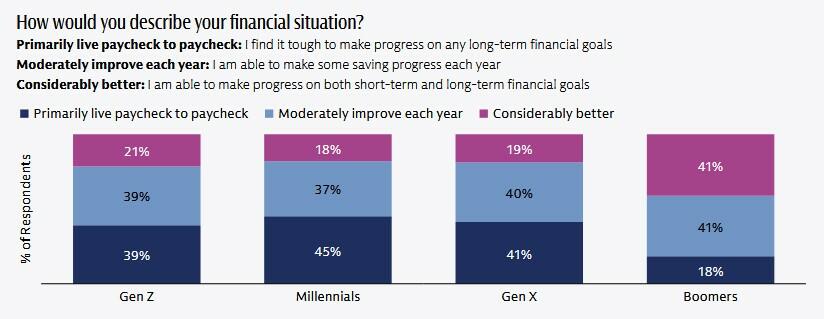
“According to a Goldman survey published earlier this month, around 40% of Americans under the age of boomer report living paycheck to paycheck as inflation continues to erode purchasing power.”

America needs a family-centered financial security reset for hard-working, tax-paying U.S. citizens. Main Street America Republicans have just such a plan.

……………………………………..

As Auto Loan Delinquencies Soar, Repossessions On Track To Break Record

ZeroHedge, Oct 22, 2025

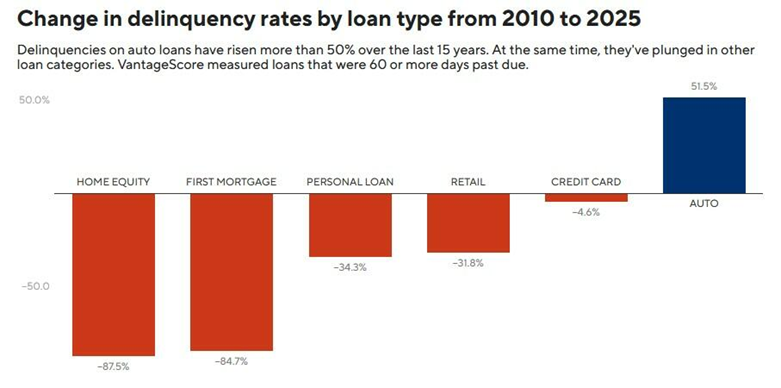
On Friday we noted that auto loan delinquencies among low-tier consumers have surged 50% since 2010, as new vehicle prices have spiked over 25% since 2019 and 20% of borrowers forking over at least $1,000 per month for their depreciating asset (at 9% APR, no less). 

Via CBS / Vantagescore

And so it makes perfect sense that with over 100 million auto loans in America, the number of cars being repossessed is approaching records.

According to data from the Recovery Database Network (RDN), there have been over 7.5 million repossession assignments in the United States so far this year – meaning, authorizations given to an agency to recover a vehicle on behalf of a lender. This figure is on track to exceed 10.5 million by the end of the year. Of note, an assignment =/= a repossession, as repo men aren’t always successful.

Yet despite recovery ratios having fallen in recent years, over three million cars could be repossessed this year, a level not seen since 2009. 

Paycheck to Paycheck

According to a Goldman survey published earlier this month, around 40% of Americans under the age of boomer report living paycheck to paycheck as inflation continues to erode purchasing power.

For those living primarily paycheck to paycheck, the top issue cited by 87% of those asked was “Too many monthly financial expenses” – like an auto loan. In second place is financial hardship (81%) such as home repairs, followed by credit card debt (77%). 

Meanwhile, Fitch reports that 6.43 percent of subprime auto loans were at least 60 days past due in August, while Cox Automotive reported last week that the average transaction price for a new vehicle hit $50,000 last month – the highest level ever. 

Auto finance is at a breaking point, as Americans owe over $1.66 trillion in auto debt. Delinquencies, defaults, and repossessions have shot up in recent years and look alarmingly similar to trends that were apparent before the Great Recession,” wrote the Consumer Federation of America, a nonprofit advocacy group.

“Cars are more expensive than ever, due in part to economic factors, but also due to the fraught experience of buying and financing a car. Dealers and lenders have long engaged in deceptive and predatory practices that jack up prices for car buyers in order to line their pockets.”

_____________________________

Main Street America Republicans currently have the one and only blockbusting plan to reset the consumer debt cycle:

The Leviticus 25 Plan – An Economic Acceleration Plan for America

$95,000 per U.S. citizen – Leviticus 25 Plan 2026 (37984 downloads )

Big Government, Economic Stagnation, Declining Living Standards – Resolved. The Leviticus 25 Plan.

Big Government, No Growth – The Implosion Of Statism

ZeroHedge, Oct 13, 2025 – Authored by Daniel Lacalle,

Excerpts:

Rising government spending and public debt create economic stagnation and declining living standards. Many citizens believe that the state will give them prosperity and equality. However, the state only makes paper promises by issuing debt, creating a constantly depreciated currency. Taxpayers are constantly expropriated, while the recipients of subsidies become a dependent subclass. Who wins? Bureaucrats.

Deficit spending is not a tool for growth. It erodes prosperity, creates persistent secular stagnation, real wage growth decline, and poor productivity growth.

High public spending and government debt falsely inflate GDP through government outlays while, in most cases, masking a private-sector recession underneath. GDP is easily manipulated by increasing government spending and changing the calculation of GDP deflators.

The state issues debt, a form of currency, and establishes a system that continuously suffocates the productive sector. In effect, GDP and CPI serve as measures of economic strength that obscure the imbalances created by the state; GDP overstates real growth by incorporating government spending financed by debt, while CPI, like the GDP deflator, underestimates the currency’s loss of purchasing power.

Major economies face a hidden real recession for households and small businesses using “robust” headline figures bloated by ever-rising government debt. Every new dollar of debt now generates less than sixty cents of nominal GDP in the U.S. However, when we look at countries like Japan, France, the UK or Germany, the multiplier effect of new government debt is either nonexistent or negative. The consequences are evident: true productive economic expansion is hurt by rising taxes, regulatory burdens, and inflation, which reduce incentives for private investment and innovation.

Statism creates enormous disincentives for productive investment and promotes malinvestment and the constant transfer of wealth from the productive sectors to the government. Governments finance their ever-expanding budgets in privileged conditions, creating a crowding out of the private sector that suffers the consequences of persistent inflation and raising taxes.

Remember that high taxes are not a tool to reduce debt but to justify it.….

…Persistent inflation is the systemic result of chronic government overspending and central bank easing to sustain sovereign debt bubbles…

Capitalism and social media do not cause inequality and discontent. Governments create inequality in its most severe form, which arises from political favouritism.

Artificial creation of currency is never neutral. It disproportionately benefits the first recipient of new money and governments and hurts the last recipients, wages, and deposit savings.

Workers and the middle class cannot protect themselves against the stealth expropriation of the economy…

By manipulating interest rates and maintaining elevated public outlays, governments create a stealthy nationalisation of the economy and a slow-motion crisis. This leads to a gradual decline in both purchasing power and living standards.

The solution is to diminish the power of the state, promote sound money, strengthen the private sector, favour entrepreneurship, and make systematic cuts to government spending.… Without decisive spending restraint, citizens remain trapped in a vicious cycle of dependency, currency devaluation, and impoverishment.

Rising government spending and public debt do not deliver productive growth. They create stagnation.

_________________________________

The Leviticus 25 Plan is America’s one and only decentralizing, debt-busting, government-shrinking economic revitalization plan – with the raw power to get America back on top as a legitimate economic superpower and true leader of the free world.

The Leviticus 25 Plan will ‘lift millions of working Americans up out of poverty’… ‘strengthen the private sector’…. ‘promote sound money’… deliver long-term economic growth… and restore economic liberty.

The Leviticus 25 Plan is a dynamic economic initiative providing direct liquidity benefits for American families, while at the same time scaling back the role of government in managing and controlling the affairs of citizens.  It is a comprehensive plan with long-term economic and social benefits for citizens and government.

The inspiration for this plan is based upon Biblical principles set forth in the Book of Leviticus, principles tendering direct economic liberties to the people.

The Leviticus 25 Plan – An Economic Acceleration Plan for America

$95,000 per U.S. citizen – Leviticus 25 Plan 2026 (37385 downloads )

Extreme Poverty Across the U.S. — and the One and Only Economic Plan in America to Lift People Up Out of It.

“No society can surely be flourishing and happy of which by far the greater part of the numbers are poor and miserable.”  – Adam Smith

…………..

Mapping Extreme Poverty Across All American States

ZeroHedge, Monday, Oct 06, 2025 – 06:20 PM

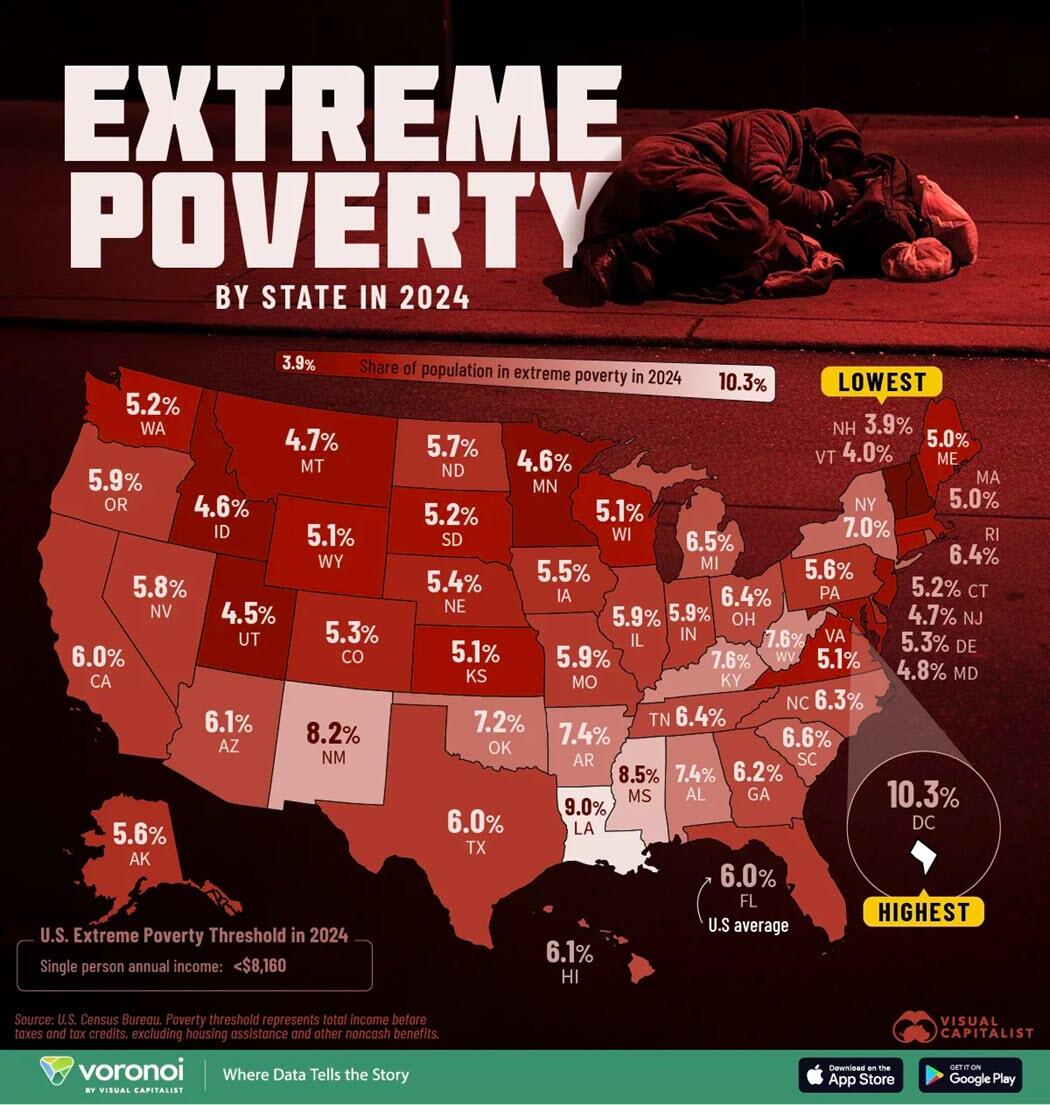
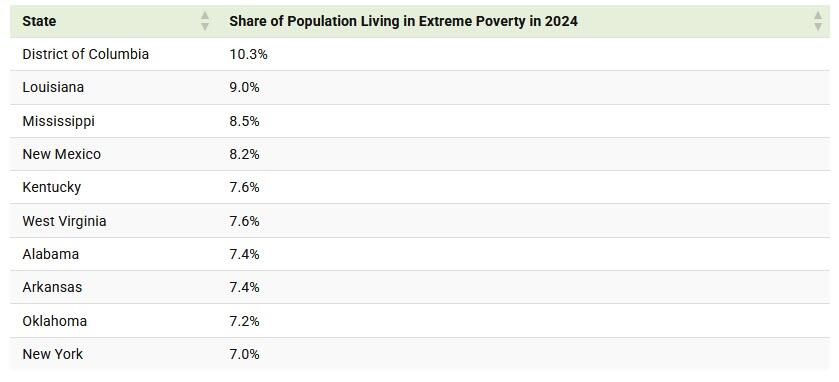
In 2024, 6% of the U.S. population lived in extreme poverty, equal to 20.4 million people.

While there are different definitions of extreme poverty, this is represented as those earning less than $8,160 in annual income, or half of the poverty line. As the federal budget makes cuts to food assistance and healthcare, levels of extreme poverty run the risk of worsening even further.

This graphic, viaVisual Capitalist’s Dorothy Neufeld, shows the share of each state living in extreme poverty in 2024, based on data from the U.S. Census Bureau.

Washington D.C. Has the Highest Level of Extreme Poverty

Last year, more than one in 10 residents of the nation’s capital lived in extreme poverty. 

Going further, economic hardship disproportionately impacts people of color in Washington D.C., with one in three black children living in poverty between 2019 and 2023, on average.

As we can see, Southern states also rank among the most impoverished. In Louisiana, 9% of residents live in extreme poverty, and on average, 18.9% lived below the poverty line between 2021 and 2023.

Meanwhile, 7% of New York’s population are extremely impoverished, equal to an estimated 1.4 million people.

On the other end of the spectrum is New Hampshire with the lowest rate nationally, at 3.9%. The Granite State benefits from a stable job market, low unemployment, and a strong education system. Paired with relatively affordable healthcare, these factors contribute to higher living standards for its residents, reducing the risk of poverty.

___________________________________

The Leviticus 25 Plan is the one plan in America with the raw, irresistible power to lift millions of qualifying U.S. citizens up out of poverty and back on the road to living productive lives.

The Leviticus 25 Plan is a dynamic economic initiative providing direct liquidity benefits for American families, while at the same time scaling back the role of government in managing and controlling the affairs of citizens.  It is a comprehensive plan with long-term economic and social benefits for citizens and government.

The inspiration for this plan is based upon Biblical principles set forth in the Book of Leviticus, principles tendering direct economic liberties to the people.

The Leviticus 25 Plan – An Economic Acceleration Plan for America

$95,000 per U.S. citizen – Leviticus 25 Plan 2026 (37306 downloads )

‘Obamacare Sweeteners’ Defrauding Taxpayers and ‘Poisoning Budget Negotiations’

Highlights:

A whopping 40 percent of enrollees in fully subsidized plans had no claims in 2024. In 2024 alone, taxpayers sent at least $35 billion to insurers for people who paid no premiums and never used their plan”…

COVID opened the door for massive waste, fraud, and abuse of government programs, like the billions in fraud and abuse allowed by the ‘temporary COVID’ enhanced Obamacare subsidies“…

_________________________________________________

The Obamacare Sweeteners Poisoning Budget Negotiations

ZeroHedge, Friday, Sep 26, 2025 – Authored by James Varney via RealClearInvestigations,

Halloween could come early this year. The Democrats have named their price to avoid a government shutdown come October – an additional $350 billion for healthcare over the next decade. Critics say a big chunk of that money may go to ghosts.

At issue are the generous subsidies the Biden administration created for Affordable Care Act policies, sweeteners that are slated to expire in December. Making healthcare essentially free for millions of Americans, those policies have skyrocketed enrollment in Obamacare plans. But a recent study found they have also sparked a curious phenomenon: an estimated 12 million enrollees “without a single claim – no doctor visit, lab test, or prescription filled” in 2024.

The Paragon Health Institute study reports that this is triple the number of no-claim policyholders before the Biden sweeteners were put in place. “Among those now eligible for zero-premium plans with low or no deductible,” the study found, “that number increased nearly sevenfold. … A whopping 40 percent of enrollees in fully subsidized plans had no claims in 2024. In 2024 alone, taxpayers sent at least $35 billion to insurers for people who paid no premiums and never used their plan,” the report said.

Although many analysts suspect that these numbers suggest widespread fraud, Democrats and the insurance industry argue that they reflect consumers taking advantage of affordable coverage. They warn that the expiration of Biden-era reforms will make policies far more expensive for more than 20 million Americans. “If Congress fails to extend the health care tax credits, millions of Americans will face immediate and severe premium increases, leading many to forgo coverage altogether,” said Chris Bond, a spokesman for AHIP, the lobbying arm of the health insurance industry. “Congress must act as quickly as possible to protect Americans from this affordability crisis.”

As Democrats have made healthcare their line in the sand to avert a partial government shutdown on Oct. 1, Biden-era expansions of Obamacare are receiving new attention as a symbol of both expanding access to healthcare and of spending run amok.

Critics say they underscore the findings of the Department of Government Efficiency (DOGE), which has highlighted a lack of accountability in massive government spending programs at a time when the federal government is struggling to corral massive deficits and debt. They say the Biden sweeteners also illustrate how and why government spending keeps increasing: Once a subsidy is put in place, it is hard to take it away from voters.

Swollen Rolls

The Obamacare expansion at issue came about through legislation and regulations during Biden’s term and was often cast as a response to the COVID pandemic.

First, the scope of who was eligible for subsidies was broadened, making it available to households with incomes above 400% of the federal poverty line – making a family of four earning up to $160,000 eligible for subsidized plans. Also, increased subsidies made Obamacare free for those with incomes between 100% and 150% of the poverty line, and longer enrollment periods were created.

The cost for this, on the other hand, is borne by taxpayers.

“Biden’s COVID credits didn’t reduce health care costs – they just shifted them to taxpayers while padding insurer and enrollment intermediary profits,” Paragon President Brian Blase said.

Like all gigantic markets and massive government programs, the Affordable Care Act and what people pay each month have become a very complicated thing, varying by age, state, level of plan, and other factors. But the figures for the Obamacare “reference plan” (silver level) reveal what has happened since the COVID pandemic.

In 2021, when Biden was inaugurated, that basic plan cost an individual $27 a month if they reported income along the federal poverty line, which stood around $14,500 a year. For those making 50% more, the “reference plan” cost $75 a month, and so on up to $152 a month for someone making more than $30,000. Those monthly payment figures were constant regardless of what the insurers charged, with taxpayers making up the difference.

Through legislation Biden pushed through by narrow majorities or via reconciliation, the amount someone would pay each month in the first two categories dropped to zero. And as Obamacare became essentially free, millions signed up – enrolling at rates the plan had never seen since its inception in 2013. 

The overall figures reflect this explosion. Between 2016 and 2020, an average of 8.5 million people signed up for a subsidized Obamacare policy each year, and in none of those years did the figure equal 9 million, according to the Center for Medicare and Medicaid Services (CMS).

In 2021, however, the subsidized total topped 10 million, and by 2024 it had nearly doubled to 19.5 million, CMS figures show. 

“It’s all counter-intuitive, that when enrollment isn’t being publicized, no one is out beating the bushes to get people enrolled like we had in the early years of Obamacare,” said Ed Haislmaier, a healthcare expert at the conservative Heritage Foundation. “Amazing, that a product’s sales would go through the roof when nobody was talking about it.”

Some analysts believe the numbers indicate rampant fraud. Blase claimed in a letter to the Wall Street Journal that the expansion has created an explosion of phantom patients – including 6.4 million of them so far in 2025. “The problem isn’t real people with coverage they don’t use – it’s fraudulent sign-ups who never should have been subsidized.

Haislmaier agreed, “We don’t have an exact number for how many people might be fake, I don’t think anyone does,” said Ed Haislmaier, “What we do have is a lot of circumstantial evidence, a lot of data points, and a lot of information about how the markets have always operated to suggest there is massive fraud here.”

Feds Smell a Rat

Paragon is not the only group voicing concerns. It often seems like fraud is endemic in federal programs, and government healthcare appears to offer a rich vein for such activity. 

In fact, CMS itself has warned of potentially rampant fraud and abuse sapping taxpayers through the revamped Obamacare exchanges. CMS focused on people unwittingly signed up for more than one plan, possibilities that multiplied when the Biden administration relaxed reviews of applicants and extended open enrollment periods.

CMS found in July that 2.8 million Americans were potentially enrolled “concurrently” in Medicaid and the Children’s Health Insurance Plan (CHIP) in more than one state, or on one of those federal programs plus the Obamacare exchange, resulting in inexplicable overlaps that could cost taxpayers $14 billion a year.

CMS insists its analysis is helping identify such problems, and that it is working with states and exchanges to strengthen eligibility verification processes and clean up enrollment data. The Trump administration has instituted some safeguards, such as sending state Medicaid agencies and state-based exchanges a list of individuals with possible concurrent enrollments so they can cross-check appropriate eligibility.

Opponents of expanded subsidies note that when the government makes a deep pool of money available, as has happened with the ACA, fraud is sure to follow. In June, Bloomberg did a deep dive on the phenomenon, describing a rat’s nest of unscrupulous call centers, primarily based in Florida, that have lured people in with various gimmicks and then signed them up for subsidized plans. 

What’s more, those licensed to sell plans had access to Obamacare exchange databases, which allowed them to change both the “agent of record” (thereby making themselves recipient of whatever bonus insurers paid for new signups), or the plan a person was enrolled in (thereby increasing their commission and the taxpayers’ bill), according to Gabrielle Kalisz, one of the authors of Paragon’s report.

Consequently, millions of Americans may be unaware that they own a subsidized Obamacare policy, and horror stories abound of unsuspecting people hit with tax bills seeking to recoup the subsidies.

“Nobody seems to have an incentive to be a good actor in the process,” Kalisz said. “The insurance companies are perfectly happy to keep getting the rising premiums, the navigators or agents are happy to keep getting the commissions, and Obamacare supporters are happy to act as if all this reflects people getting coverage.”

Nor are the so-called “phantom enrollees” the only issue. For example, the numbers don’t add up when percentages of state populations according to census data are measured against the Obamacare subsidies. Fourteen states have more people enrolled at up to 150% of the federal poverty line than they do residents who fit that category, and Florida’s total is five times what census data shows it could be.

The enrollment fraud has become a massive problem,” said Michael Cannon, a healthcare expert at the libertarian Cato Institute. “The program has become like a great big ATM spitting out checks, and there’s very little policing going on because the government doesn’t care as much as it should about other people’s money.”

The new figures also diverge from what has been fairly consistent behavior in healthcare markets – another red flag, Haislmaier said. In 2019 and 2020, less than a quarter of policyholders never filed a claim. And the huge increase in so-called “phantom enrollees” doesn’t appear in market segments other than the now highly subsidized Obamacare plans. 

Such figures make no sense if they reflected genuine people aware of what coverage they were enrolled in, and bogus enrollment activity offers a clear explanation.

“This whole situation has been ideal for the fraudster,” he said. “Now you’ve got more enrolled than are eligible, subsidized plans spiking and non-subsidized plans flat. These are just all indicators that there is something whacky going on here.”

Subsidies or Shutdown?

All of this is informing the partisan debate over healthcare and efforts to fund the government after the current fiscal year ends on Sept. 30.

Republicans, including some who got fabulously wealthy through the healthcare system, like Florida’s Sen. Rick Scott, have said extending the subsidies is ruinously expensive and foolhardy, given what has happened since they were introduced. 

COVID opened the door for massive waste, fraud, and abuse of government programs, like the billions in fraud and abuse allowed by the ‘temporary COVID’ enhanced Obamacare subsidies,” Scott posted last week. “Americans don’t want their tax dollars lining the pockets of insurance companies – it’s time to end this clear abuse of YOUR dollars.”

Scott drew attention to a Sept. 15 post by Wisconsin Republican Sen. Ron Johnson that made much the same point: “Extending the ‘temporary COVID’ enhanced Obamacare subsidies would perpetuate fraudulent activity, sending billions of dollars to insurance companies for policies that people are unaware they’re enrolled in and do not use,” he posted.

On the other side are Democrats who make strange political bedfellows of the insurance industry. Some who traditionally oppose big business, such as Massachusetts’ Sen. Elizabeth Warren or Vermont’s socialist Sen. Bernie Sanders, insist these recent subsidies must continue, preferably permanently. For them, the Obamacare rolls more than doubling – from 11.4 million to more than 24 million between 2020 and today – are a success sign of government-run healthcare.

Last week, Warren compared ending the subsidies to taking healthcare away from people.

“Still waiting to find out how Trump and Republicans think cutting health insurance for 15 million Americans makes America healthy again,” she posted on X Sept. 15. 

Polls suggest support for government-subsidized healthcare is a partisan issue. Last November, Gallup reported that “ninety percent of Democrats say that the federal government is responsible for American healthcare coverage, while 65% of Independents hold the same view. Although only 32% of Republicans share that opinion.” Another survey found that among those receiving subsidies, people who voted for Democrats outnumber Republicans by more than two to one.

Insurers say the Paragon study was flawed and accused the think tank of misunderstanding how insurance works. It’s not unusual for homeowners or car insurance policy holders to go years without filing a claim, and the same could be true with healthcare, they say. According to the industry and Democrats, the ballooning numbers reflect a thriving market in which many more Americans are enjoying healthcare coverage, as stated in a rebuttal released by AHIP on Aug. 15.

The debate will come to a head in the next week or so. President Trump this week rejected a meeting with congressional Democrats whose spending ideas he derided as fantastical. Republicans want to let the subsidies expire; Democrats want to make them permanent. 

Of course, that leaves some wiggle room, such as extending the subsidies for another year or some set period of time, a kicking-the-can option long favored by Congress. There have been some indications in the past several days that, public intransigence notwithstanding, negotiations might be ongoing.

Whatever the outcome, large subsidies that have always been part of Obamacare will continue. For all the hue and cry about rising costs, the elimination of Biden-era sweeteners would simply return the system to the way it was operating before 2021, Kalisz said.

“It’s crony math, a kind of corporate welfare,” she told RealClearInvestigations. “Why are the insurers now making it seem like all the subsidies are going away? It’s a form of scaring and spooking the public.”

_____________________________

The Leviticus 25 Plan will restore citizen-centered healthcare across America by paving forward a system in which millions of qualifying U.S. citizen families receive direct financial allocations to fund their own primary healthcare needs – and pay for insurance coverage that best fits their individual situations.

The Leviticus 25 Plan makes it possible for millions of Americans to pay directly for primary health care services, without government agency and insurance company involvement.

This will massively reduce the Medicaid rolls, massively reduce Medicare outlays, massively reduce the number of people who qualify for Obamacare ‘sweeteners.’

And it will eliminate layers of fraud woven into Medicaid, Medicare, Obamacare, and other entitlement programs like the Earned Income Tax Credit, Housing assistance, and others.

The Leviticus 25 Plan is the world’s most powerful economic rejuvenation plan in the world, It will generate $36.568 billion federal budget surpluses each of its first five years of activation (2026-2030) vs projected $2.1 trillion deficits.

And it will pay for itself entirely over the coming 10-15 years.

The Leviticus 25 Plan – An Economic Acceleration Plan for America

$95,000 per U.S. citizen – Leviticus 25 Plan 2026 (37132 downloads )