America is long overdue for a comprehensive ‘quality of life’ upgrade – one that starts with restoring economic liberty and securing financial health for families all across our land. A primary benefit of this plan must be to ‘de-stress’ American families and allow parents more quality time with their children, restored financial security, and a more manageable pace of life.
America needs a tour de force plan with the creative power to generate massive new tax revenue flows, reduce government expenditures, and eliminate government deficits – a plan that will set America, and the U.S. Dollar, on a path of long-term financial stability.
America’s upgrade must relight the fires of free market, citizen-driven economics and activate a citizen-centered health care system.
This plan must have the raw power to eliminate massive tracts of debt across all sectors of the economy, thereby allowing Federal Reserve ‘rate normalization’ measures, long-term net interest margin benefits for banks, insurers, pension funds.
There is one plan in America with the creative power to deliver these benefits.
The Leviticus 25 Plan is a dynamic economic initiative providing direct liquidity benefits for American families, while at the same time scaling back the role of government in managing and controlling the affairs of citizens. It is a comprehensive plan with long-term economic and social benefits for citizens and government.
The inspiration for this plan is based upon Biblical principles set forth in the Book of Leviticus, principles tendering direct economic liberties to the people.
The Leviticus 25 Plan – An Economic Acceleration Plan for America
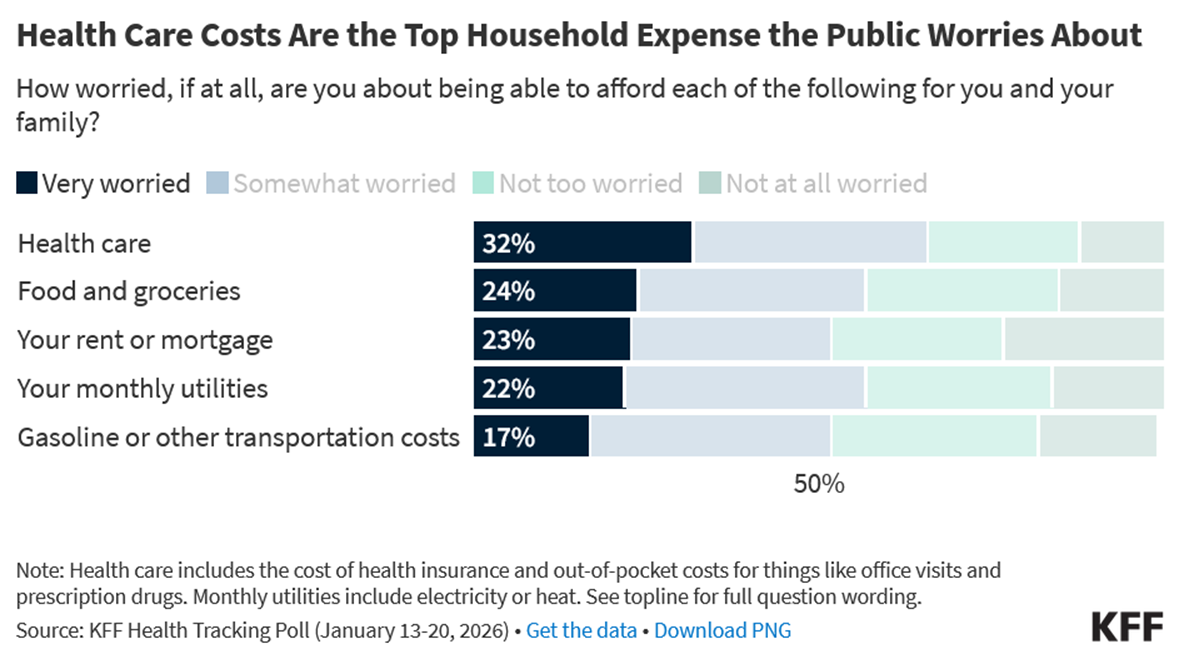
The latest KFF Health Tracking Poll finds health care costs top the list of what the public worries about being able to afford for themselves and their family. Two-thirds (66%) of the public say they worry about paying for health care, including the cost of health insurance and out-of-pocket costs for things like office visits and prescription drugs, ranking higher as a financial worry than other household expenses like utilities, food, and rent or mortgage – all three items on which a majority of Americans are still worried about being able to afford.
About a third of adults (32%) say they are “very worried” about affording health care expenses, while about a quarter of adults say the same about being able to afford food and groceries (24%), their rent or mortgage (23%), or utilities (22%). About a fifth of adults say they are “very worried” about affording gas and transportation costs (17%).
America’s ‘one and only’ comprehensive decentralizing health care plan...
The U.S. Health Care Freedom Plan, an integral component of The Leviticus 25 Plan, will restore citizen-centered health care and summarily reduce ‘annual expenditure for health insurance’ by eliminating bureaucratic bloat, unfriendly and complicated medical access pathways, cumbersome, drawn-out claims processing, and rapidly shrinking reimbursements for physicians, pharmacists, and other health practitioners.
The U.S. Health Care Freedom Plan offers a powerful new access strategy for patients receiving medical and pharmaceutical services, home medical equipment, and home care services.
The Plan grants citizens the freedom to pay directly, in person, for their week-to-week health care purchases. It cuts out layers of bureaucracy and middlemen … simplifies access to health care and restores genuine ‘patient-provider’ relationships.
The U.S. Health Care Freedom Plan is the only comprehensive, citizen-centered health care plan in America. It ‘resets’ the health care industry to present a clean, efficient and responsible system. Most importantly, this plan restores individual citizen-centered health care for all participating Americans.
The U.S. Health Care Freedom Plan is available to each and every U.S. citizen – with no coverage mandates. Each U.S. citizen who wishes to participate will be granted a full and complete exemption from the ACA.
Each participating U.S. citizen shall receive a credit extension, through a special Federal Reserve / U.S. Treasury Citizens Credit Facility of $35,000, electronically deposited into a Medical Savings Account (MSA) – for direct allocation toward family health care needs.
Private insurance – Families shall be allowed to enroll in high-deductible major medical plans, that include basic, ‘no frills’ medical plans which best suit their individual needs and desires. These streamlined plans would lower premium costs for employees and employers, encouraging employers to cost-share savings with employees through incentive-based employer MSA contributions.
Those with extraordinary medical issues may be included in a high-risk category, with such plans being eligible for a government subsidy (similar to current Medicare Advantage).
Federal / state programs – Individuals enrolled in Medicare / Medicaid / VA / TRICARE / FEHB programs would maintain their covered status, with an annual deductible of $7,000 per year per enrolled family member, for a period of five years for those benefits. The dedicated MSA funds would fully fund the offset for the higher ($7,000) deductible feature for that five-year period. MSA funds could also be used to pay Medicare supplement premiums and other potential co-pay obligations.
Where health care services paid by patients directly with MSA funds, providers would not be bound by federal / state rules pertaining to Electronic Medical Records (EMRs), and other unnecessary administrative burdens.
………………………………….
The Leviticus 25 Plan activation period is slated for the 5-year period beginning in 2027 and ending in 2031.
The Leviticus 25 Plan – Each participating U.S. citizen will receive a $60,000 deposit into a Family Account (FA) and a $35,000 deposit into a Medical Savings Account (MSA).
Qualification: All U.S. citizens residing in the United States are eligible to participate, contingent upon meeting qualification standards and agreement to specified recapture provisions. Participants (other than ‘custody account’ applicants) must prove stable credit history, stable job history, no recent drug/felony convictions.
These general recapture provisions include:
Waiving all federal income tax refunds for a period of 5 years.
Waiving benefits from income security programs, select benefits from means-tested welfare programs, SSI, and SSDI for a period of 5 years.
Enrollees in the Medicare, Medicaid, VA Healthcare system, Federal Employees Health Benefits (FEHB), and TRICARE will be subject to a $7,000 deductible for primary care and outpatient services annually for a period of 5 years. (See full plan for more details)
The Leviticus 25 Plan generates $37.303 billion federal budget surpluses annually during each of its first five years of activation (2027-2031), and pays for itself entirely over a 10-15 year period.
………………………………….
The Leviticus 25 Plan is a dynamic economic initiative providing direct liquidity benefits for American families, while at the same time scaling back the role of government in managing and controlling the affairs of citizens. It is a comprehensive plan with long-term economic and social benefits for citizens and government.
The inspiration for this plan is based upon Biblical principles set forth in the Book of Leviticus, principles tendering direct economic liberties to the people.
The Leviticus 25 Plan – An Economic Acceleration Plan for America
The 2008-2010 great financial crisis was precipitated by major Wall Street financial institutions, both foreign and domestic, that became engrossed with sewage-grade subprime mortgage paper, fell below their capital requirements, and triggered the credit market collapse.
The very same ‘too big to fail banks’ then received trillions of bailout dollars in direct liquidity transfers and credit guarantees through the Fed’s “Secret Liquidity Lifelines” … to magnanimously restore them to a state of ‘financial health.
During this same crisis, precipitated by the likes Morgan Stanley, Goldman Sachs, AIG, Citigroup, Bank of America, Merrill Lynch, JP Morgan, Wells Fargo… and foreign-based RBS, Barclays, UBS AG, Deutsche Bank, BNP Paribas, Dexia SA, 12 million Americans lost jobs.
And then, at the very time they were receiving their massive bailout packages, the big mortgage service institutions turned around and foreclosed on ~8.4 million homes. Small businesses crashed.
And now, the great American middle class is getting crushed by inflation, the affordability crisis, record high Household Debt, and stagnant economic growth.
The good news is — there is a dynamic economic plan to rebalance the scales and get America back on track… Loaded up and ready to launch.
The housing market, for much of the 20th century, was the bedrock of the American Dream. Home ownership, and the financial stability it represents, was a sure path to middle-class prosperity.
That dream turned to a nightmare for many American families during the epic real estate bubble and subsequent bust in 2008-09. What’s more, in the near two decades that followed, federal monetary policies coupled with restrictive local development standards have huffed and puffed an even more perilous bubble than the last one….
We’ve reached the point where discretionary income, the money left over after you’ve paid for basic needs, has effectively vanished for much of the population. When 67 percent of Americans are living paycheck to paycheck, saving for a down payment is impossible.
Currently, about 72 percent of Americans are struggling to pay their monthly bills. We aren’t talking about luxury vacations or even unexpected medical expenses. We’re talking about keeping the lights on and the fridge full. When the buffer is gone, the entire economic engine stalls.
The lack of affordable housing has created a generational rift. Young workers find themselves trapped in a permanent renter class. They’re unable to build the equity that once anchored the nation’s middle class.Right now, more than 75 percent of homes across the country are unaffordable for the typical household. Most Americans are effectively priced out of the housing market. And this number is climbing…
Between higher interest rates, relative to four years ago, and artificially inflated valuations, the entry-level home no longer exists….
The middle class, specifically the segment that has historically held the most private property, is under attack. By squeezing the life out of the housing market, wealth is being funneled upward. When families lose their homes to foreclosure, they don’t just lose a roof, they lose their primary vehicle for intergenerational wealth.
The result is a civilization of serfs. We’re rapidly transitioning to a rentership society. If you don’t own property, you don’t have a stake in the future. You’re left out in the cold.
In 2008, the crash was about bad paper and subprime loans. Today, the crisis is about affordability and insolvency. House price inflation in the face of stagnating wages has become too much to overcome.
Moreover, as houses are lost en masse to the banks they aren’t being foreclosed on and put back on the market at a lower price. They’re being sold in bulk to hedge funds, who promptly jack up the rents. What this means is your neighborhood could soon be owned by a corporation that doesn’t have a face, let alone a soul.
The real estate market isn’t just cooling off. It’s being hollowed out. Between the loss of discretionary income, the instability of the job market, and the sheer impossibility of the two-income mortgage, the American middle class is standing on a trap door….
Grinding the American Middle Class to Dust
For decades, the home was a forced savings account that allowed a mechanic or a teacher to retire with dignity. Today, that vehicle has been hijacked by institutional capital.
As the supply of affordable homes dwindles, we see the rise of the build-to-rent trend. This is where entire subdivisions are constructed not for families to buy, but for corporations to lease back to them in perpetuity.
This shift marks the transition from a stakeholder society to a subscription society consistent with the WEF diktat of, “you will own nothing and be happy.” Housing, the most basic of human needs, has become a subscription service.
Thus, the ability to accumulate private wealth through long-term home ownership has disappeared. As a renter, you are no longer building equity and wealth, you are funding a hedge fund’s quarterly dividends.
This exploitive model ensures that the fruits of one’s labor are siphoned away from the community and into the coffers of distant shareholders. As a result, the working class are left with nothing but receipts and a sense of perpetual instability. The economic ladder has been replaced by a treadmill to nowhere.
In addition, a society of renters is a society of transients that lack the long-term community ties that homeownership once encouraged. As the trap door swings open, the fall both destroys people’s finances and shatters the very concept of the neighborhood.
The doors are closing on the era of American middle-class independence. The dream of home ownership is being replaced by the reality of permanent debt, and the bedrock of the American middle class is ground into dust.
________________________________________
The Leviticus 25 Plan will accomplish five of America’s most critical national economic/social priorities:
Massive debt elimination and the renewed financial security for millions American families;
Breaking the vicious ‘cycle of dependence’ on federal and state social welfare subsistence programs — restoring hope and strengthening families;
The Leviticus 25 Plan is a dynamic economic initiative providing direct liquidity benefits for American families, while at the same time scaling back the role of government in managing and controlling the affairs of citizens. It is a comprehensive plan with long-term economic and social benefits for citizens and government.
The inspiration for this plan is based upon Biblical principles set forth in the Book of Leviticus, principles tendering direct economic liberties to the people.
The Leviticus 25 Plan – An Economic Acceleration Plan for America
America does not need Fed interest rate cuts. It does not need more government ‘stimulation programs,’ or meager tax cuts, or trivial spending reduction measures.
America needs massive public and private debt reduction, massive reductions in government social program spending, citizen-centered health care, economic liberty, and the restoration of free market dynamics.
……………………………………………………
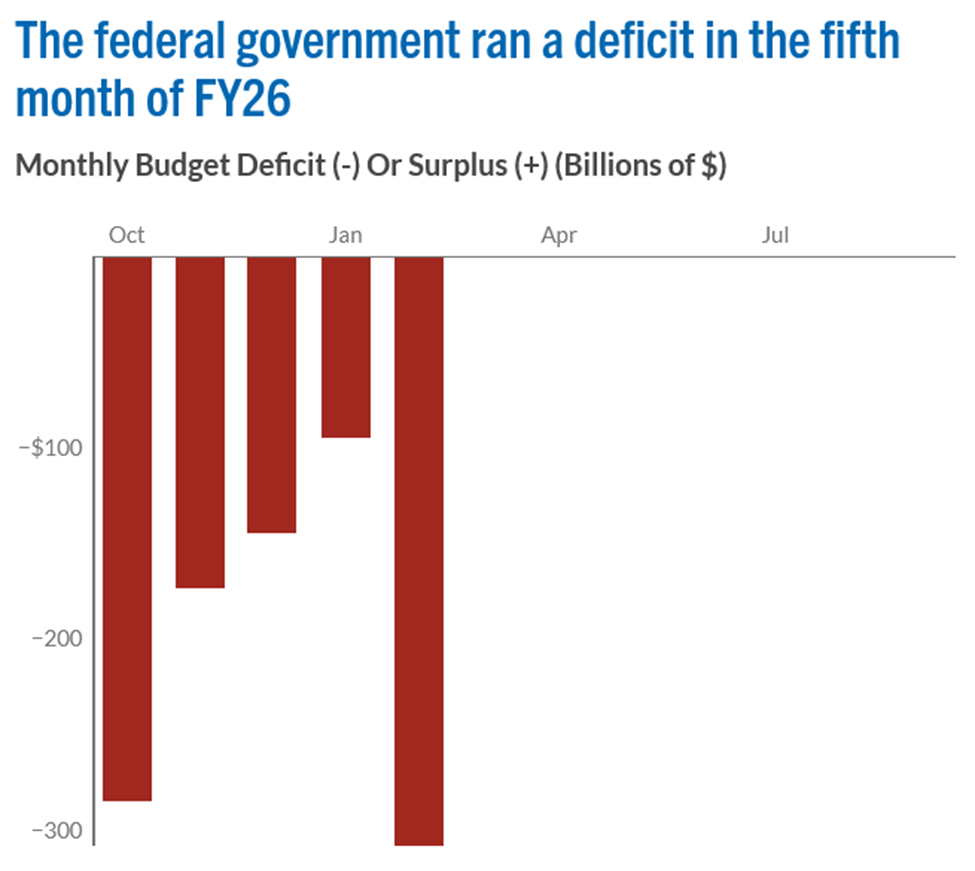
Source: Department of the Treasury
The federal government reported a deficit of $95 billion in the month of January FY26, a decrease of $34 billion from the $129 billion deficit recorded in January FY25. However, February 1 fell on a weekend in both FY25 and FY26, causing certain payments, mostly Medicare-related, to be shifted into January of both years. Those timing shifts inflated outlays for the past two Januarys. Adjusting for those timing shifts, the January FY26 deficit would have been $41 billion less than the same month in the previous year.
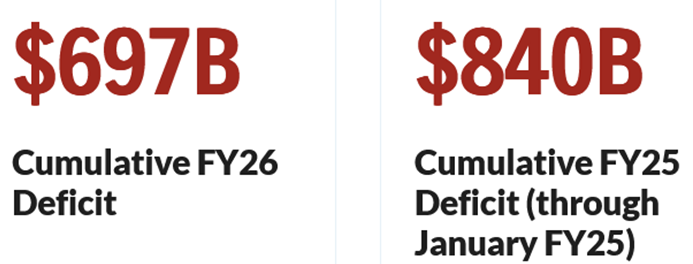
Four months through FY26, the deficit was $143 billion below last year’s level. However, the cumulative deficits of FY25 and FY26 have been affected by the aforementioned January 1 timing shifts. Without those effects, the cumulative deficit for FY26 would have been $152 billion less than last year’s adjusted total.
For FY26, total outlays were $2.5 trillion, $46 billion lower than the same period in the previous year. Adjusting for those timing shifts, spending was $37 billion below the same period last year. That increase was driven mainly by three categories: Social Security spending was up by $38 billion, stemming from cost-of-living adjustments and some retroactive payments; Medicare outlays increased by $28 billion (adjusted for timing shifts); and net interest rose by $24 billion
The US government sold $701 billion of Treasury securities this week, spread over nine auctions, including 10-year Treasury notes and 30-year Treasury bonds.
[U.S. Department of Treasury] Sold $54B of 10-Year Treasury notes at 4.18% to replace $25B of maturing 1.73% 10-year notes, pushing up amount outstanding by $29B.
…………………………………….
$11T Funding Crisis: Fed Trapped as Treasury Ponzi Fails (Your Money at Risk)
ITM Trading, Feb 10, 2026 – Excerpts:
Eight weeks. $90 billion in [Fed] Treasury bill purchases. And that’s just the appetizer. There’s $9 trillion in rollovers coming due at today’s rates, plus another $2 trillion in new issuance. That’s $11 trillion the US needs to find buyers for while China dumps Treasuries and Japanese capital flows home.
Taylor Kenney connects the dots: the Fed isn’t providing “technical support.” It’s gearing up for the largest monetization cycle in history, starting from a balance sheet that’s already 7x its pre-2008 level…
……………………………………..
Doug Casey, Feb 17, 2026 – Excerpt:
During the Covid hysteria, the Fed was creating $120 billion out of thin air each month—far larger than the $40 billion per month during QE3, which itself was larger than the monthly pace during QE1 and QE2.
That’s why I expect the coming QE—or whatever they decide to call it—will be significantly bigger than the $120 billion per month they injected into the economy during the Covid scam.
And if gold is already hitting record highs, imagine what happens when the Fed unleashes even more currency debasement than the last rounds of “stimulus.”
Here’s the reality: the monetary system is breaking down—and the people who run it know exactly how to use that breakdown to tighten their grip.
Their endgame is a digital system that can track, limit, and ultimately control every transaction. And anyone who isn’t prepared risks losing far more than purchasing power.
____________________________________
The Leviticus 25 Plan – The most powerful economic acceleration plan in the world:: * $37.303 billion federal budget surpluses annually 2027-2031; * Massive elimination of household debt (mortgage, consumer, student loan, credit card, auto loan debt); * Citizen-centered health care, driven by direct consumer spending for primary health care services – widespread of reductions in bureaucratic costs, middleman expenditures, claims processing; * Powerful, dynamic economic growth; * Long-term financial security for millions of American families;
The Leviticus 25 Plan – An Economic Acceleration Plan for America
Younger Americans were more likely to say the economy was the country’s most pressing concern last year, according to a new survey.
In the Gallup poll, 32 percent of Americans aged 15 to 34 said that economic issues were “the most important problem” the U.S. “is facing currently,” while 21 percent of Americans aged 35 to 54 said that economic issues were the most important problem. Thirteen percent of Americans aged 55 and older said the same about economic issues.
“Concern about economic issues is present across all generations, but younger adults express the most concern,” Gallup said in an article featuring the survey.
Affordability has come into focus as a key electoral issue with the 2026 midterm elections approaching. President Trump has faced criticism over the issue from Democrats in recent months, who are looking to take back the House and possibly the Senate.
U.S. private-sector employment went up by 22,000 jobs last month, according to a report from the payroll management company ADP.
ADP said in its National Employment Report that January was “a lackluster month for hiring,” but the company also noted that the health care sector “was a standout.”
Another survey from last month found that close to 60 percent of Americans had a negative view of the economy under Trump. In that Wall Street Journal poll, 57 percent said the strength of the economy was “not so good” or “poor.”
The Gallup survey took place from June 14 to June 16, 2025. It polled 1,000 people and has a margin of error of 4.4 percentage points.
___________________________________
Solution: The most powerful economic acceleration plan in the world.
The Leviticus 25 Plan will grant individual U.S. citizens the same direct Federal Reserve liquidity extensions that were provided to major U.S. and foreign banks during the 2007-2010 great financial crisis and again during the 2021-2022 Covid crisis.
Each qualifying U.S. citizen wishing to participate will receive a $60,000 deposit into a designated Family Account (FA) and $35,000 into a designated Medical Savings Account (MSA) via a Fed/U.S. Treasury Citizens Credit Facility.
Benefits – The Leviticus 25 Plan will: * Provide direct liquidity extensions to U.S. citizen families residing in the United States. * Optimize the allocation of primary health-care services funding, including Medicare and Medicaid. * Improve the economic climate for U.S. small businesses; vastly expand employment opportunities; eliminate massive amounts of public and private debt; restore financial health across the nation for all American families. * Generate dynamic, long-term, tax revenue growth cycles for government (federal, state, local). * Reduce the cost of government, strengthen U.S. housing market, and stabilize the banking system. * Reduce the scope of social programs, reduce government control over the daily affairs of U.S. citizens. * Generate $37.303 billion budget surpluses each of its first five years of activation, pay for itself entirely over a 10-15 year period, and set the U.S. Dollar on course for long-term strength and stability.
The Leviticus 25 Plan will revitalize economic growth and re-establish free market principles with positive economic and social incentives for millions of American families.
The Leviticus 25 Plan – An Economic Acceleration Plan for America
The Leviticus 25 Plan 2027 – the most powerful economic acceleration plan in the world. Updated economic scoring summary: Every qualifying U.S. citizen who wishes to participate will receive $60,000 (Family Account) and $35,000 (Medical Savings Account). $95,000 per U.S. citizen. Massive public and private debt elimination. Economic liberty
Average annual budget surplus (projected) 2027-2031: $186.517 billion / 5 years: $37.303 billion per year
Note 1: Projected budget surpluses for 2027-2031 do not factor in the additional government tax revenue gains that would accrue from the massive shift in capital away from debt service and into productive economic activity.
Note 2: Projected budget surpluses for 2027-2031 do not factor in the additional government tax revenue gains that would accrue from significantly lower levels of debt deductibility on individual income tax filings.
Note 3: Projected budget surpluses from the Medicaid / CHIP recapture do not take into account the likelihood of fewer citizens actually qualifying for Medicaid / CHIP benefits.
Note 4: Projected budget surpluses from Interest Expense Reductions during each of the first five years of activation (2027-2031) is likely understated due to the fact that ‘debt held by the public’ is projected to increase by 8.5% per year, from $28.278 trillion in 2026 to $40.198 trillion in 2030.
Note 5: The Plan’s funding of individual Medical Savings Accounts (MSAs) with the $7,000 deductible provision per year would result in an enormous drop in the number of claims each year for Medicare reimbursement. Medicare payroll taxes would generate a growing revenue stream, due to stronger economic growth, while outlays would drop significantly from the reduced claims numbers – thereby providing the Fed / Treasury Department with a powerful recapitalization of the Medicare Trust Fund, via the Citizen’s Credit Facility.
The Leviticus 25 Plan – Projection limitations There can be no question that The Leviticus 25 Plan would generate healthy, broad-based economic growth from broad-based debt reduction and improved financial stability at the family level, the restoration of free market dynamics in commerce, and scaling back social program work disincentives.
The Leviticus 25 Plan does not attempt to project how much additional tax revenue and reduced cost of government will be realized, above and beyond the Recapture Provisions, over the course of the initial five years of the plan. In that sense, The Plan understates the effect of additional dynamic economic benefits.
Robust funding of Medical Savings Accounts and the elimination of millions of insurance claims and claims resolutions for basic primary care and everyday healthcare purchases swill save millions of man-hours of health care cost on an annual basis. Scaling back government involvement in basic primary care and everyday healthcare purchases for millions of Americans will also generate massive cost savings.
The Plan makes no attempt to project the positive effects of the streamlined, consumer-driven efficiencies that will emerge, and the cost reduction and improvement in services. The Plan therefore understates the benefits. The Plan projects an 80 percent participation rate by U.S. citizens. It is assumed that a large number of wealthy Americans will not participate, because their tax refunds are larger than the annual Plan benefits. And it is assumed that a large number of Americans receiving significant government benefits for extraordinary health or economic issues will also not participate.
Cost savings from the reductions in massive social welfare spending and other programs, like unemployment insurance, workman’s compensation, SSI and SSDI can be difficult to quantity, since state and federal funding mechanisms may both be involved in various ways. In that regard, The Plan may understate, or it may overstate, the benefits.
The Leviticus 25 Plan is a dynamic economic initiative providing direct liquidity benefits for American families, while at the same time scaling back the role of government in managing and controlling the affairs of citizens. It is a comprehensive plan with long-term economic and social benefits for citizens and government.
The inspiration for this plan is based upon Biblical principles set forth in the Book of Leviticus, principles tendering direct economic liberties to the people.
The Leviticus 25 Plan – An Economic Acceleration Plan for America
Monetary expansion doesn’t spread evenly. New money concentrates where it enters—in financial assets, real estate, and the balance sheets of those with credit access. This creates two economies: one for asset-holders, enriched by expansion; another for wage-earners, crushed by the cost increases that follow.
To hit 2 percent consumer inflation, central banks must restrict money supply enough to destroy demand among ordinary households—the people furthest from the monetary spigot. But they’ve already inflated assets to the point where millions of families, pension funds, and governments depend on continued expansion to stay solvent. Tightening enough to hit 2 percent CPI means liquidating the phantom wealth propping up the entire system. We glimpsed this in 2022-2023: modest rate increases triggered bank failures and sovereign debt crises.
The trap is complete: monetary expansion enriches the few while punishing the many, but contraction would bankrupt both.
The Measurement Mirage
The CPI doesn’t measure what people experience. Housing costs appear through “owner’s equivalent rent”—a fiction understating reality by a significant amount. Healthcare, education, childcare—costs that have doubled or tripled—receive minimal weight. Meanwhile, falling electronics and import prices pull the average down.
A family whose rent has doubled, childcare tripled, and healthcare quadrupled is told inflation is “only” three percent. Central banks fight to hit a target disconnected from lived reality, using tools that damage those already most hurt by mismeasured inflation.
The Sovereign Debt Vise
The United States now carries $38.12 trillion in debt, with deficits locked in structural overdrive. For fiscal year 2025 (ending September 30, 2025), the federal budget deficit totaled approximately $1.8 trillion—marking one of the largest annual deficits in US history in nominal terms. In calendar year 2025 alone (through November), the debt has already climbed by over $1 trillion, representing one of the fastest accumulations outside of pandemic-era spikes.
The Fed cannot pursue “price stability” without triggering sovereign default. It cannot monetize the debt without abandoning its inflation target. Monetary and fiscal policy have fused into a single system where every path leads to ruin.
…..
The QT Surrender: Why the Fed Can’t Stop Printing
The Federal Reserve announced in October 2025 that quantitative tightening will end in December after reducing its balance sheet from $9 trillion to $6.6 trillion. This isn’t a policy choice—it’s mathematical surrender.
The Fed’s balance sheet remains bloated with low-yielding assets from QE rounds dating to 2008, earning two-three percent while the Fed pays 4.5 percent on reserves it created to buy them. The Fed operated at a loss for three consecutive years.
But the Fed cannot shrink its balance sheet to pre-crisis levels without triggering a liquidity crisis. The modern financial system operates under an “ample reserves framework”—a euphemism for permanent monetary expansion. Banks, pension funds, and Treasury markets have become structurally dependent on massive reserve creation. When the Fed attempted modest QT reductions, repo markets showed stress. They’re stopping, not because inflation is conquered, but because the financial system cannot handle genuine monetary normalization.
The QT cessation sets the stage for QE’s inevitable return. The Fed is now in what Austrian economists call the “crack-up boom” phase—the point where monetary authorities choose between deflation (and cascading debt defaults) or continued inflation (and currency destruction). The QT cessation signals their choice.
…..
Policy Checkmate—The Impossible Choice
High inflation destroys savings, distorts price signals, and creates social instability. But we must be honest: the 2 percent target cannot be achieved without either.
The options seem to be: 1) a deflationary depression that liquidates the debt overhang—and likely the social order with it; 2) a financial repression that slowly confiscates wealth through negative real rates; or, 3) a restructuring of how we conceptualize monetary stability in a hyper-financialized economy.
The first option is politically impossible and humanly catastrophic. The second is what we’re already doing, just with more dishonesty. The third requires admitting central banking as currently practiced has failed.
…..
The Endgame
This is the endgame of monetary central planning: not with hyperinflationary bang or deflationary whimper, but with the confused stumbling of policymakers who cannot admit their tools have welded them into a cage. The two percent target, tariff dividends, ample reserves frameworks, and technocratic jargon cannot obscure the simple truth: we have built an economic system requiring perpetual monetary expansion to avoid collapse, and we’ve run out of ways to pretend this is sustainable policy rather than slow-motion currency debasement with extra steps.
___________________________________________
The Leviticus 25 Plan is the one and only economic acceleration plan in the world with the power to ‘rebalance the scales’ which had tipped notoriously in favor of America’s “asset-holders, enriched by expansion” … to now tip back strongly in favor of America’s “wage-earners, crushed by the cost increases that follow.”
The Leviticus 25 Plan will furthermore eliminate America’s annual federal budget deficits, projected to average over $2 trillion over each of the coming five years, and thereby strengthen the U.S. Dollar and temper the ever-growing pressures of currency debasement.
The Leviticus 25 Plan will (conservatively) generate federal budget surpluses averaging $37.303 billion in each of its first five years of activation (2027-2031) and effectively pay for itself entirely over the following 10-15 year period.
The Leviticus 25 Plan – An Economic Acceleration Plan for America
Average annual budget surplus (projected) 2027-2031: $186.517 billion / 5 years: $37.303 billion per year
Note 1: Projected budget surpluses for 2027-2031 do not factor in the additional government tax revenue gains that would accrue from the massive shift in capital away from debt service and into productive economic activity.
Note 2: Projected budget surpluses for 2027-2031 do not factor in the additional government tax revenue gains that would accrue from significantly lower levels of debt deductibility on individual income tax filings.
Note 3: Projected budget surpluses from the Medicaid / CHIP recapture do not take into account the likelihood of fewer citizens actually qualifying for Medicaid / CHIP benefits.
Note 4: Projected budget surpluses from Interest Expense Reductions during each of the first five years of activation (2027-2031) is likely understated due to the fact that ‘debt held by the public’ is projected to increase by 8.5% per year, from $28.278 trillion in 2026 to $40.198 trillion in 2030.
Note 5: The Plan’s funding of individual Medical Savings Accounts (MSAs) with the $7,000 deductible provision per year would result in an enormous drop in the number of claims each year for Medicare reimbursement. Medicare payroll taxes would generate a growing revenue stream, due to stronger economic growth, while outlays would drop significantly from the reduced claims numbers – thereby providing the Fed / Treasury Department with a powerful recapitalization of the Medicare Trust Fund, via the Citizen’s Credit Facility.
The Leviticus 25 Plan – Projection limitations There can be no question that The Leviticus 25 Plan would generate healthy, broad-based economic growth from broad-based debt reduction and improved financial stability at the family level, the restoration of free market dynamics in commerce, and scaling back social program work disincentives.
The Leviticus 25 Plan does not attempt to project how much additional tax revenue and reduced cost of government will be realized, above and beyond the Recapture Provisions, over the course of the initial five years of the plan. In that sense, The Plan understates the effect of additional dynamic economic benefits.
Robust funding of Medical Savings Accounts and the elimination of millions of insurance claims and claims resolutions for basic primary care and everyday healthcare purchases swill save millions of man-hours of health care cost on an annual basis. Scaling back government involvement in basic primary care and everyday healthcare purchases for millions of Americans will also generate massive cost savings.
The Plan makes no attempt to project the positive effects of the streamlined, consumer-driven efficiencies that will emerge, and the cost reduction and improvement in services. The Plan therefore understates the benefits. The Plan projects an 80 percent participation rate by U.S. citizens. It is assumed that a large number of wealthy Americans will not participate, because their tax refunds are larger than the annual Plan benefits. And it is assumed that a large number of Americans receiving significant government benefits for extraordinary health or economic issues will also not participate.
Cost savings from the reductions in massive social welfare spending and other programs, like unemployment insurance, workman’s compensation, SSI and SSDI can be difficult to quantity, since state and federal funding mechanisms may both be involved in various ways. In that regard, The Plan may understate, or it may overstate, the benefits.
The Leviticus 25 Plan 2027 – the world’s most powerful economic acceleration plan: Updated economic scoring summary.
Interest expense on projected deficits 2027-2031
Federal debt has increased from $22.1 trillion in 2020 to $37.64 trillion as of July 1, 2025. Federal debt held by the public was reported to be $30.298 trillion, with remainder, $7.342 trillion, comprised of intra-governmental debt outstanding, which arises when one part of the government borrows from another. This intra-governmental debt interest expense item will be omitted from this calculation, since those dollars are not expensed directly.
St. Louis Fed Q3 2025: Debt held by the public, $30.3 trillion, makes up 80.0% of the $37.64 trillion National Debt. U.S. Department of the Treasury (fiscal data): Interest Expense and Average Interest Rates on the National Debt FYTD 2026: 3.324%
The Bear Traps Report, Dec 30, 2024–Excerpts: “CBO data, Bloomberg. The average weighted coupon on the U.S. debt load is about 2.7% vs. over 4.5% for 10-year U.S. Treasuries. As bonds mature, they get refinanced at much higher yields.”
“Incoming Stress Points – In 2025 the U.S. Treasury faces $9.6Tr of maturities in their so-called publicly held debt. In Q1 alone — the government faces $5.58Tr of maturities (bonds coming due, redemption), but 86% of those are short-term bills that the Treasury department rolls over into new 4-week, 8-week, 3,4, or 6-month bills, among others.”
“As a result, almost daily bill auctions are coming to a theater near you, as the Treasury Department mindlessly keeps pushing new paper into the market to pay back the colossal amount of maturing debt.”
This projection will assume an average monthly interest rate of 3.324% for 2026, and a conservative average monthly interest rate of 3.25% in calculating the interest expense to be eliminated during the budget surplus years of 2027-2031. This projection also assumes that annual federal budget deficits will be funded through Treasury Issuance at an average of 80.0% rate for Debt Held by the Public.
Year / Annual Deficit/2 2025: $1.865 trillion/2 X .79 X .03 = $22.965 billion 2026: $1.713 trillion/2 X .79 X .03 = $21.934 billion 2027: $1.687 trillion/2 X .80 X .0325 = $21.931 billion 2028: $1.911 trillion/2 X .80 X .0325 = $24.843 billion 2029: $1.938 trillion/2 X .80 X .0325 = $25.194 billion 2030: $2.140 trillion/2 X .80 X .0325 = $27.820 billion 2031: $2.233 trillion/2 X .80 X .0325 = $29.029 billion
Recapture: Total interest expense eliminated by projected operating surpluses: $128.817 billion
The Leviticus 25 Plan 2027 – the most powerful economic acceleration plan in the world: Updated economic scoring summary.
Medicaid/CHIP Recapture Each U.S. citizen participating in The Plan will receive a $35,000 deposit, funded through a Federal Reserve / U.S. Treasury Department-based Citizens Credit Facility, into a personal Medical Savings Account (MSA).
The Leviticus 25 Plan assumes 80% participation by Medicaid / CHIP enrollees. Within this comprehensive economic plan, The U.S. Health Care Freedom Plan provides Medical Savings Account (MSA) funding of $35,000 to cover the $7,000 deductible for Medicaid and CHIP eligible primary care events and select out-patient care services – primarily related to routine medical appointments, Medicaid prescription events, disease state monitoring clinics, and other desired primary care services.
September 2025 Medicaid & CHIP Enrollment – 77.05 million individuals were enrolled in Medicaid and CHIP in the 50 states and the District of Columbia that reported enrollment data for September 2025. 69,797,328 people were enrolled in Medicaid; 7,252,967 enrolled in CHIP.
Using a conservative estimate of 77.0 million for 2025, with a projected annual growth rate of 2%: 2025: 77.00 million 2026: 78.54 million 2027: 80.11 million 2028: 81.71 million 2029: 83.34 million 2030: 85.10 million 2031: 86.80 million
Total: 417.06 million receiving benefits 2027-2031
Average annual enrollment (2027-2031): 83.41 million 83.41 million X .8 = 66.728 million X $7,000/year X 5 years = $2.335 trillion
Total Medicaid/CHIP recapture during the 5-year target period (2027-2031): $2.335 trillion
Medicare Recapture Each U.S. citizen participating in The Plan will receive a $35,000 deposit, funded through a Federal Reserve / U.S Treasury Department-based Citizens Credit Facility, into a personal Medical Savings Account (MSA).
The Leviticus 25 Plan assumes 80% participation by Medicare enrollees. Within this comprehensive economic plan, The U.S. Health Care Freedom Plan provides Medical Savings Account (MSA) funding of $35,000 to cover a $7,000 annual deductible for Medicare-eligible primary care events and select out-patient services – primarily related to routine medical appointments, Medicare Part D prescription events, disease state monitoring clinics, and other desired primary care services.
There were 69.6 million people were enrolled in Medicare as of October 2025.
Projection: “Medicare spending grew 7.8% to $1,118.0 billion in 2024, or 21 percent of total National Health Expenditures.”
“Over 2024-33 average NHE growth (5.8 percent) is projected to outpace that of average Gross Domestic Product (GDP) growth (4.3 percent), resulting in an increase in the health spending share of GDP from 17.6 percent in 2023 to 20.3 percent in 2033.”
“Medicare enrollment is projected to grow steadily, with total beneficiaries rising to an estimated 78-79 million by 2030-2031.”
Applying a conservative projected enrollment growth rate of 2.5% annually through 2031, with an 80% participation rate, and a $7,000 annual deductible for the 5-year target period (2027-2031): 2025: 69.60 million X .8 X $6,000 = $334,080,000 2026: 71.34 million X .8 X $6,000 = $342,432,000 2027: 73.12 million X .8 X $7,000 = $409,472,000 2028: 74.95 million X .8 X $7,000 = $419,720,000 2029: 76.82 million X .8 X $7,000 = $430,192,000 2030: 78.74 million X .8 X $7.000 = $440,994,000 2031: 80.70 million X .8 X $7,000 = $451,920,000
Total Medicare recapture during the 5-year target period (2027-2031): $2.152 trillion
VA Healthcare The Leviticus 25 Plan assumes 80% participation by Veterans Administration healthcare enrollees. Within this comprehensive structure, The U.S. Health Care Freedom Plan provides Medical Savings Account (MSA) funding of $35,000, through a Federal Reserve / U.S. Treasury-based Citizens Credit Facility, to cover annual $7,000 deductibles for VA primary healthcare services over the course of the 5-year target period (2027-2031).
FY 2025 – 9.2 million enrollees in the VA health care system. The plan assumes a stable 9.2 million enrollment in the VA Health Care System.
2027: 9.2 X 0.8 X $7,000 = $51,520,000,000 2028: 9.2 X 0.8 X $7,000 = $51,520,000,000 2029: 9.2 X 0.8 X $7,000 = $51,520,000,000 2030: 9.2 X 0.8 X $7,000 = $51,520,000,000 2031: 9.2 X 0.8 X $7,000 = $51,520,000,000
Total recapture: $257,600,000,000
Average annual recapture (2027-2031): $51.52 billion
TRICARE The Leviticus 25 Plan assumes 80% participation by qualified TRICARE enrollees.
Through The U.S. Health Care Freedom Plan component, participating members will receive a Medical Savings Account (MSA) funding injection of $35,000, through a Federal Reserve / U.S. Treasury Department-based Citizens Credit Facility, to cover annual $7,000 deductibles for desired primary care and out-patient services over the course of the 5-year target period (2027-2031).
There are currently ~9.4 million U.S. citizen beneficiaries in various locations around the world. Recapture – total (2027-2031): 9.4 million X 0.8 X $7,000 X 5 years: $263.2 billion
Federal Employee Health Benefits (FEHB) The Leviticus 25 Plan assumes 80% participation by FEHB enrollees. Participating members will receive a Medical Savings Account (MSA) funding injection of $35,000, through a Federal Reserve / U.S. Treasury Department-based Citizens Credit Facility, to cover annual $7,000 deductibles for desired primary care and out-patient services over the course of the 5-year target period (2027-2031).
FEHB Program carriers cover most active, full-time civilian employees and retirees of the U.S. government and their families. The Program now provides benefits to over 8.2 million federal enrollees and dependents and offers over 180 health plan choices to federal members.
Note – the Federal government also pays approximately 72% of premium costs per enrollee. Recapture – total (2027-2031): 8.3 million X 0.8 X $7,000 X 5 = $229.6 billion
Social Security Disability Income (SSDI) The Leviticus 25 Plan specifies that qualifying participants will not be eligible for SSDI benefits. The Plan assumes 80% participation by SSDI recipients.
December 2025 – total beneficiaries: 8.163 million recipients; Total monthly SSDI benefit payments: $12.182 billion; Total annual SSDI benefit payments: $146.184 billion.
This projection assumes a conservative 3% growth per year for 2027-2031, covering both enrollment growth and COLA: 2025: $146.184 billion 2026: $150.570 billion 2027: $155.087 billion 2028: $159.740 billion 2029: $164.532 billion 2030: $169.468 billion 2031: $174.552 billion
Total: $823.379 billion / Average per year: $164.676 billion
Total for 5-year target period 2027-2031: Plan assumes 80% participation – recapture: $823.379 billion X 0.8 = $658.70 billion
“SSDI benefits are financed primarily by part of the Social Security payroll tax..”
“Social Security’s trustees project that the share of people in the United States receiving SSDI will rise somewhat over the next 20 years and then remain stable.”
Note: The 3% growth projection, covering both the enrollment increase and annual COLA, is likely a conservative estimation for the period 2027-2031.