Millions of Americans Living ‘Paycheck to Paycheck’

Nearly 1 in 4 American households living paycheck to paycheck, report reveals

Lower-income families hit hardest as inflation grows faster than wages, Bank of America Institute data shows

By Eric Revell FOXBusiness

Excerpts:

The Bank of America Institute report found that almost 24% of households would be classified as living paycheck to paycheck so far in 2025, an increase of 0.3 percentage points from 2024 – although the growth rate is nearly three times lower than it was a year ago.

It defines living paycheck to paycheck as households spending over 95% of their income on necessities like housing, groceries, gas, utilities, internet plans, public transit and childcare. That leaves them with little or no leftover funds for savings or “nice-to-have” discretionary purchases. 

“Although the number of households living paycheck to paycheck is increasing this year, the pace of growth has slowed significantly,” Joe Wadford, an economist at the Bank of America Institute, told FOX Business. “That’s because it seems like a lot of the financial stress that has been increasing has been concentrated in these lower-income households as these families struggle to keep up with cost increases.”

Inflation has grown faster than middle- and lower-income households’ after-tax wages since January 2025, the Bank of America Institute found. 

That trend has led to the share of lower-income households living paycheck to paycheck rising to 29% this year, from 28.6% last year and 27.1% in 2023. Among middle- and higher-income households, there has been little to no increase in the proportion living paycheck to paycheck.

“For middle- and lower-income households, I think inflation is the primary driver. Especially this year, we’ve seen the gap between wages and expenses continue to widen for lower-income households,” Wadford said….

The report also found that wage growth for lower-income earners has been easing compared to higher-income counterparts since the start of 2025, after it rose faster in 2021-22, before cooling in 2023-24….

____________________________________

The Leviticus 25 Plan will lower the cost of living and relieve financial distress for millions of working, tax-paying American families through wide-ranging debt elimination dynamics and the billions of dollars in monthly savings in interest-related debt servicing obligations.

The Leviticus 25 Plan will grant direct liquidity transfers to qualifying U.S. citizens through a Fed-U.S.Treasury based Citizens Credit Facility – in the same way that it provided direct liquidity transfers to major Wall Street global financial institutions during the great financial crisis (2008-2010) and the Covid Criiss (2021-2022), that included none other than: Morgan Stanley, Citigroup, Bank of America, JP Morgan, Goldman Sachs, State Street, AIG, Merrill Lynch, Royal Bank of Scotland (RBS), Barclays, UBS, Deutsche Bank, BNP Paribas, and others…

The Leviticus 25 Plan is a dynamic economic initiative providing direct liquidity benefits for American families, while at the same time scaling back the role of government in managing and controlling the affairs of citizens.  It is a comprehensive plan with long-term economic and social benefits for citizens and government.

The inspiration for this plan is based upon Biblical principles set forth in the Book of Leviticus, principles tendering direct economic liberties to the people.

The Leviticus 25 Plan – An Economic Acceleration Plan for America

$95,000 per U.S. citizen – Leviticus 25 Plan 2026 (40818 downloads )
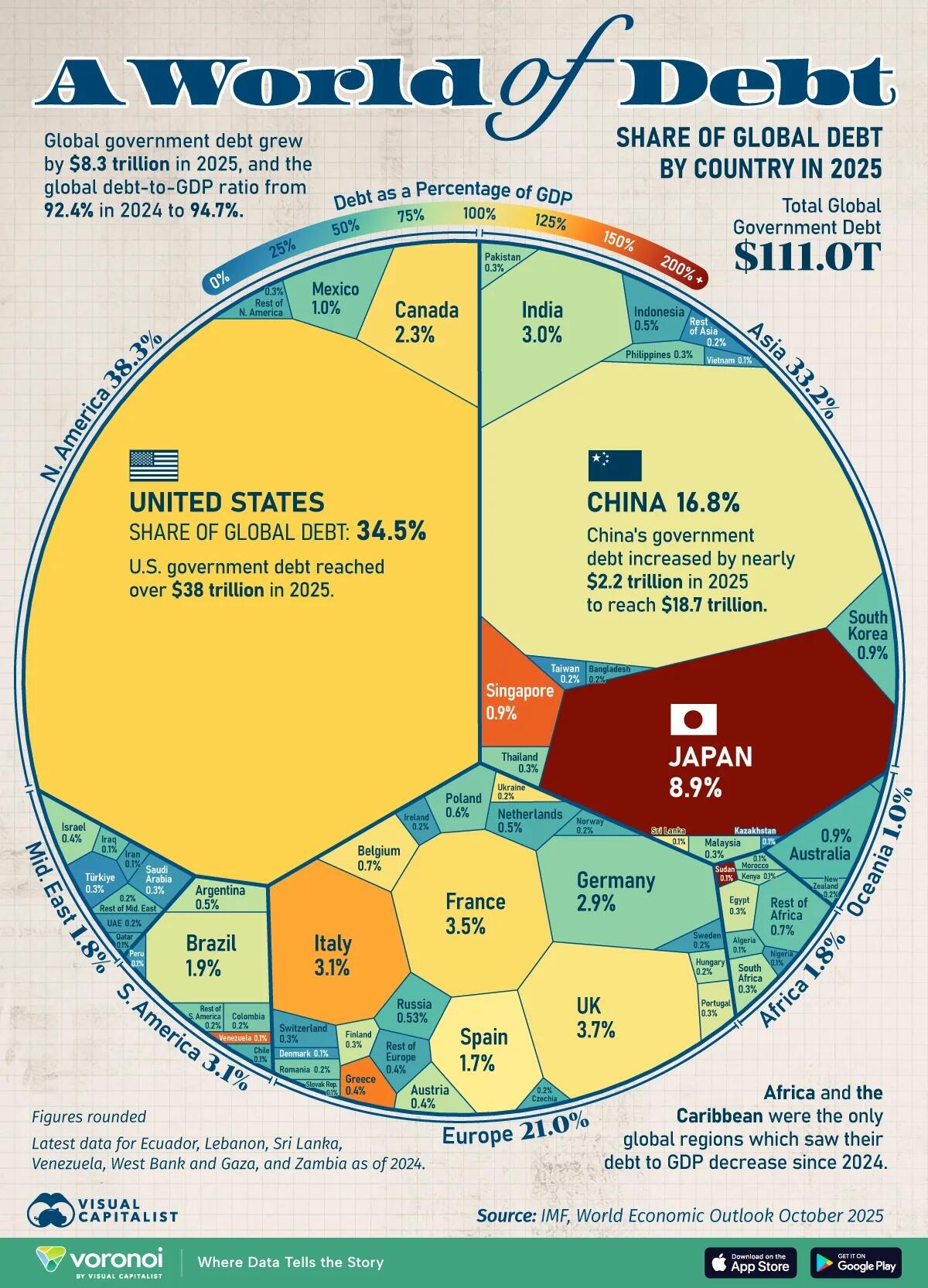
Global Debt: $111 Trillion. United States Share: $38 Trillion (34.5%).

Visualizing The World’s $111 Trillion In Government Debt In One Giant Chart

ZeroHedge, Nov 17, 2025 – Excerpt:

While global public debt is lower than pandemic highs in real terms, it remains stubbornly elevated at $111 trillion.

This graphic, via Visual Capitalist’s Dorothy Neufeld, shows world debt by country in 2025, based on data from the IMF’s latest World Economic Outlook.

…….

America’s debt burden exceeds $38 trillion in 2025, standing at 125% of GDP.

Over the past five years, net interest payments on the national debt have nearly tripled. They are projected to double again by 2035 to reach $1.8 trillion per year.

With $18.7 trillion in debt, China ranks in second. In 2025, debt expanded by almost $2.2 trillion, driven by government stimulus and weaker land revenues given a struggling property market sector.

As we can see, Japan follows next with a $9.8 trillion debt pile, equal to 230% of GDP. Even though debt remains sky-high, the country’s new prime minister, Sanae Takaichi, is proposing $92.2 billion in stimulus spending and subsidies.

The UK and France round out the top largest debt burdens, both hovering near $4 trillion. France, in particular, has experienced significant political instability amid contentious budget cut proposals, cycling through five prime ministers over the past two years.

________________________________

According to the U.S. Government Accountability Office (GAO) February 2025 report, The Nation’s Fiscal Health, “The federal government is on an unsustainable fiscal path that poses serious economic, security, and social challenges if not addressed.”

“Publicly held debt is projected to grow more than twice as fast as the economy, reaching 200% of the size of the economy by 2047.”

Perpetually rising debt as a share of GDP is unsustainable. It has many direct and indirect implications for the economy, American households, and individuals. Risks include slower economic growth and increased chances of a fiscal crisis.

Debt Held by the Public Projected to Grow Faster Than GDP

Debt Held by the Public Projected to Grow Faster Than GDP

The Government’s Borrowing Costs Are Increasing Dramatically

The government’s annual spending on net interest has more than tripled since 2017, when it was $263 billion. Spending on net interest in fiscal year 2024 exceeded spending on some of the largest categories of federal spending, including Medicare and national defense—and is projected to grow.

Annual Net Interest Spending as a Share of Gross Domestic Product, Actual and Projected

Debt Held by the Public Projected to Grow Faster Than GDP

………………………….

There is precisely one comprehensive economic acceleration plan in America with the raw power to reign in our nation’s runaway debt, revitalize economic growth, and restore financial security for millions of hard-working, tax-paying families.

The Leviticus 25 Plan is a dynamic economic initiative providing direct liquidity benefits for American families, while at the same time scaling back the role of government in managing and controlling the affairs of citizens.  It is a comprehensive plan with long-term economic and social benefits for citizens and government.

The inspiration for this plan is based upon Biblical principles set forth in the Book of Leviticus, principles tendering direct economic liberties to the people.

The Leviticus 25 Plan – An Economic Acceleration Plan for America

$95,000 per U.S. citizen – Leviticus 25 Plan 2026 (40406 downloads )

WalletHub: American Families “Drowning in Debt.” Main Street America Republicans’ Powerful Solution Loaded Up and Ready to Launch.

The Federal Reserve bailed out Wall Street financial firms (domestic and foreign) during the great financial crisis (2008-2010), to include: Morgan Stanley, Bank of America, Citibank, Goldman Sachs, JP Morgan, Merrill Lynch, AIG, State Street, UBS, BNP Paribas, Barclays, Deutsche Bank, Royal Bank of Scotland, and many others.

The Fed again stepped in to flush many of the same financial institutions with liquidity during the Covid crisis (2021-22).

It is now time to grand U.S. citizens the same direct access to liquidity that was so generously doled out to Wall Street.

It is now time to restore financial order in America: The Leviticus 25 Plan

_________________________________

Americans report strain from so reasing household debt

Total household debt increased to $18.59 trillion in the third quarter of 2025, or $990 billion below the all-time 2008 high of $19.57 trillion.

By Elyse Apel | The Center Square | Published: November 12, 2025

More than half of U.S. households say they’re struggling with debt, according to a new WalletHub survey.

Total household debt increased to $18.59 trillion in the third quarter of 2025, which is $990 billion below the all-time 2008 high of $19.57 trillion.

Still, debt is steadily rising for many, with more than two in five people expecting their household debt to increase in the next 12 months.

Chip Lupo, a writer and analyst for WalletHub, told The Center Square in an exclusive interview that the survey’s findings are very concerning.

“What stood out most to me about this survey is just how deeply Americans feel the weight of debt; not just financially, but emotionally and physically,” Lupo said. “More than half of households report struggling with debt; 36% feel ‘owned’ by credit card companies; and 38% say it affects their health. This combination of financial strain and personal stress is striking.”

The recently-released survey was done in conjunction with WalletHub’s Household Debt Report, which examined the latest economic data from the third quarter. Notably, the report found that the average American household had:

• $108,425 in mortgage debt

• $3,500 in home equity lines of credit debt

• $13,727 in auto loan debt

• $13,711 in student loan debt

• $10,227 in credit card debt

• $4,562 in other debt, which included personal loans and other financing

The survey sought to put these findings from the report in context. Across the nation, it found that American families are drowning in debt.

In total, 56% said their household is struggling with debt. Many don’t see an end in sight, with 46% anticipating they will still have debt when they die.

Credit card debt is causing the most strain for families, the survey found. In total, 46% of American households reported struggling with credit card debt the most, followed by mortgages at 23% and student loans at 13%.

Many pointed to high inflation and an ever-increasing cost of living as playing a role in their increasing debt.

“High inflation is seen as the primary driver of rising debt, and nearly half of Americans expect to carry debt to the grave,” Lupo said. “These figures highlight how critical it is for consumers to track their net worth and actively manage debt, especially credit card balances, as the survey shows that this is the most common source of financial stress.”

…………………………………………………………….

Where US Families Are Most Strained By Debt

ZeroHedge, Nov 01, 2025

Excerpt:

Americans are always worrying about debt: their own and their government’s.

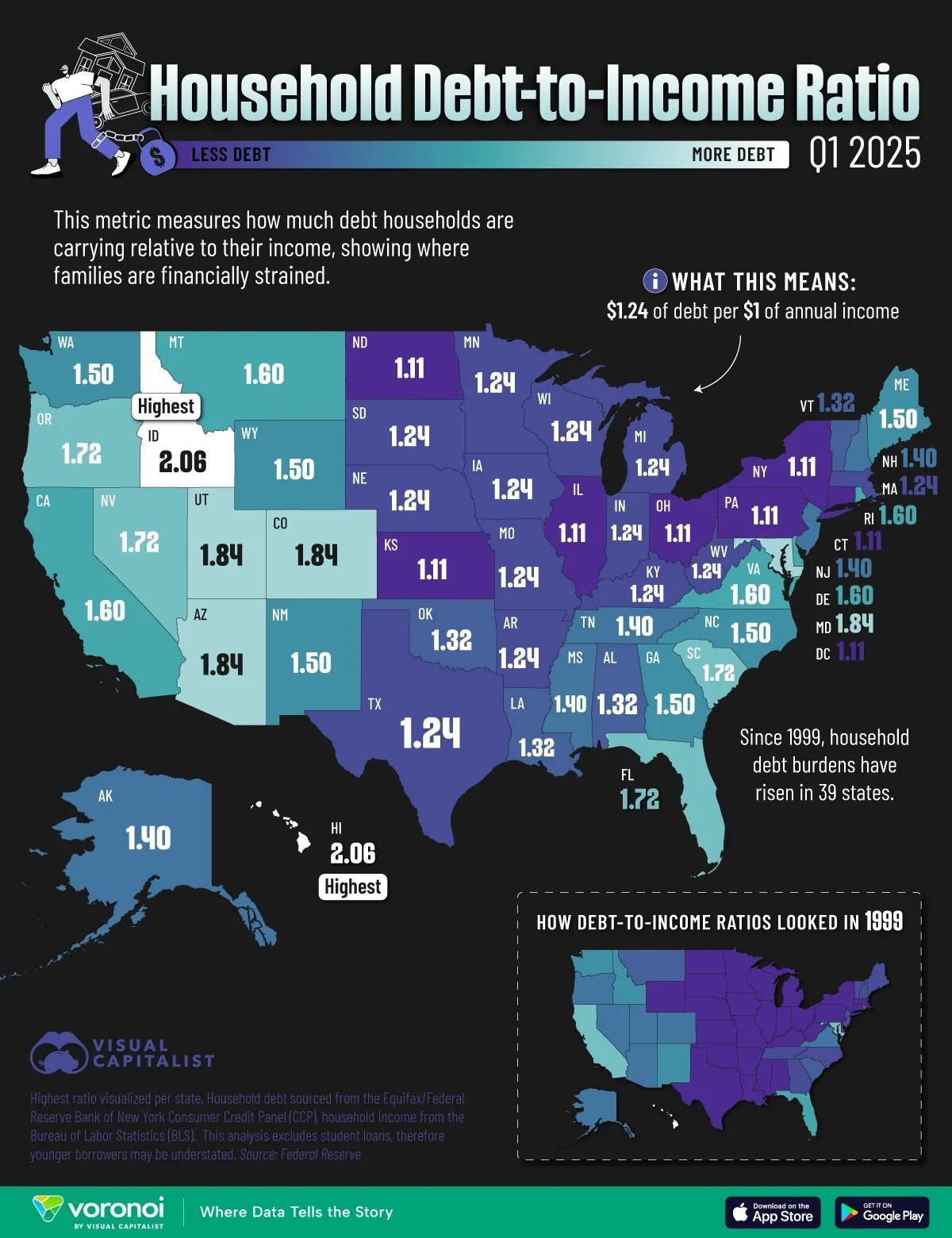
This visualization, via Visual Capitalist’s Pallavi Rao, maps each state by their household debt-to-income ratios (DTI) in Q1, 2025, revealing which states carry the heaviest burdens and which ones keep borrowing in check.

Data for this visualization comes from the Federal Reserve. The highest ratio is visualized per state.

ℹ️ Debt includes mortgages, autos, credit cards, etc., and excludes student loans. Income is based on unemployment insurance-covered wages, as reported to the Bureau of Labor Statistics.

Which States Carry the Most Debt?

Two states share the top spot: Idaho and Hawaii both post a DTI of 2.06, meaning households owe just over twice their annual after-tax income.

RankStateState CodeDebt-to-Income Ratio (2025)Debt-to-Income Ratio (1999)1999–2025 Change
1IdahoID2.061.500.56
2HawaiiHI2.062.060.00
3ArizonaAZ1.841.400.44
4ColoradoCO1.841.400.44
5UtahUT1.841.400.44
6MarylandMD1.841.720.12
7South CarolinaSC1.721.320.40
8NevadaNV1.721.400.32
9OregonOR1.721.400.32
10FloridaFL1.721.600.12
11DelawareDE1.601.110.49
12MontanaMT1.601.320.28
13Rhode IslandRI1.601.320.28
14VirginiaVA1.601.400.20
15CaliforniaCA1.601.72-0.12
16WyomingWY1.501.110.39
17GeorgiaGA1.501.240.26
18MaineME1.501.240.26
19North CarolinaNC1.501.240.26
20New MexicoNM1.501.500.00
21WashingtonWA1.501.500.00
22MississippiMS1.401.110.29
23New HampshireNH1.401.240.16
24New JerseyNJ1.401.240.16
25TennesseeTN1.401.240.16
26AlaskaAK1.401.320.08
27AlabamaAL1.321.110.21
28LouisianaLA1.321.110.21
29OklahomaOK1.321.110.21
30VermontVT1.321.240.08
31ArkansasAR1.241.110.13
32IndianaIN1.241.110.13
33IowaIA1.241.110.13
34KentuckyKY1.241.110.13
35MassachusettsMA1.241.110.13
36MichiganMI1.241.110.13
37MinnesotaMN1.241.110.13
38MissouriMO1.241.110.13
39NebraskaNE1.241.110.13
40South DakotaSD1.241.110.13
41TexasTX1.241.110.13
42West VirginiaWV1.241.110.13
43WisconsinWI1.241.110.13
44ConnecticutCT1.111.110.00
45District of ColumbiaDC1.111.110.00
46IllinoisIL1.111.110.00
47KansasKS1.111.110.00
48New YorkNY1.111.110.00
49North DakotaND1.111.110.00
50OhioOH1.111.110.00
51PennsylvaniaPA1.111.110.00

…check out Visualizing Government Debt-to-GDP Around the World on Voronoi, the new app from Visual Capitalist.

___________________________________________

The Leviticus 25 Plan is the one and only comprehensive economic acceleration plan in the world with the raw power to eliminate massive tracts of family debt and restore self-reliance and financial security for millions of qualifying American families.

It is also the only plan that can restore financial order within the U.S. federal government and the state governments of all 51 states.

The Leviticus 25 Plan will also generate an average $36.568 billion in federal budget surpluses over each of the first five years of activation (2026-2030) – versus projected $2 trillion deficits.

The Leviticus 25 Plan – An Economic Acceleration Plan for America

$95,000 per U.S. citizen – Leviticus 25 Plan 2026 (40186 downloads )

A Financial Reset for America: The Leviticus 25 Plan’s Societal Benefits – Incalculable

“It is true that the virtues which are less esteemed and practiced now – independence, self-reliance, and the willingness to bear risks, the readiness to back one’s own conviction against a majority, and the willingness to voluntary cooperation with one’s neighbors – are essentially those on which the of an individualist society rests. Collectivism has nothing to put in their place, and in so far as it already has destroyed then it has left a void filled by nothing but the demand for obedience and the compulsion of the individual to what is collectively decided to be good.”   Friedrich Hayek, The Road to Serfdom

……………………………………………………………..

The Leviticus 25 Plan re-establishes family and societal virtues which have been eroded through government encroachment and socialist-driven central planning – in America and elsewhere around the world.

The Leviticus 25 Plan – grants direct liquidity access to American families – the very same access to liquidity which was provided to the likes of Morgan Stanley, Citigroup, Bank of America Corp, Goldman Sachs, JP Morgan Chase, Merrill Lynch, Wells Fargo, Deutsch Bank, UBS AG, Royal Bank of Scotland, Plc, State Street, Barclays, and many, many others.

The primary goal of The Plan is debt elimination and the restoration of financial health and economic liberty for American families.

Imagine a family of four paying off their mortgage, car loans, credit card debt – and having additional on-hand liquidity for direct allocation for routine medical expenses.

The financial security benefits of all qualifying American families would be incalculable:

  • Financial stress relief – quality of life improvements – general living conditions, nutrition.
  • Broad-based debt elimination: Household, Student Debt, Consumer debt.
  • Working mothers desiring to spend more time with their children would be able scale back their outside employment hours or become full-time stay-at-home mothers.
  • Financial self-reliance at family level – reduced dependence on social welfare and charity programs.
  • Re-establishment of normal, positive incentives for work, enterprise, innovation, achievements.
  • Improved credit status for working Americans.
  • Improved access to primary health care.
  • Improved employment opportunities.
  • Significant potential for crime reduction.

……………………………………………………………………………….

There is no government-directed economic strategy that can provide even a fraction of these types of benefits, direct to America’s citizens.

The Leviticus 25 Plan is a dynamic economic initiative providing direct liquidity benefits for American families, while at the same time scaling back the role of government in managing and controlling the affairs of citizens.  It is a comprehensive plan with long-term economic and social benefits for citizens and government.

The inspiration for this plan is based upon Biblical principles set forth in the Book of Leviticus, principles tendering direct economic liberties to the people.

The Leviticus 25 Plan – An Economic Acceleration Plan for America

The Leviticus 25 Plan – An Economic Acceleration Plan for America

$95,000 per U.S. citizen – Leviticus 25 Plan 2026 (44906 downloads )

Household Debt All-Time High: $18.6 Trillion. Student Loan Defaults Explode.

There is precisely one plan with the raw power to clean this mess up and restore financial security to millions of American families. The Leviticus 25 Plan.

…………………………………..

US Household Debt Hits Record $18.6 Trillion As Student Loan Defaults Explode

ZeroHedge, Nov 05, 2025 – Excerpts:

The NY Fed published its Quarterly Report on Household Debt and Credit.

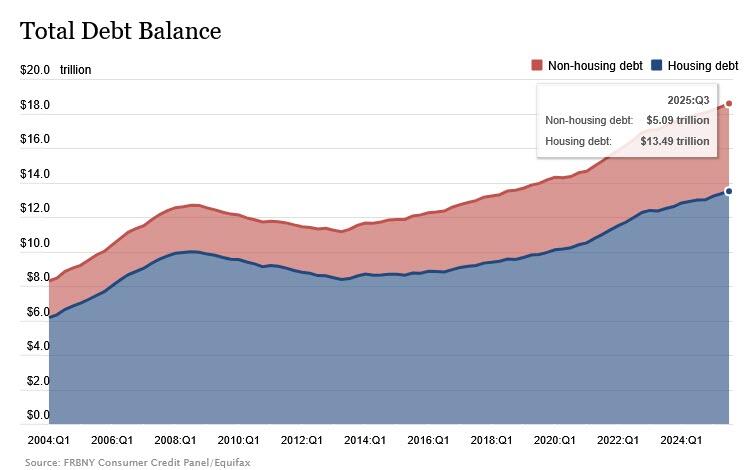
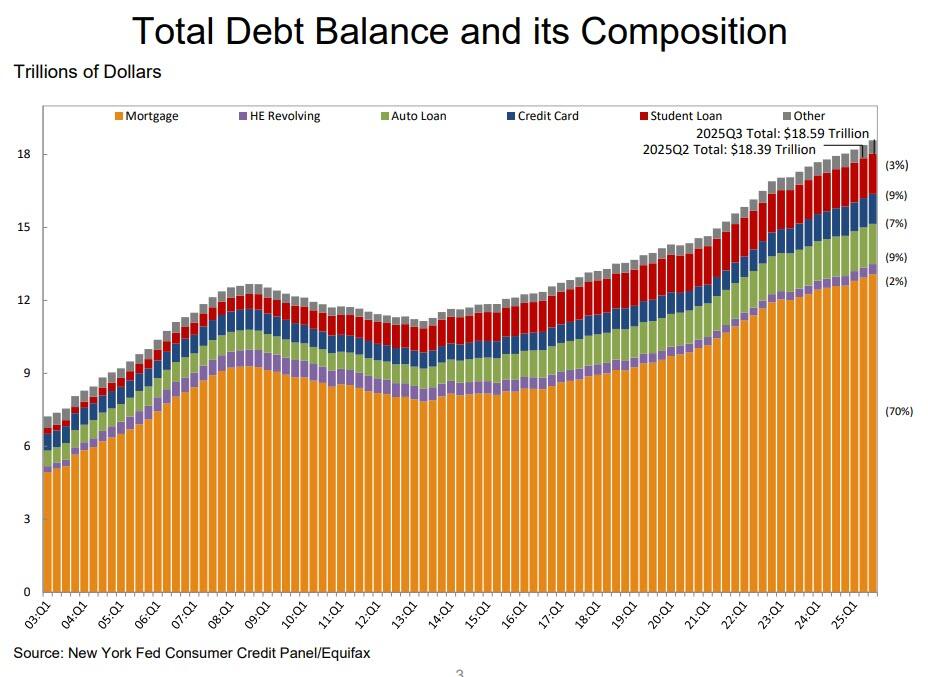
Surprising exactly no-one, the report showed that total household debt increased by $197 billion (1%) in Q3 2025, to a new record high of $18.59 trillion. split between $13.5 trillion in housing debt and $5.1 trillion in non-housing debt.

“Household debt balances are growing at a moderate pace, with delinquency rates stabilizing,” said Donghoon Lee, Economic Research Advisor at the New York Fed. “The relatively low mortgage delinquency rates reflect the housing market’s resilience, driven by ample home equity and tight underwriting standards.” 

Details:

  • Mortgage balances grew by $137 billion in the third quarter and totaled $13.07 trillion at the end of September 2025.
    • Mortgage delinquency rate rose to 0.83% from 0.82% prior quarter
  • Credit card balances rose by $24 billion from the previous quarter and stood at $1.23 trillion.
    • Delinquency rate at 12.41%, highest since 2011
  • Auto loan balances held steady at $1.66 trillion.
  • Home equity line of credit (HELOC) balances rose by $11 billion to $422 billion.
  • Student loan balances rose by $15 billion and stood at $1.65 trillion.

………

Of course, with rising debt, come rising delinquencies, and in the case of student debt, absolutely explosive ones.

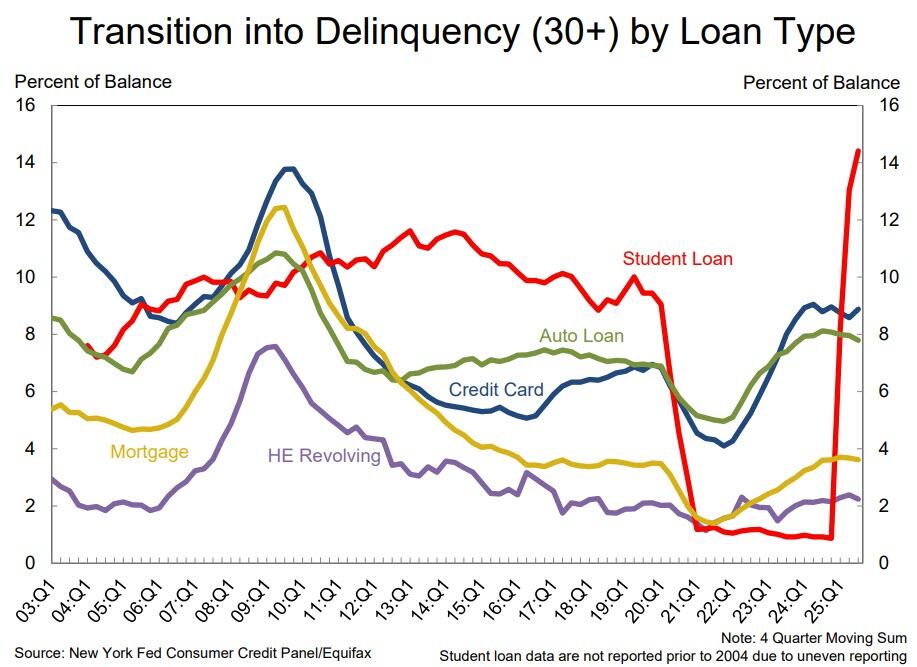
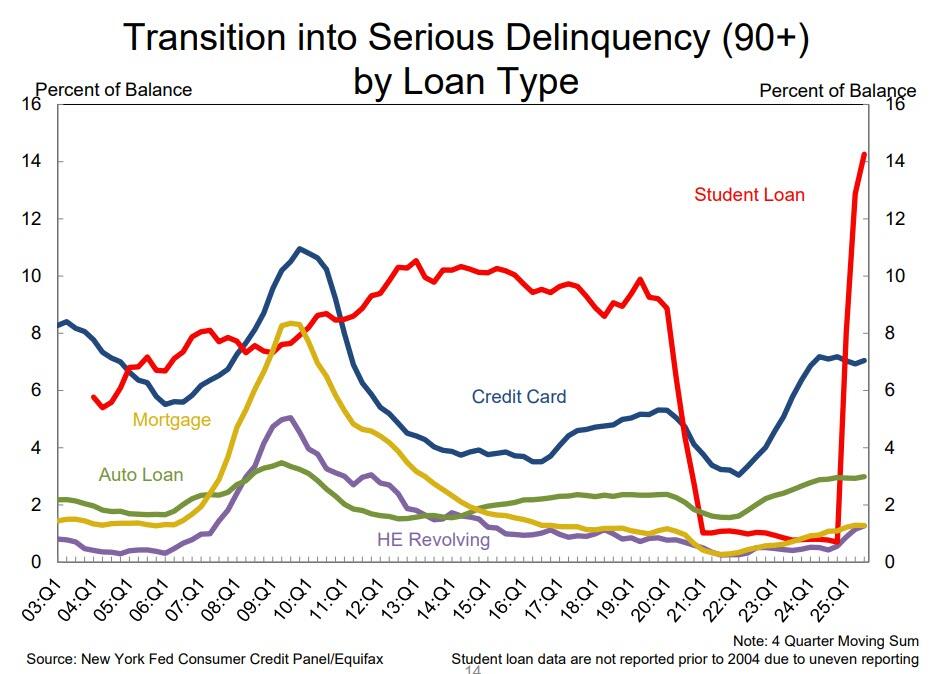
As the NY Fed writes, aggregate delinquency rates remained elevated in Q3 2025, with 4.5% of outstanding debt in some stage of delinquency. Transitions into early delinquency were mixed with credit card debt and student loans increasing, while all other debt types saw decreases.

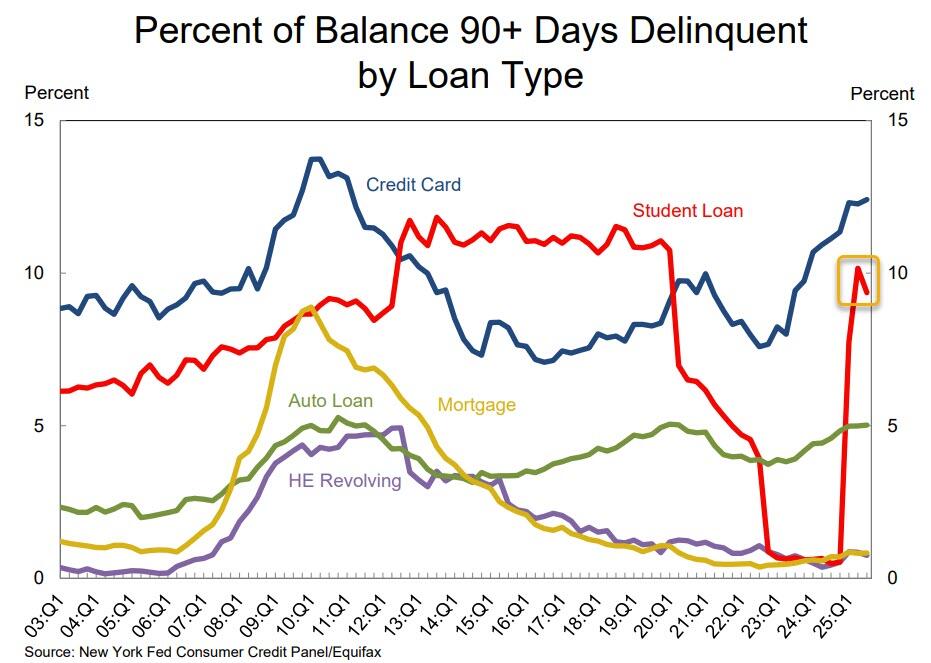
…. and serious delinquency (90+ days) increased across all debt types.

………………….

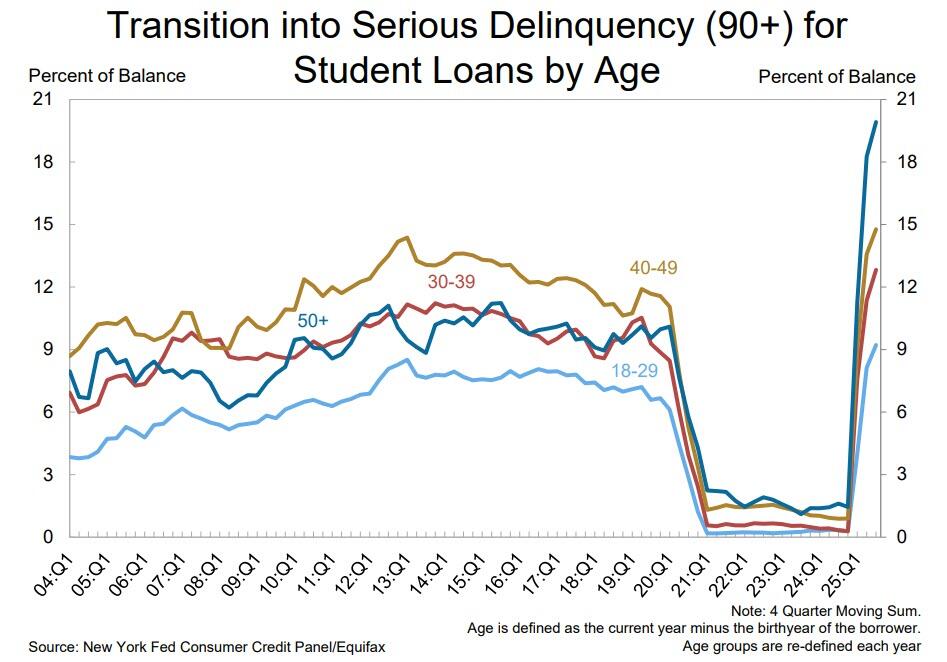
Taking a closer look at the ground zero of the current consumption crisis, namely student Loans, where outstanding debt stood at $1.65 trillion in Q3 2025.  

And the punchline: missed federal student loan payments that were not previously reported to credit bureaus between Q2 2020 and Q4 2024 are now appearing in credit reports. Consequently, student loan delinquency rates have continued to surge after a sharp rise in the first half of 2025. In Q3 2025, 9.4% of aggregate student debt was reported as 90+ days delinquent or in default, as compared to 7.8% in Q1 2025 and 10.2% in Q2 2025. Also of note in the chart below, the credit card serious delinquency rate is actually creeping up even faster, and hit 12.41%, the highest since 2011.

And the most remarkable observation: over 20% of all student debt by those aged 50 and over (!) is effectively in default (technically it is still delinquent, but if millions haven’t made even a token effort to repay it in 90 days, one can safely classify it as in default).

That’s millions of potential consumers whose credit rating is about to get obliterated and who will not have access to credit cards or other debt forms for a long time. 

More in the full New York Fed presentation.

_______________________________________

The Leviticus 25 Plan retargets Fed liquidity flows to grant U.S. citizens the same direct access to liquidity extensions that the Fed and U.S. Treasury so generously provided to very same domestic and foreign financial institutions that precipitated the subprime mortgage debacle and subsequent Great Financial Crisis (2008-2010).

The GFC housing market collapse “wiped out $11 trillion in household wealth.” Over 9 million people lost their jobs, and “at least 10 million people lost their homes due to foreclosure, according to The Los Angeles Times.”

The Leviticus 25 Plan will eliminate trillions of dollars of Household Debt and generate $36.568 trillion federal budget surpluses during each of its first five years of activation (2026-2030).

The Leviticus 25 Plan, in one fell swoop, will effectively resolve the student loan debt crisis in America – while at the same time providing equal financial security benefits to those who paid off their loans and those who chose to bypass college and enter directly into the work force.

The Leviticus 25 Plan is a dynamic economic initiative providing direct liquidity benefits for American families, while at the same time scaling back the role of government in managing and controlling the affairs of citizens.  It is a comprehensive plan with long-term economic and social benefits for citizens and government.

The inspiration for this plan is based upon Biblical principles set forth in the Book of Leviticus, principles tendering direct economic liberties to the people.

The Leviticus 25 Plan – An Economic Acceleration Plan for America

$95,000 per U.S. citizen – Leviticus 25 Plan 2026 (39855 downloads )

America’s Socialism ‘Slayer:’ The Leviticus 25 Plan

“The inherent vice of capitalism is the unequal sharing of blessings;  the inherent virtue of socialism is the equal sharing of misery.”  -Winston Churchill

“Socialism means slavery.”  -Lord Acton

“Democracy and socialism have nothing in common, but one word, equality.  But notice the difference: while democracy seeks equality in liberty, socialism seeks equality in restraint and servitude.”  -Alexis de Tocqueville

…………………………………………..

Why Politicians Win (And Workers Lose) Under Socialism

Authored by Hans-Hermann Hoppe via The Mises Institute,

ZeroHedge, Apr 20, 2017 – Excerpts:

Socialism leads to the politicization of society. Hardly anything can be worse for the production of wealth.

Socialism, at least its Marxist version, says its goal is complete equality. The Marxists observe that once you allow private property in the means of production, you allow differences. If I own resource A, then you do not own it and our relationship toward resource A becomes different and unequal. By abolishing private property in the means of production with one stroke, say the Marxists, everyone becomes co-owner of everything. This reflects everyone’s equal standing as a human being.

The reality is much different. Declaring everyone a co-owner of everything only nominally solves differences in ownership. It does not solve the real underlying problem:  there remain differences in the power to control what is done with resources.

In capitalism, the person who owns a resource can also control what is done with it. In a socialized economy, this isn’t true because there is no longer any owner. Nonetheless the problem of control remains. Who is going to decide what is to be done with what? Under socialism, there is only one way: people settle their disagreements over the control of property by superimposing one will upon another. As long as there are differences, people will settle them through political means.

If people want to improve their income under socialism they have to move toward a more highly valued position in the hierarchy of caretakers. That takes political talent.

Under such a system, people will have to spend less time and effort developing their productive skills and more time and effort improving their political talents.

As people shift out of their roles as producers and users of resources, we find that their personalities change. They no longer cultivate the ability to anticipate situations of scarcity to take up productive opportunities, to be aware of technological possibilities, to anticipate changes in consumer demand, and to develop strategies of marketing. They no longer have to be able to initiate, to work, and to respond to the needs of others.

Instead, people develop the ability to assemble public support for their own position and opinion through means of persuasion, demagoguery, and intrigue, through promises, bribes, and threats. Different people rise to the top under socialism than under capitalism. The higher on the socialist hierarchy you look, the more you will find people who are too incompetent to do the job they are supposed to do. It is no hindrance in a caretaker politician’s career to be dumb, indolent, inefficient, and uncaring. He only needs superior political skills. This too contributes to the impoverishment of society.

The United States is not fully socialized, but already we see the disastrous effects of a politicized society as our own politicians continue to encroach on the rights of private property owners. All the impoverishing effects of socialism are with us in the U.S.: reduced levels of investment and saving, the misallocation of resources, the over-utilization and vandalization of factors of production, and the inferior quality of products and services. And these are only tastes of life under total socialism.

_____________________________________

The Leviticus 25 Plan

There is currently one, and only one, comprehensive economic acceleration plan in America that re-targets liquidity flows away from government agencies and corporate middlemen directly to U.S. citizens – to revitalize self-reliance in America and reverse the ‘impoverishing effects of socialism.’

The Leviticus 25 Plan is a dynamic economic initiative providing direct liquidity benefits for American families, while at the same time scaling back the role of government in managing and controlling the affairs of citizens.  It is a comprehensive plan with long-term economic and social benefits for citizens and government.

The inspiration for this plan is based upon Biblical principles set forth in the Book of Leviticus, principles tendering direct economic liberties to the people.

The Leviticus 25 Plan – An Economic Acceleration Plan for America

$95,000 per U.S. citizen – Leviticus 25 Plan 2026 (44906 downloads )