
The Leviticus 25 Plan Generates $37.303 Billion Federal Budget Surpluses Annually (2027-2031). Part 3: Medicaid, Medicare, VA, TRICARE, FEHB, SSDI Recapture

The Leviticus 25 Plan 2027 – the most powerful economic acceleration plan in the world: Updated economic scoring summary.

Medicaid/CHIP Recapture
Each U.S. citizen participating in The Plan will receive a $35,000 deposit, funded through a Federal Reserve / U.S. Treasury Department-based Citizens Credit Facility, into a personal Medical Savings Account (MSA).

The Leviticus 25 Plan assumes 80% participation by Medicaid / CHIP enrollees.
Within this comprehensive economic plan, The U.S. Health Care Freedom Plan provides
Medical Savings Account (MSA) funding of $35,000 to cover the $7,000 deductible for Medicaid and CHIP eligible primary care events and select out-patient care services – primarily related to routine medical appointments, Medicaid prescription events, disease state monitoring clinics, and other desired primary care services.

September 2025 Medicaid & CHIP Enrollment – 77.05 million individuals were enrolled in Medicaid and CHIP in the 50 states and the District of Columbia that reported enrollment data for September 2025. 69,797,328 people were enrolled in Medicaid; 7,252,967 enrolled in CHIP.

Using a conservative estimate of 77.0 million for 2025, with a projected annual growth rate of 2%:
2025: 77.00 million
2026: 78.54 million
2027: 80.11 million
2028: 81.71 million
2029: 83.34 million
2030: 85.10 million
2031: 86.80 million

Total: 417.06 million receiving benefits 2027-2031

Average annual enrollment (2027-2031): 83.41 million
83.41 million X .8 = 66.728 million X $7,000/year X 5 years = $2.335 trillion

Total Medicaid/CHIP recapture during the 5-year target period (2027-2031): $2.335 trillion

Source(s): https://www.medicaid.gov/medicaid/program-information/medicaid-and-chip-enrollment-data/report-highlights/index.html

https://www.healthcarefinancenews.com/news/medicaid-enrollment-higher-pandemic-kff-finds
https://www.kff.org/medicaid/state-indicator/federalstate-share-of-spending/?currentTimeframe=0&sortModel=%7B%22colId%22:%22Location%22,%22sort%22:%22asc%22%7D

Note 1: The potential savings of $2.002 trillion does not take into account the additional savings to state and local government outlays, which range from 17% to 39% of total Medicaid-CHIP spending.
Source: https://www.kff.org/medicaid/state-indicator/federalstate-share-of-spending/?currentTimeframe=0&sortModel=%7B%22colId%22:%22Location%22,%22sort%22:%22asc%22%7D
Note 2: The potential savings of $2.002 trillion does not take into account the certainty of additional savings from individuals no longer being eligible for Medicaid-CHIP, due to their improving financial status.

_____________________________________

Medicare Recapture
Each U.S. citizen participating in The Plan will receive a $35,000 deposit, funded through a Federal Reserve / U.S Treasury Department-based Citizens Credit Facility, into a personal Medical Savings Account (MSA).

The Leviticus 25 Plan assumes 80% participation by Medicare enrollees.
Within this comprehensive economic plan, The U.S. Health Care Freedom Plan provides
Medical Savings Account (MSA) funding of $35,000 to cover a $7,000 annual deductible for Medicare-eligible primary care events and select out-patient services – primarily related to routine medical appointments, Medicare Part D prescription events, disease state monitoring clinics, and other desired primary care services.

There were 69.6 million people were enrolled in Medicare as of October 2025.

Projection: “Medicare spending grew 7.8% to $1,118.0 billion in 2024, or 21 percent of total National Health Expenditures.”

“Over 2024-33 average NHE growth (5.8 percent) is projected to outpace that of average Gross Domestic Product (GDP) growth (4.3 percent), resulting in an increase in the health spending share of GDP from 17.6 percent in 2023 to 20.3 percent in 2033.”

“Medicare enrollment is projected to grow steadily, with total beneficiaries rising to an estimated 78-79 million by 2030-2031.”

Applying a conservative projected enrollment growth rate of 2.5% annually through 2031, with an 80% participation rate, and a $7,000 annual deductible for the 5-year target period (2027-2031):
2025: 69.60 million X .8 X $6,000 = $334,080,000
2026: 71.34 million X .8 X $6,000 = $342,432,000
2027: 73.12 million X .8 X $7,000 = $409,472,000
2028: 74.95 million X .8 X $7,000 = $419,720,000
2029: 76.82 million X .8 X $7,000 = $430,192,000
2030: 78.74 million X .8 X $7.000 = $440,994,000
2031: 80.70 million X .8 X $7,000 = $451,920,000

Total Medicare recapture during the 5-year target period (2027-2031): $2.152 trillion

Detailed enrollment data can be viewed here: https://data.cms.gov/summary-statistics-on-beneficiary-enrollment/medicare-and-medicaid-reports/medicare-monthly-enrollment.

Source(s): https://www.cms.gov/data-research/statistics-trends-and-reports/national-health-expenditure-data/nhe-fact-sheet
https://data.cms.gov/summary-statistics-on-beneficiary-enrollment/medicare-and-medicaid-reports/medicare-monthly-enrollment / https://www.cms.gov/newsroom/press-releases/cms-office-actuary-releases-2021-2030-projections-national-health-expenditures

_____________________________________

VA Healthcare
The Leviticus 25 Plan assumes 80% participation by Veterans Administration healthcare enrollees. Within this comprehensive structure, The U.S. Health Care Freedom Plan provides Medical Savings Account (MSA) funding of $35,000, through a Federal Reserve / U.S. Treasury-based Citizens Credit Facility, to cover annual $7,000 deductibles for VA primary healthcare services over the course of the 5-year target period (2027-2031).

FY 2025 – 9.2 million enrollees in the VA health care system.
The plan assumes a stable 9.2 million enrollment in the VA Health Care System.

2027: 9.2 X 0.8 X $7,000 = $51,520,000,000
2028: 9.2 X 0.8 X $7,000 = $51,520,000,000
2029: 9.2 X 0.8 X $7,000 = $51,520,000,000
2030: 9.2 X 0.8 X $7,000 = $51,520,000,000
2031: 9.2 X 0.8 X $7,000 = $51,520,000,000

Total recapture: $257,600,000,000

Average annual recapture (2027-2031): $51.52 billion

Total recapture 2027-2031: $257.6 billion

Sources: https://department.va.gov/administrations-and-offices/management/archived-plans-and-reports/ https://www.va.gov/health/aboutvha.asp
Note: Budget Request (FY 2026) of $441.3 billion represents a 10% increase over the total VA budget for FY 2025.

_______________________________________

TRICARE
The Leviticus 25 Plan assumes 80% participation by qualified TRICARE enrollees.

Through The U.S. Health Care Freedom Plan component, participating members will receive a Medical Savings Account (MSA) funding injection of $35,000, through a Federal Reserve / U.S. Treasury Department-based Citizens Credit Facility, to cover annual $7,000 deductibles for desired primary care and out-patient services over the course of the 5-year target period (2027-2031).

There are currently ~9.4 million U.S. citizen beneficiaries in various locations around the world.
Recapture – total (2027-2031): 9.4 million X 0.8 X $7,000 X 5 years: $263.2 billion

Source: https://dha.mil/About-DHA/TRICARE-Numbers
Note: Outpatient visits: 87.9 million; Prescriptions filled: 101.7 million

_____________________________________

Federal Employee Health Benefits (FEHB)
The Leviticus 25 Plan assumes 80% participation by FEHB enrollees.
Participating members will receive a Medical Savings Account (MSA) funding injection of $35,000, through a Federal Reserve / U.S. Treasury Department-based Citizens Credit Facility, to cover annual $7,000 deductibles for desired primary care and out-patient services over the course of the 5-year target period (2027-2031).

FEHB Program carriers cover most active, full-time civilian employees and retirees of the U.S. government and their families. The Program now provides benefits to over 8.2 million federal enrollees and dependents and offers over 180 health plan choices to federal members.

Note – the Federal government also pays approximately 72% of premium costs per enrollee.
Recapture – total (2027-2031): 8.3 million X 0.8 X $7,000 X 5 = $229.6 billion

Source: https://www.opm.gov/news/secrets-of-opm/open-season/

_______________________________________

Social Security Disability Income (SSDI)
The Leviticus 25 Plan specifies that qualifying participants will not be eligible for SSDI benefits. The Plan assumes 80% participation by SSDI recipients.

December 2025 – total beneficiaries: 8.163 million recipients;
Total monthly SSDI benefit payments: $12.182 billion;
Total annual SSDI benefit payments: $146.184 billion.

This projection assumes a conservative 3% growth per year for 2027-2031, covering both enrollment growth and COLA:
2025: $146.184 billion
2026: $150.570 billion
2027: $155.087 billion
2028: $159.740 billion
2029: $164.532 billion
2030: $169.468 billion
2031: $174.552 billion

Total: $823.379 billion / Average per year: $164.676 billion

Total for 5-year target period 2027-2031:
Plan assumes 80% participation – recapture: $823.379 billion X 0.8 = $658.70 billion

Source(s): Social Security Benefits Dec 2025 – Disability Insurance
https://www.ssa.gov/policy/docs/quickfacts/stat_snapshot/
https://www.cbpp.org/research/social-security/social-security-disability-insurance-0

“SSDI benefits are financed primarily by part of the Social Security payroll tax..”

“Social Security’s trustees project that the share of people in the United States receiving SSDI will rise somewhat over the next 20 years and then remain stable.”

Note: The 3% growth projection, covering both the enrollment increase and annual COLA, is likely a conservative estimation for the period 2027-2031.

__________________________________________________

The Leviticus 25 Plan Generates $37.303 Billion Federal Budget Surpluses Annually (2027-2031). Part 2: Federal Income Tax Recapture; Economic Security / Means-Tested Welfare Recapture.

The Leviticus 25 Plan – the most powerful economic acceleration plan in the world: Updated economic scoring summary.

Federal Income Tax Recapture
This scoring model assumes that 80% of qualified U.S. citizens will voluntarily participate in The Leviticus 25 Plan. Participants must give up their tax refunds through the Plan’s recapture provisions for the 5-year target period (2027-2031).

According to 2025 IRS Filing season statistics, through Dec 28, 2025: 103,846,000 total refunds were paid out, totaling $328.878 billion.

Refund totals have increased by approximately $25.117 billion over the past eight years, from $303.761 billion (2018) to a current (estimated) $328.878 billion (2025), representing an average increase of $3.14 billion per year.

A conservative estimated average of $3.1 billion per year (2027-2031) will be used for this recapture calculation.
2024: $329.1 billion (actual)
2025: $328.9 billion (actual)
2026: $332.0 billion
2027: $335.1 billion
2028: $338.2 billion
2029: $341.3 billion
2030: $344.4 billion
2031: $347.5 billion

Total: $1.707 trillion

Total recapture X 80%: $1.707 trillion X .8 = $1.366 trillion

Total recapture per annum (2027-2031): $1.366 trillion / 5 = $273.2 billion

Source(s): https://www.irs.gov/newsroom/filing-season-statistics-by-year

._____________________________________
Means-tested welfare / Economic Security Programs – Recapture

Participants in the Plan will forego Economic Security Program benefits and select means-tested welfare benefits for the period 2027-2031.

Economic security programs: Outlays were about 10 percent (or $701.6 billion) of the federal budget in 2025, in funding [safety net] programs that provide aid (other than health insurance or Social Security benefits) to individuals and families facing hardship. Economic security programs include: the refundable portions of the Earned Income Tax Credit and Child Tax Credit, which assist low- and moderate-income working families; programs that provide cash payments to eligible individuals or households, including unemployment insurance and Supplemental Security Income for low-income people who are elderly or disabled; various forms of in-kind assistance for low-income people, including the Supplemental Nutrition Assistance Program (formerly known as food stamps), school meals, low-income housing assistance, child care assistance, and help meeting home energy bills; and other programs such as those that aid abused or neglected children.1

Economic Security outlays were $701.6 billion in fiscal year 2025, an increase of 4.5 percent or $30.5 billion above the prior fiscal year.
Source: https://www.cbpp.org/research/federal-budget/where-do-our-federal-tax-dollars-go

Assuming 80% participation and a modest 3.5% growth / year:

2025: $701.600 billion
2026: $701.600 billion + $24.556 billion = $726.156 billion
2027: $726.156 billion + $25.415 billion = $751.571 billion
2028: $751.571 billion + $26.305 billion = $777.876 billion
2029: $777.876 billion + $27.226 billion = $805.102 billion
2030: $805.102 billion + $28.178 billion = $833.280 billion
2031: $833.280 billion + $29.165 billion = $862.445 billion

Total projected federal means-tested welfare outlays 2027-2031 = $4.030 trillion
Assuming 80% participation: $4.030 trillion x .8 = $3.224 trillion

Total Means-tested Welfare recapture during the 5-year target period (2027-2031): $3.224 trillion

Source(s):
https://www.fiscal.treasury.gov/files/reports-statements/combined-statement/cs2025/outlay.pdf
https://fiscaldata.treasury.gov/americas-finance-guide/federal-spending/ FY2025 – $7.01 trillion
https://www.cbpp.org/research/federal-budget/where-do-our-federal-tax-dollars-go
https://www.ssa.gov/policy/docs/statcomps/ssi_monthly/2024-11/table01.html
https://turbotax.intuit.com/tax-tips/general/how-are-federal-taxes-spent/L6kinGuUt : “Safety net programs, including unemployment insurance, food stamps, and low-income housing assistance, make up about 11% of your FY2024 federal budget [$742.5 billion].”

The Leviticus 25 Plan 2027 Generates $37.303 Billion Federal Budget Surpluses Annually (2027-2031). Part 1: Overview, Deficit Projections (CBO)

The Leviticus 25 Plan will generate annual budget surpluses of $37.303 billion during each of the first five years of activation (2027-2031), versus the CBO-projected $1.982 trillion average annual deficits, representing a positive budget gain of $2.019 trillion annually for the period.

Budget surpluses would be negotiable for partial transfer back to the Federal Reserve to effect ongoing reductions of the Citizens Credit Facility balance sheet. More importantly, $37.303 billion annual budget surpluses would provide a dynamic counterbalance to the inevitable demands on the Fed to purchase T-Bills and T-Bonds in support of Treasury Auctions throughout 2027-2031.

Overview, Primary Assumptions, Economic Scoring

The Leviticus 25 Plan activation period is slated for the 5-year period beginning in 2027 and ending in 2031.

  1. The Leviticus 25 Plan – Each participating U.S. citizen will receive a $60,000 deposit into a Family Account (FA) and a $35,000 deposit into a Medical Savings Account (MSA).

All U.S. citizens residing in the United States are eligible to participate, contingent upon meeting qualification standards and agreement to specified recapture provisions.
Participants (other than ‘custody account’ applicants) must prove stable credit history, stable job history, no recent drug/felony convictions.

These general recapture provisions include:

  • Waiving all federal income tax refunds for a period of 5 years.
  • Waiving benefits from economic security programs, select benefits from means-tested welfare programs, SSI, and SSDI for a period of 5 years.
  • Enrollees in the Medicare, VA Healthcare system, Federal Employees Health Benefits
    (FEHB), and TRICARE will be subject to a $7,000 deductible for primary care and outpatient
    services annually for a period of 5 years. (See full plan for more details)

Primary scoring assumptions:

The Plan assumes an 80% participation rate by U.S. citizens. Wealthier Americans would choose not to participate, due to the comparative benefit of income tax refund amounts. Many individuals of lower socio-economic sector would also choose not to participate, due to the comparatively high benefits profiles that they would not wish to give up.

The Plan assumes that participating families would use significant funds to pay down / eliminate debt, and that these longer-term, lower debt service obligations would enhance the financial security of participating families for several decades beyond the opening activation period. Federal, state, and local government entities would benefit from longer-term tax revenue growth and reduced citizen dependence on government-based entitlement program benefits.

The Plan assumes that dynamic new efficiencies would emerge in the healthcare system – with more families managing/directing healthcare expenditures through their MSAs.

The Plan assumes that apart from the recapture provisions, there would also be significant tax revenue growth for federal, state and local government entities from free-market economic revitalization, more people working and paying taxes, and from the elimination of various income tax deductions (e.g. mortgage / HELOC interest expense).

The Plan assumes that there would not be a massive full-scale move back into the means-tested welfare programs, income security programs, SSI, and SSDI at the end of the initial 5-year activation period.

The benefits of a free-market economy and newfound economic liberty for American families would provide positive economic inertia throughout years 5-10, and for several decades beyond.

Recapture provisions would provide substantial federal budget surpluses for each year of the initial 5-year period. Economic growth over the following 10-15 years would generate sufficient recapture funding and tax revenue growth to offset the entire initial Federal Reserve balance sheet expansion.

Significant inertia from The Plan would also provide on-going, market-based growth benefits over succeeding years that far exceed any prospect for healthy economic growth that may be expected under America’s current big-government, central-planning approach.

Dynamic economic benefits would flow from:

  • Family level massive debt elimination, financial security gains.
  • Timely, sweeping reversal of big government “central planning” control.
  • Productivity gains from reversal of work disincentives currently embedded in social programs.
  • Economic growth, improved productivity, job creation, free market dynamics.
  • Stabilization of bank capitalization, housing market.
  • Strengthen / stabilize long-term value of U.S. Dollar.
  • Minimizing the role of government in managing, directing, controlling the affairs of citizens.
  1. Federal Budget Deficit Projections – Congressional Budget Office
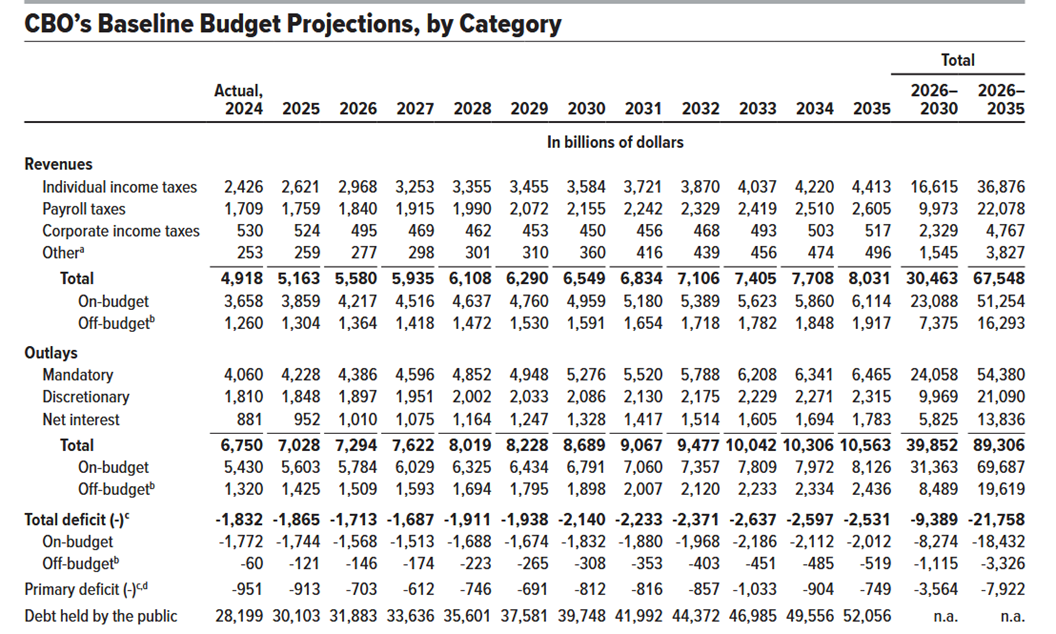
    The Budget and Economic Outlook: 2025-2035 projects budget deficits ranging from $1.713 trillion 2026 to $2.140 trillion in 2030, and on up to $2.531 trillion by 2035. Actual deficits for the out years are likely to be higher than CBO projections, based upon history (“actual” versus “projected”).

Congressional Budget Office (CBO) Deficit Projections 2025-2035

CBO deficit projections for target period (2027-2031)
2024: $1.832 trillion (actual) vs $1.915 trillion (projected)
2025: $1.865 trillion
2026: $1.713 trillion
2027: $1.687 trillion
2028: $1.911 trillion
2029: $1.938 trillion
2030: $2.140 trillion
2031: $2.233 trillion

Total deficits projected 2027-2031: $9.909 trillion
Average annual budget deficits 2027-2031: $1.982 trillion

Source: CBO 10-Year Budget Projections (2025-2035): https://www.cbo.gov/system/files/2025-01/60870-Outlook-2025.pdf