Eyeball deep in the global debt ‘slop hole, Part 2: Corporate debt

Record debt levels are choking corporations in America.

…………………………………………..

Corporate Debt To EBITDA Hits All Time High

“When using the aggregated data, both gross and net corporate debt/EBITDA are at or near record leverage levels, well above prior cycle peaks.” – Morgan Stanley  Apr 21, 2017

__________________________

America is drowning in debt.  We need re-targeted liquidity, and here is the solution:

The Leviticus 25 Plan 2018 –  $75,000 per U.S. citizen

The Leviticus 25 Plan 2018 (2279)


Eyeball deep in the global debt ‘slop hole,’ Part 3: Total Non-financial Debt

Debt is surging in the U.S.

…………………………………………………..

Hoisington Quarterly Review and Outlook, Q1 2017

By Lacy Hunt and Van Hoisington

Excerpts:

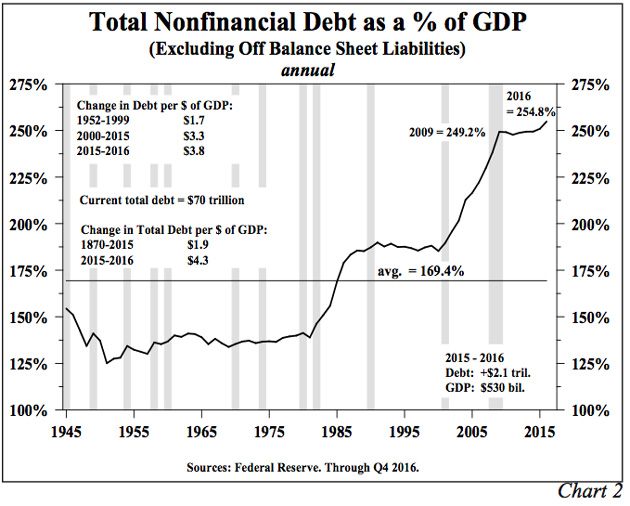
Debt. Total domestic nonfinancial debt, excluding off balance sheet liabilities such as leases and unfunded pension liabilities, surged to a record 254.8% of GDP in 2016, 5.6% greater than in 2009 when Lehman Brothers failed (Chart 2). Total debt, which includes domestic nonfinancial, foreign and bank debt, amounted to 372.5% of GDP in 2016, compared with 251.9% of GDP in 2006, the final year of previous tightening cycle, which, in turn, was greater than in any earlier time from 1870 through 2006.

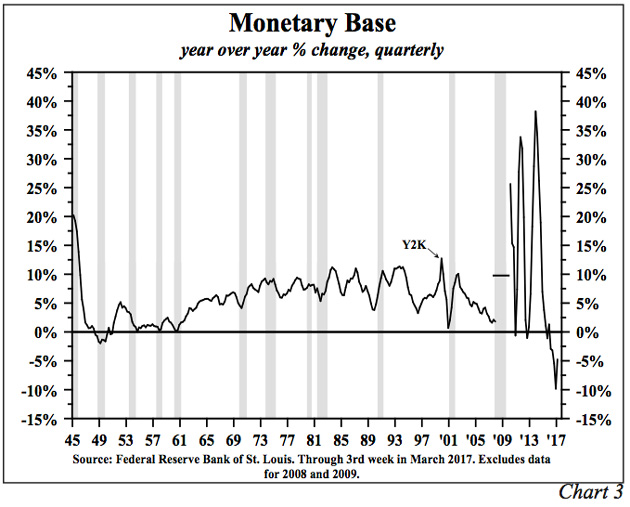
First, in the initial quarter of 2017, the year-over-year change in the monetary base was -4.8%. This comes after sharp contractions in each of the previous four quarters, the largest such decreases since the end of World War II (Chart 3). Some argue that this unprecedented weakness in the monetary base is not relevant since the depository institutions still hold $2.1 trillion of excess reserves (defined as the difference between total reserves and required reserves). The textbook writers emphasize that excess reserves are the key to money and credit expansion. But, the multiple expansion of bank reserves so diligently explained in the textbooks was written for a regulatory environment that no longer exists, which is the second different condition.

______________________________

America is drowning in debt.

There is one dynamic solution:  Grant U.S. citizens the same access to liquidity that was provided to Wall Street’s financial sector during 2008-2010 – to help them unwind their debt profiles and return to ‘financial stability.’

It is time to unwind debt at ground level – and pump up America’s Monetary Base.

It is time to restore economic liberty for American families and set them on course for long-term ‘financial health.’

The Leviticus 25 Plan 2018 –  $75,000 per U.S. citizen

The Leviticus 25 Plan 2018 (2276)

U.S. Fed paying $22 billion annually Interest on Excess Reserves (IOER) to world’s largest banks. The big winners: foreign banks.

The Fed is giving ‘free money’ to the world’s largest banks, and the big winners, according to the Wall Street Journal, are foreign banks.  The latest report: $22 billion annually.

………………………………………….

   (FROM THE WALL STREET JOURNAL 12/24/15) 
   By Katy Burne 

Some of the biggest beneficiaries of the Federal Reserve’s recent interest-rate increase will be foreign banks.

Units of foreign banks this year [2015] received nearly half the roughly $6.25 billion in interest the Fed paid banks on the money, called reserves, they park with the Fed, the central bank’s data show. Those institutions control just about 15% of all bank assets in the U.S.

The Fed’s interest payments to banks are likely to roughly double next year because in mid-December it raised the rate it pays on reserves to 0.50% from 0.25%. The amounts could rise even more in coming years if the central bank continues lifting the rate, called the interest on excess reserves rate, or IOER.

Foreign banks receive a disproportionate share of the interest payments because they own an outsize share of total reserves.

[snip]

U.S.-chartered banks, including those owned by foreign banking companies, pay premiums to the Federal Deposit Insurance Corp. — ranging from 0.05% to 0.35% — based on their assets, including reserves but minus other capital measures. But U.S. lenders that don’t take deposits, and firms incorporated overseas whose U.S. operations don’t take deposits, don’t have to pay FDIC fees.

Both foreign and domestic banks can borrow money overnight at low short-term rates and park them at the Fed at a higher rate, earning a profit or “spread.” But for some foreign firms, the spread can be larger because they often don’t have to pay the FDIC fees.

To illustrate: Before the Fed’s rate increase, banks paid about 0.13% to borrow overnight in the federal-funds market and earned 0.25% on their reserves — a difference of 0.12 percentage point. A foreign bank could get a spread of 0.12%. Domestic banks that paid FDIC fees of about 0.07% on average on their insured deposits would be left with a spread of about 0.05%.

After the rate increase, both types of banks could pay about 0.35% to borrow overnight and get 0.50% on their reserves. That is a 0.15% spread for some foreign banks. But domestic banks, after paying the FDIC fees, get a roughly 0.08% spread.

The New York branches of Deutsche Bank AG and Credit Suisse Group AG each had about $40 billion in reserves at the Fed as of June 30, earning about $100 million in interest.

[snip]

Raising the IOER rate to 0.50% from 0.25% will increase the Fed’s interest payments to banks to about $13 billion annually, assuming reserves stay at the same level, said Karen Petrou of Federal Financial Analytics Inc.

The Fed is subsidizing both U.S. and foreign banks, said Joseph Gagnon, a former Fed economist now at the Peterson Institute for International Economics, and the latter have a proportionately larger advantage. “I’m surprised it hasn’t gotten more attention,” Mr. Gagnon said.

[snip]

The Fed started paying interest on reserves in 2008. It plans to use the IOER rate as its primary lever for controlling short-term rates, in part because its postcrisis stimulus policies left markets awash in money, rendering its old tools less effective.

Still, some Fed officials have expressed concern about how it looks to have the central bank making big interest payments to banks.

James Bullard, president of the Federal Reserve Bank of St. Louis, said in an August radio interview that if Congress isn’t comfortable with the size of payments to banks, in particular foreign ones, “They should definitely tell us right now, because . . . we would need to change our exit strategy dramatically if we cannot rely on the interest on excess reserves as being a tool of monetary policy.”

_________________________

So the U.S. Federal Reserve is doling out billions of dollars annually in free money handouts to the world’s largest banks, the very banks whose leveraged speculation strategies precipitated the great financial crisis.  The very banks that foreclosed on millions of American home owners.  The very banks that engaged in blatantly criminal FX and LIBOR rate manipulation, mortgage fraud and predatory lending.

And meanwhile, U.S. citizens are scraping along, neck deep in debt, stalled out with stagnant real median household income growth, lathered up in suffocating social welfarism…?

And Congress is sitting their heads up their ‘rear ends’… and no plan whatsoever to change anything related to the economic mess we are sitting in.

You have got to be kidding me..(!)

It is time for U.S. citizens to be granted the same access to liquidity that the Fed has provided, through various funding facilities, to Wall Street’s financial sector and continues to provide via IOER payments.

The Leviticus 25 Plan 2018 –  $75,000 per U.S. citizen

The Leviticus 25 Plan 2018 (2260)


ObamaCare replacement bill fails. Solution: The U.S. Health Care Freedom Plan.

The ObamaCare replacement plan sailed into some stiff headwinds in the U.S. House on Friday over a number of significant concerns:

1. 14 million Americans would lose insurance by 2018, rising up to 24 million losing coverage by 2026.

2. The new ObamaCare replacement plan remained ‘mandate-heavy.’

3. It was too costly and inefficient, with the already high ObamaCare premiums spiking another 15-20% in 2018-19.

Meet the comprehensive health care plan that overcomes these objections: The U.S. Health Care Freedom Plan.

Number of Americans that will lose coverage: 0

If you like your ObamaCare you can keep your ObamaCare.  All others who wish to be granted an exemption, along with a $25,000 HSA deposit per citizen (see plan for further details).

Mandates: 0

Citizens may choose their providers and insurance plans, and allocate their health care resources in the manner that suite fulfills their needs and desires.

Efficiency: 99%

The U.S. Health Care Freedom Plan eliminates government red tape and enormous amounts of ‘middle-man’ cost and interference.

The U.S. Health Care Freedom Plan 2017: America’s clean and affordable alternative to ObamaCare. Ready to Launch.

A part of America’s dynamic, comprehensive economic acceleration plan:

The Leviticus 25 Plan 2018 –  $75,000 per U.S. citizen

The Leviticus 25 Plan 2018 (2192)

GOP Healthcare Plan – pulled… Enter the GOP’s bold, outside-the-box plan: The U.S. Health Care Freedom Plan

The GOP’s new Patient Care Act is a big step in the right direction as an ObamaCare replacement strategy, but it is hitting some choppy water...

………………………………………………

“It’s A Train Wreck”: Conservative Groups Savage GOP Healthcare Plan

As discussed earlier, the Obamacare repeal and replace effort, derisively called by some either “Obamacare Lite”, “RyanCare”, “ObamaCare 2.0″,  and even Trumpcare”. is running into major hurdles as prominent conservative groups threaten to derail Trump’s broader economic agenda.  ZeroHedge – Mar 7, 2017

________________________

There is a very simple answer to all of this –

Dear Republican Party: 

Be bold. Think outside the box.

What American families need is a powerful, new replacement strategy for ObamaCare that is citizen-centered, putting people back in charge and allocating resources themselves for their week to week health care needs.

And here it is:

America’s dynamic new health care strategy:

The U.S. Health Care Freedom Plan 2017: America’s clean and affordable alternative to ObamaCare. Ready to launch.

The U.S. Health Care Freedom Plan is the only comprehensive, citizen-centered health care plan in America.  It ‘resets’ the health care industry to present a clean, efficient and responsible system.  Most importantly, this plan restores individual freedom and liberty for all participating Americans.

The Plan:

  1. The U.S. Health Care Freedom Plan is available to each and every U.S. citizen – with no coverage mandates. Each U.S. citizen who wishes to participate will be granted a full and complete exemption from the ACA.
  2. This plan offers freedom of choice and equal justice for all. Those Americans who might wish to stay with the ACA may stay (‘If you like your ObamaCare, you can keep your ObamaCare’).
  3. Each participating U.S. citizen shall receive a credit extension, through a special Federal Reserve Citizens Credit Facility, of $25,000, electronically deposited into a Medical Savings Account (MSA) – for direct allocation toward family health care needs.
  4. Private insurance – Families shall be allowed to enroll in high-deductible ($10,000 – $15,000) major medical plans, to include basic, ‘no frills’ medical plans which best suit their individual needs and desires. These streamlined plans would lower premium costs for employees and employers, encouraging employers to cost-share savings with employees through incentive-based employer MSA contributions.
  5. Policies would not be automatically loaded with expensive government healthcare mandates.
  6. Those with extraordinary medical issues may be included in a high-risk category, with such plans being eligible for a government subsidy (similar to current Medicare Advantage).
  7. Federal / state programs – Individuals enrolled in Medicare / Medicaid / VA / TRICARE / FEHB programs would maintain their covered status, with an annual deductible of $5,000 per year per enrolled family member, for a period of five years for those benefits. The dedicated MSA funds would fully fund the offset for the higher ($5,000) deductible feature for that five-year period. MSA funds could also be used to pay Medicare supplement premiums and other potential co-pay obligations.
  8. Where health care services paid by patients directly with MSA funds, providers would not be bound by federal / state rules pertaining to Electronic Medical Records (EMRs), and other unnecessary administrative burdens.

ContinueThe U.S. Health Care Freedom Plan 2017: America’s clean and affordable alternative to ObamaCare. Ready to launch.

The Leviticus 25 Plan 2018 –  $75,000 per U.S.

The Leviticus 25 Plan 2018 (2131)


U.S Treasury OFR: “U.S. global systemically important banks (G-SIBs) have more than $2 trillion in total exposures to Europe”

Round 2.  Wall Street Banks and Insurers are overexposed in the arena of risky debt holdings, with hedging strategies that involve meaningful counter-party vulnerabilities.

………………………………………………………………..

U..S Quietly Drops Bombshell: Wall Street Banks Have $2 Trillion European Exposure

Wall Street on Parade / By Pam Martens and Russ Martens: January 3, 2017  
Excerpts:

According to a report quietly released by the U.S. Treasury’s Office of Financial Research less than two weeks before Christmas, another financial implosion on Wall Street can’t be ruled out.

The Office of Financial Research (OFR)….. Its 2016 Financial Stability Report, released on December 13, indicates that Wall Street banks have been allowed by their “regulators” to take on unfathomable risks and that dark corners remain in the U.S. financial system that are impenetrable to even this Federal agency that has been tasked with peering into them.

At a time when international business headlines are filled with reports of a massive banking bailout in Italy and the potential for systemic risks from Germany’s struggling giant, Deutsche Bank, the OFR report delivers this chilling statement:

“U.S. global systemically important banks (G-SIBs) have more than $2 trillion in total exposures to Europe. Roughly half of those exposures are off-balance-sheet…U.S. G-SIBs have sold more than $800 billion notional in credit derivatives referencing entities domiciled in the EU.”

When a Wall Street bank buys a credit derivative, it is buying protection against a default on its debts by the referenced entity like a European bank or European corporation. But when a Wall Street bank sells credit derivative protection, it is on the hook for the losses if the referenced entity defaults. Regulators will not release to the public the specifics on which Wall Street banks are selling protection on which European banks but just the idea that regulators would allow this buildup of systemic risk in banks holding trillions of dollars in insured deposits after the cataclysmic results of similar hubris in 2008 shows just how little has been accomplished in terms of meaningful U.S. financial reform.

Adding to the potential for another epic crash on Wall Street taking down the entire U.S. economy is data within the OFR report showing how interconnected the big Wall Street banks have become to the largest U.S. insurers through derivatives. This has been allowed to happen despite the fact that the giant insurer, AIG, required a government backstop of $182 billion following the 2008 crash because it had sold credit default protection via derivatives to the big Wall Street banks.

The OFR report includes the following data on life insurers:

“At the end of 2015, U.S. life insurers’ derivatives exposure, as reported in statutory filings, totaled $2 trillion in notional value. This $2 trillion does not include derivative contracts held in affiliated reinsurers, non-insurance affiliates, and parent companies that do not have to file statutory statements. Details on these entities’ derivatives positions are not publicly available.”

Just who is backstopping this $2 trillion in risk? The answer is mind-numbing. The counterparties to the life insurers are the same behemoth Wall Street banks who have their own potential nightmare scenario if there are major European bank defaults. The OFR report indicates the following:

“According to statutory data on insurance company legal entities, nine large U.S. and European banks are counterparties to about 60 percent of U.S. life insurers’ $2 trillion in notional derivatives. These data show that despite central clearing, derivatives interconnectedness between the U.S. life insurance industry and banks remains substantial.”

An accompanying chart shows (in order of magnitude) the following Wall Street banks with the greatest interconnectedness via derivatives to U.S. life insurers: Goldman Sachs, Deutsche Bank, Bank of America, Citigroup, Credit Suisse, Morgan Stanley, Barclays, JPMorgan Chase, and Wells Fargo.

It is impossible to overstate the dangers of this daisy chain of interconnectedness. The Wall Street banks that created the greatest financial collapse since the Great Depression in 2008 have now metastasized their failed derivatives model throughout the life insurance industry of the U.S. – raising the very real specter that in the next crash both massive banks and massive life insurers would require a taxpayer bailout.

Five of the largest U.S. banks that show up on the derivatives counterparty list to the U.S. life insurers, also show up on another list. The OFR report notes:

“The Basel Committee methodology measures banks’ complexity in part by looking at data on notional derivatives positions. These data reflect the nominal value of underlying derivatives contracts. They have been volatile since 2012 but remain highly concentrated among the five largest banks. As with OFR findings on insurance (see Section 2.5), OFR analysis suggests higher derivatives exposures for banks are associated with greater systemic risk.”

The five banks referenced above are: JPMorgan Chase, Citigroup, Goldman Sachs, Bank of America and Morgan Stanley.

The OFR report also indicates that regulators still do not have access to adequate data from the biggest banks and insurers to assess the dangers in real time. The report notes:

Deficiencies in data and data management remain a critical vulnerability. Data needs remain unfilled, particularly in shadow banking markets. Many of the new data are not ready or available for analysis. Despite progress, the probability remains high that data deficiencies will again prevent risk managers and regulators from assessing risks before it is too late.”

__________________________________

Solution: In a world where the global economic system is fragile, and European economic stability is deteriorating at an accelerating rate (Italy, Greece… and now Germany), U.S. Global – Systemically Important Banks (G-SIBs) will be sucked in to the vacuum when the default wave begins to roll in and counter-parties collapse.

And so, now would be the right time to insulate U.S. citizens by granting liquidity access through a Citizens Credit Facility – to eliminate vast tracts of deb at ground level.

Properly targeted liquidity infusions will help protect American families from losing their homes and businesses.  It will help keep main street America ‘humming’ during the next hard bank-driven financial downturn, protect jobs, and avoid major credit market dislocation.

The Leviticus 25 Plan 2018 –  $75,000 per U.S. citizen

The Leviticus 25 Plan 2018 (2069)

 

America’s dynamic solution to big government’s dead-end, debt-fueled social welfarism and stagnant economic growth: The Leviticus 25 Plan

Big government central planning:                                                                                      Middle Income Americans (share of U.S. Households) have been caught up in a long term declining trend.

Over a full 9-year period, Real (inflation-adjusted) Median Household Income growth has been ‘negative.’

……………………………………………………

Decade of Negative Real Interest Rates: Who Benefited?                                              Mish Talk – Global Trend Analysis,  Nov 29, 2016  /  Excerpts:

Wealth Gap

Real (inflation-adjusted) Median Household Income is ‘off’ 0.6% since 2008.

medium-household-income-2016-11b

Doug Short notes: The reality illustrated here is that the real median household income series spent most of the first nine years of the 21st century struggling slightly below its purchasing power at the turn of the century. Real incomes (the blue line) hit an interim peak at a fractional 0.7% in early 2008, far below the nominal illusionary interim peak (as in money illusion) of 27.2% six months later and the latest at 42%, a record high. The real median household income is now at -0.6% from its turn-of-the-century level. In essence, the real recovery from the trough has been frustratingly slow.”

Who Benefited?

  • Bailed out banks
  • Government bodies via property tax hikes, income tax hikes, sales tax hikes and collection
  • Asset holders – The wealthy

The median guy lost. Those at the bottom end got clobbered much harder. Only the top 10% or so fared well.

The primary beneficiary of QE, negative real rates, and inflation was the top 1%.

___________________________

Note again:  The primary beneficiary of Central Bank policies over the past 9 years has been the top 1%.

America does not need government-inspired wealth redistribution schemes to rebalance income inequalities.

America should not, and cannot, continue to facilitate ongoing dead-end, debt-fueled social welfarism to care for the poor.

America needs a dynamic new economic acceleration plan that grants U.S. citizens the same access to liquidity that was granted to Wall Street’s privileged financial class during the great bailout bonanza of 2007-2010.

America’s dynamic new plan:

The Leviticus 25 Plan 2017 –  $75,000 per U.S. citizen                                                        The Leviticus 25 Plan 2017 (1831)

ObamaCare-related taxes and premiums plaguing America. A powerful new alternative emerges: The U.S. Health Care Freedom Plan 2017

American families and U.S. companies are being taxes ‘silly’ to help cover massive ObamaCare costs.

In addition to the suffocating new tax burdens, premiums have recently begun skyrocketing higher:                                                                                                                               Obamacare Premiums Up 30% In TX, MS, KS; 50% In IL, AZ, PA; 93% In NM: When Does The Death Spiral Blow Up?   –  ZeroHedge Oct 21, 2016

More on Taxes…                                                                                       ………………………………………………………………………………..

How Many Obamacare Taxes Are There? – Forbes  Feb 17, 2015

  • 2.3% Tax on Medical Device Manufacturers (this doesn’t hit you directly, but indirectly it sure can).
  • 3.8% Net Investment Income Tax. This one is a big one. Depending on your income, it adds a 3.8% tax on top of your interest, dividends and capital gains.
  • Employer Mandate on business with over 50 full-time equivalent employees to provide health insurance to full-time employees. $2000 per employee $3000 if employee uses tax credits to buy insurance on the exchange.
  • 40% Excise Tax on high-end (Cadillac) Health Insurance Plans (40% excise tax on the portion of employer-sponsored health coverage that exceeds $10,200 a year and $27,500 for families).
  • Medical Deduction Threshold tax increase (threshold to deduct medical expenses as an itemized deduction increases to 10% from 7.5%).
  • Individual Mandate (a tax for not purchasing insurance, though the tax penalty is called a Shared Responsibility Payment, the greater of 1% of your income above the filing threshold of $10,150 for singles and $20,300 for married couples filing jointly or $95 per adult ($47.50 per child), with a maximum of $285 for a family, whichever is higher. It goes up in 2015.
  • Excise Tax on Charitable Hospitals which fail to comply with the requirements of ObamaCare.
  • Elimination of tax deduction for employer-provided retirement Rx drug coverage in coordination with Medicare Part D.
  • Medicare Part A Tax increase of .9% over $200k/$250k.
  • An annual $63 fee levied by ObamaCare on all plans (decreased each year until 2017 when pre-existing conditions are eliminated) to help pay for insurance companies covering the costs of high-risk pools.
  • Medicine Cabinet Tax (over the counter medicines no longer qualify as medical expenses for flexible spending accounts (FSAs), health reimbursement arrangements (HRAs), health savings accounts (HSAs), and Archer Medical Saving accounts (MSAs).
  • Additional Tax on HSA/MSA Distributions
  • Health savings accounts or Archer medical savings accounts, penalties for non-qualified medical expenses of 10% to 20% in the case of a HSA and from 15% to 20% for an MSA.

_____________________

The U.S. Health Care Freedom Plan is a comprehensive health care plan featuring  citizen-centered, not government-driven, health care.  It offers a clean ‘patient-provider’ focus, improved efficiencies, and dramatically lower costs.  It offers significantly improved operating margins for health care providers and the companies/organizations they represent.

The U.S. Health Care Freedom Plan eliminates 99% of the complexities  plaguing the current health care system.  It improves access for patients and reduces costs and bureaucratic entanglements for providers, health systems, and employers.

The U.S. Health Care Freedom Plan 2017: America’s clean and affordable alternative to ObamaCare. Ready to launch.

The Leviticus 25 Plan 2017 –  $75,000 per U.S. citizen                                                        The Leviticus 25 Plan 2017 (1793)

2009: The U.S. big government $831 billion ‘stimulus plan’ – How’d that work out?

The American Recovery and Reinvestment Act of 2009 (ARRA) authorized $787 billion in ‘stimulus’ spending to revive the U.S. economy – later revised upward to $831 billion in ‘stimulus’ spending.

The money was fire-hosed out through some 27 government agencies, with the lofty expectation that it would generate a significant, long-lasting economic recovery with significant trickle-down benefits to American families

Here is a modest sampling of the agencies involved, courtesy of Propublica:            Smithsonian ($25 million)                                                                                              National Endowment for the Arts ($50 million)                                                                 NASA ($513 million)                                                                                                            U.S. Agency for International Development ($38 million)                                       Department of State ($564 million)

The U.S. government also airmailed out hundreds of billions of dollars, direct to major banks, via the Troubled Asset Relief Program (TARP), and the Federal Reserve transfused, direct to Wall Street’s financial sector, over $1.2 trillion via the Fed’s “secret liquidity lifelines.”

The results – anemic.

The economy is limping along with GDP barely scratching the 1.2% growth level.

American families are mired in poverty, according to Feeding America reports:

Poverty Statistics in the United States[i]

In 2014:

  • 46.7 million people (14.8 percent) were in poverty.
  • 15.5 million (21.1 percent) children under the age of 18 were in poverty.
  • 4.6 million (10 percent) seniors 65 and older were in poverty.
  • The overall national poverty rate according to the Supplemental Poverty Measure is 15.3 percent, as compared with the official poverty rate of 14.8 percent.[ii]
  • Under the Supplemental Poverty Measure, there are 48.4 million people living in poverty, nearly 2 million more than are represented by the official poverty measure (46.7 million).[iii]

Very Low Food Insecurity & Food Insecurity in the US[iv]

In 2014:

  • 48.1 million Americans lived in food insecure households, including 32.8 million adults and 15.3 million children.
  • 14 percent of households (17.4 million households) were food insecure.
  • 6 percent of households (6.9 million households) experienced very low food security.

Tent Cities Full of Homeless People are Booming – all across America (ZeroHedge)

______________________________________________

Big government solutions have been, thus far, a travesty. 

It is time to grant U.S. citizens the same ‘direct access’ to liquidity that as provided to Wall Street banks during the financial crisis (2007-2010).

The Leviticus 25 Plan 2017 –  $75,000 per U.S. citizen                                                   The Leviticus 25 Plan 2017 (1662)

IMF: $12 billion additional funding to shore up Egypt’s ailing economy

The NY Times reports: “IMF Lends $12 billion to Egypt to Fix Ailing Economy”            CAIRO — The International Monetary Fund has tentatively agreed to lend Egypt $12 billion in exchange for significant economic reforms, senior government finance officials said Thursday.

……………………

The International Monetary Fund Members’ Quotas Report (August 12, 2016) confirms the U.S. quota of 17.51%, totaling $82.994 billion, to the most recent IMF annual budget:

United States3 82,994.2 17.51

On a pro-rated basis then, U.S. taxpayers are helping to shore up Egypt’s ailing economy to the tune of about $2.1 billion.

That $2.1 billion is just a little ‘drop in the bucket’ in light of past bailouts involving Greece, Ukraine, Egypt and many other nations with troubled economies.

_______________________________

It is time for the government to grant U.S. citizens the same access to their own money that they have been freely providing to foreign citizens, through the IMF, in dozens of other nations (many of them ‘hostile’ to the U.S.) around the world.

It is time for a dynamic new economic acceleration plan for America.

The Leviticus 25 Plan 2017 –  $75,000 per U.S. citizen                                                   The Leviticus 25 Plan 2017 (1607)