Act 1: Billions in taxpayer dollars landed in the financial coffers of none other than Warren Buffett during the 2007-10 Wall Street bailouts. Act 2: Buffett, the slumlord.

A Look Back: Thank you Hank Paulson, Tim Geithner, and Ben Bernanke – from the bottom of Warren Buffett’s heart…

The U.S. government responded to critical liquidity shortages within Wall Street’s financial sector and a crumbling U.S. economy during the 2008-09 financial crisis, by funneling trillions of dollars in direct cash transfers, emergency loans, credit guarantees, and balance-sheet-clearing toxic mortgage debt purchases – to many of America’s premier financial corporations.

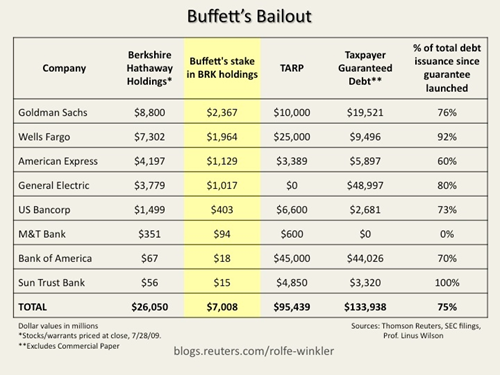
Billionaire Warren Buffett lobbied hard for the massive bailouts…. and with good reason. At least eight of these companies receiving billions of dollars of taxpayer bailouts were owned by Mr. Buffett’s Berkshire Hathaway.

Buffett’s Betrayal: Rolfe Winkler | Reuters / Aug 4, 2009 – Excerpts:
A good chunk of his [Warren Buffett’s] fortune is dependent on taxpayer largess. Were it not for government bailouts, for which Buffett lobbied hard, many of his company’s stock holdings would have been wiped out.

Berkshire Hathaway, in which Buffett owns 27 percent, according to a recent proxy filing, has more than $26 billion invested in eight financial companies that have received bailout money. The TARP at one point had nearly $100 billion invested in these companies and, according to new data released by Thomson Reuters, FDIC backs more than $130 billion of their debt.

To put that in perspective, 75 percent of the debt these companies have issued since late November has come with a federal guarantee.
Without FDIC’s debt guarantee program, even impregnable Goldman would have collapsed.And this excludes the emergency, opaque lending facilities from the Federal Reserve that also helped rescue the big banks. Without all these bailouts, the financial system would have been forced to recapitalize itself.

Banks that couldn’t finance their balance sheets would have sold toxic assets at market prices, and the losses would have wiped out their shareholder’s equity. With $7 billion at stake, Buffett is one of the biggest of these shareholders.

…………………………………………………………………………………

Fast-forward to 2015… the country’s second richest man was back, ‘sticking it to’ the very people whose billions of dollars bailed him out seven short years ago – U.S. taxpayers.

Warren Buffett, Slumlord – Predatory Loans, Kickbacks & Preying On The Poor  

ZeroHedge, Apr 6, 2015 – Excerpts:                                                                  

Buffett’s mobile-home empire promises low-income Americans the dream of homeownership. But Clayton [controlled by America’s second richest man, billionaire Warren Buffet], relied on predatory sales practices, exorbitant fees, and interest rates that can exceed 15 percent, trapping many buyers in loans they can’t afford and in homes that are almost impossible to sell or refinance, an investigation by The Seattle Times and Center for Public Integrity has found.

  _____________________________________

America does not need ‘wealth redistribution,’ as many socialist-minded politicians are demanding.

What America does need is equal access by the citizenry to the types of Federal Reserve monetary credit flows that were so generously provided to Mr. Buffett and his well-heeled, well-connected Wall Street cronies received during the stupendous financial sector bailouts.

U.S. citizens deserve nothing less than to be granted that same direct access to liquidity that the U.S. Federal Reserve showered on Wall Street’s wealthy elites over what ended up being a 5-year flow from 2007-2012.

The Leviticus 25 Plan is a dynamic economic initiative providing direct liquidity benefits for American families, while at the same time scaling back the role of government in managing and controlling the affairs of citizens.  It is a comprehensive plan with long-term economic and social benefits for citizens and government.

The inspiration for this plan is based upon Biblical principles set forth in the Book of Leviticus, principles tendering direct economic liberties to the people.

The Leviticus 25 Plan – An Economic Acceleration Plan for America

$90,000 per U.S. citizen – Leviticus 25 Plan 2023 (3986 downloads)

PGP: U.S. Health Care System inefficiency “creates enormous challenges for the U.S. economy and federal government.” Solution: The Leviticus 25 Plan

U.S. Health Care – massive costs with under-performing outcomes….

……………………………………………………

Peter G. Peterson Foundation

Key Drivers of the National Debt – Health Care Costs

Excerpts:

One of the primary drivers of America’s long-term fiscal challenges is our inefficient healthcare system. Combined with the demographic realities of an aging population, America’s healthcare system leaves us with an unsustainable fiscal future. Not only will more Americans qualify for federal healthcare programs like Medicare in the coming years, but older people, on average, need more healthcare. Consequently, without reform, the federal budget will bear the cost of rapidly growing healthcare bills.

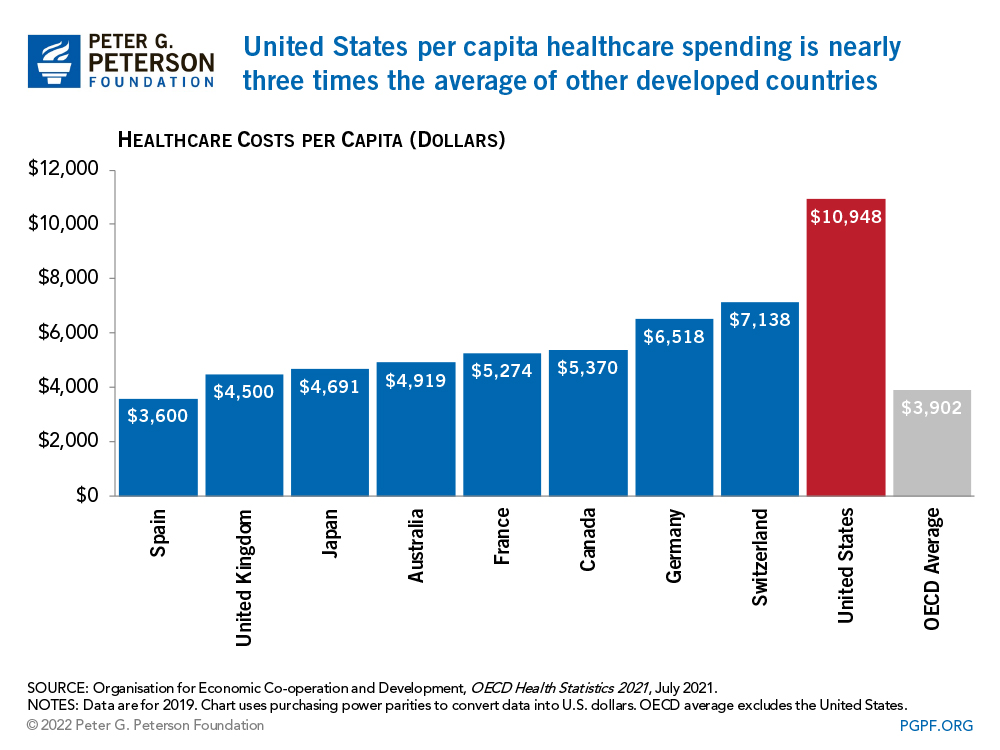
United States per capita healthcare spending is nearly three times the average of other developed countries

In 2020, the United States spent $4.1 trillion — or 20 percent of the national economy — on healthcare. On a per capita basis, our healthcare system is the most expensive among advanced nations. Yet, America’s health outcomes are generally no better than those of our peers, and in some cases are worse, including in areas like life expectancy, infant mortality, asthma, and diabetes.

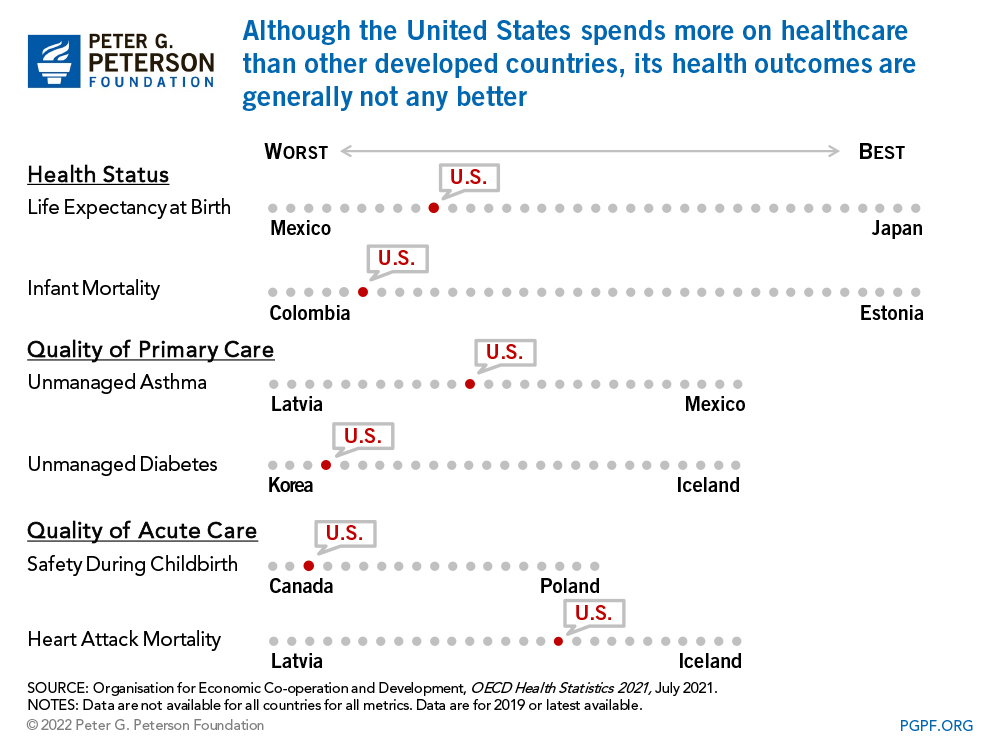
Although the United States spends more on healthcare than other developed countries, its health outcomes are generally not any better

Put simply, we are paying more than other countries, but we aren’t seeing better results. Healthcare experts have estimated that 25 percent of our total healthcare spending goes to unnecessary and wasteful services. Furthermore, healthcare spending is projected to keep rising — faster than inflation, wages, and the overall economy. Not only does the system result in health outcomes that are generally no better for patients, but its inefficiency also creates enormous challenges for the U.S. economy and federal government.

The primary reasons why our healthcare system underperforms is because the typical factors that fuel improvement and innovation in other industries are lacking in healthcare:

  • Historically, consumers have not been cost sensitive because their employers and health plans often cover a large share of their costs and because they lack the information required to assess quality and cost.
  • Employers and insurers often assume a passive role, accepting annual cost increases, and eventually pass those costs on to customers and employees.
  • Providers generally operate under a fee-for-service model in which they are compensated based on the volume of their services, rather than the value of the care they provide.
  • Improvements in technology often make healthcare more expensive.

Under this system, the demands and rewards for quality, efficiency, and price sensitivity are sharply reduced.

The growth in healthcare costs per person has slowed in the last few years, but it is uncertain how long this welcomed trend will continue. Despite the slowdown, the Centers for Medicare and Medicaid Services projects that total spending for healthcare will climb to 19 percent of GDP in 2025. According to CBO, spending on the major federal healthcare programs will rise from 5.7 percent of GDP in 2022 to 9.4 percent in 2051 — an increase of 64 percent.

___________________________________

It is time to decentralize the U.S. economy – and return to a citizen-centered health care system.

Putting citizens back in control of their access to primary health care services will lead to participating consumers taking a more active, cost sensitive role in their health care decisions. It will re-establish and strengthen patient-provider relationships, and reduce inefficiencies and costs.

The Leviticus 25 Plan is a dynamic economic initiative providing direct liquidity benefits for American families, while at the same time scaling back the role of government in managing and controlling the affairs of citizens.  It is a comprehensive plan with long-term economic and social benefits for citizens and government.

The inspiration for this plan is based upon Biblical principles set forth in the Book of Leviticus, principles tendering direct economic liberties to the people.

The Leviticus 25 Plan – An Economic Acceleration Plan for America

$90,000 per U.S. citizen – Leviticus 25 Plan 2023 (3978 downloads)

2022: Monetizing the Debt – No Longer a ‘Temporary’ measure. Time for a New Dynamic: The Leviticus 25 Plan

Our U.S. Congress has, as a practical matter, completely jettisoned fiscal discipline in their budgeting process.

The Government Accountability Office (GAO) stated in their March 23, 2021 report, The Nation’s Fiscal Health: “The unsustainable fiscal path strains the federal budget and contributes to growing debt. According to CBO, high and rising federal debt increases the likelihood of a fiscal crisis and could lead to a large drop in the value of the dollar or to a loss of confidence in the government’s ability or commitment to repay its debt in full.”

To accommodate the ongoing failure of our U.S. Congress to address this debt crisis, The Federal Reserve has had no choice but to ‘create’ new money, primarily to purchase large amounts of Treasury and Agency debt…..

………………………………………………………..

Felder Report: “Is It ‘Monetization’ Yet, Dr. Bernanke?”

Feb 19, 2022 | Authored by Jesse Felder via The Felder Report, | https://thefelderreport.com/2022/02/16/is-it-monetization-yet-dr-bernanke/

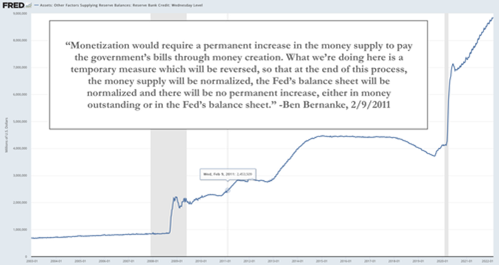
Eleven years ago, shortly after the onset of QE 2, Ben Bernanke gave us his definition for “monetization” of the debt, telling Congress (hat tip, Grant’s):

Monetization would require a permanent increase in the money supply to pay the government’s bills through money creation.

What we’re doing here is a temporary measure which will be reversed, so that at the end of this process, the money supply will be normalized, the Fed’s balance sheet will be normalized and there will be no permanent increase, either in money outstanding or in the Fed’s balance sheet.

At the time, The Fed’s balance sheet was approaching $2.5 trillion.

Today, it stands at nearly $9 trillion, more than triple the figure from a decade ago.

And so it only seems fair to ask, ‘Is it monetization yet, Dr. Ben?’

__________________________________________

The Leviticus 25 Plan is the one and only plan that is ‘primed up’ and ready to launch.

The Leviticus 25 Plan will provide a dynamic ‘recharge’ to the U.S. economy and restore economic liberty in America – and work get America’s budget deficits back under control and protect the long-term viability of the U.S. Dollar.

The Leviticus 25 Plan will generate $583 billion federal budget surpluses for the initial 5 years of activation (2023-2027), and completely pay for itself over the next 10-15 years.

The Leviticus 25 Plan is a dynamic economic initiative providing direct liquidity benefits for American families, while at the same time scaling back the role of government in managing and controlling the affairs of citizens.  It is a comprehensive plan with long-term economic and social benefits for citizens and government.

The inspiration for this plan is based upon Biblical principles set forth in the Book of Leviticus, principles tendering direct economic liberties to the people.

The Leviticus 25 Plan – An Economic Acceleration Plan for America 2023

Economic Scoring links:

·  The Leviticus 25 Plan 2023 – $583 billion Federal Budget Surpluses (2023-2027), Part 1: Overview, Deficit Projection

·  The Leviticus 25 Plan 2023 – $583 Billion Federal Budget Surpluses Annually (2023-2027), Part 2: Federal Income Tax and Means-Tested Welfare Recapture Benefits.

·  The Leviticus 25 Plan 2023 – $583 Billion Federal Budget Surpluses Annually (2023-2027), Part 3: Medicaid/CHIP and Medicare Recapture Benefits

·  The Leviticus 25 Plan 2023 – $583 Billion Federal Budget Surpluses Annually (2023-2027), Part 4: VA, TRICARE, FEHB, SSDI Recapture Benefits

·  The Leviticus 25 Plan 2023 – $583 Billion Federal Budget Surpluses Annually (2023-2027), Part 5: Subtotals, Interest Expense Savings, Summary

The Leviticus 25 Plan – An Economic Acceleration Plan for America

$90,000 per U.S. citizen – Leviticus 25 Plan 2023 (3972 downloads)

The Fed’s “Instability Trap” – and the Leviticus 25 Plan Solution

The Fed “Instability” Trap

Authored by Lance Roberts via RealInvestmentAdvice.com,

Jan 28, 2022 – Excerpts:

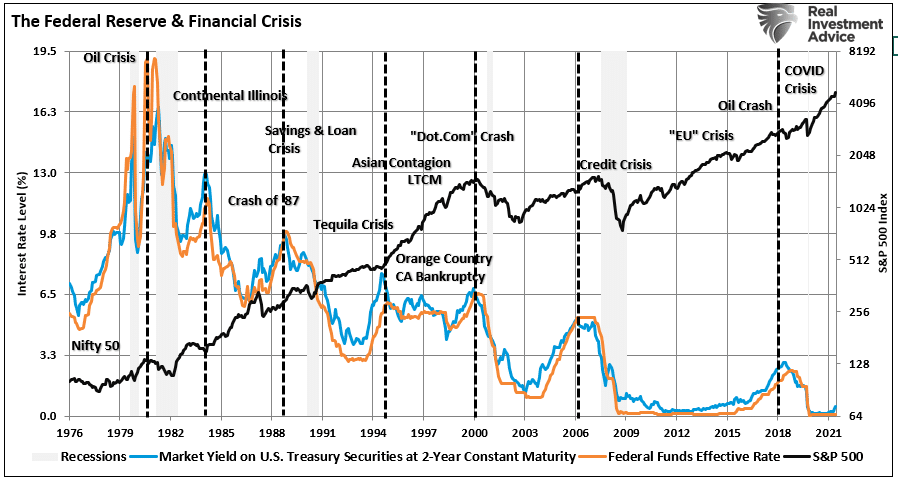
After more than 12-years of the most unprecedented monetary policy program in U.S. history, the Fed realizes there are significant risks in the financial system. The behavioral biases of individuals remain the most serious risk facing the Fed. 

With the Fed now reversing monetary accommodation, the question is how long before something breaks.

In the short term, the economy and the markets (due to the current momentum) can DEFY the laws of financial gravity as interest rates rise. However, as interest rates increase, they act as a “brake” on economic activity. Such is because higher rates NEGATIVELY impact a highly levered economy:

  • Rates increases debt servicing requirements reducing future productive investment.
  • Housing slows. People buy payments, not houses.
  • Higher borrowing costs lead to lower profit margins.
  • The massive derivatives and credit markets get negatively impacted.
  • Variable rate interest payments on credit cards and home equity lines of credit increase, reducing consumption.
  • Rising defaults on debt service will negatively impact banks which are still not as well capitalized as most believe.
  • Many corporate share buyback plans and dividend payments are done through the use of cheap debt.
  • Corporate capital expenditures are dependent on low borrowing costs.
  • The deficit/GDP ratio will soar as borrowing costs rise sharply.

The debt problem exposes the Fed’s risk and why they continue to look for excuses NOT to hike rates. (Like “full employment” even though jobless claims are at record lows.) However, given economic stability was not achieved in the last decade, it is doubtful the withdrawal of monetary accommodation will be “risk-free.”

The evidence is quite clear that surging debt and deficits inhibit organic growth, and the massive debt levels are sensitive to increases in interest rates.

Fed Rate Hikes, Fed Rate Hikes & Risks Of Financial Instability – Part II

With exceptionally high market valuations, Fed rate hikes historically led to events that devastated investors. Those events created the Fed’s repetitive cycle of monetary policy.

  1. Monetary policy drags forward future consumption leaving a void in the future.
  2. Since monetary policy does not create self-sustaining economic growth, ever-larger amounts of liquidity are needed to maintain the same level of activity.
  3. The filling of the “gap” between fundamentals and reality leads to economic contraction.
  4. Job losses rise, wealth effect diminishes, and real wealth reduces. 
  5. The middle class shrinks further.
  6. Central banks act to provide more liquidity to offset recessionary drag and restart economic growth by dragging forward future consumption. 
  7. Wash, Rinse, Repeat.

Conclusion

“Financial markets’ sensitivity to monetary policy has never been higher. The Fed’s balance sheet doubled since the end of the last financial crisis and is now 40% of gross domestic product. By buying massive amounts of bonds, the Fed lowered rates and used asset prices, like stocks, as the primary tool for monetary policy. That’s through the so-called wealth effect, or the tendency for consumers (two-thirds of GDP) to spend more as their assets grow.” – Joe LaVorgna

Therein lies the problem…. If the Fed tightens, the existing debt pile becomes more expensive to service, and stocks fall, hampering consumer confidence and economic growth.

On the other hand, if the Fed doesn’t tighten, debt across households, companies, and the government will continue to grow, making it more challenging for the Fed to act in the future

___________________________________

Exactly. The Fed cannot raise rates, in any meaningful way, with the U.S. economy surrounded by mountains of debt. According to the NY Fed, Household Debt climbed over the $15 trillion mark in Q3 2021. Corporate debt in 2020 rose to $11 trillion, according to Federal Reserve data.

The National Debt just hit $30 trillion. State and Local debt stands at $3.2 trillion.

The solution: America needs a dynamic new ‘debt elimination plan.’

There is just such a plan – loaded up and ready to launch. It will eliminate massive amounts of ‘ground level’ debt in America, usher in a long-term economic growth cycle, strengthen free market dynamics, and restore economic liberty.

It will generate $583 billion Federal budget surpluses during each of its first five years of activation – and pay for itself over a 10-15 year period.

The Leviticus 25 Plan is a dynamic economic initiative providing direct liquidity benefits for American families, while at the same time scaling back the role of government in managing and controlling the affairs of citizens.  It is a comprehensive plan with long-term economic and social benefits for citizens and government.

The inspiration for this plan is based upon Biblical principles set forth in the Book of Leviticus, principles tendering direct economic liberties to the people.

The Leviticus 25 Plan – An Economic Acceleration Plan for America

$90,000 per U.S. citizen – Leviticus 25 Plan 2022 (3941 downloads)

CDIA: Waste, Fraud, and Abuse – Selected Programs: $90 Billion

America needs a qualitatively new economic strategy – one that will elevate large segments of our population up the scales of financial security, so they do not need so many of these social programs to survive…

…………………………………………………

The GAO Shows That Data Matching Can Reduce Waste, Fraud, and Abuse

Source: https://www.cdiaonline.org/data-delivered-for-good/2021/12/20/the-gao-shows-that-data-matching-can-reduce-waste-fraud-and-abuse/

Excerpts:

In 2021, the GAO conducted a review of several programs that assist low-income individuals and concluded, among other things, that better data matching can prevent fraud, waste, and abuse, and can better direct funds to people that really need it

In a report, the GAO looked at Earned Income Tax Credit (EITC), Housing Choice Vouchers, Low Income Home Energy Assistance Program (LIHEAP), Medicaid (Modified Adjusted Gross Income (MAGI) eligible), Supplemental Nutrition Assistance Program (SNAP), and Supplemental Security Income (SSI).  All of these programs have income eligibility requirements.

The amount of improper payments made for a number of federal assistance programs is staggering.  In 2019, improper payments for four programs was around $90b: Medicaid ($57.4b), the Earned Income Tax Credit (EITC) ($17.4b), Supplemental Security Income (SSI) ($5.5b), and SNAP ($4b).

For energy assistance programs, the GAO added that “[b]ased on [its] review of state plans, 13 agencies administering LIHEAP reported using no electronic data to verify beneficiaries’ income, verifying income in other ways, such as checking beneficiaries’ documents.”  The report added that while the U.S. “Department of Health and Human Services (HHS) has encouraged LIHEAP agencies to use electronic data to improve program integrity, [it] has not taken recent steps to share information that could facilitate its use. HHS officials said that doing so could help state agencies’ verification efforts.

___________________________________________

The Leviticus 25 Plan will eliminate massive amounts of personal and household debt for working, tax-paying Americans – and grant millions of American families liquidity benefits that will allow them to directly allocate resources that best suit their needs – particularly in the realm of health care.

The Plan will help lift people up economically to a level where they will not need, and subsequently will not qualify for, many of these social programs.

Reducing the raw numbers of people enrolled in these programs will also serve to reduce the scope of fraud, waste, and abuse.

The Leviticus 25 Plan is a dynamic economic initiative providing direct liquidity benefits for American families, while at the same time scaling back the role of government in managing and controlling the affairs of citizens.  It is a comprehensive plan with long-term economic and social benefits for citizens and government.

The inspiration for this plan is based upon Biblical principles set forth in the Book of Leviticus, principles tendering direct economic liberties to the people.

The Leviticus 25 Plan – An Economic Acceleration Plan for America

$90,000 per U.S. citizen – Leviticus 25 Plan 2022 (3934 downloads)

“He who will not apply new remedies must expect new evils.” – Sir Francis Bacon

WSJ: Government Student Loan Takeover’ a “Policy Fiasco”

Navient is a Government-Sponsored Enterprise (GSE), formerly known as Sallie Mae, which effectively took over the student loan market in 2010. It is now losing a ‘boat-load’ of money, and taxpayers are ‘on the hook’ for billions.

………………………………………………………….

WSJ: Navient, the Student Loan Punching Bag

The Wall Street Journal Editorial Board, Jan 14, 2022 – Excerpts:

The Democrats’ government student loan takeover in 2010 is one of the great policy fiascoes of the age. But politicians can never admit it, so instead they’re kicking Navient, the student loan servicer.

Navient, formerly Sallie Mae, on Thursday agreed to settle 39 state Attorneys General lawsuits by cancelling $1.7 billion in defaulted debt. It will also make $260 payments to 350,000 federal student loan borrowers who were allegedly wrongly placed in long-term forbearance.

The State AGs accused Navient of “predatory lending” for making private loans to lower-income borrowers who attended for-profit schools, and for charging higher interest rates due to their higher credit risk. Heaven forbid a private lender, unlike the feds, try to avoid losing money.

Lower-income students couldn’t pay tuition with federal aid alone, so Navient filled the gap. For-profits also must derive at least 10% of their revenues from sources other than federal aid. So Navient indirectly helped those schools stay in business—and compete with community colleges. That’s another Navient political sin.

…..

The AGs accused Navient of wrongly placing borrowers in forbearance, which lets them defer payments while continuing to accrue interest. Borrowers enrolled in loan forgiveness plans also accrue interest because they often don’t pay enough to reduce their balance. This is a big reason the federal student loan balance sheet has doubled over the last decade to $1.6 trillion.

Navient denies wrongdoing and continues to fight similar legal charges filed by Obama Consumer Financial Protection Bureau Director Richard Cordray in early 2017. But it says settling the AG lawsuits was less expensive than continuing to fight. In September it also sought to end its government servicing contract because it was more hassle than it is worth.

But get this—Mr. Cordray, now chief operating officer of the Education Department’s Federal Student Aid office, requested that Navient renew the contract through 2023. Democrats need to keep around a punching bag as the government student loan debacle grows.

_______________________________

Note – “The average student loan debt for recent college graduates is nearly $30,000,” according to U.S News data, Sept. 14, 2021.

The Leviticus 25 Plan grants U.S. citizens the same direct access to liquidity that was provided to major banks and insurers during the great financial crisis. Each participating/qualifying citizen would receive a deposit of $60,000 into a Family Account (FA) and $30,000 into a Medical Savings Account (MSA).

The Plan would put students back in control of their college financing – and allow the government to dramatically shrink its student loan footprint.

It would facilitate a free market environment for higher education financing and provide It would provide direct liquidity extensions to reduce/eliminate loan balances.

It would provide liquidity for loan recipients of non-government financing – and help them also reduce/eliminate debt.

The Leviticus 25 Plan is a dynamic economic initiative providing direct liquidity benefits for American families, while at the same time scaling back the role of government in managing and controlling the affairs of citizens.  It is a comprehensive plan with long-term economic and social benefits for citizens and government.

The inspiration for this plan is based upon Biblical principles set forth in the Book of Leviticus, principles tendering direct economic liberties to the people.

The Leviticus 25 Plan – An Economic Acceleration Plan for America

$90,000 per U.S. citizen – Leviticus 25 Plan 2022 (3926 downloads)

January 2022 – Inflation: Real Wages “Plummet”

Massive government spending initiativesand the law of unintended consequences…

……………………………………………………………

Real Wages Plummet As Inflation Hits The US Recovery

ZeroHedge, Jan 10, 2022 | Authored by Daniel Lacalle, Excerpt:

The United States December jobs report shows that the labor market remains weak.

The headline 3.9% unemployment rate looks positive, but job creation fell significantly below consensus, at 199,000 in December versus a consensus estimate of 450,000.

The weak jobs figure should be viewed in the context of the largest stimulus plan in recent history. With massive monetary and fiscal support and a government deficit of $2.77 trillion, the second highest on record, job creation falls significantly short of previous recoveries and the employment situation is significantly worse than it was in 2019.

The most alarming datapoint is that real wages are plummeting. Average hourly earnings have risen 4.7% in 2021, but inflation is 6.8%, sending real wages to negative territory and the worst reading since 2011.

___________________________________________

“Government is not the answer,” as Pres. Ronald Reagan once said. “Government is the problem.”

Government, over the long haul, has an individualizing characteristic of complicating social issues and making problems worse.

It is high time to decentralize the system – and allow U.S. citizens to directly allocate resources, on their own behalf, in ways that best serve their personal needs and wishes, and free them from the tentacles of government control over their daily lives.

It is time to decentralize the system in a way that will eliminate massive amounts of ground-level debt in America, generate significant government budget surpluses and reduce long-term debt, and restore economic liberty for all Americans.

The Leviticus 25 Plan is a dynamic economic initiative providing direct liquidity benefits for American families, while at the same time scaling back the role of government in managing and controlling the affairs of citizens.  It is a comprehensive plan with long-term economic and social benefits for citizens and government.

The inspiration for this plan is based upon Biblical principles set forth in the Book of Leviticus, principles tendering direct economic liberties to the people.

The Leviticus 25 Plan – An Economic Acceleration Plan for America

$90,000 per U.S. citizen – Leviticus 25 Plan 2022 (3925 downloads)

F.A. Hayek: The mortal danger of big-government “economic control.”

“Economic control is not merely control of a sector of human life which can be separated from the rest; it is the control of the means for all our ends. And whoever has sole control of the means must also determine which ends are to be served, which values are to be rated higher and which lower — in short, what men should believe and strive for.”  ― Friedrich Hayek

……………………………………………………………………

The Leviticus 25 Plan – the most powerful economic acceleration plan in the world – the road to Economic Liberty. Leviticus 25 Plan 2022 (3913 downloads)

OpenTheBooks: Message to Taxpayers on BBB.

Wall Street Journal: Dear Mr. and Ms. Taxpayer

December 17, 2021 09:14 AM

Dear Mr. and Ms. Taxpayer:

In January, Democrats plan to bring back the so-called Build Back Better Bill. If your Congressman, your Senator vote for it, that vote says everything you need to know about who she/he represents. And it is not you.

Here is what your Congressmen and Senators say the bill costs: $1,750,000,000,000.

However, the permanent cost—as estimated by the Congressional Budget Office—to fund this pork-filled so-called Build Back Better Bill is up to $4,730,000,000,000.

So much for the president’s claim that this bill is “free” or “costs nothing.” Do the politicians really think we are that stupid?

Try to even imagine what $1 trillion—$1,000,000,000,000—is. We all know what a day is, what a year is. Instead of dollars, let’s think in terms of trillions of days. How many years are one trillion days?

2.7 billion years. 2,700,000,000. That is a lot of lifetimes!

If your trillion-touting Congressman and Senator vote for this bill, here is how they want to spend your present and future tax dollars.

This bill gives tax breaks to reporters, the media, unions, and trial attorneys. The bill-voting Congressman and Senators, obviously, believe it is more important to give tax breaks to reporters, the media, unions, trial attorneys than to plumbers, truck drivers, etc.—than to you, than to cut your tax dollars. This is a clear statement of who they really represent. And Mr. and Ms. Taxpayer Voter—it is not you.

If your Congressman, if your Senator vote for this bill, they have voted to give rich taxpayers in states like California, Illinois, and New York a big tax break. Again, not you.

If your Congressman, if your Senator vote for this bill, they are targeting small businesses. The bill increasing the occupational safety penalties (this is hard to believe) 10 times to $700,000 per violation. $700,000? It would break many businesses. If you, Mr. and Ms. Small Business Owner, do not follow the vaccine regulations you’re bankrupt.

Ronald Reagan stated, “The nine most terrifying words in the English language are: I’m from the government, and I’m here to help.”

This bill brings those terrifying words into reality. With this bill, your Congressman, your Senator voted to give the EPA $7 billion to employ a “climate corps.” Really? $7,000,000,000. That’s enough to fund an army of climate corps cops. If this bill passes, be prepared. That $7 billion climate corps army has to have something to do. The local climate cop will be on your doorstep surveying your carbon footprint.

Items as irresponsible as the above fill every page of this 2,466-page bill. All with lots of zeros. 2,466 pages… when is the last time you read 10 books?

Think of the price pain you are already feeling at the gas pump, in the grocery store. If this bill passes, that price pain will become more painful. Wait until you receive your heating bill this winter. This bill will accelerate the inflation price pain for a long time.

Your vote counts. Call, e-mail your Congressman. Call, e-mail your Senator. Ask why they voted for the bill. Will they vote for the bill? Ask them if they read this 2,466-page, 10-book bill. In all likelihood, few, if any, Congressmen or Senators read this bill, especially those who voted for the bill or will vote for it. To find your Congressman’s or Senator’s phone number and e-mail address, go to www.house.gov or www.senate.gov.

If your Congressman, your Senator vote for this bill, that vote says everything you need to know about whether they represent you. About whether they are qualified to remain in office. About whether you should ever vote for them again.

________________________________

Our Washington-based Democrat and Republican members of Congress should consider the one and only plan that favors individual citizens, rather than special interest groups… and that will actually reduce government deficits, rather than grow them precipitously… and that reduces dependence on government and restores economic liberty for all Americans

The Leviticus 25 Plan is a dynamic economic initiative providing direct liquidity benefits for American families, while at the same time scaling back the role of government in managing and controlling the affairs of citizens.  It is a comprehensive plan with long-term economic and social benefits for citizens and government.

The inspiration for this plan is based upon Biblical principles set forth in the Book of Leviticus, principles tendering direct economic liberties to the people.

The Leviticus 25 Plan – An Economic Acceleration Plan for America

$90,000 per U.S. citizen – Leviticus 25 Plan 2022 (3906 downloads)

Hubbard: “Bailouts Shouldn’t Be Only for Banks.”

Glenn Hubbard, dean of the Columbia Business School and former chairman of the Council of Economic Advisers during the George W. Bush presidency,. recently urged that financial crisis interventions should not be limited to banks.

………………………………………………

*Bailouts Shouldn’t Be Only for Banks – WSJ

Wall Street Journal, 9-14-18 – Excerpts:

“To be sure, recapitalizing financial institutions was an important element of the policy response. The depletion of capital buffers before the crisis reduced loan supply and exacerbated fire sales of distressed assets once the market collapsed. Cash infusions by the Treasury under the Troubled Asset Relief Program, in concert with the Fed’s bold lender-of-last-resort interventions, blunted the impact of the crisis.

That said, the perceived lack of attention to “Main Street” fed public suspicion of the bailouts. The government appeared to be more interested in addressing the decline in bank capital than the decline in home values. Millions of homeowners who were current in their mortgage payments were unable to refinance at lower interest rates because they were underwater. Yet many of these mortgages were already guaranteed by Fannie Mae and Freddie Mac , meaning taxpayers held the credit risk. Banks and investors holding the mortgages would never receive less than par.

The government should have directed a mass refinancing of mortgages for primary homes in which the borrower was current in payments. This would have led to an increase in disposable income and in home prices totaling more than $100 billion, according to a proposal Christopher Mayer and I offered at the time. The Treasury instead offered a tepid version of this with the Home Affordable Modification Program and the Home Affordable Refinance Program. These initiatives lacked the boldness of the bank bailouts, and Americans noticed…”

_____________________________

Hubbard concluded, “Ten years on, the U.S. still lacks a detailed plan for postcrisis intervention…”

What America really needs, to restore financial health to working families and ‘power up’ economic vitality throughout Main Street America – is a detailed plan for ‘pre-crisis’ intervention.

America needs a comprehensive economic plan that will insulate Main Street America from the next financial crisis and generate massive new tax revenue flows with a powerful, sustainable reduction in government deficits.

America’s new economic plan is currently loaded up and ready to go…

The Leviticus 25 Plan – An Economic Acceleration Plan for America

$90,000 per U.S. citizen – Leviticus 25 Plan 2022 (3902 downloads)