Pharmacy Closures – PBM Market Power Abuse. Problem Solved: The Leviticus 25 Plan

“You never change things by fighting the existing reality. To change something, build a new model that makes the existing model obsolete. –R. Buckminster Fuller

……………………………………..

The Leviticus 25 Plan and its U.S. Health Care Freedom Plan component shift a sizeable portion of government subsidy payments from layers of embedded health care ‘middlemen’ to Medical Savings Accounts for direct allocation by U.S. citizens – all through a special Federal Reserve / U.S. Treasury U.S. Citizens Credit Facility (similar to the gigantic credit facilities which were set up to bail out Wall Street financial institutions during the 2008-2010 great financial crisis and the 2021-2022 Covid-19 crisis).

Imagine millions of patients paying cash for billions of prescriptions processed each year.

Imagine a new model where the MediCare Trust fund collects payroll taxes, while at the same time Part C and D Prescription Drug Event claims plummet – effectuating Medicare Trust Fund bailout, through the hands of hard-working, tax-paying U.S. citizens.

That time is here. The Leviticus 25 Plan – loaded up and ready to launch.

………………………………………

Over 300 Pharmacy Closures Reported in the Last 3 Months
Drug Topics – News Article
March 14, 2025
By Brian Nowosielski
Excerpt:

A new report from the American Economic Liberties Project presents the continued challenges pharmacies face since Congress’ failure to pass PBM reform at the end of 2024.

Since December 19, 2024, as many as 326 pharmacy storefronts have closed their doors for good, according to a news release.1 That late-2024 December day is notable because it was when Congress’ plan for pharmacy benefit manager (PBM) reform was abandoned in the 2025 spending package, leading to continued hardships within the pharmacy industry.

“As predicted, without Congressional intervention, the Big Three PBMs have continued to abuse their market power, squeezing at least 326 pharmacies—237 of them independentout of business in fewer than 10 weeks and stranding their most vulnerable patients in pharmacy deserts without access to lifesaving care,” said Emma Freer, Senior Health Care Policy Analyst with the American Economic Liberties Project (AELP). “Given these high stakes, it is critical that Congress stand up to these health care monopolist middlemen and pass structural PBM reforms that will save their constituents’ time, money, and lives.”

From A Plus Pharmacy in El Paso, Texas, to Woodside Rx Inc in New York City, pharmacy closures have become common within the industry in recent history. Going back even further, a Health Affairs study found that 29.4% of all retail pharmacies operating in the US had closed at some point from 2010 to 2021. They also found that closures were more likely in minority communities than in those that were predominantly White.2

With pharmacy closures and their subsequent deserts becoming an increasingly pressing issue, many experts blame it on Congress’ failure to pass PBM reform. Last year was unprecedented for the pharmacy industry, partially because of the record number of store closures, but also due to the increased attention on PBMs and their controversial tactics that harm smaller community pharmacies.

Increased attention on PBMs led to a Federal Trade Commission (FTC) investigation into the prescription drug middlemen. With its first report released in July 2024—and eventually a second report in early 2025—the FTC confirmed many of the PBMs’ common tactics used to grow their profits at the expense of patients and pharmacies.3,4

However, despite all of the positive movement in the eyes of PBM critics, what was considered significantly bipartisan support for PBM reform failed to come to fruition at the end of 2024.

Now, with a new administration settling into the White House, PBM reform has since taken a back seat and the provisions that community pharmacies were hoping for must now be put on hold. In the meantime, reform advocates on both sides of the political aisle are continuing to highlight the need for PBM legislation and what it will do for the industry.

Simultaneously, they are highlighting the sheer unsustainability of the Big 3 PBMs— Caremark Rx, LLC (CVS), Express Scripts, Inc. (ESI), and OptumRx, Inc.—and their market control.4

“The Big Three PBMs also use their market power—combined with a rebate-driven business model that biases PBMs toward higher list price drugs, as Economic Liberties detailed in a February 2023 policy brief—to mark up drug prices by as much as 7,736%, according to the Federal Trade Commission,” continued the AELP press release.1 “As Economic Liberties has outlined in recent letters to Congress, the strongest PBM structural reform legislation would require PBMs to reimburse pharmacies fairly while eliminating the conflicts of interest that incentivize them to gouge patients.”

__________________________________

The Leviticus 25 Plan and its U.S. Health Care Freedom Plan component “create a model that makes the existing [PBM-centered] model obsolete.”

The most powerful economic acceleration plan in the world – restoring liquidity, profitability, and financial security for pharmacies across the nation.

The Leviticus 25 Plan is a dynamic economic initiative providing direct liquidity benefits for American families, while at the same time scaling back the role of government in managing and controlling the affairs of citizens.  It is a comprehensive plan with long-term economic and social benefits for citizens and government.

The inspiration for this plan is based upon Biblical principles set forth in the Book of Leviticus, principles tendering direct economic liberties to the people.

The Leviticus 25 Plan – An Economic Acceleration Plan for America

$95,000 per U.S. citizenLeviticus 25 Plan 2026 (32660 downloads )
World Class Health Care Solved: The Leviticus 25 Plan

WSJ: Health Care Plans: Something Must Be Done

The Wall Street Journal (Letters, March 21, 2017) published a letter several years ago from a New Jersey physician which included this on-target excerpt:

“If costs of delivering world-class health care are driven downward, then government mandates, overregulation and new taxes may not be necessary. Those of us who provide medical and surgical services each day know what it takes to stop the bleeding.  All the politicians need to do is ask.

Lack of price transparency, drug advertising hype, defensive medicine, self-referrals, pre-approved hurdles, insurance billing labyrinths, high overhead, big patient subsidies, discontinuity of care, electronic data keeping, specialty fee disparities, top-down decision-making, emerging hospital cartels, and case work overload are some of the systemic flaws that must be addressed sooner rather than later.”  – Jonathan L. Fox, M.D. Orthopedic Surgery and Sports Medicine, Northfield, N.J.

_______________________________

The U.S. Health Care Freedom Plan, an integral component of The Leviticus 25 Plan, directly addresses those very “systemic flaws by eliminating bureaucratic bloat, skyrocketing premiums, unfriendly and complicated medical access pathways, cumbersome, drawn-out claims processing, and rapidly shrinking reimbursements for physicians, pharmacists, and other health practitioners.

The U.S. Health Care Freedom Plan offers a powerful new access strategy for patients receiving medical and pharmaceutical services, home medical equipment, and home care services.

The Plan grants citizens the freedom to pay directly, in person, for their week-to-week health care purchases. It cuts out layers of bureaucracy and middlemen … simplifies access to health care and restores genuine ‘patient-provider’ relationships.

The U.S. Health Care Freedom Plan is the only comprehensive, citizen-centered health care plan in America.  It ‘resets’ the health care industry to present a clean, efficient and responsible system.  Most importantly, this plan restores individual citizen-centered health care for all participating Americans.

The U.S. Health Care Freedom Plan is available to each and every U.S. citizen – with no coverage mandates. Each U.S. citizen who wishes to participate will be granted a full and complete exemption from the ACA.

This plan offers freedom of choice and equal justice for all. Those Americans who might wish to stay with the ACA may stay (‘If you like your ObamaCare, you can keep your ObamaCare’).

Each participating U.S. citizen shall receive a credit extension, through a special Federal Reserve / U.S. Treasury Citizens Credit Facility of $35,000, electronically deposited into a Medical Savings Account (MSA) – for direct allocation toward family health care needs.

Private insurance – Families shall be allowed to enroll in high-deductible major medical plans, that include basic, ‘no frills’ medical plans which best suit their individual needs and desires. These streamlined plans would lower premium costs for employees and employers, encouraging employers to cost-share savings with employees through incentive-based employer MSA contributions.

Policies would not be automatically loaded with expensive government healthcare mandates.

Those with extraordinary medical issues may be included in a high-risk category, with such plans being eligible for a government subsidy (similar to current Medicare Advantage).

Federal / state programs – Individuals enrolled in Medicare / Medicaid / VA / TRICARE / FEHB programs would maintain their covered status, with an annual deductible of $7,000 per year per enrolled family member, for a period of five years for those benefits. The dedicated MSA funds would fully fund the offset for the higher ($7,000) deductible feature for that five-year period. MSA funds could also be used to pay Medicare supplement premiums and other potential co-pay obligations.

Where health care services paid by patients directly with MSA funds, providers would not be bound by federal / state rules pertaining to Electronic Medical Records (EMRs), and other unnecessary administrative burdens.

………………………………….

The Leviticus 25 Plan activation period is slated for the 5-year period beginning in 2027 and ending in 2031.

The Leviticus 25 Plan – Each participating U.S. citizen will receive a $60,000 deposit into a Family Account (FA) and a $35,000 deposit into a Medical Savings Account (MSA).

Qualification: All U.S. citizens residing in the United States are eligible to participate, contingent upon meeting qualification standards and agreement to specified recapture provisions. Participants (other than ‘custody account’ applicants) must prove stable credit history, stable job history, no recent drug/felony convictions.

These general recapture provisions include:

  • Waiving all federal income tax refunds for a period of 5 years.
  • Waiving benefits from income security programs, select benefits from means-tested welfare programs, SSI, and SSDI for a period of 5 years.
  • Enrollees in the Medicare, Medicaid, VA Healthcare system, Federal Employees Health Benefits (FEHB), and TRICARE will be subject to a $7,000 deductible for primary care and outpatient services annually for a period of 5 years. (See full plan for more details)

The Leviticus 25 Plan generates $37.303 billion federal budget surpluses annually during each of its first five years of activation (2027-2031), and pays for itself entirely over a 10-15 year period.

………………………………….

The Leviticus 25 Plan is a dynamic economic initiative providing direct liquidity benefits for American families, while at the same time scaling back the role of government in managing and controlling the affairs of citizens.  It is a comprehensive plan with long-term economic and social benefits for citizens and government.

The inspiration for this plan is based upon Biblical principles set forth in the Book of Leviticus, principles tendering direct economic liberties to the people.

The Leviticus 25 Plan – An Economic Acceleration Plan for America

$95,000 per U.S. citizen – Leviticus 25 Plan 2026 (32625 downloads )

A Look Back: ObamaCare Administrative costs “shocking” – The Hill

When government controls the allocation of resources in a given economic sector (‘for the public good’) … bureaucratic red tape, systemic inefficiencies, pricing distortions, and other economic dislocations  become the rule of law.

…………………………………………………………

Overhead costs exploding under ObamaCare, study finds | TheHill

by Sarah Ferris 05/27/2015 – Excerpts:

The administrative costs for healthcare plans are expected to explode by more than a quarter of a trillion dollars over the next decade, according to a new study published by the Health Affairs blog.

The $270 billion in new costs, for both private insurance companies and government programs, will be “over and above what would have been expected had the law not been enacted,” one of the authors, David Himmelstein, wrote Wednesday.

Those costs will be particularly high this year, when overhead is expected to make up 45 percent of all federal spending related to the Affordable Care Act. By 2022, that ratio will decrease to about 20 percent of federal spending related to the law.

The study is based on data from both the government’s National Health Expenditure Projections and the Congressional Budget Office. Both authors are members of Physicians for a National Health Program, which advocates for a single-payer system.

“This number – 22.5 percent of all new spending going into overheard – is shocking even to me, to be honest. It’s almost one out of every four dollars is just going to bureaucracy,” the study’s other author, Steffie Woolhandler, said Wednesday.

She said private insurers have been expanding their administrative overhead despite some regulations from the Obama administration to control those costs, such as the medical loss ratio, which requires a certain amount of premium dollars to be spent directly on healthcare. She argues that a better approach would be a type of Medicare-for-all system.

The extra administrative costs amount to the equivalent of $1,375 per newly insured person per year, the authors write.

About two-thirds of the new overhead costs are the result of rising enrollment in private plans, which the authors say carries “high costs for administration and profits.”

The rest is the result of expanded government programs, such as Medicaid. It also includes the cost of running ObamaCare exchanges at both the federal and state levels.

The federal exchange, as well as the 13 state-run exchanges, have all been boosted by grant money, though those funds will run out by 2016. The exchange will then need to rely on fees to plan premiums.

…………………………………….

Additional 2015 headlines:

$2.1 billion cost for ACA federal exchange

Obamacare Adds 3,322 Pages of Regs to $234 Billion Tax Complexity Burden…

______________________________

The U.S. Health Care Freedom Plan, an integral feature of The Leviticus 25 Plan, allows U.S. citizens to allocate resources directly and take ownership of their own health care needs and decisions.

This dynamic new plan is the only comprehensive, citizen-centered health care plan in America.

Freedom starts at ground level.

The Leviticus 25 Plan is a dynamic economic initiative providing direct liquidity benefits for American families, while at the same time scaling back the role of government in managing and controlling the affairs of citizens.  It is a comprehensive plan with long-term economic and social benefits for citizens and government.

The inspiration for this plan is based upon Biblical principles set forth in the Book of Leviticus, principles tendering direct economic liberties to the people.

The Leviticus 25 Plan – An Economic Acceleration Plan for America

$95,000 per U.S. citizen – Leviticus 25 Plan 2026 (32592 downloads )

WSJ: “Give Medicaid Dollars Directly to Patients.” There is a much better plan: The U.S. Health Care Freedom Plan

A Wall Street Journal editorial several years ago by Justin Haskins and Michael Hamilton of the Heartland Institute was a step in the right direction.  At the same time, it was weighed down by several major flaws…

…………………………………….

Give Medicaid Dollars Directly to Patients – WSJ

Apr 12, 2017: As Republicans take another crack at devising a plan to replace ObamaCare, here’s an idea they should consider: Give each Medicaid patient a health savings account—and put $7,000 in it every year.

Under ObamaCare, Medicaid has become the only option for millions of Americans. But that doesn’t mean much if the doctors in their communities don’t accept new patients through the program—and 30% of physicians don’t.

Full article accessed via Lux Llibertas:

_______________________

“Give Medicaid Dollars Directly to Patients” – shortcomings:

This plan does nothing to offer exemptions from ObamaCare.

This plan does nothing to benefit working families NOT on Medicaid.

It does nothing to untangle and change the complexion of other government health care programs like Medicare, Medicaid/CHIP, VA, FEHB, TRICARE.

This plan is an ongoing, open-ended cash-based subsidy.

There is a better way.

The U.S. Health Care Freedom Plan, an essential component of The Leviticus 25 Plan, is the only comprehensive, citizen-centered health care plan in America.  It ‘resets’ the health care industry to present a clean, efficient and responsible system.  Most importantly, this plan restores individual freedom and liberty for all participating Americans.

The Plan:

  1. The U.S. Health Care Freedom Plan is available to each and every U.S. citizen who wishes to participate – with no coverage mandates. Each U.S. citizen who wishes to participate will be granted a full and complete exemption from the ACA.
  2. This plan offers freedom of choice and equal justice for all. Those Americans who might wish to stay with the ACA may stay (‘If you like your ObamaCare, you can keep your ObamaCare’).
  3. Each participating U.S. citizen shall receive a credit extension, through a special Federal Reserve Citizens Credit Facility, of $35,000, electronically deposited into a Medical Savings Account (MSA) – for direct allocation toward family health care needs.
  4. Each participating U.S. citizen will then have a $7,000 deductible for each of the five years of activation (2027-2031) for primary health care claims related to Medicare, Medicaid, VA, TRICARE, FEHB.
  5. Private insurance – Families shall be allowed to enroll in high-deductible major medical plans. These streamlined plans would lower premium costs for employees and employers, encouraging employers to cost-share savings with employees through incentive-based employer MSA contributions.
  6. Policies would not be automatically loaded with expensive government healthcare mandates.
  7. Those with extraordinary medical issues may be included in a high-risk category, with such plans being eligible for a government subsidy (similar to current Medicare Advantage).
  8. Federal / state programs – Individuals enrolled in Medicare / Medicaid / VA / TRICARE / FEHB programs would maintain their covered status, with an annual deductible of $6,000 per year per enrolled family member, for a period of five years for those benefits. The dedicated MSA funds would fully fund the offset for the higher ($6,000) deductible feature for that five-year period. MSA funds could also be used to pay Medicare supplement premiums and other potential co-pay obligations.
  9. Where health care services paid by patients directly with MSA funds, providers would not be bound by federal / state rules pertaining to Electronic Medical Records (EMRs), and other unnecessary administrative burdens.

Benefits:                                                                                 

Lower health care costs – With the elimination of millions of minor insurance claims across the nation over the course of each month, system-wide efficiency would improve, medical costs would drop significantly, and the direct patient-provider relationship would be restored. Medical professionals would not have to answer to HMOs, insurance companies, or government agencies in providing basic day-to-day healthcare access for their patients.

Scoring – if 240 million U.S. citizens were to participate in the plan, the total dollar transfer into family-based Medical Savings Accounts (MSAs) would amount to $8.4 trillion.

The potential cost savings from the $7,000 deductible provision for the approximate 173.5 million people currently enrolled in Medicare (69.6 million), Medicaid / CHIP (77.0 million), VA (9.2 million), TRICARE (9.4 million), and FEHB (8.3 million) would amount to just under $5.25 trillion over the first 5 years (or, 62.5% of the $8.4 trillion initial roll out cost).

Summary:

This plan would generate trillions of dollars in cost savings from streamlining, vastly improved efficiency, and reductions in waste and fraud.

This plan would improve quality and ease of access to health care for all participating Americans.

 For patients: It would dramatically lower the cost of health care, while improving quality and access for all who chose to participate.

 For providers:  It would streamline payment dynamics and improve reimbursement for services, and restore the patient-provider relationship, and significantly reduce massive cost and time burdens imposed by a centralized system.

 The U.S. Health Care Freedom Plan is an integral feature of a larger, comprehensive economic plan: The Leviticus 25 Plan.

The Leviticus 25 Plan 2027 – An Economic Acceleration Plan for America

$95,000 per U.S. citizen – Leviticus 25 Plan 2026 (32591 downloads )

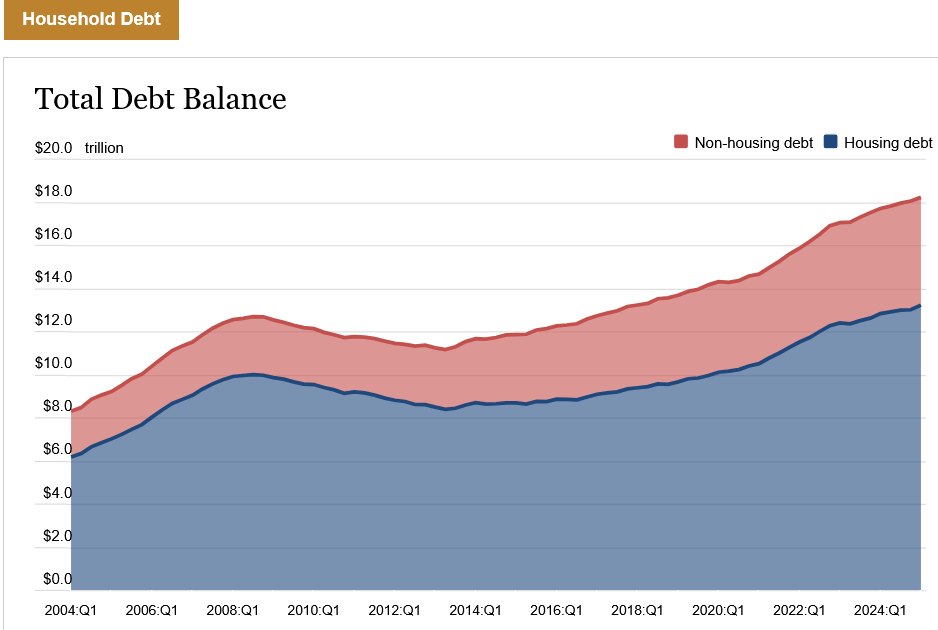
U.S. Mortgage Debt: $12.80 Trillion. Massive Lifetime Interest Charges Paid Out.

The Fed and U.S. Treasury Department dealt out massive debt relief benefits and credit guarantees to major U.S. and foreign banks during the great financial crisis (2008-2010) and the Covid-19 crisis (2020-2021).

It is now time to deal out major mortgage debt relief for 50 million American families.

The Leviticus 25 Plan: Millions of debt-burdened mortgage holders will experience immediate debt relief. Delinquent loans will become instantly current. Financial health restored restored across Main Street America.

Lending institutions will instantly become cash-rich competitive bidders on treasury debt, municipal debt, consumer debt, and small business loans.

…………………………………………………

Mortgage Debt Lifetime Interest: A study by CNBC found that someone purchasing a median-priced home with a typical 20% down payment could owe $142,614.31 in interest over the life of their 30-year mortgage. 

………………………………………………..

Mortgage balances shown on consumer credit reports grew by $199 billion during the first quarter of 2025 and totaled $12.80 trillion at the end of March. (The change between 2024Q4 and 2025Q1 was elevated because of a gap in reporting mortgage balances in 2024Q4.) Balances on home equity lines of credit (HELOC) rose by $6 billion, the twelfth consecutive quarterly increase. There is now $402 billion in outstanding HELOC balances, $85 billion above the low reached in the first quarter of 2022.

……………………………………………………………

Source: National Mortgage Database (NMDB)

Total mortgage loan value in the USA: There are currently 51.1 million outstanding mortgages with a loan value of $12.80 trillion dollars.

Average interest rate on all outstanding residential mortgages: The average interest rate on all outstanding residential mortgages in the USA is 4.2% as of Q3 2024. This average is based on the contract interest rate at origination of the loan. Of these loans 2.3% are mortgages with adjustable rates which would be impacted by changes in interest rates.

Average monthly payment on all outstanding residential mortgages: The average monthly payment is $1,869 which is a combination of the average principal, interest, and escrow (where applicable). When looking at mortgage data the average tends to be skewed by expensive homes. Therefore, it is important to also consider the median monthly payment which is $1,606 as of Q3 2024.

Average age of outstanding loans: All of the outstanding loans in the USA have an average loan age of 72 months or 6 years. This is the average number of months since the loans origination. The average mark-to-market ltv of outstanding mortgages in the USA is 46.60%. This is the ratio of unpaid principal to the current property value. This means that the average home has 53.40% equity in the home from both payments of principal and increases in property value.

___________________________________

The Leviticus 25 Plan is a dynamic economic initiative providing direct liquidity benefits for American families, while at the same time scaling back the role of government in managing and controlling the affairs of citizens.  It is a comprehensive plan with long-term economic and social benefits for citizens and government.

The inspiration for this plan is based upon Biblical principles set forth in the Book of Leviticus, principles tendering direct economic liberties to the people.

The Leviticus 25 Plan – An Economic Acceleration Plan for America

$95,000 per U.S. citizen – Leviticus 25 Plan 2026 (32415 downloads )

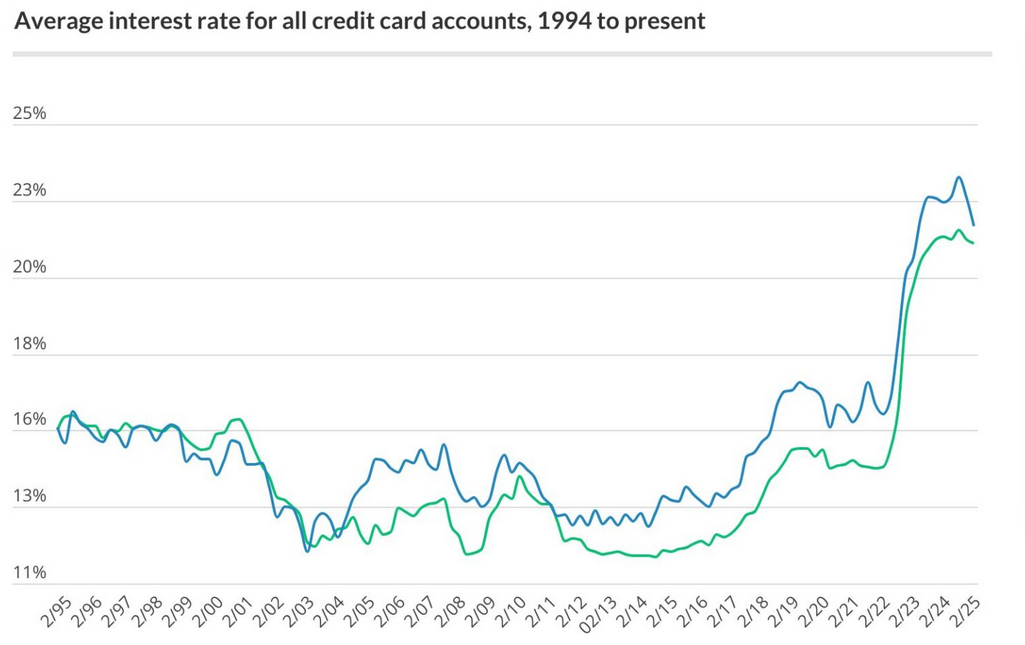
America 2025: $1.21 Trillion Credit Card Debt; Average Interest Rate: 24.33%. Solution: The Leviticus 25 Plan – Loaded Up and Ready to Launch.

Vast numbers of Americans, buried under stifling credit card debt loads, are facing rising credit card balances and high interest rates:

  • Total debt: Americans owed a record $1.21 trillion on their credit cards as of February 2025.
  • Average household debt: The average household carries about $8,940 in credit card debt as of early 2025.
  • Average individual debt: Among cardholders with unpaid balances, the average debt was $7,321 in Q1 2025, according to LendingTree.
  • People aged 50-59 have the most credit card debt in total at $0.21 trillion,

Americans shelled out a hefty $163.89 billion in credit card interest and fees in 2022 when interest rates were far lower. Current estimates put that figure up at a shocking $180 billion annually.

………………………..

Average Credit Card Interest Rate in America Today – LendingTree, June 5, 2025

Excerpt: The average credit card interest rate in America is 24.33%, the highest since December, after a third straight monthly increase.

_______________________________

The Federal Reserve and U.S. Treasury Department unleashed massive liquidity flows and credit guarantees to Wall Street banks and insurers during the great financial crisis (2008-2010) to help restore them to ‘financial health.’

The beneficiaries: Morgan Stanley, Bank of America, CitiGroup, Goldman Sachs, AIG, JP Morgan, Merrill Lynch, Wells Fargo, State Street, UBS, Barclays, Deutsche Bank, Royal Bank of Scotland, BNP Paribas, and others..

It is now time to restore U.S. citizen families to positions of ‘financial health’ with the same direct liquidity extensions that were extended to Wall Street heavyweights.

The Leviticus 25 Plan will eliminate massive amounts of Credit Card Debt, Mortgage Debt, Student Loan Debt, Consumer Installment Debt.

It will lift millions of Americans up out of poverty and massively reduce entitlement spending.

The Leviticus 25 Plan will generate $36.568 billion federal budget surpluses each of its first five years of activation (2026-2030), and help get state and local budgets back into balance all across the U.S..

The most powerful economic acceleration plan in the world. Loaded up and ready to launch:

The Leviticus 25 Plan is a dynamic economic initiative providing direct liquidity benefits for American families, while at the same time scaling back the role of government in managing and controlling the affairs of citizens.  It is a comprehensive plan with long-term economic and social benefits for citizens and government.

The inspiration for this plan is based upon Biblical principles set forth in the Book of Leviticus, principles tendering direct economic liberties to the people.

The Leviticus 25 Plan – An Economic Acceleration Plan for America

$95,000 per U.S. citizen – Leviticus 25 Plan 2026 (32387 downloads )

“Washington’s Fiscal Doomsday” – Publicly Held Debt on Track to Grow by $102 Trillion over Next Three Decades.

There is precisely one economic acceleration plan in the world with the raw power to eliminate America’s colossal public and private load – and get the country back on track for long-term economic growth and fiscal solvency. The Leviticus 25 Plan.

……………………………………………………………………………….

Stockman: Washington’s Fiscal Doomsday

Authored by David Stockman via The Brownstone Institute, Wednesday, June 24, 2025

Excerpt:

If you don’t think Washington is in the maws of a Fiscal Doomsday Machine, think again. And the place to start is with the 30-year CBO projections, expressed as the dollar increase from the current $29 trillion level of publicly held US Treasury debt.

If Washington does nothing except leave current tax, spending, and structural deficit policies in place (i.e. baseline policy), the publicly-held debt will grow by $102 trillion over the next three decades, reaching a staggering 154% of what would be $85 trillion of GDP by 2054.

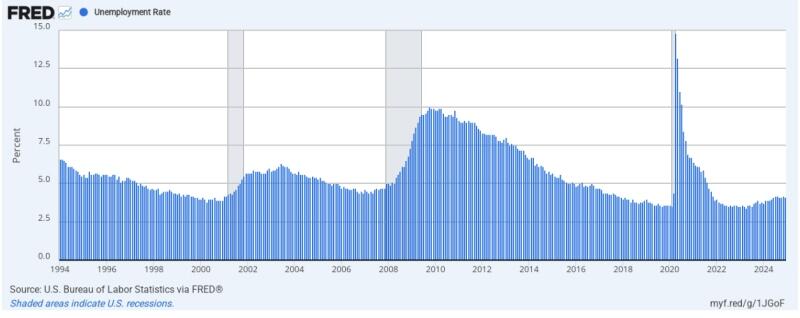
Moreover, that outcome assumes that [the CBO) Rosy Scenario does not lose her footing for even a moment through the middle of the century. Stated differently, the underlying CBO projections presume that there will be no recession during the 34-year span from 2020 to 2054, and that, in fact, there will be perpetual full employment at about 4% from here on out.

Of course, during the last 30 years there have been three recessions (shaded area) and no such full-employment perfection was even remotely achieved. The short spells of 4% unemployment or under, in fact, were few and far between—in stark contrast to the CBO baseline which presumes 4% unemployment year after year until 2054.

Monthly Unemployment Rate, 1994 to 2024

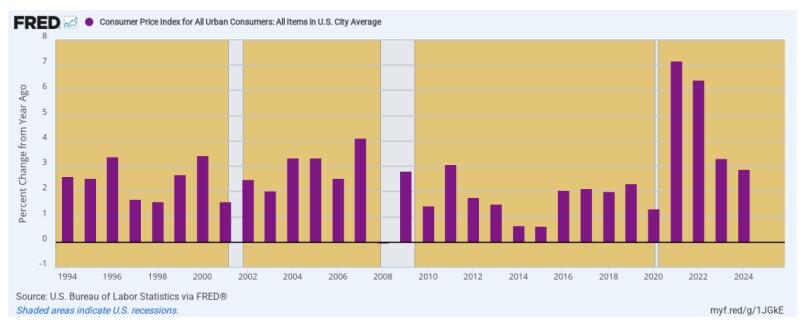
The CBO projections also assume that inflation stays strictly in its Fed-prescribed lane at around 2.0% for the next 30 years, as well. That hasn’t remotely happened during the last 30 years, when the inflation rate has exceeded the 2.0% mark during 17 years, and frequently by substantial amounts.

Y/Y Change In CPI 1994 to 2024

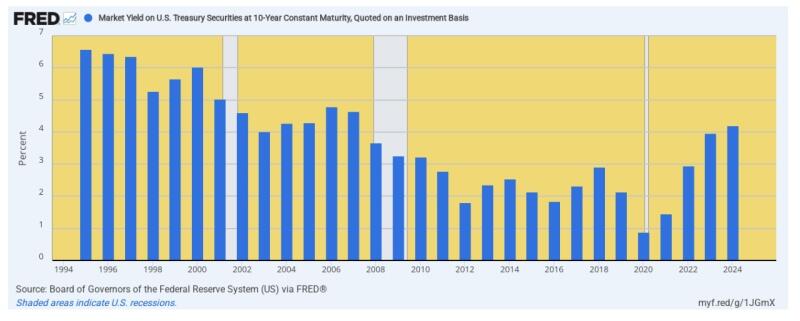
Likewise, it assumes that the bond pits will have no problem funding more than $100 trillion of new Treasury debt at yields which average just 3.6% over the next 30 years. Of course, the actual weighted average yield in the Treasury market today stands at 4.2% and the fulcrum 10-year note has been cycling around 4.4%, albeit at this point the prospective debt inundation is just getting started.

Again, judging by the last 30 years of history, the odds that interest rates will be pushed down into the mid-3% range and remain there for 30 years running would not seem very compelling, either.

Indeed, during the past 30-year period shown in the graph below the bond pits had the Fed’s big wind at their back as the latter monetized upwards of $8.5 trillion of US Treasury and GSE paper by the 2022 peak. Even then, yields were well above the CBO 3.6% assumption half the time, and were pushed lower only by the massive money-printing spree between 2008 and 2022—a feat not likely to be repeatable again without fueling even more inflation and speculation than we already have.

Read full article: https://brownstone.org/articles/washingtons-fiscal-doomsday/

________________________________________

The Leviticus 25 Plan is a dynamic economic initiative providing direct liquidity benefits for American families, while at the same time scaling back the role of government in managing and controlling the affairs of citizens.  It is a comprehensive plan with long-term economic and social benefits for citizens and government.

The inspiration for this plan is based upon Biblical principles set forth in the Book of Leviticus, principles tendering direct economic liberties to the people.

The Leviticus 25 Plan – An Economic Acceleration Plan for America

$95,000 per U.S. citizen – Leviticus 25 Plan 2026 (31409 downloads )

Message for America, 2025 – Monsignor Fulton J. Sheen

Monsignor Fulton J. Sheen – 1931 essay:

“America, it is said, is suffering from intolerance – it is not.  It is suffering from tolerance. Tolerance of right and wrong, truth and error, virtue and evil, Christ and chaos. Our country is not nearly so overrun with the bigoted as it is overrun with the broadminded.”

“Tolerance is an attitude of reasoned patience toward evil … a forbearance that restrains us from showing anger or inflicting punishment. Tolerance applies only to persons … never to truth. Tolerance applies to the erring, intolerance to the error … Architects are as intolerant about sand as foundations for skyscrapers as doctors are intolerant about germs in the laboratory.

Tolerance does not apply to truth or principles. About these things we must be intolerant, and for this kind of intolerance, so much needed to rouse us from sentimental gush, I make a plea. Intolerance of this kind is the foundation of all stability.”

“The refusal to take sides on great moral issues is itself a decision. It is a silent acquiescence to evil. The Tragedy of our time is that those who still believe in honesty lack fire and conviction, while those who believe in dishonesty are full of passionate conviction.”

______________________________________

Hubbard: “Bailouts Shouldn’t Be Only For Banks.”

Glenn Hubbard, dean of the Columbia Business School and former chairman of the Council of Economic Advisers during the George W. Bush presidency,. recently urged that financial crisis interventions should not be limited to banks.

………………………………………………

*Bailouts Shouldn’t Be Only for Banks – WSJ

Wall Street Journal, 9-14-18 – Excerpts:

“To be sure, recapitalizing financial institutions was an important element of the policy response. The depletion of capital buffers before the crisis reduced loan supply and exacerbated fire sales of distressed assets once the market collapsed. Cash infusions by the Treasury under the Troubled Asset Relief Program, in concert with the Fed’s bold lender-of-last-resort interventions, blunted the impact of the crisis.

That said, the perceived lack of attention to “Main Street” fed public suspicion of the bailouts. The government appeared to be more interested in addressing the decline in bank capital than the decline in home values. Millions of homeowners who were current in their mortgage payments were unable to refinance at lower interest rates because they were underwater. Yet many of these mortgages were already guaranteed by Fannie Mae and Freddie Mac , meaning taxpayers held the credit risk. Banks and investors holding the mortgages would never receive less than par.

The government should have directed a mass refinancing of mortgages for primary homes in which the borrower was current in payments. This would have led to an increase in disposable income and in home prices totaling more than $100 billion, according to a proposal Christopher Mayer and I offered at the time. The Treasury instead offered a tepid version of this with the Home Affordable Modification Program and the Home Affordable Refinance Program. These initiatives lacked the boldness of the bank bailouts, and Americans noticed…”

Hubbard concluded, “Ten years on, the U.S. still lacks a detailed plan for post-crisis intervention…”

____________________________________

Solution: What America really needs, to restore financial health to working families and ‘power up’ economic vitality across Main Street America – is a detailed plan for ‘pre-crisis’ intervention.

America needs a plan that will insulate Main Street America from the next financial crisis. This detailed plan must also generate massive new tax revenue flows and a powerful, sustainable reduction in government deficits.

The Leviticus 25 Plan is currently loaded up and ready to launch…

The Leviticus 25 Plan is a dynamic economic initiative providing direct liquidity benefits for American families, while at the same time scaling back the role of government in managing and controlling the affairs of citizens.  It is a comprehensive plan with long-term economic and social benefits for citizens and government.

The inspiration for this plan is based upon Biblical principles set forth in the Book of Leviticus, principles tendering direct economic liberties to the people.

The Leviticus 25 Plan – An Economic Acceleration Plan for America

$95,000 per U.S. citizenLeviticus 25 Plan 2026 (31187 downloads )