BNP Paribas is the largest bank in the Eurozone and 10th largest bank worldwide. This French financial behemoth is headquartered in Paris, with global headquarters in London. It owns subsidiaries all over the world, including BankWest in the U.S..
BNP was a major recipient of U.S taxpayer funds courtesy of the Federal Reserve and U.S. Treasury Department during the financial crisis years – to help restore them to ‘financial health.’ BNP has been involved in some distinctly ‘shady’ (and blatantly illegal) schemes in the past. They have recently ‘rolled the dice’ on an $80 million derivatives trade – and came up empty…
ZeroHedge (Feb 6, 2019): BNP lost $80 million in S&P500-linked derivative trades around Christmas; the massive trading loss emerged after Antoine Lours, BNP’s head of US index trading, put on positions on the S&P 500 which then quickly started losing money.
“BNP Paribas escaped the 2007–09 credit crisis relatively unscathed reporting a €3 billion net profit for the year of 2008, and €5.8 billion for 2009.” (Source: Wikipedia)
Thanks in no small part to U.S. taxpayers…
Background – Exhibit A:
Zero Hedge Feb 13, 2014: US Taxpayer “Bailed Out” BNP Paribas Probed By DoJ & Fed“TARP Recipient BNP Paribas got $4.9bn of bailouts from the U.S. Taxpayer – Today, as the WSJ reports we learn BNP Paribas has been funding transactions in Iran, Syria and other countries subject to U.S. Sanctions since 2002. The bank set aside $1.1 billion to settle investigations by the Department of Justice and the Federal Reserve but as the NY Times reports, investigations are playing out on multiple fronts – centering on whether the firm did “a significant amount” of business in “blacklisted” countires (and routed the deals through the US financial system).”
Via WSJ, – “…an internal probe conducted over the past few years “a significant volume of transactions” between 2002 and 2009 that could be “considered impermissible under U.S. laws and regulations...” “involving entities that were doing business in U.S.-sanctioned countries, such as Iran, Cuba, Sudan and Libya during the 2002 to 2009 period.
“BNP Paribas SA on Thursday became the latest bank to disclose the extent of its litigation problems in the U.S., saying it has set aside $1.1 billion against potential penalties related to transactions in countries under sanctions...
Oct. 19, 2011 (Bloomberg) — “BNP Paribas SA was sued by the U.S. over allegations the Paris-based bank aided a grain export fraud scheme involving commodity payment guarantees provided by the Department of Agriculture.
A corporate banker in BNP’s Houston office allegedly helped a scheme that defrauded the Agriculture Department of at least $78 million through deals he made with four U.S. grain exporters, according to a complaint filed yesterday in federal court in Houston.”
“The credit crisis accelerated after BNP Paribas SA, France’s biggest bank, announced in August 2007 that it would halt withdrawals from three funds because mortgage-market turmoil “made it impossible” to value certain assets. BNP began taking Federal Reserve loans in December 2007 when the Term Auction Facility opened. By April 2008, its Fed debt reached $29.3 billion. In 2009, BNP became the euro region’s largest bank by deposits, purchasing Brussels-based Fortis’s units in Belgium and Luxembourg for 10.4 billion euros ($15.2 billion). It issued 5.1 billion euros of preference shares to the French government in March 2009, and reimbursed the state by October. In December 2010, when the Fed disclosed the loans, BNP said it used the TAF “to assist in recycling and facilitating liquidity.”
Peak Amount of Debt on 4/18/2008: $29.3B
_______________________________________
BNP Paribas received $4.9 billion in TARP funds from the U.S., and they went on to rake in a tidy $29.3 billion credit extension from the Fed via the Term Auction Facility… “to assist in recycling and facilitating liquidity.”
They were meanwhile funding significant transactions (Bloomberg) “involving entities that were doing business in U.S.-sanctioned countries, such as Iran, Cuba, Sudan and Libya during the 2002 to 2009 period.” And they ran a “grain export fraud scheme” which ‘cooked’ the U.S. Department of Agriculture for a cool $78 million.
Begging the question: If BNP Paribas is deserving of direct liquidity infusions from the U.S. government and the Fed, then would it not be perfectly reasonable for U.S. citizens to also qualify for their own direct liquidity extensions “to assist in recycling and facilitating liquidity” at the family level.
………………………………………….
The Leviticus 25 Plan is the most powerful and dynamic economic acceleration plan in the world – delivering citizen-driven economic growth and citizen-centered healthcare.
The inspiration for this plan is based upon Biblical principles set forth in the Book of Leviticus, principles tendering direct economic liberties to the people.
The Leviticus 25 Plan – An Economic Acceleration Plan for America
The Leviticus 25 Plan vs the Fed’s 2008-2010 secret emergency lending programs – A critical perspective, in planning for America’s future.
The Federal Reserve’s ‘secret liquidity lifelines’ for major banks:
Bloomberg LP filed a Freedom of Information Act (FOIA) lawsuit on Nov 7, 2008 to gain access to information regarding special emergency lending programs that the U.S. Federal Reserve had been running to help borrower banks deal with cash shortages and collateral deficiencies. The Fed fought the lawsuit, but ultimately lost.
Bloomberg gained access to more than 29,000 pages of previously secret loan documents and Fed spreadsheets, and published the highlights of those programs in late 2011.
According to Bloomberg, the top 15 recipients of Fed’s ‘secret liquidity lifelines’ were: Morgan Stanley ($107 billion), Citigroup Inc. ($99.5 billion), Bank of America Corp ($91.4 billion), Royal Bank of Scotland Plc ($84.5 billion), State Street Corp ($77.8 billion), UBS AG ($77.2 billion), Goldman Sachs Group Inc. ($69 billion), JP Morgan Chase & Co ($68.6 billion), Deutsche Bank AG ($66 billion), Barclays Plc ($64.9 billion), Merrill Lynch & Co Inc. ($62.1 billion), Credit Suisse Group AG ($60.8 billion), Dexia SA ($58.5 billion), Wachovia ($50 billion).
………………………………………………………………………..
The Fed ‘flooded’ the financial coffers of these major U.S. and foreign banks (with U.S subsidiaries) with trillions of dollars in direct cash transfers, credit guarantees, and balance sheet transfers of (often ‘sewage grade’) agency debt and MBS – and the principles of those institutions ended up making out very well. None of the principles involved took a serious haircut.
Meanwhile, Main Street America did not fare well…
There were severe financial dislocations. 8.7 million Americans lost their jobs during the financial crisis years. 4.1 million American families lost their homes through completed foreclosures from September 2008 through December 2012, according to CoreLogic.
_________________________________
It is now time for a Round 2 “emergency lending program,” one that would restore financial security for millions of American families – via direct liquidity extensions channeled through a Federal Reserve / U.S. Treasury Citizens Credit Facility.
The Leviticus 25 Plan – An Economic Acceleration Plan for America
A coordinated series of major cyberattacks targeting “transportation nodes, telecommunications services, power grids, water facilities… and likely much more,” would wreak unimaginable societal upheaval across the U.S., with devastating consequences for millions of families – who currently have no financial reserves to help insulate them from financial hurricane that would be sure to follow.
America needs a dynamic, massive debt-elimination plan that would insulate the broad American public from the loss of homes, the temporary loss of jobs and income, and the loss of opportunity to provide for their families.
“Serving as FBI Director for the past seven-plus years has given me an unparalleled view of the threats to our country’s public safety and national security. From where I sit, these threats are more dangerous and complex than at any time I can recall since I began my career in law enforcement almost 30 years ago.
Our adversaries—whether they be violent gangs, child predators, cartels, hackers, hostile nation-states, or terrorists—are more emboldened, better resourced, savvier with technology, and more relentless than ever before. With a keystroke, a foreign hacker can shut down a hospital or take our critical infrastructure offline. A would-be terrorist can communicate with plotters overseas through encrypted apps to secretly plan an attack on U.S. soil. Cartels can manufacture loads of deadly drugs with a potency no one has ever seen before using chemicals acquired half a world away.
“Looking ahead, the challenges to our security will grow even more daunting, and our margin for error will continue to shrink.”
“The Chinese government, in particular, has engineered an unprecedented effort to gut American innovation, steal our most precious personal data, and meddle in our free and open society. History will mark this as the defining threat of our generation,” Wray wrote.
Wray urged the the United States to prioritize unity and vigilance, warning that the margin for error in combating these threats is shrinking rapidly.
According to outgoing FBI Director Christopher Wray in a Sunday [Jan 12, 2025] appearance on “60 Minutes,” – “The Chinese government is prepositioning on American civilian critical infrastructure to lie in wait on those networks to be in a position to wreak havoc & inflict real world harm at a time & place of their choosing.”
Wray described the CCP as “the greatest long-term threat” and the “defining threat of our generation” due in part to its state-funded cyber program that’s poised to “wreak havoc” on a whim – targeting water treatment plants, the electrical grid, natural gas infrastructure and other systems.
According to Wray, China has pre-positioned malware throughout American infrastructure.
He also says that Beijing has been listening to communications by high-level US officials.
According to a Feb. 5 assessment from the Office of the Director of National Intelligence, China is the “most active and persistent cyber threat to U.S. Government, private-sector, and critical infrastructure networks.”
Jen Easterly, director of the U.S. Cybersecurity and Infrastructure Security Agency, highlighted the geopolitical context of Beijing’s increasing cyberespionage in a Jan. 15 blog post titled “Strengthening America’s Resilience Against the PRC Cyber Threats.”
“A crisis in Asia, precipitated by an invasion of Taiwan or a blockade of the Taiwan Strait, could have very real consequences for the safety and security of American citizens here at home,” Easterly wrote.
Such an invasion, she wrote, could be followed by disruptive attacks against “everything, everywhere, all at once.” Those attacks could hit transportation nodes, telecommunications services, power grids, water facilities, “and likely much more,” she wrote.
______________________________
“He who will not apply new remedies must expect new evils.” – Sir Francis Bacon
The Leviticus 25 Plan is a dynamic economic initiative providing direct liquidity benefits for American families, while at the same time scaling back the role of government in managing and controlling the affairs of citizens. It is a comprehensive plan with long-term economic and social benefits for citizens and government.
The inspiration for this plan is based upon Biblical principles set forth in the Book of Leviticus, principles tendering direct economic liberties to the people.
The Leviticus 25 Plan – An Economic Acceleration Plan for America
The Leviticus 25 Plan has the raw power to quench such fatalistic views — effecting massive reductions in government outlays and generating enormous, ongoing tax revenue inflows. to bring about dynamic federal, state, and local budget surpluses.
The Leviticus 25 Plan will generate average annual budget surpluses of $36.568 billion for each of the first five years of activation (2026-2030) — vs current CBO-projected average annual deficits of $1.938 trillion.
This represents a monumental $2.304 trillion positive budget gain annually (2026-2030) for the U.S. federal budget, with major gains falling into line, also, for state and local government entities.
Note 1: Projected budget surpluses for 2026-2030 do not factor in the additional government tax revenue gains that would accrue from the massive shift in capital away from debt service and into productive economic activity.
Note 2: Projected budget surpluses for 2026-2030 do not factor in the additional government tax revenue gains that would accrue from significantly lower levels of debt deductibility on individual income tax filings.
Note 3: Projected budget surpluses from the Medicaid / CHIP recapture do not take into account the likelihood of fewer citizens actually qualifying for Medicaid / CHIP benefits.
Note 4: Projected budget surpluses from Interest Expense Reductions during each of the first five years of activation (2026-2030) is likely understated due to the fact that ‘debt held by the public’ is projected to increase by 8.5% per year, from $28.278 trillion in 2026 to $40.198 trillion in 2030.
Note 5: The Plan’s funding of individual Medical Savings Accounts (MSAs) with the $6,000 deductible provision per year would result in an enormous drop in the number of claims each year for Medicare reimbursement. Medicare payroll taxes would generate a growing revenue stream, due to stronger economic growth, while outlays would drop significantly from the reduced claims numbers – thereby providing the Fed with a powerful tool to recapitalize the Medicare Trust Fund, vis the Citizen’s Credit Facility.
While the economic picture presented by the CBO is hardly shocking, if as ridiculous as always, with zero recessions expected over the coming decade when the CBO projects GDP growing at a 1.8% annual pace, with inflation magically flat at 2.0%, unemployment rate a sticky 4.4% and a 3.2% fed funds rate (translating into 3.8% 10Y yield)…
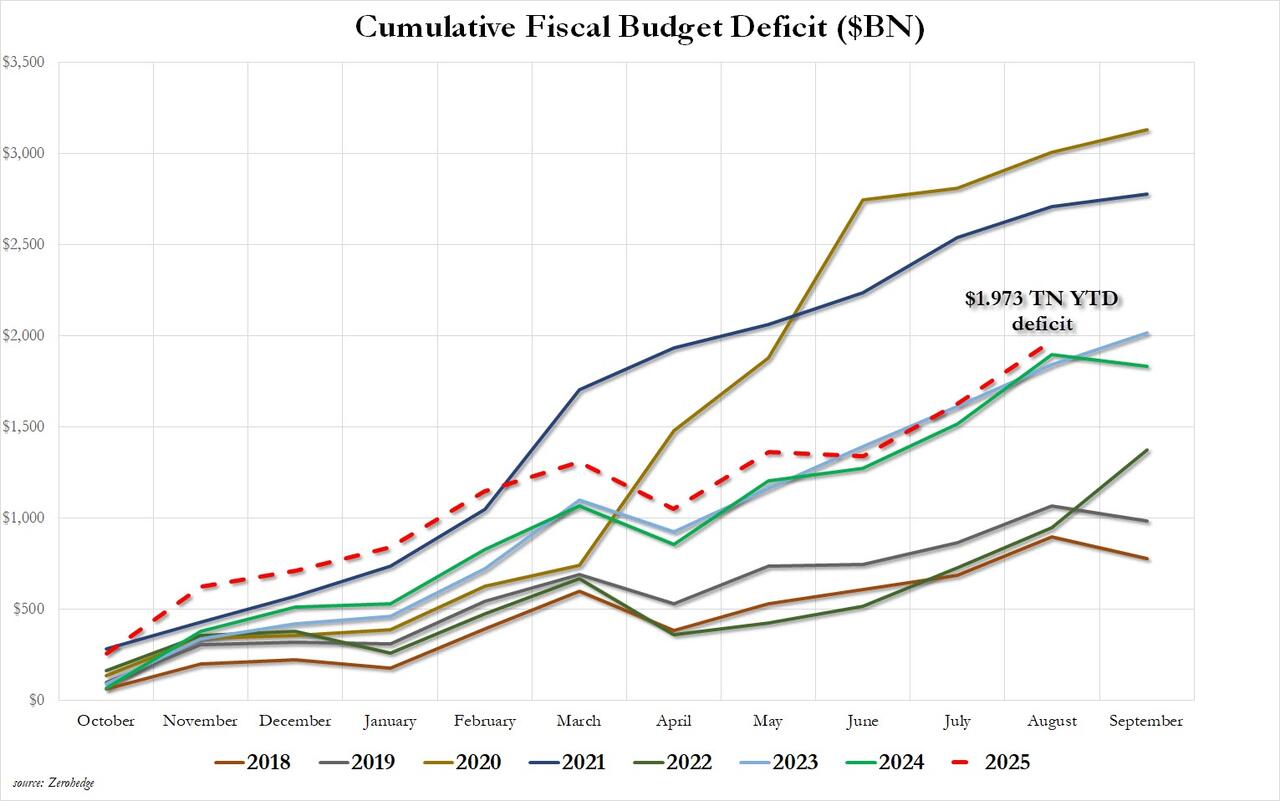
… it gets more exciting when looking at how all this growth is going to be funded. And the answer, of course, is through trillions more in unsustainable deficits, although according to the CBO these are perhaps sustainable since they never seem to end.
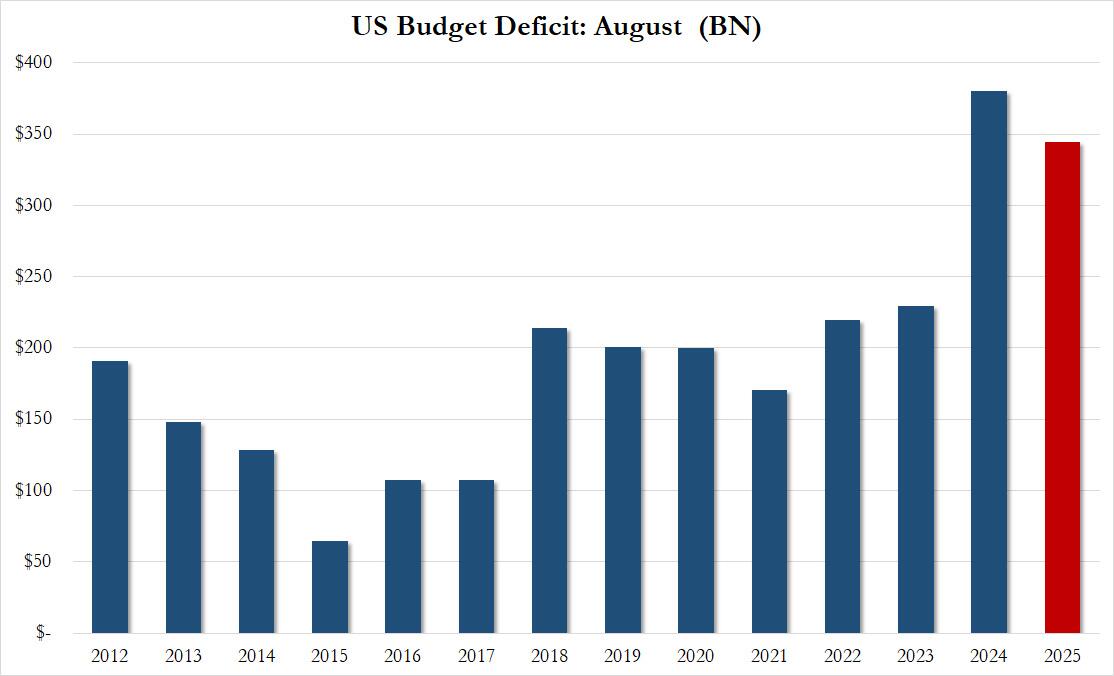
So starting with the deficit projection, the CBO expects a 2025 federal deficit of $1.9 trillion, a number which grows to $2.7 trillion by 2035. And while it amounts to 6.2% of GDP in 2025, and then drops to 5.2% by 2027 as revenues increase faster than outlays, this modestly beneficial trend quickly reverses and in later years, outlays once again increase faster than revenues, and by 2035, the deficit once again equals 6.1% of GDP, a number which according to the CBO is “significantly more than the 3.8 percent that deficits have averaged over the past 50 years.” It goes without saying that the actual deficit number will be far, far greater because even a modest recession will assure a surge in government spending (i.e., much more debt-funded deficit) which however will not result in faster growth.
It gets better. In an attempt to entrap Trump, who will very [likely] extend the expiring TCJA, or Trump tax cuts, the CBO amusingly enough cuts its long-term deficit forecast by $1 billion, but not because of higher growth or anything like that, but because it forecasts “increases in projected revenues from individual income taxes” even as “legislative changes and technical (that is, neither economic nor legislative) changes boosted projected deficits.” As a result, the cumulative deficit from 2025-2034 is expected to decline by $1 trillion, from $22.1 trillion to $21.1 trillion.
That way, in one year when the Trump tax cuts are extended, the CBO will throw the book at trump and blame him when it once again revises its deficit forecast dramatically higher.
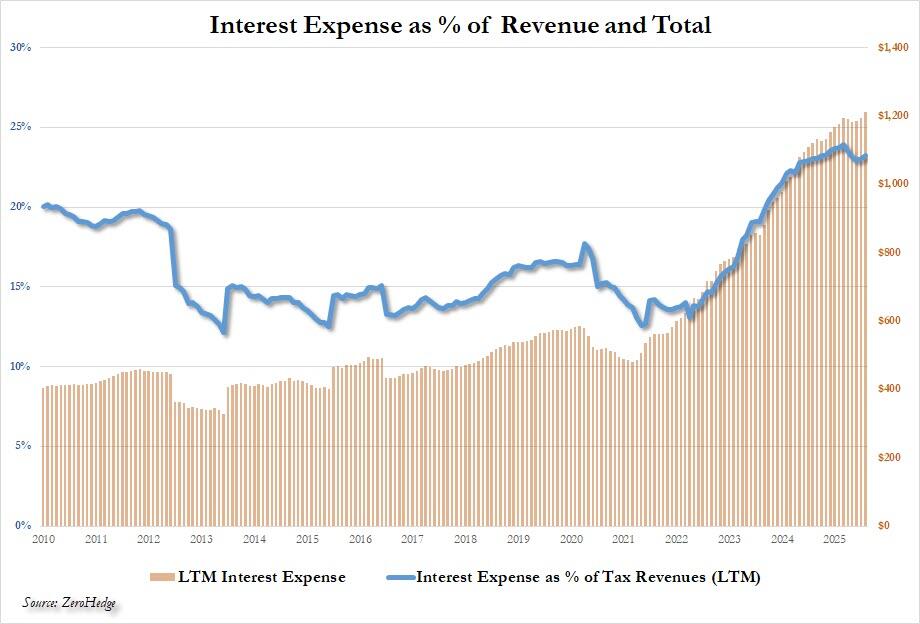
As for the real reason why the US deficit is about to go exponential has little to do with taxes, and everything to do with the stratospheric levels of US debt, or rather interest on that debt, we find that while things are more or less normal for the next 3 years, then they go vertical, to wit:
“Federal outlays in 2025 total $7.0 trillion, or 23.3 percent of GDP. They remain close to that level through 2028 and then rise, reaching 24.4 percent of GDP in 2035 (if adjusted to exclude the effects of shifts in the timing of certain payments). The main reasons for that increase are growth in spending for Social Security and Medicare and rising net interest costs.”
Unfortunately, there is no such hockeystick effect to US government revenues which total $5.2 trillion, or 17.1% of GDP, in 2025, then rise to 18.2% of GDP by 2027, which according to the CBO is “because of the scheduled expiration of provisions of the 2017 tax act”, which obviously will not expire and instead will be extended, meaning revenues will not increase and while the CBO knows this, it will instead wait for 6-12 months before letting the hammer fall in its next, far uglier forecast.
But even without the 2017 tax act, the CBO projects that revenues as a share of GDP will then decline over the next two years, falling to 17.9% in 2029, and flatline around 18.3% in 2035. In reality, this number will be far lower, perhaps around 15% if note worse, due to the extension of the Trump tax cuts which means that the next CBO forecast will be substantially worse than the current one.
Alas, this one is also a disaster, and one has to look no further than the CBO’s debt forecast to see that. That’s because while debt held by the public (which conveniently excludes debt used to fund Social Security), is currently at $28.2 trillion, this number nearly doubles by 2035, when it is expected to hit $52.1 trillion.
But wait, wouldn’t debt only increase as GDP also increased, with the relative ratio improving? Actually no, because as the infamous CBO “chart of doom” shows, as debt held by the public rises each year, it does so at a faster pace than GDP; in fact, from 2025 to 2035, debt/GDP swells from 100% to 118%, an amount which as the CBO admits, is “greater than at any point in the nation’s history.”
Now the reason why the CBO published a report that saw a modest improvement in the US fiscal picture over the next decade is not because the US fiscal picture is actually improving, but on the contrary, was to entrap Trump and republicans. As ABC notes, “the analysis paints a difficult picture for an incoming Republican administration bent on cutting taxes in ways that further widen deficits unless they’re also paired with major spending cuts.” Indeed, Trump’s proposed extension of his 2017 tax cuts that are set to expire after this year along with new cuts could easily exceed $4 trillion and his nominee to be treasury secretary, Scott Bessent, warned Thursday that the economy could crash without them.
“We do not have a revenue problem in the U.S.,” Bessent insisted at his confirmation hearings. “We have a spending problem.”
He’s right, but the even bigger problem is that cutting any spending, whether discretionary or mandatory, would lead to unprecedented economic devastation for a country that is used to issuing debt and spending it like a drunken sailor.
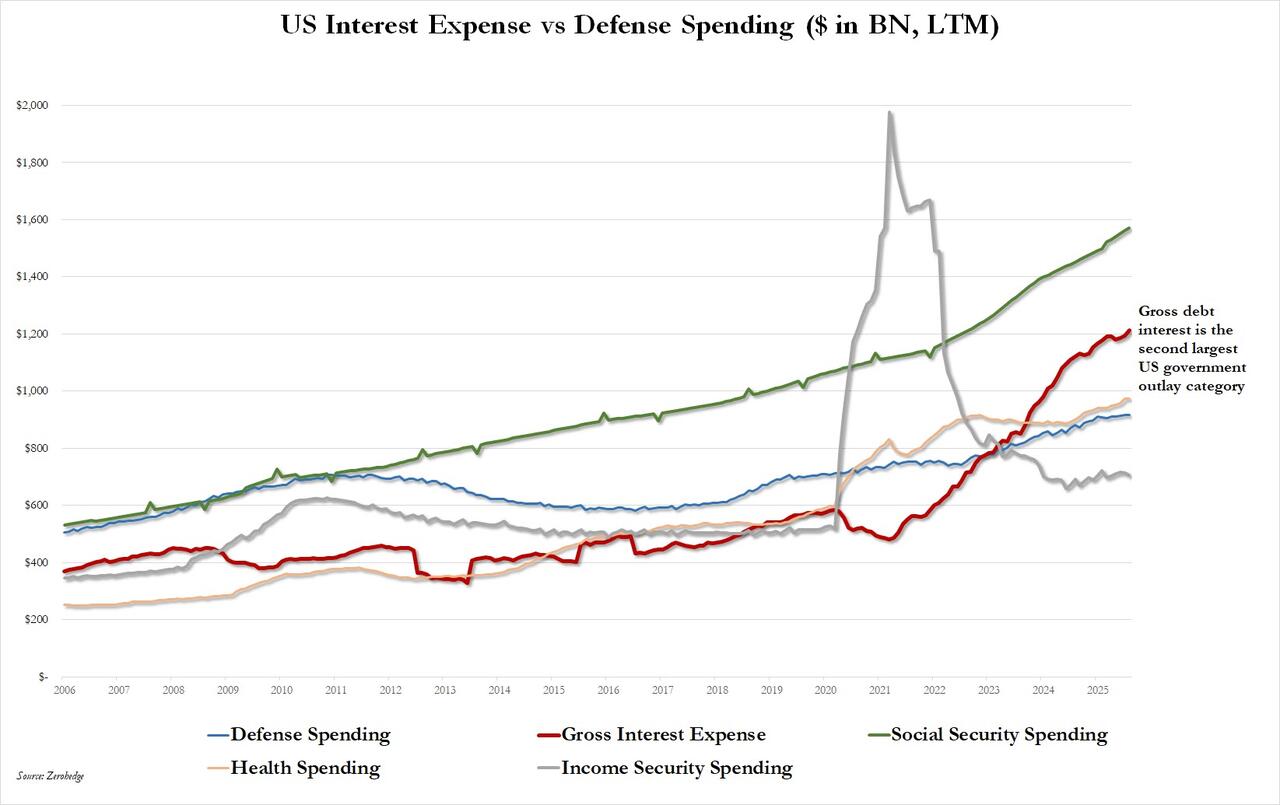
While tax revenues as a share of the total U.S. economy are close to the 50-year average, government spending is poised to continue growing, largely because of the unprecedented $1.2 trillion in gross interest expense, a number that will almost certainly never go down again, because even if interest rates do drop briefly, the total amount of debt will just keep rising, more than offsetting any rate decline. Meanwhile, discretionary spending on national security and social programs will account for $1.85 trillion next year. The CBO already has spending in these categories on a downward trajectory as discretionary spending would equal 5.3% of GDP, down from the half-century average of 7.9%.
CBO Director Phillip Swagel told reporters at a press conference Friday that net interest costs are a major contributor to the deficit and “in the coming years, net interest costs are projected to be similar to the amounts of discretionary spending for either defense or non-defense” programs.
And all of that is, of course assuming no recession and a demographic picture that remains unchanged; alas both assumptions are ludicrous….
Unfortunately for the US, it is now way too late to change the inevitable outcome of an existence that has been driven by exorbitant debt-funded spending. Indeed, when it comes to normalizing or “doing no fiscal harm” that ship has sailed, and as much as we would like for there to be some happy ending, we are terrified at what will happen when the brightest minds in the room admit that the Department of Government Efficiency (DOGE) has been a failure, and that nothing can prevent the inevitable US implosion.
The Leviticus 25 Plan – the most powerful economic acceleration plan in the world.
…………………………………….
“He who will not apply new remedies must expect new evils.” – Sir Francis Bacon
The Leviticus 25 Plan is a dynamic economic initiative providing direct liquidity benefits for American families, while at the same time scaling back the role of government in managing and controlling the affairs of citizens. It is a comprehensive plan with long-term economic and social benefits for citizens and government.
The inspiration for this plan is based upon Biblical principles set forth in the Book of Leviticus, principles tendering direct economic liberties to the people.
The Leviticus 25 Plan – An Economic Acceleration Plan for America
“The record of history is absolutely crystal clear. There is no alternative way so far discovered of improving the lot of the ordinary people that can hold a candle to the productive activities that are unleashed by a free enterprise system.” – Milton Friedman 1976 Nobel Memorial Prize in Economic Sciences
Reduced inflation and wage increases haven’t stemmed the economic struggles of middle-class Americans. In fact, some middle-income earners say it’s harder than ever to put money away in savings.
“It’s not just that middle-income families aren’t saving. They’re actively going into debt to stay afloat. The rise in buy-now-pay-later options for groceries and essentials shows just how precarious cash flow has become,”…
Paycheck to Paycheck
In October, Bank of America released a sobering study on American households living paycheck to paycheck. The results indicated the number of households barely making it between paychecks has increased across every income bracket since 2019, even those making more than $150,000 per year.
Middle-income earners in the $51,000 to $75,000 range had the largest increase between 2019 and 2024, after households with less than $50,000, in which a quarter or more live paycheck to paycheck.
Moving up the income spectrum showed similar results, with roughly a quarter of all households living in this manner. Almost half of all respondents perceive themselves as living paycheck to paycheck.
The study noted that these households have much higher necessity spending, adding that most of the expenses are “likely unavoidable, as they relate to family and housing costs.”
Zane said that groceries have become a “silent tax” on the middle class, but pointed at rising utility costs as another big factor.
“Utility costs—often neglected in mainstream discussions—have become a household budget breaker. For families living in regions with harsh winters or sweltering summers, energy bills consume a more considerable monthly income than ever,” he said.
___________________________________
Main Street America Republicans have a powerful plan to get America out of debt, revitalize financial health for American families, and clean this mess up.
The Leviticus 25 Plan is a dynamic economic initiative providing direct liquidity benefits for American families, while at the same time scaling back the role of government in managing and controlling the affairs of citizens. It is a comprehensive plan with long-term economic and social benefits for citizens and government.
The inspiration for this plan is based upon Biblical principles set forth in the Book of Leviticus, principles tendering direct economic liberties to the people.
The Leviticus 25 Plan – An Economic Acceleration Plan for America
Affordable, high quality childcare is a serious problem across America today, reaching all the way down to the smallest of communities.
Big government programs, featuring direct funding supplements and tax breaks, to address this problem will increase the role of state and federal governmental agencies over the daily affairs of citizens – and further bloat the already roaring ‘federal and state budget deficits.’
These big government childcare programs, furthermore, will do nothing to fundamentally change the landscape – and offer American families an upgrade in their quality of life.
The Leviticus 25 Plan is a comprehensive economic acceleration plan with the power to eliminate federal and state budget deficits, eliminate massive sums of household debt, and provide direct economic and social benefits, including childcare needs for all participating U.S. citizens.
U.S. childcare costs surpass those in all other OECD countries when taking into account single parents and couples earning average wage.
The price tag for having two children minded while working full-time is also significantly higher in the U.S. than in most other developed countries that are part of the organization.
Only Switzerland, the United Kingdom and New Zealand come even close to the high price parents have to shoulder for childcare in the United States.
For singles on average wage, this rises to 37 percent.
In most countries, single parents pay less as they receive a more favorable rate.
In Switzerland, the most expensive OECD country after the United States, couples with two children spent a whopping 32 percent of their disposable income on childcare if working full-time and earning average wage. For singles, this was lowered to 18 percent, however. In the U.S. and Switzerland alike, childcare is dominated by the private sector and does not receive substantial amounts of regulation or subsidies, leading to high market rates.
Many Anglophone nations, also including Ireland, New Zealand and Australia struggle with high private market rates for childcare, low subsidies or a combination of the two.
In 2022, Canadian couples working full-time for average wage still needed to shell out 19 percent of disposable income, but the government has since made changes. Like in Canada, many English-speaking nations began to regulate and subsidize their childcare markets much later than elsewhere, leading to them lagging behind in affordability despite the topic of childcare becoming ever more important in the face of demographic change. Outside of Anglophone OECD countries, couples paid the most for childcare in relative terms in the Netherlands – another place dominated by private childcare – at 19 percent of disposable income. Singles paid the most in the Czech Republic at 18 percent.
In many European countries, parents paid substantially less, often just a couple of percent of their disposable incomes, as childcare centers are either run as a public service or private providers are heavily subsidized and regulated. In France, parents who work full-time and earn average wage spent between 6 percent and 10 pecent, while this number was even lower in South Korea, other German-speaking, Scandinavian and Baltic countries. In Germany, rates were as low as 1 percent of disposable income as all parents receive childcare vouchers depending on work time to be redeemed at private or public institutions.
Working parents pay a small fee on top if they receive more than the standard five care hours. Free childcare was provided in OECD countries Italy and Latvia as well as in associated nations Bulgaria and Malta. Single parents also paid no fees in Greece and were substantially unburdened in Canada, under rent subsidies in the United Kingdom and under social assistance benefits in Japan, if they qualified for those.
_________________________________
The Leviticus 25 Plan has the power to ‘de-stress’ the average American family by granting direct liquidity benefits to resolve the childcare crisis in the U.S. today.
Participating families will be able to reduce/eliminate mortgage payments, credit card bills, car payments, installment debt — and re-balance their family finances in profoundly positive ways.
Millions of mothers who dream of staying at home and being ‘full time moms’ for their children would see that option become an instant reality. The same would apply to dads, where that option happened to be a better fit for their families.
In situations where both parents might wish to remain in the workforce and continue on with childcare, they would have more than adequate funding to cover childcare costs.
The Leviticus 25 Plan is a dynamic economic initiative providing direct liquidity benefits for American families, while at the same time scaling back the role of government in managing and controlling the affairs of citizens. It is a comprehensive plan with long-term economic and social benefits for citizens and government.
The inspiration for this plan is based upon Biblical principles set forth in the Book of Leviticus, principles tendering direct economic liberties to the people.
The Leviticus 25 Plan – An Economic Acceleration Plan for America
Neil Barofsky, the Special Inspector General of the Troubled Asset Relief Program filed an official SIG TARP report in July 2009 projecting the government’s “Total Potential Support Related to Crisis” at an astounding $23.7 trillion.
Barofsky’s report was immediately criticized as being misleading in its characterizations, prompting him to respond on May 12, 2014 to one of the chief critics, Tim Geithner, who was Secretary of the Treasury during the crisis years.
The SIG TARP report did not say that the government might “lose” $23.7 trillion, as critics claimed.
Barofsky: “What the report actually ascribes to that number (at page 138) is the “Total Potential Support Related To Crisis” (and not potential losses) of the myriad pledges of support to the financial system from an alphabet soup of agencies and programs. The numbers underlying that estimate, of course, were provided to us by Treasury and other governmental agencies, the report was vetted with Treasury before it was issued, and the report makes clear in a series of caveats that it was not an estimate of actual potential losses.
Again, the U.S. government’s “Total Potential Support Related to the Crisis” weighed in at an astounding $23.7 trillion.
The effects of that “support” for main street America were marginal, with the best of it short-lived. _________________________________________
The Leviticus 25 Plan features a Citizens Credit Facility – to serve as the conduit, from the Fed through the U.S. Department of the Treasury, for direct liquidity access by U.S. citizens – the same direct of access that was granted to Wall Street financial heavyweights during the crisis.
The Leviticus 25 Plan will provide for massive ‘ground level’ debt elimination and restore financial health for millions of American families. Money would still flow into the banking system – after first passing through the hands of U.S. citizens and the millions of small businesses in main street America.
The Leviticus 25 Plan would re-ignite powerful, long-term economic growth and put America on track for substantial budget surpluses. It would drastically scale back government control over the daily affairs of citizens. It would restore basic social freedoms and economic liberty for all.
Question: What would be the U.S. government’s “Total Potential Support Related to The Leviticus 25 Plan?”
Answer: $21.6 trillion – all of which would get ‘repaid’ to the government over a 10-15 year period.
The Leviticus 25 Plan is a dynamic economic initiative providing direct liquidity benefits for American families, while at the same time scaling back the role of government in managing and controlling the affairs of citizens. It is a comprehensive plan with long-term economic and social benefits for citizens and government.
The inspiration for this plan is based upon Biblical principles set forth in the Book of Leviticus, principles tendering direct economic liberties to the people.
It is time for an economic recovery plan that grants access to liquidity for all Americans, not just Wall Street and the wealthy ‘elite.’
Loaded up and ready to launch: The Leviticus 25 Plan 2025.
……………………………………………………………
Global Banks 2008: “We need a transfusion.” And $23.7 trillion later, the Fed said: “Tell Us When to Stop.”
And transfuse they did.
The U.S. Treasury turned the spigot into the ‘flow’ position with the Troubled Asset Relief Program (TARP).
And the Fed followed up by turning the spigot into the ‘gusher’ position with their emergency lending, discount window lending, and their QE-based purchases of cesspool-grade MBS and agency debt from various global lending institutions.
……………………………………………………………
Notes on the liquidity transfusions: 1. SIGTARP, the oversight agency of the Troubled Asset Relief Program (TARP), in its July 2009 report, vetted by Treasury, noted that the U.S. Government’s “Total Potential Support Related to Crisis” (page 138) amounted to $23.7 trillion. While this figure represents a backstop commitment, not a measure of total potential loss, it is nonetheless an astounding degree of support, in the form of liquidity infusions, credit extensions and guarantees, various other forms of assistance for financial institutions and other business entities affected by the financial crisis.
One example of the mechanics of these backstop commitments involved two of the major investment-banks which were at the forefront of the U.S. financial crisis, Goldman Sachs and JP Morgan who, through their high-risk exposure to subprime debt and derivatives, received enormous financial assistance at the expense of U.S. taxpayers.
Goldman Sachs and J.P. Morgan received these direct liquidity infusions during the financial crisis via Fed disbursements through the Primary Dealer Credit Facility and numerous other credit facilities. The two (according to ZeroHedge 4-1-11) “had the temerity to pledge bonds that had defaulted (i.e. had a rating of D)… as in bankrupt, and pretty much worthless. . . that have no value whatsoever. . .” Goldman Sachs received $24.7 million and JP Morgan $1.4 million on the worthless collateral (September 15, 2008). Goldman Sachs pledged D-rated securities again September 29, 2008 and received $82.7 million (Citigroup received $102.8 million; Merrill Lynch – $217.8 million; Morgan Stanley – $261.0 million; UBS – $202.2 million).
In addition, the same two investment banking giants, Goldman Sachs and JP Morgan, earned free interest (again at taxpayer expense) through their access to credit extensions at the Federal Reserve discount window. Within two years, Goldman Sachs was paying out $111.3 million in “delayed bonuses” for the years 2007 and 2009 (NY Times 12-15-10).
_________________________________
U.S. citizens deserve nothing less than to be grated the same direct access to credit extensions for resolving liquidity issues of their own at the family level, than those that were so graciously provided by the Fed to major domestic and foreign financial institutions.
The initial credit extension outlay with The Leviticus 25 Plan ($21.6 trillion – assuming an 80% participation rate by U.S. citizens) would hardly be prohibitive, in light of the trillions of dollars in Federal Reserve and Treasury outlays over the past 5 years to major U.S. banking and financial institutions (Morgan Stanley, Citigroup, Bank of America, State Street Corp, Goldman Sachs, Merrill Lynch, JPMorgan Chase, Wachovia, Lehman Brothers, Wells Fargo, Bear Stearns) and major foreign financial institutions (Royal Bank of Scotland, UGS AG, Deutsche Bank AG, Barclays, Credit Suisse. Dexia, BNP Paribas).
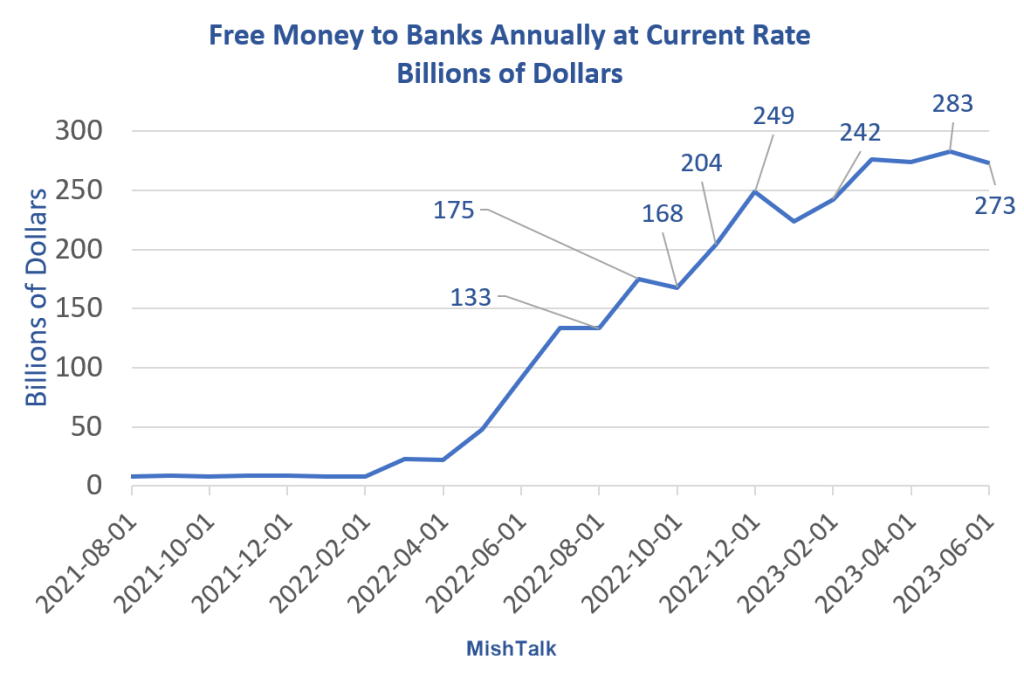
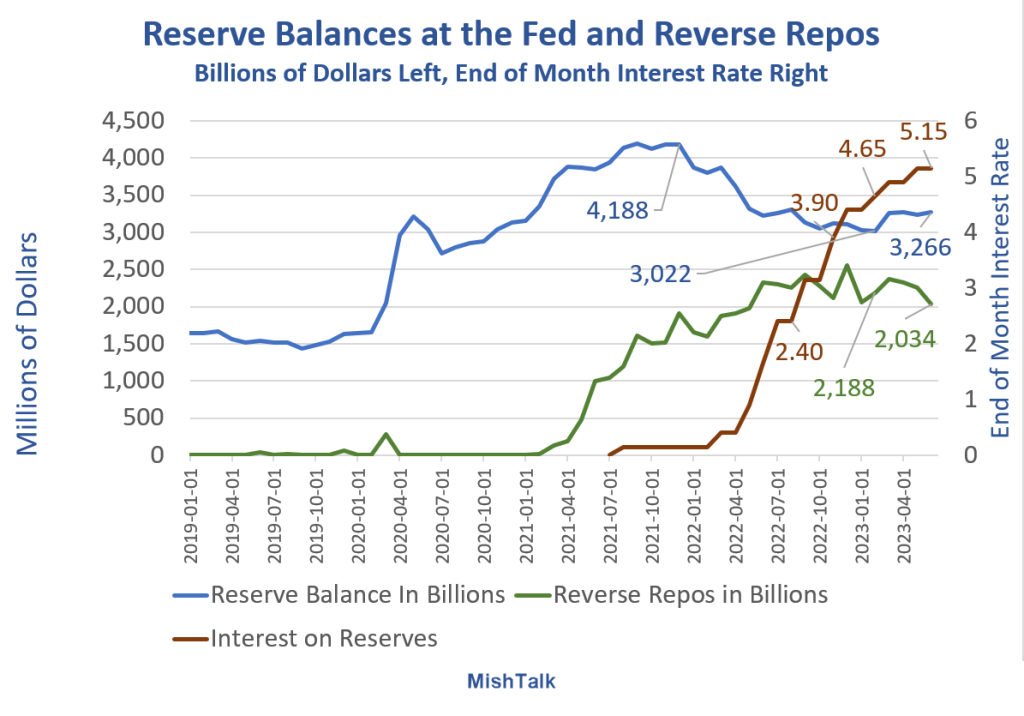
The Federal Reserve’s various credit facilities, discount window transactions, emergency loans, Foreign Exchange swap lines, Interest on Excess Reserves (IOER) for foreign banks, and Treasury’s TARP and stimulus programs have done little to improve the financial status for the majority of American families. These government programs have also done nothing to change the dominance and risk profile of “too big to fail banks,” and they have done little to lessen the counterparty default risk in the global derivatives markets.
The time is now to rebalance the financial dynamics of America – and grant U.S. citizens the same direct access to liquidity that was provided to Wall Street’s financial sector.
The Leviticus 25 Plan – An Economic Acceleration Plan for America
Leviticus, chapter 25 outlines a divinely inspired plan which “the Lord spake unto Moses” in proclaiming a unique period of Jubile. “And ye shall hallow the fiftieth year, and proclaim liberty throughout all the land unto all the inhabitants thereof” (verse 10).
Debtors – bondmen and bondmaids – were granted liberty from their indebtedness. Property was returned to the rightful owners, and distinct benefits were accorded “the poor, who now were acquitted from all their debts, and restored to their possessions” (Wesley). Leviticus 25:17 sets forth the solemn reminder, “Ye shall not therefore oppress one another; but thou shalt fear thy God: for I am the Lord your God.”
Jubile “set bounds both to the insatiable avarice of some, and the foolish prodigality of others, that the former might not wholly and finally swallow up the inheritances of their brethren, and the latter might not be able to undo themselves and their posterity forever, which was a singular privilege of this law and people.” (Wesley)
Jubile provided a fresh start with economic liberties and a societal rebalancing to counter permanent class structures.
America is ready now for a plan that is modeled upon these divine precepts – an economic recovery plan that directly benefits American citizens in a timely manner.
The Leviticus 25 Plan – An Economic Acceleration Plan for America
Leviticus 25 Plan – what is the justification for allowing U.S. citizens access to Federal Reserve liquidity extensions (or, via liquidity extensions that flow from the Fed to the U.S. Treasury Department, and then directly on to qualifying U.S. citizens) ?
First, a review of key precipitating events’ leading into the 2007 financial crisis…
During the peak of the housing boom, mortgage brokers were pumping the red-hot housing market for all it was worth. Major financial institutions entered the game, purchasing massive amounts of mortgage ‘paper,’ which they repackaged into tranches which were then securitized as Mortgage Backed Securities (MBS) – and peddled as high-grade income-producing investment vehicles.
Financial heavyweights like Morgan Stanley, Merrill Lynch, Goldman Sachs and many others jumped into the game. They purchased ‘insurance’ to hedge their risks in the event that the underlying value of their warehoused mortgage paper suddenly evaporated… and to maintain ‘capital adequacy’ requirements.
The ‘insurance,’ in the form of Credit Default Swaps (CDS), was purchased primarily from triple-A rated AIG. And, thanks to some nifty deregulation orchestrated by Treasury Chief Robert Rubin, AIG was not required to carry any meaningful level of reserves to back their Credit Default Swap business – to pay their counterparties if the Mortgage Backed Securities market… ‘went south.’
It did just that, and the rest is history. Housing tanked. MBS’ tanked. And AIG had no reserves with which to pay Goldman and others. Had normal bankruptcy proceedings prevailed, Goldman Sachs would likely have received just pennies on the dollar in settlement – for placing a huge ‘blind bet’ on an investment that had no reserves backing it up.
But – the U.S. Government stepped in and arbitrated a settlement of 100 cents on the dollar, amounting to a direct cash transfusion of a cool $12.9 trillion – from the U.S. taxpayer – to Goldman Sachs.
And then the real ‘fun’ began. The investment banking heavyweights, Goldman Sachs and J.P. Morgan, were ‘fast-tracked’ for “federal bank charters.’ Their newly acquired status as commercial banks allowed them to joined in with “Bank of America, Citigroup, J.P. Morgan Chase and other banking titans who could go to the Fed and borrow massive amounts of money” at near-zero percent interest.
“The ability to go to the Fed and borrow big at next to no interest was what saved Goldman, Morgan Stanley and other banks from death in the fall of 2008. “They had no other way to raise capital at that moment, meaning they were on the brink of insolvency,” says Nomi Prins, a former managing director at Goldman Sachs.
“The Fed was the only shot.”
“In fact, the Fed became not just a source of emergency borrowing that enabled Goldman and Morgan Stanley to stave off disaster — it became a source of long-term guaranteed income. Borrowing at zero percent interest, banks like Goldman now had virtually infinite ways to make money. In one of the most common maneuvers, they simply took the money they borrowed from the government at zero percent and lent it back to the government by buying Treasury bills that paid interest of three or four percent. It was basically a license to print money — no different than attaching an ATM to the side of the Federal Reserve.”
“You’re borrowing at zero, putting it out there at two or three percent, with hundreds of billions of dollars — man, you can make a lot of money that way,” says the manager of one prominent hedge fund. “It’s free money.” (Source: Wall Street’s Bail out Hustle – Matt Taibbi, 2-17-10).
And therein lies the primary justification for the Leviticus 25 Plan. If the Federal Reserve can bail out the very financial entities that precipitated the financial crisis with their leveraged speculation gambling binge, then they can help restore financial health to American families, also.
U.S. citizens deserve nothing less than to be granted the same direct access to the Federal Reserve / U.S. Treasury liquidity extensions that was previously provided, on the most generous of terms, to the likes of Morgan Stanley, Citigroup, Bank of America, Goldman Sachs, JP Morgan, State Street, Merrill Lynch, Lehman, AIG, Deutsche Bank, UBS, Barclays, RBS, BNP Paribas… and numerous others.
__________________________________
The Leviticus 25 Plan is a dynamic economic initiative providing direct liquidity benefits for American families, while at the same time scaling back the role of government in managing and controlling the affairs of citizens. It is a comprehensive plan with long-term economic and social benefits for citizens and government.
The inspiration for this plan is based upon Biblical principles set forth in the Book of Leviticus, principles tendering direct economic liberties to the people.
The Leviticus 25 Plan – An Economic Acceleration Plan for America