WSJ: Medicaid Dollars “Directly to Patients”

WSJ: Give Medicaid Dollars Directly to Patients

Each beneficiary could get $7,000 a year in a health savings account.

By Justin Haskins and Michael Hamilton | April 12, 2017

As Republicans take another crack at devising a plan to replace ObamaCare, here’s an idea they should consider: Give each Medicaid patient a health savings account—and put $7,000 in it every year.

Under ObamaCare, Medicaid has become the only option for millions of Americans. But that doesn’t mean much if the doctors in their communities don’t accept new patients through the program—and 30% of physicians don’t.

The GOP’s recently benched health-care bill would have substantially reformed Medicaid by giving the states block grants, along with more flexibility on how to spend the money. But there’s a better model. Republicans should empower Medicaid patients by providing funds to them directly, which would allow them to build a personal safety net that could last a lifetime.

Washington and state governments spent $545 billion in 2015 on 73 million Americans covered by Medicaid and the Children’s Health Insurance Program. Instead lawmakers could take $511 billion of that total, divide it equally among enrollees, and give each one a health savings account with $7,000 a year. This would be real money for the poor, stored in real private accounts.

Recipients could use the deposit to buy health insurance and cover the cost of prescriptions, copays, deductibles and other related expenses. Unspent money would carry over to the following year. Enrollees could share that $7,000 with a sick spouse, sibling, parent or child.

Most recipients would probably use the funds to buy private health insurance, many for the first time. The average annual premium last year for an (overpriced) bronze plan on the ObamaCare exchanges was about $3,100 for a 30-year-old, $3,500 for a 40-year-old, $4,900 for a 50-year-old, and $7,400 for a 60-year-old. After that, at age 65, Americans qualify for Medicare.

Those figures mean that even after paying the premiums, all but the oldest Medicaid recipients would have money left over each year to save or spend on additional health-care costs. Enrollees who are relatively young and healthy soon would build personal safety nets worth tens of thousands of dollars. This would not only be good for them, it would stabilize Medicaid, which has become an enormous and unpredictable burden on state budgets.

Because bronze-plan deductibles are high—a 2017 average of about $6,100 for an individual and $12,400 for a family—some patients, especially those over 59 or with serious health problems, will need more help. Lawmakers could allocate the remaining $34 billion in the Medicaid budget line to assist them.

Under this plan, ObamaCare’s ban on pre-existing conditions should be kept in place for a set period with a firm sunset date. That would give Medicaid recipients time to buy in without penalty. Increasing the number of people enrolled in private insurance would then help spread risk and lower costs.

This plan would be a major improvement on both ObamaCare and the Republican proposal, creating personal safety nets and giving tens of millions access to high-quality health insurance. It might just be popular too.

Mr. Haskins is executive editor and Mr. Hamilton a research fellow at the Heartland Institute.

______________________________

The WSJ $7,000 plan is a small step in the right direction.

The Leviticus 25 Plan’s U.S. Health Care Freedom Plan, however, would be a major, far more powerful, step in the right direction.

1) It would help lift hundreds of thousands of U.S. citizens up and out of poverty, and reduce, by tens of thousands, the number of people even qualifying for Medicare enrollment (due to asset limitations); 2) It would clean up the health care system and restore citizen-centered, market-based health care that would be far more cost-effective, clean, and effective for everyone involved; 3) It would generate federal and state budget surpluses each of its first five years of activation (2026-2030), and pay for itself entirely over a 10-15 year period.

The Leviticus 25 Plan is a dynamic economic initiative providing direct liquidity benefits for American families, while at the same time scaling back the role of government in managing and controlling the affairs of citizens.  It is a comprehensive plan with long-term economic and social benefits for citizens and government.

The inspiration for this plan is based upon Biblical principles set forth in the Book of Leviticus, principles tendering direct economic liberties to the people.

The Leviticus 25 Plan – An Economic Acceleration Plan for America

$90,000 per U.S. citizen – Leviticus 25 Plan 2026 (25667 downloads )

U.S. Budget Deficit Hits New Record $840 Billion over First 4 Months of 2025…

US Budget Deficit Hits A Record $840 Billion In First 4 Months Of 2025; Interest On Debt Hits Record $1.2 Trillion

ZeroHedge, Feb 12, 2025 – Excerpts:

First the good news: Elon Musk’s DOGE is going through government spending with a fine-toothed comb, slashing a million here, a billion there.

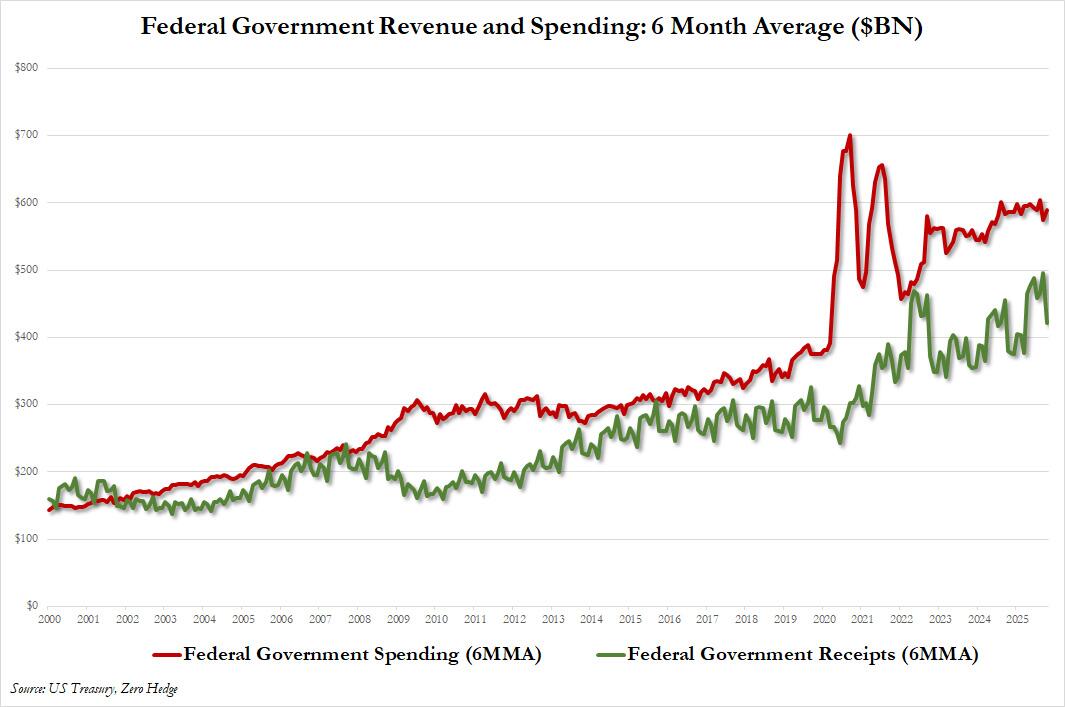
The bad news: at the rate it is going, DOGE will need a few hundred years to make a tangible impact, because as the Treasury reported earlier today, in January the US government spent a near-record $642 billion, a 29% increase from the $500 billion in January…

… while it collected just $513.3 billion in tax revenues, a far more modest 7.5% increase YoY…

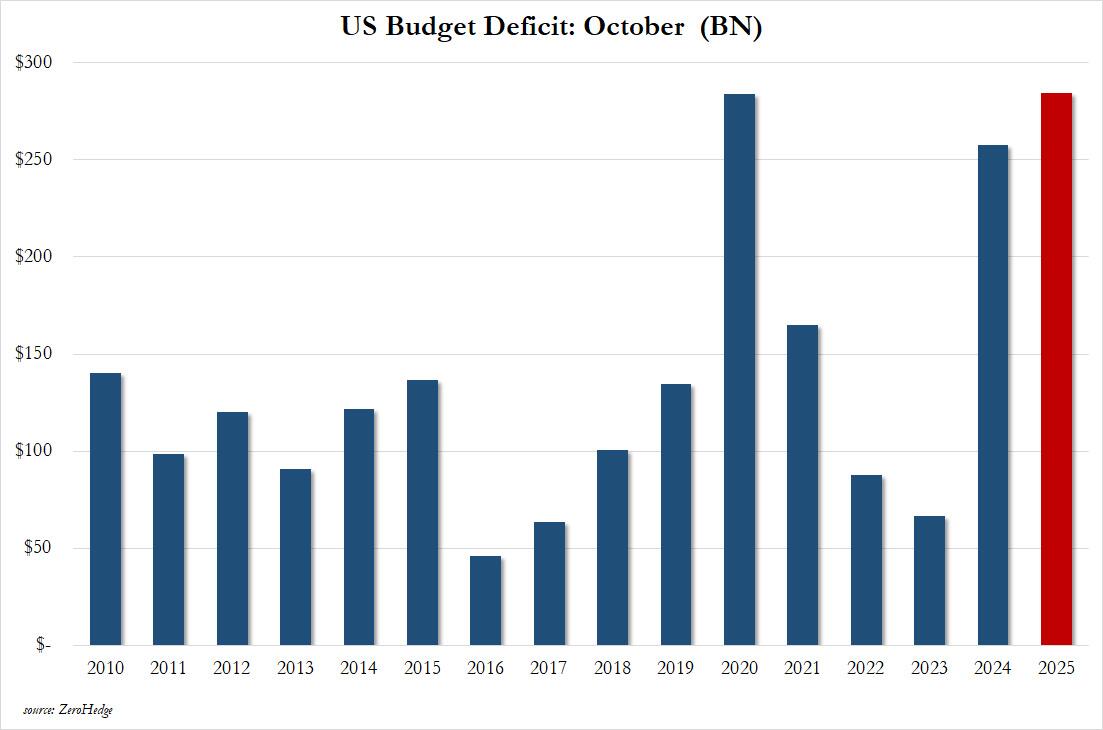
… which resulted in a $129 billion budget deficit for the month

… the second highest January deficit on record (only the post-covid shock of 2021 was great)…

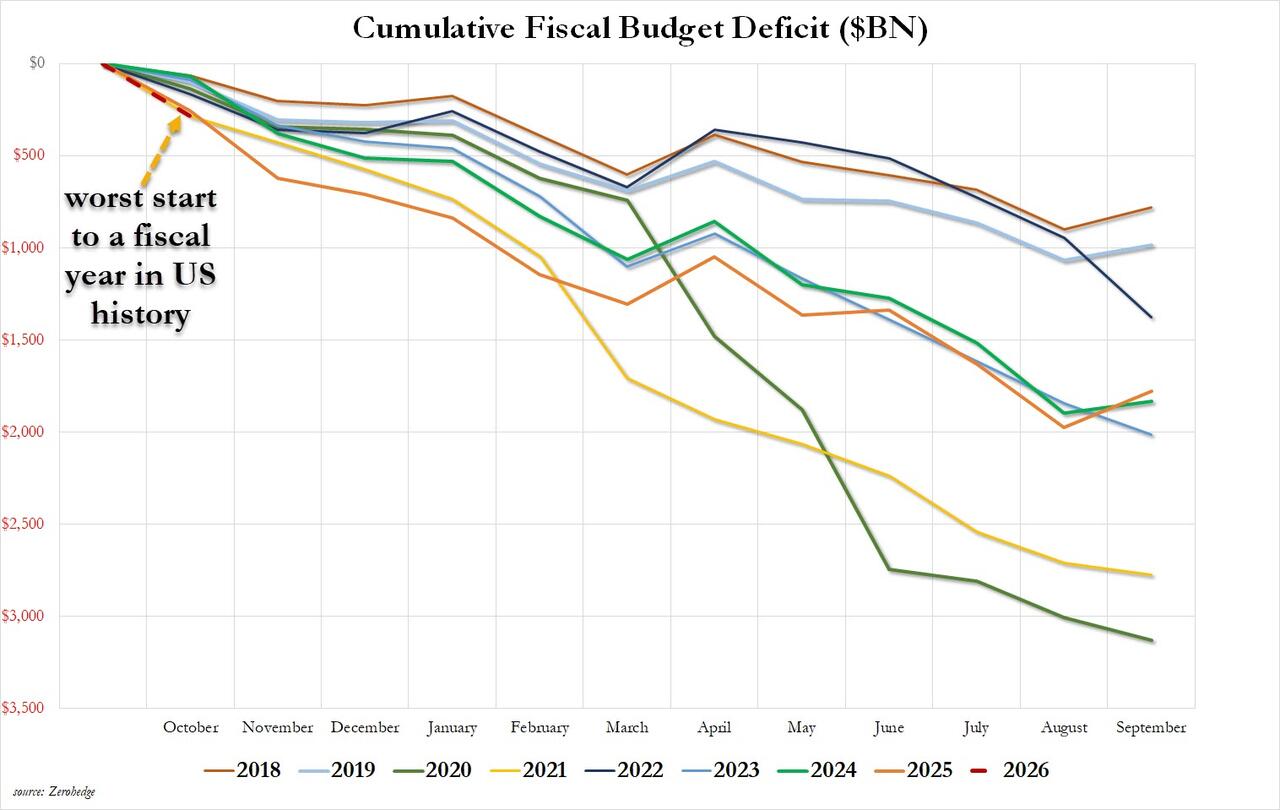
… and $840 billion so far in fiscal 2025.

This is a problem because as shown in the next chart, the cumulative budget deficit for the first 4 months of fiscal 2025 is the highest on record, surpassing even the fiscal shock from the depths of the post-covid response.

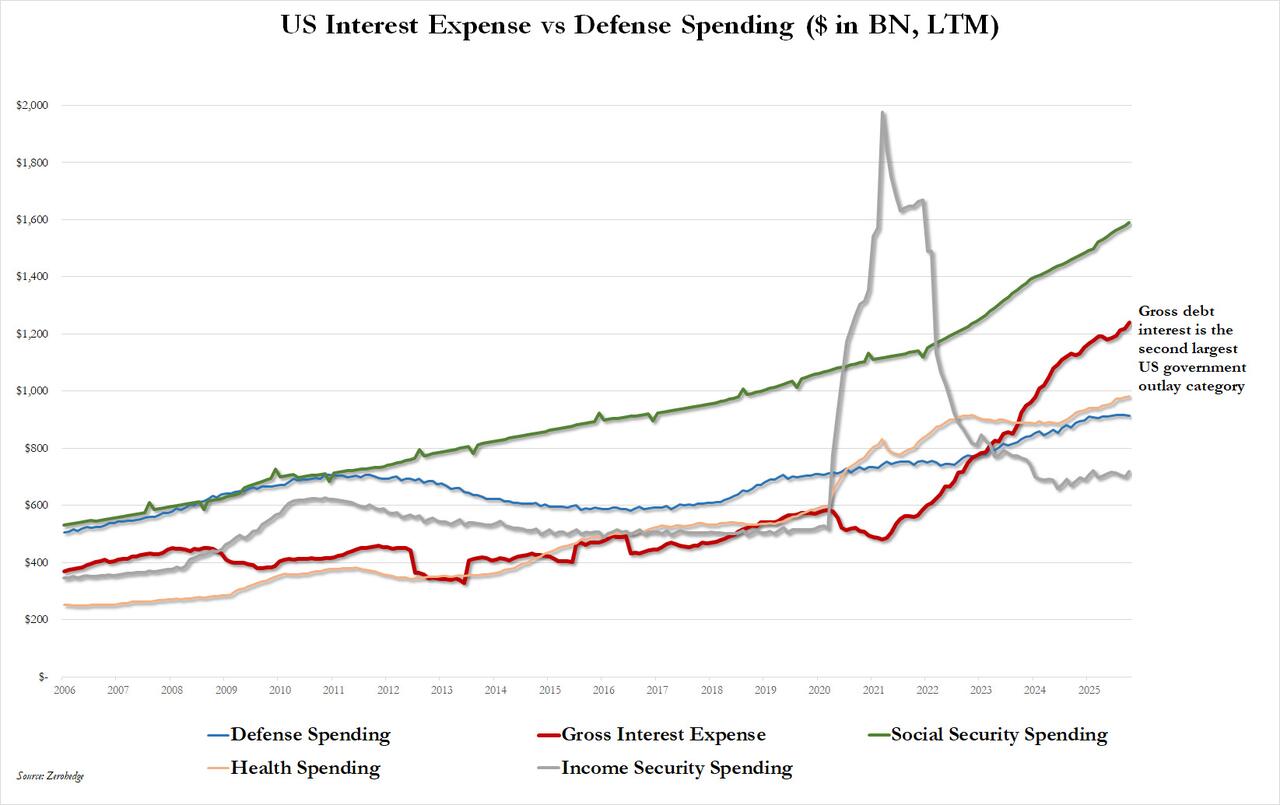
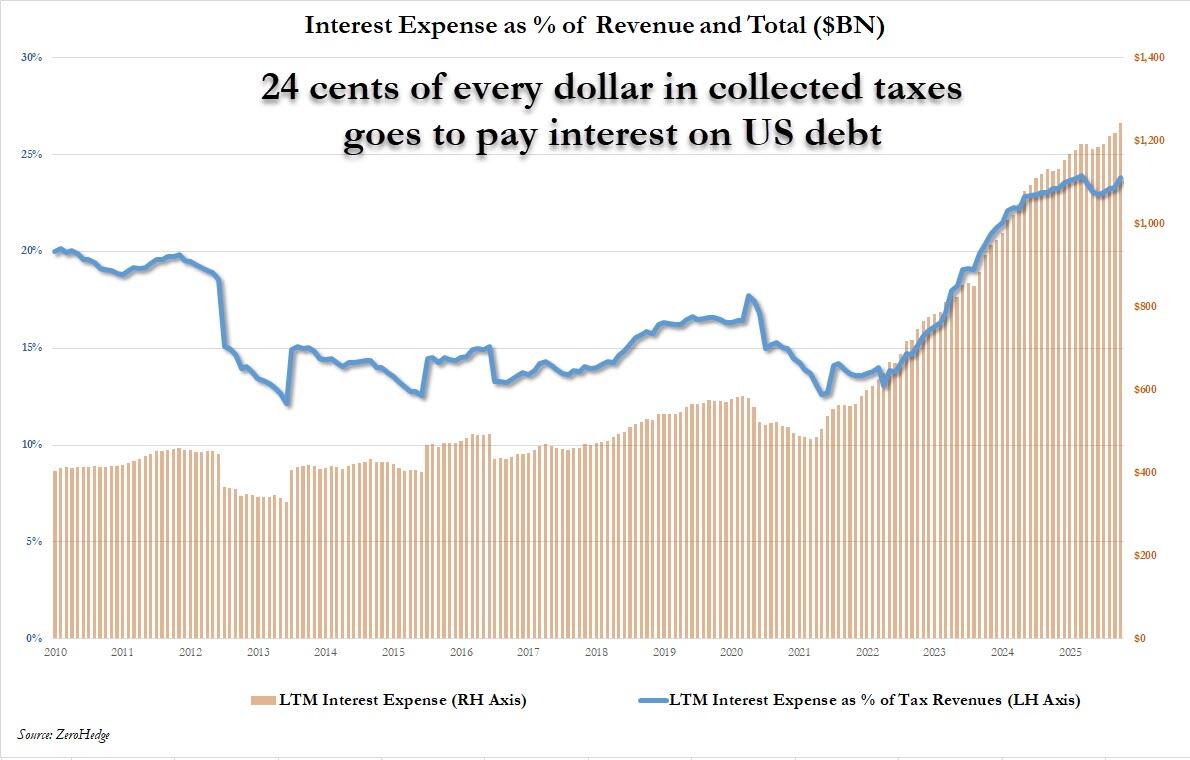
And the punchline is that no matter what Musk does, the USS Titanic is now more or less on autopilot because while a few billions in discretionary spending can be cut, interest on the debt can not be – without a default (it can however be inflated away… and it will be) – and in January, gross interest on the Federal debt hit a record $1.167 trillion in the past twelve months thanks to another $83.6 billion in interest spending.

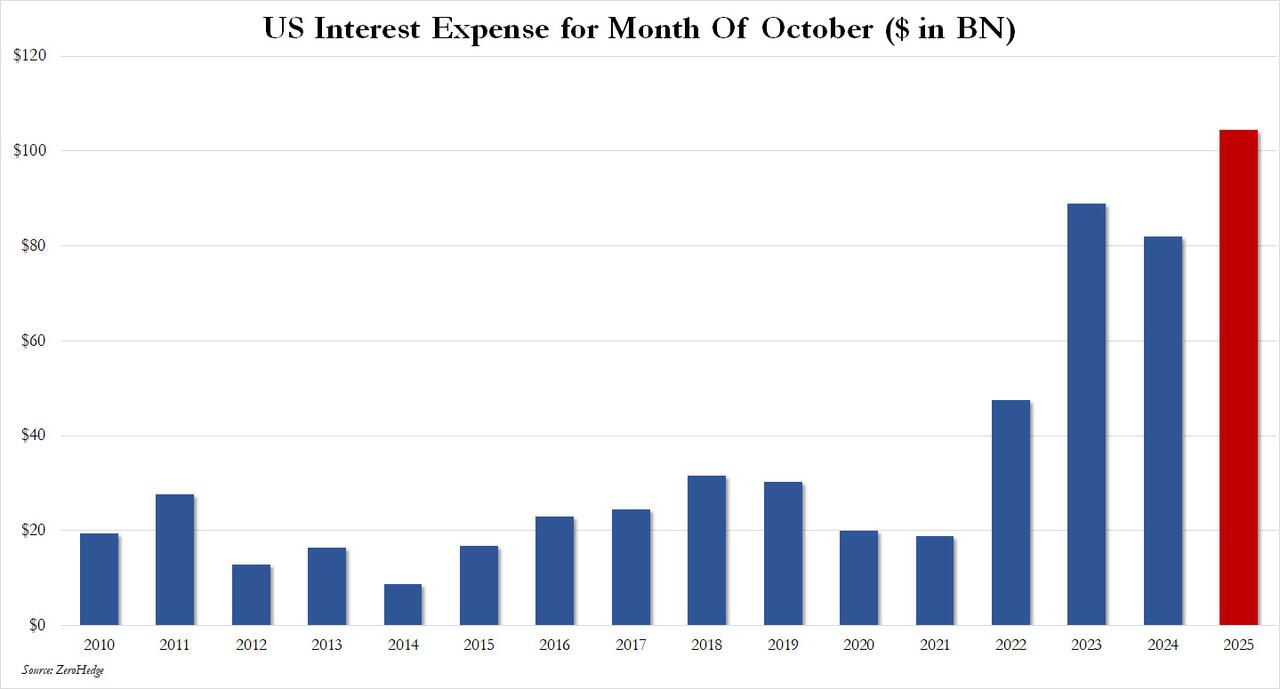
Another way of looking at it: in the first four months of the fiscal year, the US has spent $392 billion on interest alone, the highest 4 month total ever.

_____________________________________________

There is only one plan in the all the world with the power to clean up this paralyzing debt burden once and for all — a plan with a Biblical precedent.

The Leviticus 25 Plan is a dynamic economic initiative providing direct liquidity benefits for American families, while at the same time scaling back the role of government in managing and controlling the affairs of citizens.  It is a comprehensive plan with long-term economic and social benefits for citizens and government.

The inspiration for this plan is based upon Biblical principles set forth in the Book of Leviticus, principles tendering direct economic liberties to the people.

The Leviticus 25 Plan – An Economic Acceleration Plan for America

$90,000 per U.S. citizen – Leviticus 25 Plan 2026 (25334 downloads )

Student Loan Debt: 42.7 Million Borrowers ‘In the Hole’ for $1.773 Trillion. The Leviticus 25 Plan – Problem Solved.

Student Loan Debt is a massive problem for 42.7 million borrowers, totaling $1.773 trillion and compounding at an annual rate of 6.87%.

The Leviticus 25 Plan offers a powerful and fair solution to all of this – the only viable solution on the table anywhere in the U.S.. It is a solution that cleans up massive amounts of debt across the board, in both the public and private sectors.

……………………………………

Student Loan Interest Rates: Federal, Private, Refinancing

NerdWallet

Dec 16, 2024 — The average student loan interest rate is 6.87% among all households with student debt, according to the Education Data Initiative, an organization that collects statistics on the U.S. education system. That includes both federal and private student loans — 94.81% of all student debt is federal.

With a 6.87% interest rate on $30,000 of student loans, a borrower would pay about $11,500 in interest over 10 years….

The federal student loan interest rate for undergraduates is 6.53% for new loans taken out for the 2024-25 school year, effective from July 1, 2024, to June 30, 2025. Federal rates for graduate student loans and PLUS loans are higher — 8.08% and 9.08%, respectively. These rates are the highest they’ve been in at least 16 years.

…………………………………………….

Student Loan Debt Statistics – Education Data Initiative

By Melanie Hanson | Last Updated: January 15, 2025 – Excerpts:

Report Highlights. Student loan debt in the United States totals $1.773 trillion; annual growth resumed in 2024 following year-over-year (YoY) declines that began in 2023.

  • The outstanding federal student loan balance is $1.693 trillion; 42.7 million student borrowers have federal loan debt.
  • Federal student loan debt represents 92.4% of all student loan debt; 7.57% of student loan debt is private, including $29.3 billion in refinance loans.
  • The average federal student loan debt balance is $38,375, while the total average balance (including private loan debt) may be as high as $41,520.
  • 4.86% of federal student loans dollars were in default as of 2024’s fourth financial quarter (2024 Q4); 1.61% of private student loans were in default as of 2024 Q1.
  • The average public university student borrows $31,960 to attain a bachelor’s degree.

__________________________________

The Leviticus 25 Plan grants qualifying U.S. citizens direct liquidity extensions via a Fed / U.S. Treasury Citizens Credit Facility.

Each qualifying U.S. citizen who wishes to participate will receive $60,000 deposited directly into a Family Account and $30,000 deposited into a Medical Savings Account.

Students with loan debt wishing to participate would have their existing student loan balance subtracted from their $60,000 direct deposit, leaving the average student not only ‘debt free,’ but also with an average of $20,000 in excess reserve, plus $30,000 in reserve for primary care medical needs.

This plan is far superior to any ‘student loan forgiveness’ plan, in that it properly rewards $60,000 / $30,000) the millions of college and technical school graduates who worked hard and paid back their loans. The same direct credit extensions would be granted to qualifying U.S. citizen children into a family custody account, setting them up for a college education or other life career path when they graduate from high school.

And it properly and fairly rewards ($60,000 / $30,000) each and every other qualifying hard-working, tax-paying (including now-retired) U.S. citizens across all sectors of society (military, law enforcement, construction, service-sector, industry, small business…).

The Leviticus 25 Plan will generate $36.568 billion federal budget surpluses during each of its first five years of activation (2026-2030). And it will restore financial security for millions of American families.

The most powerful debt-busting economic acceleration plan anywhere in the world.

The Leviticus 25 Plan is a dynamic economic initiative providing direct liquidity benefits for American families, while at the same time scaling back the role of government in managing and controlling the affairs of citizens.  It is a comprehensive plan with long-term economic and social benefits for citizens and government.

The inspiration for this plan is based upon Biblical principles set forth in the Book of Leviticus, principles tendering direct economic liberties to the people.

The Leviticus 25 Plan – An Economic Acceleration Plan for America

$90,000 per U.S. citizen – Leviticus 25 Plan 2026 (25332 downloads )

Consumer Credit Soars into All-Time High APRs

Tapped-out consumers resorted to credit card liquidity to make ends meet in December.

America needs a rescue plan…

…………………………………….

Consumer Credit Unexpectedly Surges By Most On Record Despite All-Time High APRs

ZeroHedge, Feb 07, 2025 – Excerpts:

…. US consumers exited 2024 with a bang after Consumer credit soared by a record $40.8 billion in December, a complete reversal of the $5.4 billion November drop, and a month that sticks out like a sore thumb in the history of consumer credit as shown below.

The December print is all the more remarkable when considering that Wall Street consensus was for a $14.6BN consumer credit print. This means that the actual number was a 4 sigma beat to expectations, the biggest on record for this particular data series……..

Taking a closer look at the number, while non-revolving debt (i.e. student and auto loans) rose modestly as it always does rising by $18 billion, it was revolving, or credit card debt, that cratered soared by a whopping $22.3 billion, a remarkable reversal to the $14 billion drop in November which was the biggest drop since the covid crash shut down the economy, and the biggest monthly increase on record.

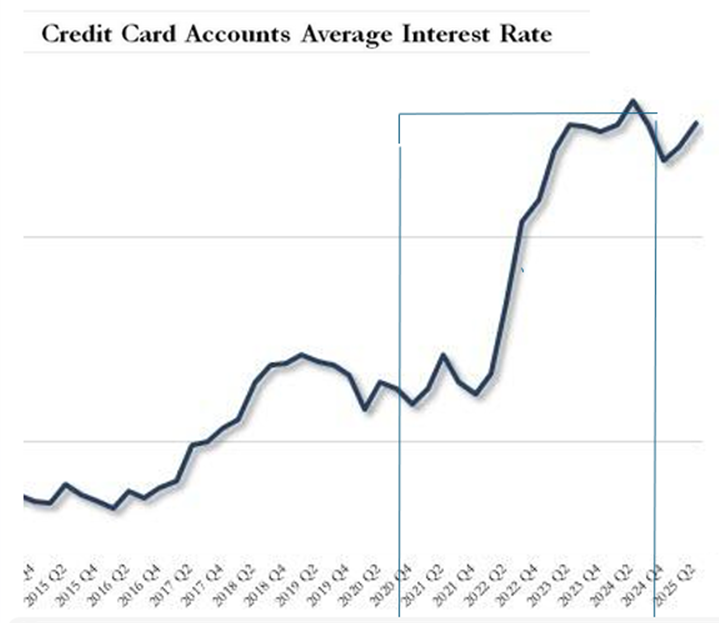
And while last month’s unexpected drop could at least have been explained with the fact that credit card APRs were at all time highs (currently 23% up almost 10% from a decade again), the fact that APRs remained there just under a record high certainly does not explain why US consumers scrambled to max out their credit cards at the end of 2024, just as their savings accounts hit the lowest level in years.

While the surge in credit card usage may explain the burst in spending to end the year, there is only so far that an economy can be pushed with maxed out credit cards.

___________________________________

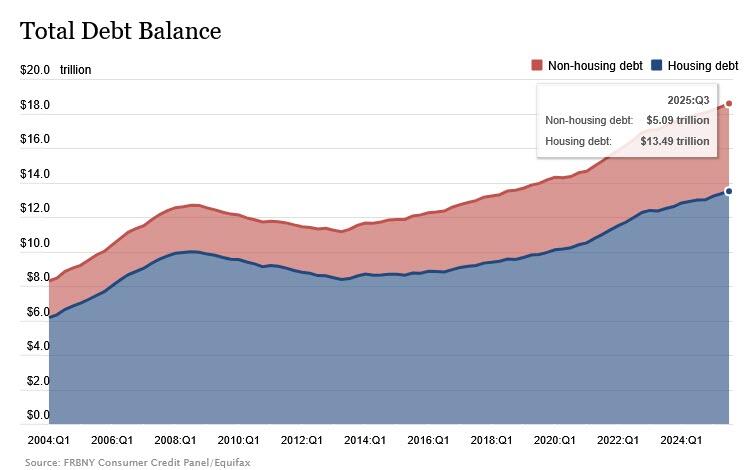
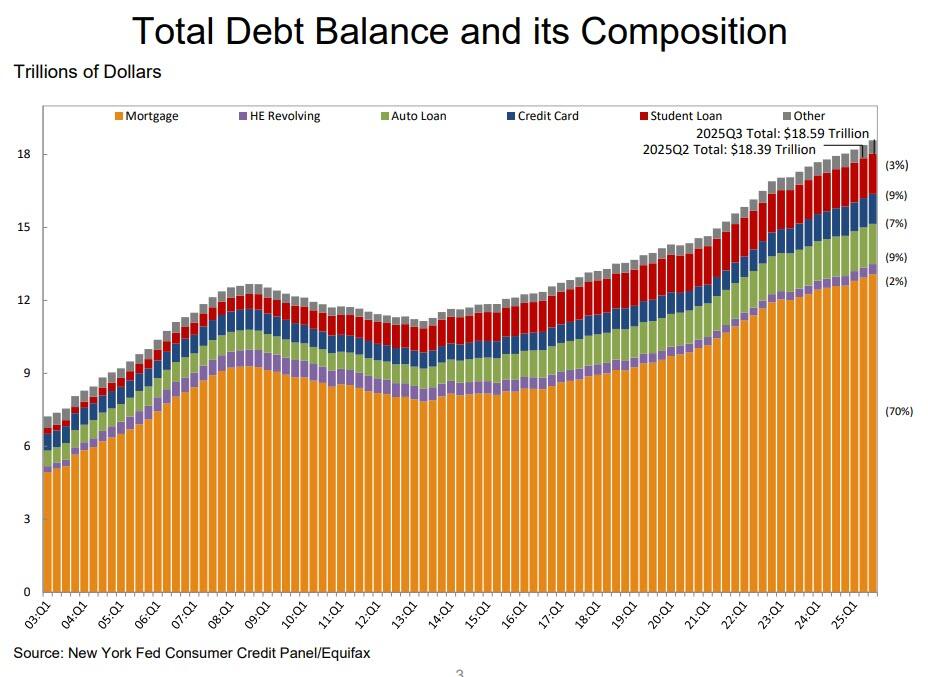
According to the latest report, Household Deb has reached $17.94 trillion.

Federal Reserve Bank of New York – Q3 2024

There is only one plan in the world right now with the power to get this debt tsunami back under control – and set America back on track for societal contentment and economic prosperity.

The Leviticus 25 Plan is a dynamic economic initiative providing direct liquidity benefits for American families, while at the same time scaling back the role of government in managing and controlling the affairs of citizens.  It is a comprehensive plan with long-term economic and social benefits for citizens and government.

The inspiration for this plan is based upon Biblical principles set forth in the Book of Leviticus, principles tendering direct economic liberties to the people.

The Leviticus 25 Plan – An Economic Acceleration Plan for America

$90,000 per U.S. citizen – Leviticus 25 Plan 2026 (25034 downloads )

U.S. Bailout of Banking Titan BNP Paribas – Another Strong Case for The Leviticus 25 Plan

BNP Paribas is the largest bank in the Eurozone and 10th largest bank worldwide. This French financial behemoth is headquartered in Paris, with global headquarters in London.  It owns subsidiaries all over the world, including BankWest in the U.S..

BNP was a major recipient of U.S taxpayer funds courtesy of the Federal Reserve and U.S. Treasury Department during the financial crisis years – to help restore them to ‘financial health.’ BNP has been involved in some distinctly ‘shady’ (and blatantly illegal) schemes in the past. They have recently ‘rolled the dice’ on an $80 million derivatives trade – and came up empty…

ZeroHedge (Feb 6, 2019): BNP lost $80 million in S&P500-linked derivative trades around Christmas; the massive trading loss emerged after Antoine Lours, BNP’s head of US index trading, put on positions on the S&P 500 which then quickly started losing money.

BNP Paribas escaped the 2007–09 credit crisis relatively unscathed reporting a €3 billion net profit for the year of 2008, and €5.8 billion for 2009.” (Source: Wikipedia)

Thanks in no small part to U.S. taxpayers…

Background – Exhibit A:

Zero Hedge  Feb 13, 2014US Taxpayer “Bailed Out” BNP Paribas Probed By DoJ & Fed “TARP Recipient BNP Paribas got $4.9bn of bailouts from the U.S. Taxpayer – Today, as the WSJ reports we learn BNP Paribas has been funding transactions in Iran, Syria and other countries subject to U.S. Sanctions since 2002. The bank set aside $1.1 billion to settle investigations by the Department of Justice and the Federal Reserve but as the NY Times reports, investigations are playing out on multiple fronts – centering on whether the firm did “a significant amount” of business in “blacklisted” countires (and routed the deals through the US financial system).”

Via WSJ,  –  “…an internal probe conducted over the past few years “a significant volume of transactions” between 2002 and 2009 that could be “considered impermissible under U.S. laws and regulations...” “involving entities that were doing business in U.S.-sanctioned countries, such as Iran, Cuba, Sudan and Libya during the 2002 to 2009 period.

BNP Paribas SA on Thursday became the latest bank to disclose the extent of its litigation problems in the U.S., saying it has set aside $1.1 billion against potential penalties related to transactions in countries under sanctions...

…………………………………

Background – Exhibit B:                    

BNP Paribas Sued by US Over Banker’s Alleged Role in Fraud 

Oct. 19, 2011 (Bloomberg) — “BNP Paribas SA was sued by the U.S. over allegations the Paris-based bank aided a grain export fraud scheme involving commodity payment guarantees provided by the Department of Agriculture.

A corporate banker in BNP’s Houston office allegedly helped a scheme that defrauded the Agriculture Department of at least $78 million through deals he made with four U.S. grain exporters, according to a complaint filed yesterday in federal court in Houston.”

………………………….

Bloomberg  Nov 28, 2011  –  #18 recipient of Fed’s “secret liquidity lifelines”

The credit crisis accelerated after BNP Paribas SA, France’s biggest bank, announced in August 2007 that it would halt withdrawals from three funds because mortgage-market turmoil “made it impossible” to value certain assets. BNP began taking Federal Reserve loans in December 2007 when the Term Auction Facility opened. By April 2008, its Fed debt reached $29.3 billion. In 2009, BNP became the euro region’s largest bank by deposits, purchasing Brussels-based Fortis’s units in Belgium and Luxembourg for 10.4 billion euros ($15.2 billion). It issued 5.1 billion euros of preference shares to the French government in March 2009, and reimbursed the state by October. In December 2010, when the Fed disclosed the loans, BNP said it used the TAF “to assist in recycling and facilitating liquidity.”

Peak Amount of Debt on 4/18/2008:  $29.3B

_______________________________________

BNP Paribas received $4.9 billion in TARP funds from the U.S., and they went on to rake in a tidy $29.3 billion credit extension from the Fed via the Term Auction Facility… “to assist in recycling and facilitating liquidity.”

They were meanwhile funding significant transactions (Bloomberg) “involving entities that were doing business in U.S.-sanctioned countries, such as Iran, Cuba, Sudan and Libya during the 2002 to 2009 period.”  And they ran a “grain export fraud scheme” which ‘cooked’ the U.S. Department of Agriculture for a cool $78 million.

Begging the question:  If BNP Paribas is deserving of direct liquidity infusions from the U.S. government and the Fed, then would it not be perfectly reasonable for U.S. citizens to also qualify for their own direct liquidity extensions “to assist in recycling and facilitating liquidity” at the family level.

………………………………………….

The Leviticus 25 Plan is the most powerful and dynamic economic acceleration plan in the world – delivering citizen-driven economic growth and citizen-centered healthcare.

The inspiration for this plan is based upon Biblical principles set forth in the Book of Leviticus, principles tendering direct economic liberties to the people.

The Leviticus 25 Plan – An Economic Acceleration Plan for America

$90,000 per U.S. citizen – Leviticus 25 Plan 2026 (24699 downloads )

2008 Review: The Federal Reserve’s “Secret Liquidity Lifelines” for Major Banks.

The Leviticus 25 Plan vs the Fed’s 2008-2010 secret emergency lending programs – A critical perspective, in planning for America’s future.

The Federal Reserve’s ‘secret liquidity lifelines’ for major banks:

Bloomberg LP filed a Freedom of Information Act (FOIA) lawsuit on Nov 7, 2008 to gain access to information regarding special emergency lending programs that the U.S. Federal Reserve had been running to help borrower banks deal with cash shortages and collateral deficiencies. The Fed fought the lawsuit, but ultimately lost.

Bloomberg gained access to more than 29,000 pages of previously secret loan documents and Fed spreadsheets, and published the highlights of those programs in late 2011.

According to Bloomberg, the top 15 recipients of Fed’s ‘secret liquidity lifelines’ were: Morgan Stanley ($107 billion), Citigroup Inc. ($99.5 billion), Bank of America Corp ($91.4 billion), Royal Bank of Scotland Plc ($84.5 billion), State Street Corp ($77.8 billion), UBS AG ($77.2 billion), Goldman Sachs Group Inc. ($69 billion), JP Morgan Chase & Co ($68.6 billion), Deutsche Bank AG ($66 billion), Barclays Plc ($64.9 billion), Merrill Lynch & Co Inc. ($62.1 billion), Credit Suisse Group AG ($60.8 billion), Dexia SA ($58.5 billion), Wachovia ($50 billion).

………………………………………………………………………..

The Fed ‘flooded’ the financial coffers of these major U.S. and foreign banks (with U.S subsidiaries) with trillions of dollars in direct cash transfers, credit guarantees, and balance sheet transfers of (often ‘sewage grade’) agency debt and MBS – and the principles of those institutions ended up making out very well. None of the principles involved took a serious haircut.

Meanwhile, Main Street America did not fare well…

There were severe financial dislocations. 8.7 million Americans lost their jobs during the financial crisis years. 4.1 million American families lost their homes through completed foreclosures from September 2008 through December 2012, according to CoreLogic.

_________________________________

It is now time for a Round 2 “emergency lending program,” one that would restore financial security for millions of American families – via direct liquidity extensions channeled through a Federal Reserve / U.S. Treasury Citizens Credit Facility.

The Leviticus 25 Plan – An Economic Acceleration Plan for America

$90,000 per U.S. citizen – Leviticus 25 Plan 2026 (24670 downloads )

America 2025: Cyberattacks, Security Threats “Daunting,” Critical Infrastructure Highly Vulnerable.

A coordinated series of major cyberattacks targeting “transportation nodes, telecommunications services, power grids, water facilities… and likely much more,” would wreak unimaginable societal upheaval across the U.S., with devastating consequences for millions of families – who currently have no financial reserves to help insulate them from financial hurricane that would be sure to follow.

America needs a dynamic, massive debt-elimination plan that would insulate the broad American public from the loss of homes, the temporary loss of jobs and income, and the loss of opportunity to provide for their families.

Solution: The Leviticus 25 Plan

………………………………

“Defining Threat of our Generation”Christopher Wray Fox News

January 18, 2025 – Excerpts:

“Serving as FBI Director for the past seven-plus years has given me an unparalleled view of the threats to our country’s public safety and national security. From where I sit, these threats are more dangerous and complex than at any time I can recall since I began my career in law enforcement almost 30 years ago.

Our adversaries—whether they be violent gangs, child predators, cartels, hackers, hostile nation-states, or terrorists—are more emboldened, better resourced, savvier with technology, and more relentless than ever before. With a keystroke, a foreign hacker can shut down a hospital or take our critical infrastructure offline. A would-be terrorist can communicate with plotters overseas through encrypted apps to secretly plan an attack on U.S. soil. Cartels can manufacture loads of deadly drugs with a potency no one has ever seen before using chemicals acquired half a world away.

The terrorism threat is elevated across the board.

“Looking ahead, the challenges to our security will grow even more daunting, and our margin for error will continue to shrink.”

“The Chinese government, in particular, has engineered an unprecedented effort to gut American innovation, steal our most precious personal data, and meddle in our free and open society. History will mark this as the defining threat of our generation,” Wray wrote.

Wray urged the the United States to prioritize unity and vigilance, warning that the margin for error in combating these threats is shrinking rapidly.

________________________________

FBI’s Wray Drops ‘Chinese Infiltration’ Bomb On Way Out, Warns Of Threat To Critical Infrastructure

ZeroHedge, Jan 13, 2025 – Excerpts:

According to outgoing FBI Director Christopher Wray in a Sunday [Jan 12, 2025] appearance on “60 Minutes,” – “The Chinese government is prepositioning on American civilian critical infrastructure to lie in wait on those networks to be in a position to wreak havoc & inflict real world harm at a time & place of their choosing.”

Wray described the CCP as “the greatest long-term threat” and the “defining threat of our generation” due in part to its state-funded cyber program that’s poised to “wreak havoc” on a whim – targeting water treatment plants, the electrical grid, natural gas infrastructure and other systems.

According to Wray, China has pre-positioned malware throughout American infrastructure.

He also says that Beijing has been listening to communications by high-level US officials.

According to a Feb. 5 assessment from the Office of the Director of National Intelligence, China is the “most active and persistent cyber threat to U.S. Government, private-sector, and critical infrastructure networks.”

_____________________________

CCP Cyberattacks Stoke Calls To Beef Up Western Counterespionage

ZeroHedge, Jan 22, 2025 – Authored by Venus Upadhayaya via The Epoch Times

Excerpts:

Jen Easterly, director of the U.S. Cybersecurity and Infrastructure Security Agency, highlighted the geopolitical context of Beijing’s increasing cyberespionage in a Jan. 15 blog post titled “Strengthening America’s Resilience Against the PRC Cyber Threats.”

A crisis in Asia, precipitated by an invasion of Taiwan or a blockade of the Taiwan Strait, could have very real consequences for the safety and security of American citizens here at home,” Easterly wrote.

Such an invasion, she wrote, could be followed by disruptive attacks against “everything, everywhere, all at once.” Those attacks could hit transportation nodes, telecommunications services, power grids, water facilities, “and likely much more,” she wrote.

______________________________

“He who will not apply new remedies must expect new evils.” – Sir Francis Bacon

The Leviticus 25 Plan is a dynamic economic initiative providing direct liquidity benefits for American families, while at the same time scaling back the role of government in managing and controlling the affairs of citizens.  It is a comprehensive plan with long-term economic and social benefits for citizens and government.

The inspiration for this plan is based upon Biblical principles set forth in the Book of Leviticus, principles tendering direct economic liberties to the people.

The Leviticus 25 Plan – An Economic Acceleration Plan for America

$90,000 per U.S. citizen – Leviticus 25 Plan 2026 (24670 downloads )

“Soaring Debt” and the fatalistic view that “nothing can prevent the inevitable US implosion.”

The Leviticus 25 Plan has the raw power to quench such fatalistic views — effecting massive reductions in government outlays and generating enormous, ongoing tax revenue inflows. to bring about dynamic federal, state, and local budget surpluses. 

The Leviticus 25 Plan will generate average annual budget surpluses of $36.568 billion for each of the first five years of activation (2026-2030) — vs current CBO-projected average annual deficits of $1.938 trillion.

This represents a monumental $2.304 trillion positive budget gain annually (2026-2030) for the U.S. federal budget, with major gains falling into line, also, for state and local government entities.

__________________________________ 

Scoring Update Summary:

*  The Leviticus 25 Plan 2026 Generates $36.568 Billion Federal Budget Surpluses Annually (2026-2030). Part 1: Overview, Deficit Projections (CBO)

*  The Leviticus 25 Plan Generates $36.568 Billion Federal Budget Surpluses Annually (2026-2030). Part 2: Federal Income Tax Recapture; Economic Security / Means-Tested Welfare Recapture.

*  The Leviticus 25 Plan Generates $36.568 Billion Federal Budget Surpluses Annually (2026-2030). Part 3: Medicaid, Medicare, VA, TRICARE, FEHB, SSDI Recapture

The Leviticus 25 Plan Generates $36.568 Billion Federal Budget Surpluses Annually (2026-2030). Part 4: Interest Expense Recapture

The Leviticus 25 Plan Generates $36.568 Billion Federal Budget Surpluses Annually (2026-2030). Part 5: Current Economic Scoring – Summary Totals

___________________________________  

Note 1:  Projected budget surpluses for 2026-2030 do not factor in the additional government tax revenue gains that would accrue from the massive shift in capital away from debt service and into productive economic activity.

Note 2:  Projected budget surpluses for 2026-2030 do not factor in the additional government tax revenue gains that would accrue from significantly lower levels of debt deductibility on individual income tax filings. 

Note 3:  Projected budget surpluses from the Medicaid / CHIP recapture do not take into account the likelihood of fewer citizens actually qualifying for Medicaid / CHIP benefits.

Note 4:  Projected budget surpluses from Interest Expense Reductions during each of the first five years of activation (2026-2030) is likely understated due to the fact that ‘debt held by the public’ is projected to increase by 8.5% per year, from $28.278 trillion in 2026 to $40.198 trillion in 2030.

Note 5The Plan’s funding of individual Medical Savings Accounts (MSAs) with the $6,000 deductible provision per year would result in an enormous drop in the number of claims each year for Medicare reimbursement. Medicare payroll taxes would generate a growing revenue stream, due to stronger economic growth, while outlays would drop significantly from the reduced claims numbers – thereby providing the Fed with a powerful tool to recapitalize the Medicare Trust Fund, vis the Citizen’s Credit Facility.

……………………………………….

CBO Projects US Debt To Soar By $24 Trillion Over Next Decade, And Then It Gets Much Worse…

ZeroHedge, Jan 17, 2025 – Excerpts:

….According to the latest CBO budget and economic outlook for the decade 2025 to 2035 the situation is hopeless and getting worse, and even though the budget office doesn’t use those actual terms, it does get pretty close.

While the economic picture presented by the CBO is hardly shocking, if as ridiculous as always, with zero recessions expected over the coming decade when the CBO projects GDP growing at a 1.8% annual pace, with inflation magically flat at 2.0%, unemployment rate a sticky 4.4% and a 3.2% fed funds rate (translating into 3.8% 10Y yield)…

it gets more exciting when looking at how all this growth is going to be funded. And the answer, of course, is through trillions more in unsustainable deficits, although according to the CBO these are perhaps sustainable since they never seem to end.

So starting with the deficit projection, the CBO expects a 2025 federal deficit of $1.9 trillion, a number which grows to $2.7 trillion by 2035. And while it amounts to 6.2% of GDP in 2025, and then drops to 5.2% by 2027 as revenues increase faster than outlays, this modestly beneficial trend quickly reverses and in later years, outlays once again increase faster than revenues, and by 2035, the deficit once again equals 6.1% of GDP, a number which according to the CBO is “significantly more than the 3.8 percent that deficits have averaged over the past 50 years.” It goes without saying that the actual deficit number will be far, far greater because even a modest recession will assure a surge in government spending (i.e., much more debt-funded deficit) which however will not result in faster growth.

It gets better. In an attempt to entrap Trump, who will very [likely] extend the expiring TCJA, or Trump tax cuts, the CBO amusingly enough cuts its long-term deficit forecast by $1 billion, but not because of higher growth or anything like that, but because it forecasts “increases in projected revenues from individual income taxes” even as “legislative changes and technical (that is, neither economic nor legislative) changes boosted projected deficits.” As a result, the cumulative deficit from 2025-2034 is expected to decline by $1 trillion, from $22.1 trillion to $21.1 trillion.

That way, in one year when the Trump tax cuts are extended, the CBO will throw the book at trump and blame him when it once again revises its deficit forecast dramatically higher.

As for the real reason why the US deficit is about to go exponential has little to do with taxes, and everything to do with the stratospheric levels of US debt, or rather interest on that debt, we find that while things are more or less normal for the next 3 years, then they go vertical, to wit:

“Federal outlays in 2025 total $7.0 trillion, or 23.3 percent of GDP. They remain close to that level through 2028 and then rise, reaching 24.4 percent of GDP in 2035 (if adjusted to exclude the effects of shifts in the timing of certain payments). The main reasons for that increase are growth in spending for Social Security and Medicare and rising net interest costs.”

Unfortunately, there is no such hockeystick effect to US government revenues which total $5.2 trillion, or 17.1% of GDP, in 2025, then rise to 18.2% of GDP by 2027, which according to the CBO is “because of the scheduled expiration of provisions of the 2017 tax act”, which obviously will not expire and instead will be extended, meaning revenues will not increase and while the CBO knows this, it will instead wait for 6-12 months before letting the hammer fall in its next, far uglier forecast.

But even without the 2017 tax act, the CBO projects that revenues as a share of GDP will then decline over the next two years, falling to 17.9% in 2029, and flatline around 18.3% in 2035. In reality, this number will be far lower, perhaps around 15% if note worse, due to the extension of the Trump tax cuts which means that the next CBO forecast will be substantially worse than the current one.

Alas, this one is also a disaster, and one has to look no further than the CBO’s debt forecast to see that. That’s because while debt held by the public (which conveniently excludes debt used to fund Social Security), is currently at $28.2 trillion, this number nearly doubles by 2035, when it is expected to hit $52.1 trillion.

But wait, wouldn’t debt only increase as GDP also increased, with the relative ratio improving? Actually no, because as the infamous CBO “chart of doom” shows, as debt held by the public rises each year, it does so at a faster pace than GDP; in fact, from 2025 to 2035, debt/GDP swells from 100% to 118%, an amount which as the CBO admits, is “greater than at any point in the nation’s history.”

Now the reason why the CBO published a report that saw a modest improvement in the US fiscal picture over the next decade is not because the US fiscal picture is actually improving, but on the contrary, was to entrap Trump and republicans. As ABC notes, “the analysis paints a difficult picture for an incoming Republican administration bent on cutting taxes in ways that further widen deficits unless they’re also paired with major spending cuts.” Indeed, Trump’s proposed extension of his 2017 tax cuts that are set to expire after this year along with new cuts could easily exceed $4 trillion and his nominee to be treasury secretary, Scott Bessent, warned Thursday that the economy could crash without them.

“We do not have a revenue problem in the U.S.,” Bessent insisted at his confirmation hearings. “We have a spending problem.”

He’s right, but the even bigger problem is that cutting any spending, whether discretionary or mandatory, would lead to unprecedented economic devastation for a country that is used to issuing debt and spending it like a drunken sailor.

While tax revenues as a share of the total U.S. economy are close to the 50-year average, government spending is poised to continue growing, largely because of the unprecedented $1.2 trillion in gross interest expense, a number that will almost certainly never go down again, because even if interest rates do drop briefly, the total amount of debt will just keep rising, more than offsetting any rate decline. Meanwhile, discretionary spending on national security and social programs will account for $1.85 trillion next year. The CBO already has spending in these categories on a downward trajectory as discretionary spending would equal 5.3% of GDP, down from the half-century average of 7.9%.

CBO Director Phillip Swagel told reporters at a press conference Friday that net interest costs are a major contributor to the deficit and “in the coming years, net interest costs are projected to be similar to the amounts of discretionary spending for either defense or non-defense” programs.

And all of that is, of course assuming no recession and a demographic picture that remains unchanged; alas both assumptions are ludicrous….

Unfortunately for the US, it is now way too late to change the inevitable outcome of an existence that has been driven by exorbitant debt-funded spending. Indeed, when it comes to normalizing or “doing no fiscal harm” that ship has sailed, and as much as we would like for there to be some happy ending, we are terrified at what will happen when the brightest minds in the room admit that the Department of Government Efficiency (DOGE) has been a failure, and that nothing can prevent the inevitable US implosion.

More in the full CBO bidget forecast.

__________________________________

The Leviticus 25 Plan – the most powerful economic acceleration plan in the world.

…………………………………….

“He who will not apply new remedies must expect new evils.” – Sir Francis Bacon

The Leviticus 25 Plan is a dynamic economic initiative providing direct liquidity benefits for American families, while at the same time scaling back the role of government in managing and controlling the affairs of citizens.  It is a comprehensive plan with long-term economic and social benefits for citizens and government.

The inspiration for this plan is based upon Biblical principles set forth in the Book of Leviticus, principles tendering direct economic liberties to the people.

The Leviticus 25 Plan – An Economic Acceleration Plan for America

$90,000 per U.S. citizen – Leviticus 25 Plan 2026 (24516 downloads )

The Leviticus 25 Plan 2026 Generates $36.568 Billion Federal Budget Surpluses Annually (2026-2030). Part 1: Overview, Deficit Projections (CBO)

The Leviticus 25 Plan – the most powerful economic acceleration plan in the world: Annual economic scoring update. For each of the first five years of activation (2026-2030), The Leviticus 25 Plan will generate average annual budget surpluses of $36.568 billion vs current CBO-projected average annual deficits of $1.983 trillion for the same period, representing a positive budget gain $2.109 trillion annually for the period.

______________________________

Overview, Primary Assumptions, Economic Scoring

The Leviticus 25 Plan activation period is slated for the 5-year period beginning in 2026 and ending in 2030

1.  The Leviticus 25 Plan – Each participating U.S. citizen will receive a $60,000 deposit into a Family Account (FA) and a $30,000 deposit into a Medical Savings Account (MSA).

All U.S. citizens residing in the United States are eligible to participate, contingent upon meeting qualification standards and agreement to specified recapture provisions. 

Participants (other than ‘custody account’ applicants) must prove stable credit history, stable job history, no recent drug/felony convictions.

These general recapture provisions include:

* Waiving all federal income tax refunds for a period of 5 years.

* Waiving benefits from economic security programs, select benefits from means-tested welfare programs, SSI, and SSDI for a period of 5 years.

* Enrollees in the Medicare, VA Healthcare system, Federal Employees Health Benefits     (FEHB), and TRICARE will be subject to a $6,000 deductible for primary care and outpatient services annually for a period of 5 years.  (See full plan for more details)

Primary scoring assumptions:

The Plan assumes an 80% participation rate by U.S. citizens. Wealthier Americans would choose not to participate, due to the comparative benefit of income tax refund amounts.  Many individuals of lower socio-economic sector would also choose not to participate, due to the comparatively high benefits profiles that they would not wish to give up.

The Plan assumes that participating families would use significant funds to pay down / eliminate debt, and that these longer-term, lower debt service obligations would enhance the financial security of participating families for several decades beyond the opening activation period.  Federal, state, and local government entities would benefit from longer-term tax revenue growth and reduced citizen dependence on government-based entitlement program benefits.

The Plan assumes that dynamic new efficiencies would emerge in the healthcare system – with more families managing/directing healthcare expenditures through their MSAs.

The Plan assumes that apart from the recapture provisions, there would also be significant tax revenue growth for federal, state and local government entities from free-market economic revitalization, more people working and paying taxes, and from the elimination of various income tax deductions (e.g. mortgage / HELOC interest expense).

The Plan assumes that there would not be a massive full-scale move back into the means-tested welfare programs, income security programs, SSI, and SSDI at the end of the initial 5-year activation period. 

The benefits of a free-market economy and newfound economic liberty for American families would provide positive economic inertia throughout years 5-10, and for several decades beyond.

Recapture provisions would provide a substantial federal budget surpluses for each year of the initial 5-year period. Economic growth over the following 10-15 years would generate sufficient recapture funding and tax revenue growth to offset the entire initial Federal Reserve balance sheet expansion.

Significant inertia from The Plan would also provide on-going, market-based growth benefits over succeeding years that far exceed any prospect for healthy economic growth that may be expected under America’s current big-government, central-planning approach.

Dynamic economic benefits would flow from:

* Family level massive debt elimination, financial security gains.

* Timely, sweeping reversal of big government “central planning” control.

* Productivity gains from reversal of work disincentives currently embedded in social programs.

* Economic growth, improved productivity, job creation, free market dynamics.

* Stabilization of bank capitalization, housing market.

* Strengthen / stabilize long-term value of U.S. Dollar.

* Minimizing the role of government in managing, directing, controlling the affairs of citizens.

2.  Federal Budget Deficit Projections – Congressional Budget Office

The Budget and Economic Outlook: 2024-2034 projects budget deficits ranging from $1.938 trillion 2025 to $2.193 in 2030, and on up to $2.862 trillion by 2034. Actual deficits for the out years are likely to be higher than CBO projections, based upon history (“actual” versus “projected”).

Congressional Budget Office (CBO) Deficit Projections 2024-2034

CBO deficit projections for target period (2026-2030)

2024: $1.915 trillion (actual) vs $1.571 trillion (projected)

2025:  $1.938 trillion

2026:  $1.851 trillion

2027:  $1.756 trillion

2028:  $1.942 trillion

2029:  $1.949 trillion

2030:  $2.193 trillion

Total deficits projected 2026-2030:  $9.691 trillion

Source: CBO 10-Year Budget Projections (2024-2034):  https://www.cbo.gov/publication/60419

___________________________________

The Leviticus 25 Plan Generates $36.568 Billion Federal Budget Surpluses Annually (2026-2030). Part 2: Federal Income Tax Recapture; Economic Security / Means-Tested Welfare Recapture.

The Leviticus 25 Plan – the most powerful economic acceleration plan in the world: economic scoring summary.

____________________________

Federal Income Tax Recapture

The scoring model assumes that 80% of U.S. citizens will participate in The Leviticus 25 Plan.

Participants must give up their tax refunds through the Plan’s recapture provisions for the 5-year target period (2026-2030).

According to 2024 IRS Filing season statistics, through Dec 27, 2024: 104,866,000 total refunds were paid out, totaling $329.073 billion.

Refund totals have increased by ~$25.312 billion over the past seven years, from $303.761 billion (2018) to a current (estimated) $329.073 billion (2024), representing an average increase of $3.6 billion per year. 

A conservative estimated average of $3.6 billion per year (2026-2030) will be used for this recapture calculation.

2024: $329.1 billion

2025: $332.7 billion

2026: $336.3 billion

2027: $339.9 billion

2028: $343.5 billion

2029: $347.1 billion

2030: $350.7 billion

Total: $1.718 trillion

Total recapture X 80%: $1.717 trillion X .8 = $1.374 trillion

Total recapture per annum (2026-2030): $1.374 trillion / 5 = $274.8 billion

Source(s): https://www.irs.gov/newsroom/filing-season-statistics-by-year

____________________

Means-tested welfare / Economic Security Programs – Recapture

Participants in the Plan will forego Economic Security Program benefits and select means-tested welfare benefits for the period 2026-2030.

Economic security programs: About 11 percent (or $742.5 billion) of the federal budget in 2024 supported [safety net] programs that provide aid (other than health insurance or Social Security benefits) to individuals and families facing hardship. Economic security programs include: the refundable portions of the Earned Income Tax Credit and Child Tax Credit, which assist low- and moderate-income working families; programs that provide cash payments to eligible individuals or households, including unemployment insurance and Supplemental Security Income for low-income people who are elderly or disabled; various forms of in-kind assistance for low-income people, including the Supplemental Nutrition Assistance Program (formerly known as food stamps), school meals, low-income housing assistance, child care assistance, and help meeting home energy bills; and other programs such as those that aid abused or neglected children.1

Source: https://www.cbpp.org/research/federal-budget/where-do-our-federal-tax-dollars-go

The Plan assumes a modest 1.5% growth / year:

2024:  $742.500 billion

2025:  $742.500 billion + $11.138 billion = $753.638 billion

2026:  $753.638 billion + $11.305 billion = $764.943 billion

2027:  $764.943 billion + $11.474 billion = $776.417 billion

2028:  $776.417 billion + $11.646 billion = $788.063 billion

2029:  $788.063 billion + $11.821 billion = $799.884 billion

2030:  $799.884 billion + $11.998 billion = $811.882 billion

Total projected federal means-tested welfare outlays 2026-2030 = $3.941 trillion

Assuming 80% participation: $3.941 trillion x .8 = $3.153 trillion

Total Means-tested Welfare recapture during the 5-year target period (2026-2030):  $3.153 trillion 

Source(s): https://www.cbpp.org/research/federal-budget/where-do-our-federal-tax-dollars-go

https://www.ssa.gov/policy/docs/statcomps/ssi_monthly/2024-11/table01.html

https://turbotax.intuit.com/tax-tips/general/how-are-federal-taxes-spent/L6kinGuUt : “Safety net programs, including unemployment insurance, food stamps, and low-income housing assistance, make up about 11% of your federal budget [$742.5 billion].”

https://fiscaldata.treasury.gov/americas-finance-guide/federal-spending/ 2024 – $6.75 trillion”