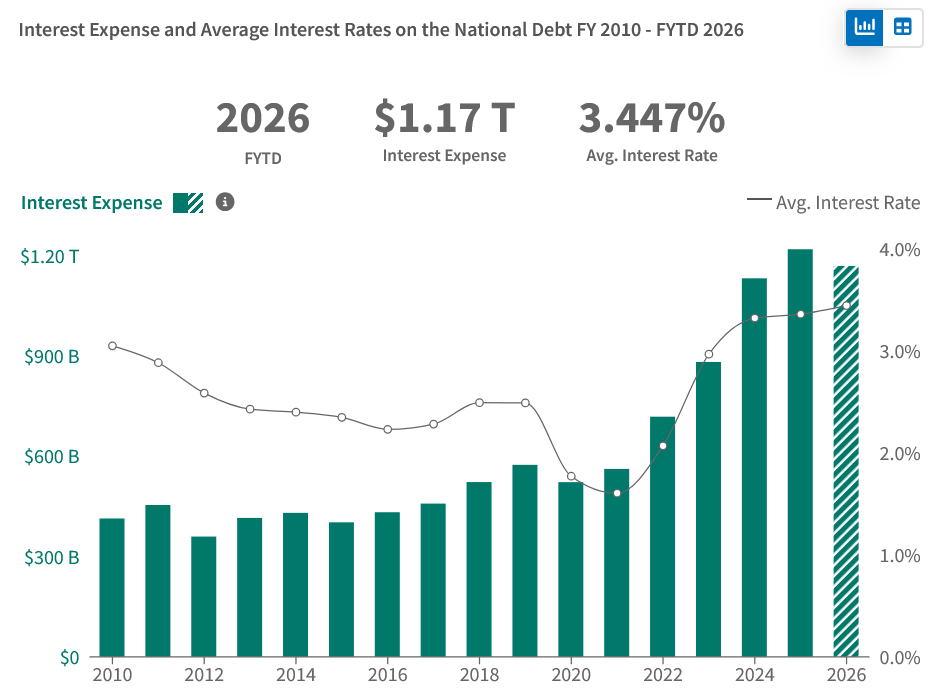
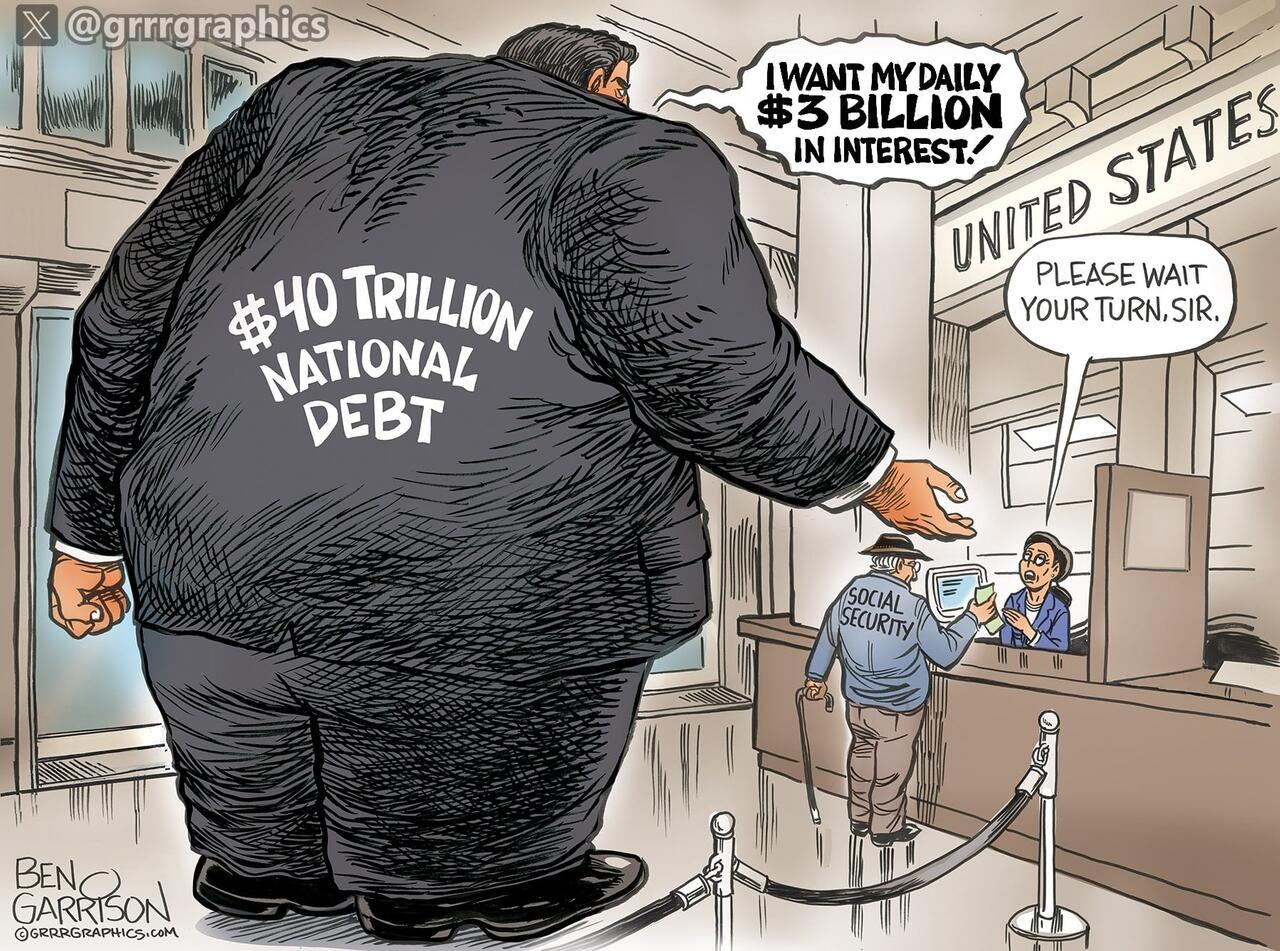
Report: “As the debt grows, so does the average interest rate the government is paying. That rate jumped from 2.378% five years ago to 3.447% now. Since one of the key drivers of U.S. debt growth is interest on the debt, a vicious spending cycle has been created, one that lawmakers in the U.S. House Committee on the Budget recently called ‘completely unsustainable.’”
The national debt is composed of distinct types of debt, similar to an individual whose debt consists of a mortgage, car loan, and credit cards. The national debt can be broken down by whether it is non-marketable or marketable and whether it is debt held by the public or debt held by the government itself (known as intragovernmental). The national debt does not include debts carried by state and local governments, such as debt used to pay state-funded programs; nor does it include debts carried by individuals, such as personal credit card debt or mortgages.
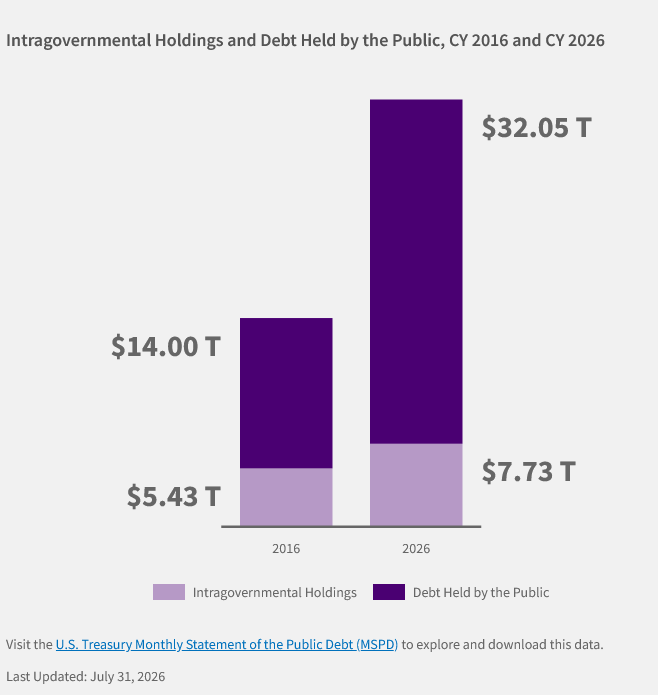
The visual below comparing calendar year 2016 and 2026 displays the difference in growth between debt held by the public and intragovernmental debt. While both types of debt combine to make up the national debt, they have increased by different amounts in the past several years. One of the main causes of the jump in public debt can be attributed to increased funding of programs and services during the COVID-19 pandemic. Intragovernmental debt has not increased by quite as much since it is primarily composed of debt owed on agencies’ excess revenue invested with the Treasury. The revenue of the largest investor in Treasury securities, the Social Security Administration, has not increased significantly in recent years, resulting in this slower intragovernmental holding increase.
The Debt Ceiling
The debt ceiling, or debt limit, is a restriction imposed by Congress on the amount of outstanding national debt that the federal government can have. The debt ceiling is the amount that the Treasury can borrow to pay the bills that have become due and pay for future investments. Once the debt ceiling is reached, the federal government cannot increase the amount of outstanding debt, losing the ability to pay bills and fund programs and services. However, the Treasury can use extraordinary measures authorized by Congress to temporarily suspend certain intragovernmental debt allowing it to borrow to fund programs or services for a limited amount of time after it has reached the ceiling.
Since the United States has never defaulted on its obligations, the scope of the negative repercussions related to a default are unknown but would likely have catastrophic repercussions in the United States and in markets across the globe.
………………………………
Current Debt: $40.03 trillion.
Current Debt Limit: Congress set the debt limit at $41.1 trillion in 2025 via reconciliation.
____________________________
There is precisely one plan, one dynamic, comprehensive economic acceleration plan in Americawith the power to resolve this looming fiscal inferno. Economically viable, politically feasible…
The Leviticus 25 Plan is a dynamic economic initiative providing direct liquidity benefits for American families, while at the same time scaling back the role of government in managing and controlling the affairs of citizens. It is a comprehensive plan with long-term economic and social benefits for citizens and government.
The inspiration for this plan is based upon Biblical principles set forth in the Book of Leviticus, principles tendering direct economic liberties to the people.
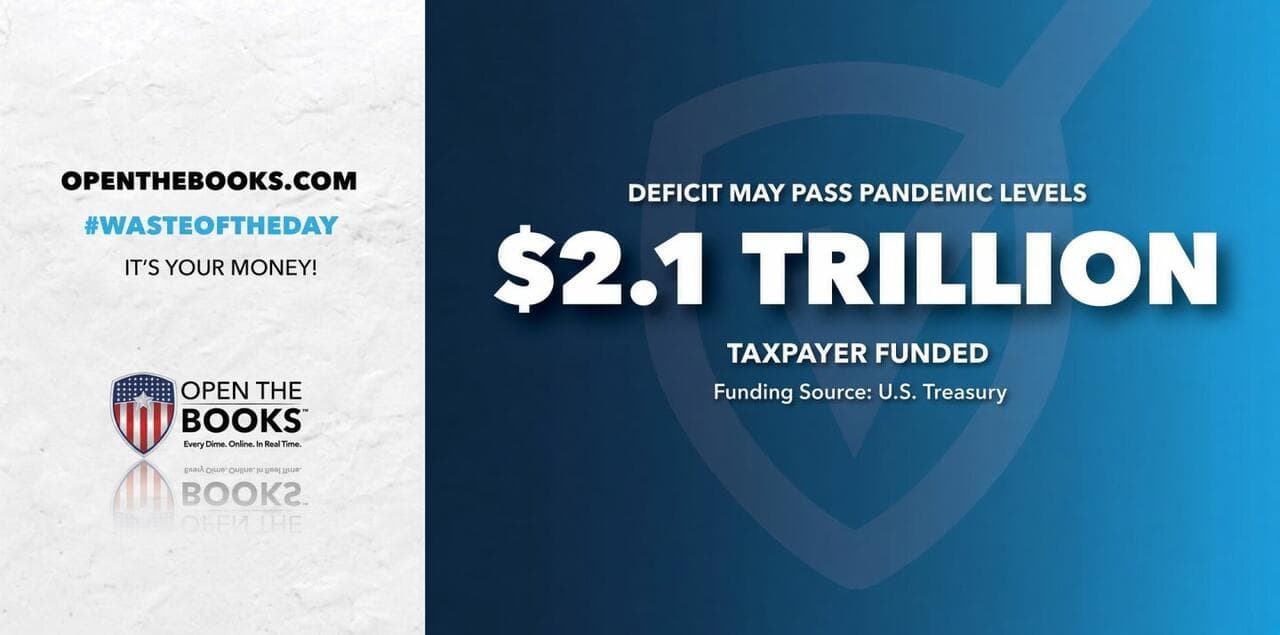
The federal deficit will be $2.1 trillion when fiscal year 2026 ends on Sept. 30, the Congressional Budget Office projected in its monthly budget review.
The deficit – the gap between what the government spends and what it collects from taxes and other revenue – has never surpassed $1.8 trillion, except during the Covid-19 pandemic.
Key facts: Federal revenues are up 3% in 2026 compared to last year. Even though corporate income tax revenue has declined, income and payroll tax collections increased.
But federal spending is up 5%, according to the CBO. Interest on the national debt increased 14% compared to last year. Social Security, Medicare, Medicaid, and defense are also facing increased costs.
The CBO originally projected this year’s deficit would be $1.9 trillion. The estimate was changed “mostly because of smaller-than-expected collections of tariff duties” after the Supreme Court struck down tariffs imposed by President Donald Trump in February.
Though Trump later imposed new tariffs, the CBO still expects federal revenue to be $250 billion less than originally anticipated. About $100 billion has been refunded to companies so far, under an order from the U.S. Court of International Trade.
Critical quote: “We’ve borrowed an astounding $1.8 trillion this fiscal year, with $431 billion in the month of July alone, and equating to nearly $6 billion per day,” said Maya MacGuineas, president of the Committee for a Responsible Federal Budget. “We’re on track to surpass $2 trillion in borrowing this fiscal year despite not being in a recession. That is not normal.”
Background: The University of Pennsylvania recently estimated that under current policy, it will likely be mathematically impossible for the U.S. to pay off its debt by the year 2048.
That was before Trump asked Congress to increase discretionary spending by 19% next year, which would be the second-largest spending increase in at least 60 years.
Summary: America’s affordability crisis is the most prominent political issue in the country, yet neither party has committed to reducing government deficits. Until then, the crisis is likely to only worsen.
The #WasteOfTheDay is brought to you by the forensic auditors at Open the Books. Search all federal, state and local salaries and vendor spending with the world’s largest government spending database at OpenTheBooks.com.
_________________________________
The Leviticus 25 Plan: $37.303 Billion Federal Budget Surpluses Annually (2027-2031)
The Leviticus 25 Plan 2027 – the most powerful economic acceleration plan in the world. Updated economic scoring summary: Every qualifying U.S. citizen who wishes to participate will receive $60,000 (Family Account) and $35,000 (Medical Savings Account). $95,000 per U.S. citizen. Massive public and private debt elimination. Economic liberty
Average annual budget surplus (projected) 2027-2031: $186.517 billion / 5 years: $37.303 billion per year
Note 1: Projected budget surpluses for 2027-2031 do not factor in the additional government tax revenue gains that would accrue from the massive shift in capital away from debt service and into productive economic activity.
Note 2: Projected budget surpluses for 2027-2031 do not factor in the additional government tax revenue gains that would accrue from significantly lower levels of debt deductibility on individual income tax filings.
Note 3: Projected budget surpluses from the Medicaid / CHIP recapture do not take into account the likelihood of fewer citizens actually qualifying for Medicaid / CHIP benefits.
Note 4: Projected budget surpluses from Interest Expense Reductions during each of the first five years of activation (2027-2031) is likely understated due to the fact that ‘debt held by the public’ is projected to increase by 8.5% per year, from $28.278 trillion in 2026 to $40.198 trillion in 2030.
Note 5: The Plan’s funding of individual Medical Savings Accounts (MSAs) with the $7,000 deductible provision per year would result in an enormous drop in the number of claims each year for Medicare reimbursement. Medicare payroll taxes would generate a growing revenue stream, due to stronger economic growth, while outlays would drop significantly from the reduced claims numbers – thereby providing the Fed / Treasury Department with a powerful recapitalization of the Medicare Trust Fund, via the Citizen’s Credit Facility.
The Leviticus 25 Plan – Projection limitations There can be no question that The Leviticus 25 Plan would generate healthy, broad-based economic growth from broad-based debt reduction and improved financial stability at the family level, the restoration of free market dynamics in commerce, and scaling back social program work disincentives.
The Leviticus 25 Plan does not attempt to project how much additional tax revenue and reduced cost of government will be realized, above and beyond the Recapture Provisions, over the course of the initial five years of the plan. In that sense, The Plan understates the effect of additional dynamic economic benefits.
Robust funding of Medical Savings Accounts and the elimination of millions of insurance claims and claims resolutions for basic primary care and everyday healthcare purchases swill save millions of man-hours of health care cost on an annual basis. Scaling back government involvement in basic primary care and everyday healthcare purchases for millions of Americans will also generate massive cost savings.
The Plan makes no attempt to project the positive effects of the streamlined, consumer-driven efficiencies that will emerge, and the cost reduction and improvement in services. The Plan therefore understates the benefits.
The Plan projects an 80 percent participation rate by U.S. citizens. It is assumed that a large number of wealthy Americans will not participate, because their tax refunds are larger than the annual Plan benefits. And it is assumed that a large number of Americans receiving significant government benefits for extraordinary health or economic issues will also not participate.
Cost savings from the reductions in massive social welfare spending and other programs, like unemployment insurance, workman’s compensation, SSI and SSDI can be difficult to quantity, since state and federal funding mechanisms may both be involved in various ways. In that regard, The Plan may understate, or it may overstate, the benefits.
The Leviticus 25 Plan is a dynamic economic initiative providing direct liquidity benefits for American families, while at the same time scaling back the role of government in managing and controlling the affairs of citizens. It is a comprehensive plan with long-term economic and social benefits for citizens and government.
The inspiration for this plan is based upon Biblical principles set forth in the Book of Leviticus, principles tendering direct economic liberties to the people.
‘Teacher pay’ is a critically important goal for attracting and retaining dedicated, top-notch teachers and providing the best resources for high achievement by America’s school children.
At the same time, eliminating debt and restoring the financial health of all working American families is an equally vital cause, across all of America.
All working Americans – military, law enforcement, medical / healthcare, maintenance workers, construction, fire and rescue, service workers – are deserving of an opportunity, a comprehensive initiative, to strengthen their families’ financial status and relieve the burden of government interference in their daily lives.
A math review – to make a comparison between two significant economic initiatives.
Plan 1: The Leviticus 25 Plan – $95,000 per U.S. citizen. $60,000 per U.S. citizen is electronically deposited into a Family Account and $35,000 per citizen is electronically deposited into a Medical Savings Account.
Who benefits? Answer: All participating U.S. citizens and their families.
Who pays? Answer: The Federal Reserve creates a funding facility, a Citizens Credit Facility, to channel liquidity through the U.S. Treasury Department to American families, in the same way that the Fed set up various credit facilities to fire-hose liquidity out to Wall Street’s financial sector during the great economic crises years (2008-2010). Many of these U.S. and foreign banks and insurers were the very institutions that had precipitated the financial crisis with their financial innovation schemes and leveraged speculation – which ‘bled out’ in the form of gaping balance sheet ‘capital holes’ when the big mortgage default wave hit.
How does the Federal Reserve then get the money back, in order to reduce its balance sheet back down to ‘normal dimensions,’ over time? Answer: Through a series of simple recapture provisions.
#1. Participating families would be required to give up their tax refunds each year for a period of five years.
#2. Participating families would also be required give up means-tested welfare benefits, income security program benefits, unemployment insurance, workman’s comp, SSI, SSDI, and various other social welfare benefits.
#3. For participating families, there would be a $7,000 deductible for five years ($35,000 total) for primary health care services for those enrolled in Medicare, Medicaid, VA, TRICARE, FEHB.
The Leviticus Plan pays for itself over a 10-15 year period.
How much would The Leviticus 25 Plan benefit a typical teacher’s family? Case 1: Family of four. Mother teaches – salary $55,000 / year. Father also works. Two school-age children. $165,000 balance on 30-year fixed mortgage – maturing in 20 years. Two modest car loans. Monthly health care premiums – fairly substantial.
Through the Citizens Credit Facility, $240,000 would be electronically deposited into their Family Account, and $140,000 would be electronically deposited into their Medical Savings Account.
These liquidity grants are tax-free. The net benefit of these grants would be reduced slightly over the course of time through the loss of income tax refunds for five years (estimate: $5,000 per year for five years: $25,000).
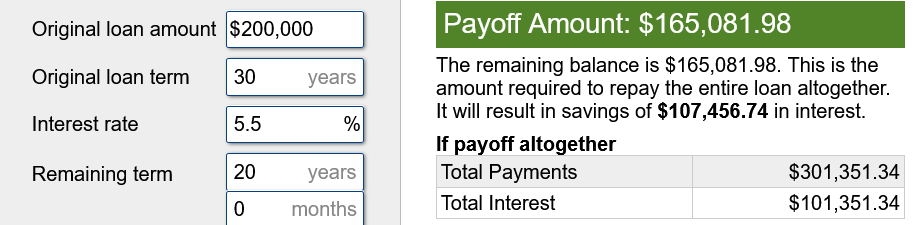
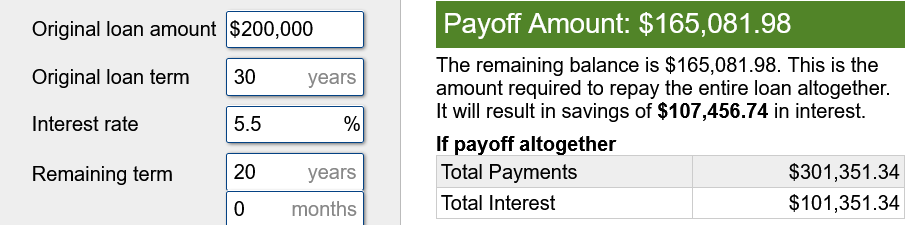
Mortgage payoff example: Family pays off $165,000 balance remaining on a 30-year fixed $200,000 mortgage at 5.5% interest rate / 20 years remaining to maturity with principle and interest payments of $1,136 per month.
Total savings: $165,000 principle and $101,351 interest. Total: $266,351.
Approximate annual savings: $13,600 per year for 20 years.
This savings amount dwarfs the anticipated $5,000 loss per year from income tax refunds ($25,000 total over the 2027-2031 activation period).
Family retains $75,000 in Family Account for additional installment debt reduction, discretionary purchases and savings.
With $140,000 in Medical Savings Account, family chooses to purchase a high-deductible policy with reduced premium costs.
Total impact on family financial health: significant. Benefits: powerful
And even more importantly, all qualifying U.S. citizen families in America would benefit in similar ways.
…………………….
Plan 2 (the ‘Big Government’ solution): Raise teachers’ pay by a healthy 15% – via tax increases.
Who benefits? Answer: Teachers and their families.
Who pays? Answer: Everyone whose taxes were raised to cover the additional outlay on behalf of teachers. And that would include teachers themselves, whose taxes would also go up – and would therefore slightly reduce the net benefit of a 15% pay raise.
How much would a 15% pay hike actually benefit a typical teacher’s family? Case 1: Family of four. Mother teaches – salary $50,000 / year. Father also works. Two school-age children. $165,000 balance on 30-year fixed mortgage at 5.5% interest – maturing in 20 years. Two modest car loans. Monthly health care premiums – fairly substantial.
A 15% pay raise for the teacher in the family would generate additional gross income of $7,500 per year, or $37,500 over a five-year period – before taxes.
This increased income would provide additional resources for some possible modest reductions in mortgage and installment debt, certain discretionary spending, and it might allow for additional modest savings for their children’s future college education.
Teachers and their families alone would benefit financially. Others would not. Mortgage debt reduction: modest. Health plan premium reduction: none. Net cash benefit over five years: $37,500. ______________________________________
America needs a comprehensive economic acceleration plan that benefits all Americans – through massive debt reduction and the restoration of economic liberty..
The choice is clear.
The Leviticus 25 Plan will also generate $37.303 billion budget surpluses at the federal level during each of its first five years of activation (2027-2031) – compared to $2 trillion dollar annual deficits each year for the same period.
The Leviticus 25 Plan is a dynamic economic initiative providing direct liquidity benefits for American families, while at the same time scaling back the role of government in managing and controlling the affairs of citizens. It is a comprehensive plan with long-term economic and social benefits for citizens and government.
The inspiration for this plan is based upon Biblical principles set forth in the Book of Leviticus, principles tendering direct economic liberties to the people.
ZeroHedge, Aug 19, 2026 – Authored by Simon White, Bloomberg macro strategist,
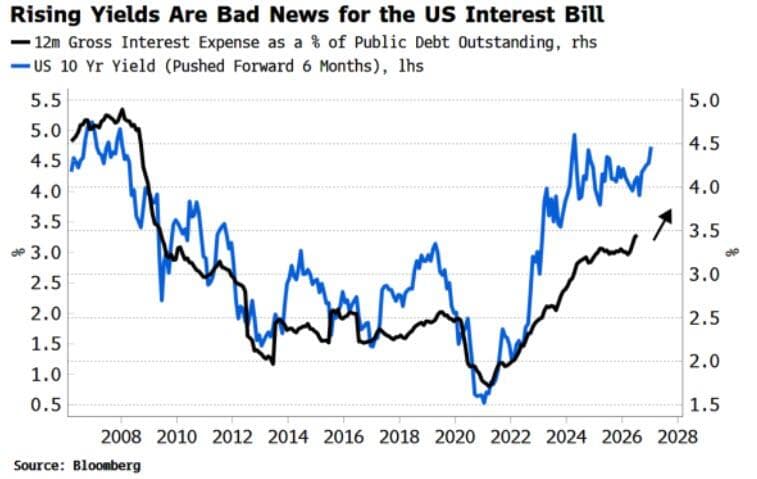
The rise in Treasury yields is inflaming the US’s increasingly untenable interest bill on its debt.
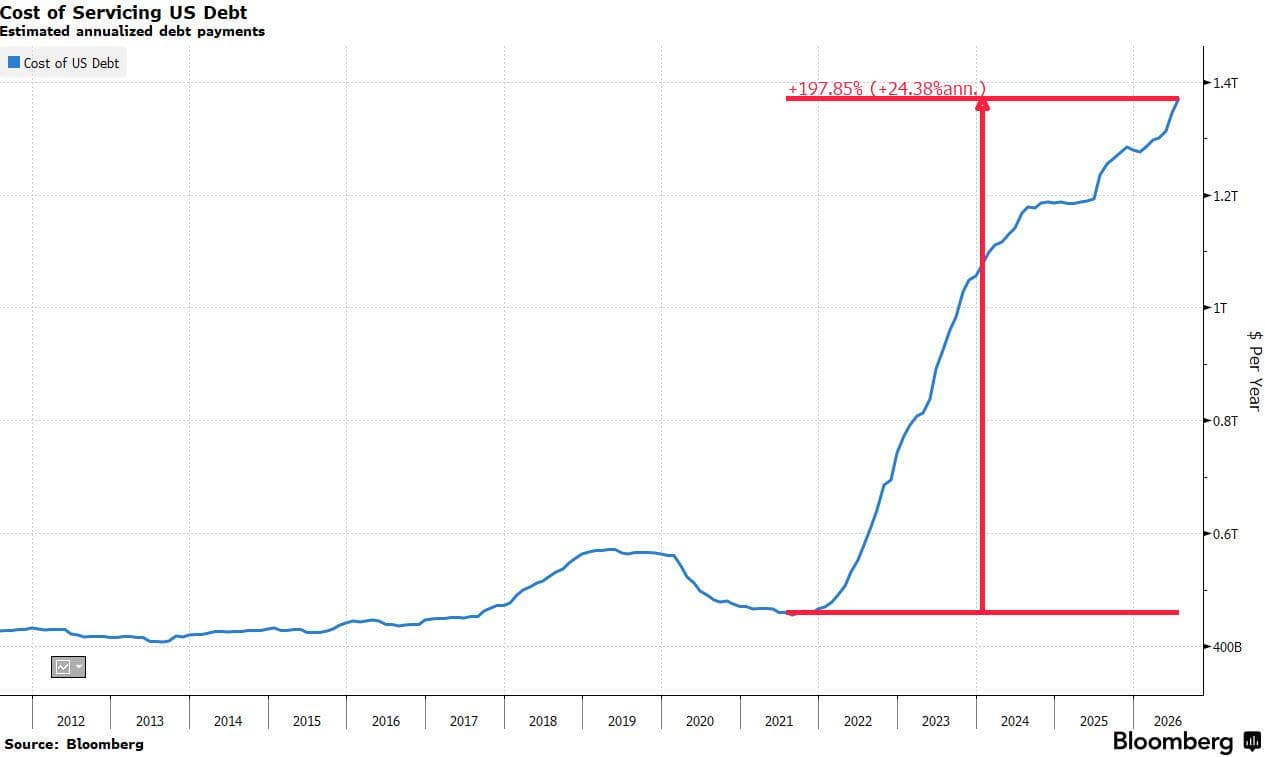
At almost $1.4 trillion, the annual cost of servicing the US’s public debt is greater than the GDP of over 175 of the world’s 195 countries.
Net interest isn’t much better, at just over $1 trillion each year.
And both net and gross are only growing as yields keep creeping higher. US 10-year yields lead the gross interest expense as a percentage of debt outstanding by about six months.
The gross interest expense versus the debt outstanding is about 3.5%, but that’s also a function of so much debt being issued; the ratio was over 5% at the time of the GFC.
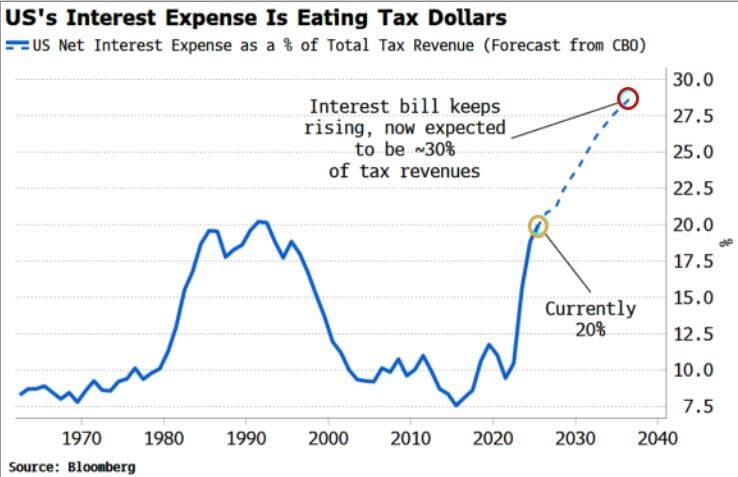
But interest is paid out of tax revenue (and more borrowing), so it’s better to look at it in these terms.
Here the picture is pretty bleak, with 20% of tax going towards debt service, a modern-day high.
The CBO projects it will get worse, estimating that close to one in three tax dollars will be used to pay interest by 2036.
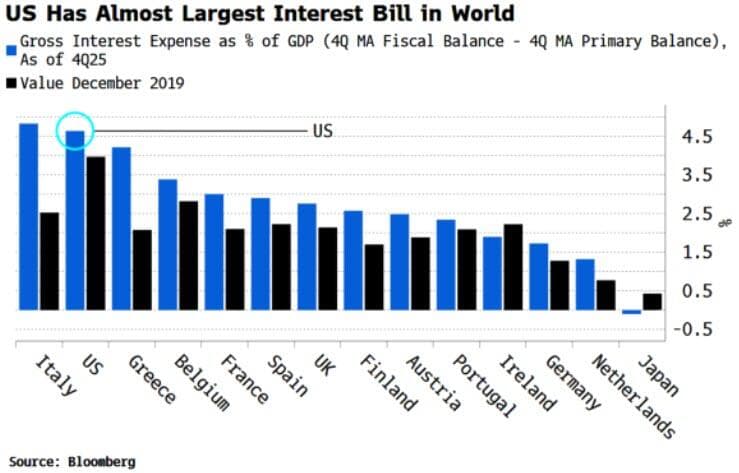
Interest bills have risen across the world as deficits have risen and rates have climbed higher.
But the US’s expense is particularly egregious. Only Italy has a larger bill of the main developed countries in GDP terms.
Thirty-year yields recently punched through to 20-year highs, while the 10-year is within about 30 bps of its two-decade top.
There are signs that liquidity in the Treasury market has started to deteriorate, which increases the risk of more unstable yields with an upwards bias.
But the rising interest bill creates a second order risk, as rises in yields make more borrowing reflexively more likely.
It’s not a dynamic that can persist indefinitely without something eventually breaking.
__________________________________
The Leviticus 25 Plan will generate massive banking sector cash inflows, $37.303 billion federal budget surpluses (2027-2031) — and robust liquidity in the Treasury market.
It will reignite a long-term, non debt-based economic growth cycle.
It will relight the fires of economic liberty, eliminate massive amounts of public and private debt, and restore financial security for millions of U.S. citizen families across America.
And – it will crush the animal spirits of socialism which threaten to destroy freedom and the future of economic prosperity.
The Leviticus 25 Plan is a dynamic economic initiative providing direct liquidity benefits for American families, while at the same time scaling back the role of government in managing and controlling the affairs of citizens. It is a comprehensive plan with long-term economic and social benefits for citizens and government.
The inspiration for this plan is based upon Biblical principles set forth in the Book of Leviticus, principles tendering direct economic liberties to the people.
“It is impossible to grasp the meaning of the idea of sound money if one does not realize that it was devised as an instrument for the protection of civil liberties against despotic inroads on the part of governments. Ideologically, it belongs in the same class with political constitutions and bills of rights.” -The Theory of Money and Credit (1912), Austrian economist Ludwig von Mises
Middle class working (and ‘retired’) Americans are now feeling the inflationary after-effects of the last two big rounds of Federal Reserve and U.S. Treasury fiscal and monetary interventions.
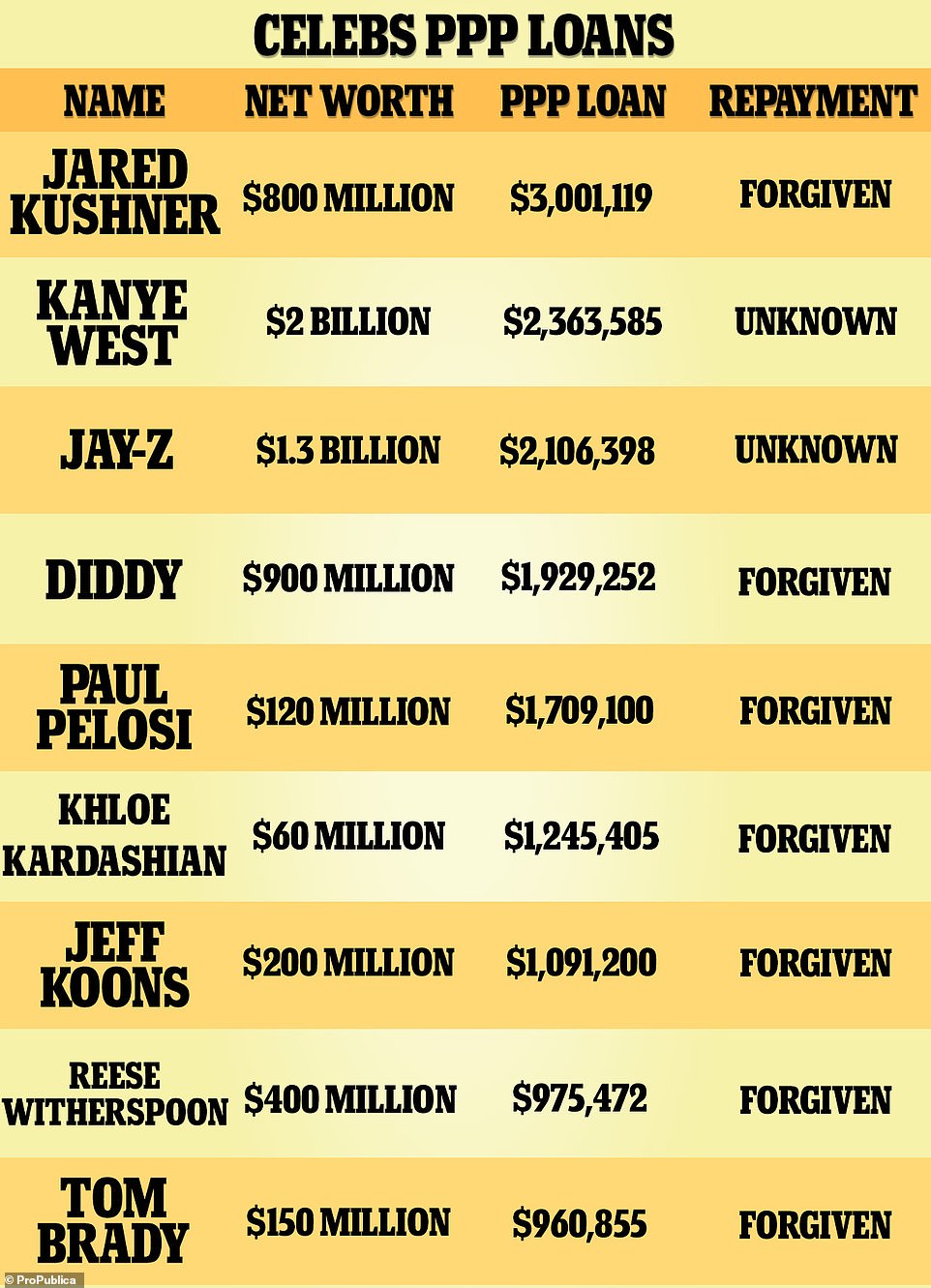
Daily MailEXCLUSIVE: It pays to be rich! America’s wealthiest, including Tom Brady, Khloe Kardashian, Reese Witherspoon, Kanye and Nancy Pelosi’s husband took millions in PPP loans – and nearly all have been forgiven
Celebrities including Kanye West, Jay-Z and Khloe Kardashian received millions in government PPP (Payment Protection Program) loans, set up for desperate businesses hit by the Covid pandemic
DailyMail.com can now reveal the exact amounts that these millionaires took out via the government program
Kanye West’s Yeezy LLC borrowed $2,363,585, with $1,772,689 being spent on payroll for 106 staff
Khloe Kardashian’s denim brand Good American LLC had a loan of $1,245,405 approved on April 14, 2020, mostly for the payroll of 57 workers. The full amount, plus interest, was forgiven
In most cases, the loans have been ‘forgiven’ so the full amount, including interest, will not have to be repaid, despite the owners’ wealth
Published: 09:29 EDT, 17 August 2022 | Updated: 11:40 EDT, 17 August 2022
The companies of mega-rich celebrities, including billionaires Kanye West and Jay-Z, received millions in government PPP loans – and in virtually every case the A-listers have been let off the hook for paying back the full amount.
For the first time, DailyMail.com can reveal the exact amounts that these wealthy companies got through the Payment Protection Program, which was set up for desperate businesses hit by the Covid pandemic.
In all but two of the cases we examined, the company was ‘forgiven’ despite the star owners being multi-millionaires. The status of the others is unknown.
The loan program cost US taxpayers $953billion, with the University of Texas estimating that 15 percent of PPP claims – around $76billion – were fraudulent.
It was claimed that after the first round of PPP loans, up to 90 percent of ethnic minority business owners were unsuccessful at getting the loan and were at the ‘end of a line’, according to an Associated Press survey, which showed a disproportionate amount of white people in rich areas being approved for a loan.
Yet celebs and their businesses had no problems.
Kanye West’s Yeezy LLC, based in La Palma, California, borrowed $2,363,585, with $1,772,689 being spent on payroll for 106 staff
Jay-Z is associated to two firms approved for a loan two years ago. Malibu Entertainment is linked to his streaming platform Tidal and took $2,106,398 to secure 95 jobs and was let off of repaying the full amount
DailyMail.com can now reveal the exact amounts that these millionaires – and some billionaires – took out via the government program
Kanye West’s Yeezy LLC, based in La Palma, California, borrowed $2,363,585, with $1,772,689 being spent on payroll for 106 staff.
Khloe Kardashian’s denim brand Good American LLC had a loan of $1,245,405 approved on April 14, 2020, mostly for the payroll of 57 workers. The full amount, plus interest, was forgiven
ProPublica, which has published the amount and status of every federal loan, states that Yeezy’s loan status is ‘not disclosed.’
_____________________________________________
Wall Street banks and their ultra wealthy principles made out handsomely during the great financial crisis (2008-2010) – with massive Federal Reserve liquidity infusions.
They hit the jackpot again with additional
They were ‘indirect beneficiaries’ during the Covid Crisis (2021-2022) as the Fed activates “massive broad-based fiscal and monetary interventions—including corporate debt purchases and the structure of the PPP—indirectly protected large financial institutions and asset markets by ensuring borrowers could service their debt, shielding Wall Street from severe asset devaluations.”
At the same time (2021-2022), mega-rich celebrities also struck gold.
And now it is time to rebalance the ‘monetary intervention’ books – this time in favor of Main Street America’s hard-working, tax-paying U.S. citizens…
The Leviticus 25 Plan is a dynamic economic initiative providing direct liquidity benefits for American families, while at the same time scaling back the role of government in managing and controlling the affairs of citizens. It is a comprehensive plan with long-term economic and social benefits for citizens and government.
The inspiration for this plan is based upon Biblical principles set forth in the Book of Leviticus, principles tendering direct economic liberties to the people.
“It is true that the virtues which are less esteemed and practiced now – independence, self-reliance, and the willingness to bear risks, the readiness to back one’s own conviction against a majority, and the willingness to voluntary cooperation with one’s neighbors – are essentially those on which the of an individualist society rests. Collectivism has nothing to put in their place, and in so far as it already has destroyed then it has left a void filled by nothing but the demand for obedience and the compulsion of the individual to what is collectively decided to be good.” Friedrich Hayek, The Road to Serfdom
……………………………………………………………..
The Leviticus 25 Plan re-establishes family and societal virtues which have been eroded through unending government encroachment and socialist-driven central planning across America – and elsewhere around the world.
The Leviticus 25 Plan – grants direct liquidity access to American families – the very same access to liquidity which was provided to the likes of Morgan Stanley, Citigroup, Bank of America Corp, Goldman Sachs, JP Morgan Chase, Merrill Lynch, Wells Fargo, Deutsche Bank, UBS AG, Royal Bank of Scotland, Plc, State Street, AIG, Barclays, BNP Paribas,and dozens of others.
The two primary goals of The Plan: 1) Resolving America’s fiscal crisis; 2) Eliminating Household Debt and restoring financial health and economic liberty for millions of American families.
Imagine the U.S. Department of the Treasury running $37.303 billion budget surpluses 2027-2031 – instead of the CBO-projected $2 trillion annual deficits.
Imagine a family of four paying off their mortgage, car loans, credit card debt – and having additional Medical Savings Account (MSA) liquidity for direct allocation toward primary care medical expenses and health care insurance premiums.
The financial security benefits of all qualifying American families would be incalculable:
Financial stress relief – massive private debt elimination / extraordinary reductions in monthly debt service obligations, affordability crisis resolved;
Quality of life improvements – general living conditions, nutrition security;
Financial self-reliance at family level – freedom from dependence on social welfare and charity programs;
Working mothers desiring to spend more time with their children would be able scale back outside employment hours or become full-time stay-at-home mothers; reduced dependence on daycare, reduced time-management stress;
Re-establishment of normal, positive incentives for work, enterprise, innovation, achievements;
Improved credit status for working Americans;
Improved access to primary health care;
Improved employment opportunities;
Significant potential for crime reduction.
……………………………………………………………………………….
There isno government-directed economic strategy that can provide so much as a fraction of these types of benefits, direct to America’s citizens.
The Leviticus 25 Plan is a dynamic economic initiative providing direct liquidity benefits for American families, while at the same time scaling back the role of government in managing and controlling the affairs of citizens. It is a comprehensive plan with long-term economic and social benefits for citizens and government.
The inspiration for this plan is based upon Biblical principles set forth in the Book of Leviticus, principles tendering direct economic liberties to the people.
ZeroHedge. Aug 11, 2026 By Mark Cudmore, Bloomberg markets live reporter and strategist
US long-end yields have plenty more upside into year-end.
The estimated annualized cost to service the US debt is increasing at a near-parabolic pace – roughly tripling over the past five years.
It will require a momentous shift in fiscal policy to alter the narrative of this being unsustainable and such a change would seem extremely unlikely this side of the mid-term elections.
The resulting yield rise will engender volatility in stocks, as it threatens corporate credit, most relevantly in the tech space.
It will also be a form of higher rates that is counterintuitively negative for the dollar, as it will be predicated on declining US policy credibility and the related fear that the only exit will be to monetize the debt burden over the long-term.
______________________________________
Bloomberg’s Mark Cudmore has evidently not been fully briefed o the world’s most powerful economic acceleration plan – and its capacity to reset America’s public and private debt dynamics.
The Leviticus 25 Plan will achieve extraordinary gains within the U.S. economy that all of Fed’s “Quantitative easing, near-zero interest rates, endless debt monetization, emergency lending facilities” over the past two decades have failed entirely to produce.
It will strengthen the U.S. Dollar, monumentally enhance Treasury market liquidity with lower rates across the curve, and restore U.S. policy credibility.
The Leviticus 25 Plan will retarget Fed / U.S. Treasury liquidity extensions through a Citizens Credit Facility directly to qualifying U.S. citizens who wish to participate – to generate four unprecedented gains:
The Plan will generate average annual budget surpluses of $37.303 billion vs current CBO-projected average annual deficits of $1.982 trillion – over each of the first five years of activation (2027-2031);
Massive debt elimination and restored financial security for millions of hard-working, tax-paying American families;
Robust, long-term economic growth – not financed by debt;
Fundamental gains in U.S. and global credit market stability, U.S. Dollar strength and integrity.
The Leviticus 25 Plan is a dynamic economic initiative providing direct liquidity benefits for American families, while at the same time scaling back the role of government in managing and controlling the affairs of citizens. It is a comprehensive plan with long-term economic and social benefits for citizens and government.
The inspiration for this plan is based upon Biblical principles set forth in the Book of Leviticus, principles tendering direct economic liberties to the people.
The Leviticus 25 Plan – An Economic Acceleration Plan for America
The United States borrowed $1.4 trillion in the first nine months of Fiscal Year (FY) 2026, including $120 billion in June, according to the latest Monthly Treasury Statement from the Treasury Department.
The following is a statement from Maya MacGuineas, president of the Committee for a Responsible Federal Budget:
Only three months left in FY 2026, and the Treasury Department just confirmed the deficit has now surpassed the FY 2025 deficit over the same period. At $1.4 trillion in the first nine months of FY 2026 – including $120 billion in the month of June alone – we are on track to borrow $2 trillion or more this fiscal year.
But these alarming deficit numbers represent just one of the many fiscal challenges facing the United States. Not only are we borrowing at an unsustainable rate, but lawmakers have yet to fund any part of the government for the upcoming fiscal year with very little time left. On top of that, our major trust funds are facing insolvency in the next seven years, meaning there is little time left to avoid across-the-board cuts to benefits. Lawmakers should work together to prevent insolvency of our trust funds, put in place much-needed deficit reduction, and stop making the problem worse with new borrowing.
Rather than continuing the same unsustainable path, adopting a realistic fiscal target like bringing the deficit down to 3% of GDP or creating a bipartisan commission to address the nation’s laundry list of fiscal challenges would be a great start. Regardless, one thing is clear: something needs to change, and it is up to lawmakers to decide how.
………………………………………….
The Leviticus 25 Plan will do far more than bring the deficit “down to 3% of GDP.” It will generate $37.303 billion budget surpluses during each of its first five years of activation (2027-2031).
It will revitalize fiscal balance in the U.S. federal budget, restore economic liberty, and scale back the role of government in managing and controlling the affairs of citizens. This comprehensive plan will produce long-term economic and social benefits for citizens and government. The inspiration for this plan is based upon Biblical principles set forth in the Book of Leviticus, tendering direct economic liberties to the people.
DynamicBenefits – The Leviticus 25 Plan will:
Provide direct liquidity extensions to qualifying U.S. citizen families residing in the United States;
Optimize the allocation of primary health-care services funding, including Medicare and Medicaid;
Improve the economic climate for U.S. small businesses; vastly expand employment opportunities; eliminate public and private debt; restore financial health across the nation for all American families;
Generate dynamic, long-term, tax revenue growth cycles for government (federal, state, local);
Reduce the cost of government, strengthen U.S. housing market, and stabilize the banking system;
Reduce the scope of social programs, reduce government control over the daily affairs of U.S. citizens;
Generate $37.303 billion budget surpluses each of its first five years of activation, pay for itself entirely over a 10-15 year period, and set the U.S. Dollar on course for long-term strength and stability.
Federal Reserve monetary policy, in coordination with the U.S. Treasury Department, must include a channel for direct liquidity extensions to U.S. citizens in the form of a Citizens Credit Facility, to advance the cause of economic liberty for U.S. citizens and revitalize free market dynamics in America.
The Leviticus 25 Plan will restore fiscal balance in the federal budget, revitalize economic growth and re-establish free market principles with positive economic and social incentives for all Americans
U.S. Secretary of the Treasury Scott Bessent laid out President Trump’s financial policy priorities for the American Bankers Association (ABA) on Wednesday, saying that Main Street America will now take priority.
Bessent speaking at the ABA’s Washington Summit, said, “For too long, financial policy has served large financial institutions at the expense of smaller ones— no more.”
The Treasury Secretary stated that, “It’s Main Street’s turn to hire workers, it’s Main Street’s turn to drive investment and it’s Main Street’s turn to restore the American dream.”
Bessent announced the Trump administration’s shift to focusing on helping Main Street businesses and consumers thrive by giving all institutions a chance to succeed, adding, “For the last four decades, basically since I began my career in Wall Street, Wall Street has grown wealthier than ever before, and it can continue to grow and do well.”
Addressing fears of a looming recession, Bessent defended Trump’s agenda of tax cuts, deregulation and trade rebalancing and noting that,
“We want to de-leverage the government sector, re-leverage the private sector …. we can’t do it all at once, or that will cause a recession.”
Bessent added, “What will keep us from having a recession is making sure that the tax bill doesn’t expire, adding back 100% depreciation and then adding some of President Trump’s agenda — no tax on tips, no tax on Social Security, no tax on overtime.”
___________________________________
The Leviticus 25 Plan
There is one more step that America needs to take to “re-leverage” the debt-logged private sector and activate the powerful reset that millions of American families and small businesses need – Main Street America needs liquidity.
The Leviticus 25 Plan provides that in full measure with its massive, public and private sector debt elimination dynamic.
The Leviticus 25 Plan is a dynamic economic initiative providing direct liquidity benefits for American families, while at the same time scaling back the role of government in managing and controlling the affairs of citizens. It is a comprehensive plan with long-term economic and social benefits for citizens and government.
The inspiration for this plan is based upon Biblical principles set forth in the Book of Leviticus, principles tendering direct economic liberties to the people.
The Leviticus 25 Plan – An Economic Acceleration Plan for America