$65 Billion – 2024 ObamaCare Fraud in Full Bloom

America needs a return to citizen-centered healthcare – where citizens allocate healthcare dollars for primary care services.

…………………………………….

Taxpayers Lost $65 Billion On Obamacare Fraud Last Year

ZeroHedge, Aug 30, 2026

Taxpayers spent $65 billion on health insurance premiums for people who either didn’t exist or didn’t qualify for benefits in two federal programs in 2024, according to an Aug. 26 report from Paragon Health Institute.

Expanded Medicaid and Obamacare, the signature programs of the Affordable Care Act, improperly enrolled a combined 14.3 million people that year, researchers concluded.

Expanded Medicaid allows states to enroll people making up to 138 percent of the federal poverty level, versus up to 100 percent for traditional Medicaid. That limit was about $35,600 for a family of three in 2024.

Obamacare was open to people earning up to 400 percent of the federal poverty level at that time, about $103,000 for a family of three.

Both programs are administered through the Affordable Care Act Marketplace, with coverage provided by commercial insurance companies.

As Lawrence Wilson details below, via The Epoch Timesresearchers estimate that about 34 percent of all Marketplace enrollees in 2024 were either fraudulent, duplicates, or simply didn’t meet the benefit criteria.

And the number went up the next year, researchers said.

“Improper exchange enrollment increased by more than 26 percent from 2024 to 2025 – up to an estimated 6.5 million enrollees,” the report stated.

Enrollment Problems

Researchers studied federal data from surveys, program enrollment, and spending and concluded that more than 9 million Medicaid expansion enrollees in 2024 probably didn’t qualify for the benefit.

Those were likely people whose income was over the limit, did not meet citizenship, immigration, or residency requirements, or should have been enrolled in traditional Medicaid.

With Obamacare, the $0 premium policies made possible during the post-COVID years became a target for fraud, according to Paragon President Brian Blase.

Testifying before Congress in December, Blase said many people were enrolled in the program without their knowledge by unscrupulous insurance brokers, prompting the federal government to send a commission check to them – and premium payments to an insurance company.

These phantom enrollees are detected in part by their lack of activity once enrolled, Blase said.

Also, 28 states had more people enrolled in Obamacare than there were people in the state who met the income requirements.

Skepticism

Paragon had previously reported its enrollment analysis, though the cost calculation is new.

Based on previous reports, some observers have questioned the assertion that improper enrollment, particularly in Obamacare, is as widespread as the think tank concluded.

“There is no evidence of systemic fraud, waste, or abuse in [state-based marketplaces],” according to Covered California, the state’s health insurance marketplace.

As for the lack of activity by some enrollees, America’s Health Insurance Plans released a statement in 2025 saying, “A ‘no-claims’ year is evidence that a consumer stayed healthy or only had a few months of coverage – not that taxpayer money was misdirected or that their policy was illegitimate.”

Others observers say Paragon’s research method doesn’t factor in all the variables. “There are a number of reasons why people who report incomes somewhat above 138 percent of the poverty line in a survey may be eligible for the Medicaid expansion,” the Center on Budget and Policy Priorities said about a previous Paragon report.

Yet in December 2025, the Government Accountability Office reported that investigators were able to enroll 20 nonexistent identities in Obamacare in 2024 by using Social Security numbers that had never been issued to any person and other easily created counterfeit documents.

Of the 20 false enrollments, 18 were still active in September 2025, costing taxpayers more than $10,000 per month.

Investigators also found 26,000 accounts that received subsidies in 2023 based on Social Security numbers that matched records in the Social Security Administration’s death file.

Taxpayers paid more than $94 million in subsidies for one year based on false enrollments uncovered by the investigators.

Savings and Recovery

The federal government has taken aggressive action to root out improper enrollment over the last two years.

That includes suspending agents and brokers from the program for suspected fraud, reinstating data matching between federal programs to prevent duplicate enrollment, canceling phantom enrollments, and requiring Medicaid eligibility recertification every six months.

The Centers for Medicare and Medicaid Services reported in January it had removed more than 1 million enrollees who were concurrently enrolled in Obamacare and Medicaid or the Children’s Health Insurance Program, or who had failed to file and reconcile previously received subsidies.

Another 250,000 were removed who’d been enrolled without their consent.

Those actions produced $10 billion in annual savings, according to a government statement.

_____________________________

ObamaCare: Soaring Premiums, Phantom Enrollees. Ready for Launch: America’s Powerhouse, Vote-Winning Health Care Solution – The Leviticus 25 Plan.

The Leviticus 25 Plan is a dynamic economic initiative providing direct liquidity benefits for American families, while at the same time scaling back the role of government in managing and controlling the affairs of citizens.  It is a comprehensive plan with long-term economic and social benefits for citizens and government.

The inspiration for this plan is based upon Biblical principles set forth in the Book of Leviticus, principles tendering direct economic liberties to the people.

The Leviticus 25 Plan – An Economic Acceleration Plan for America

$95,000 per U.S. citizen – Leviticus 25 Plan 2027 (69461 downloads )

America’s Economic “Endgame” – And Washington Politicians Have No Plan

The Endgame Has Begun

The Market Ear, Sunday, Sep 13, 2026

Excerpts:

The price of keeping the endgame going

Everyone knows the story. Governments have too much debt, deficits are too large and none of it can continue forever. What is new, or at least increasingly difficult to ignore, is the price of keeping the game going.

The debt accumulated during the cheap-money era is steadily being refinanced at much higher rates. Interest expense is exploding, deficits remain enormous and the bond market is beginning to demand a higher price for absorbing it all.

Herbert Stein famously observed that “if something cannot go on forever, it will stop.”

Nobody knows when. Nobody knows exactly how. But right now, the arithmetic matters more than ever.

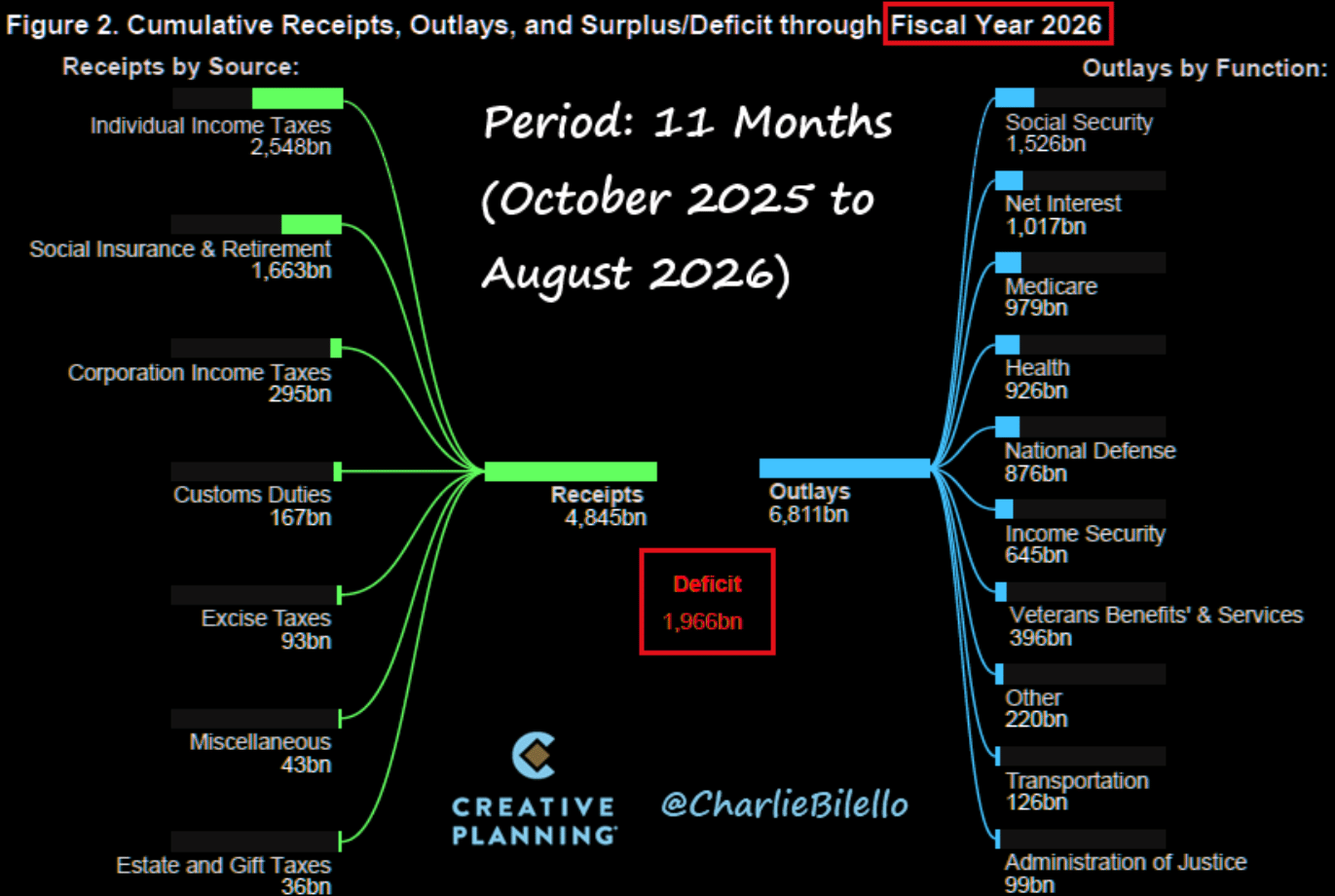
Unbalanced

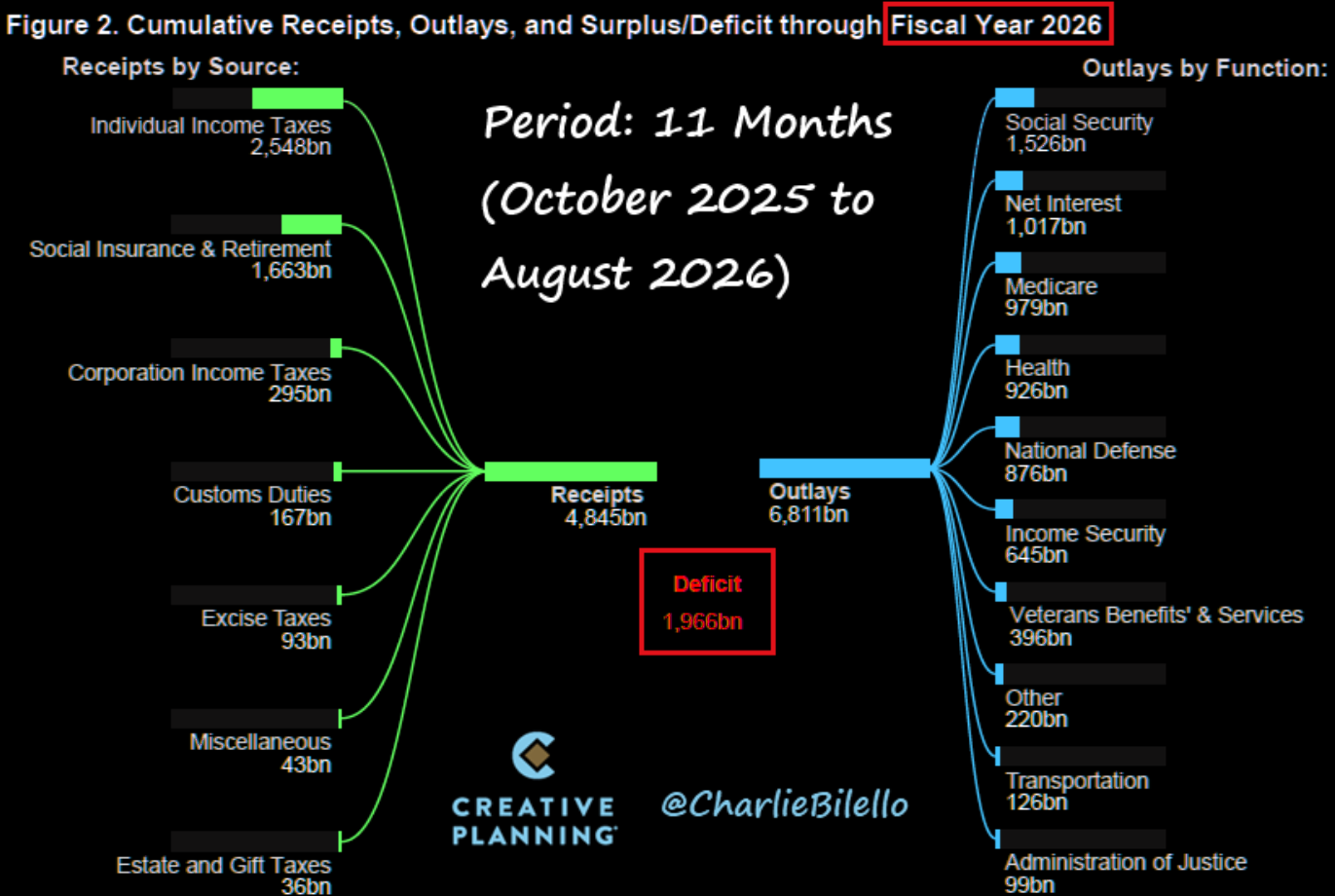
In the first 11 months of fiscal 2026, the US government collected $4.8 trillion — and spent $6.8 trillion. A $2 trillion hole, and we’re not even talking about a recession…..

Source: Bilello

……………………

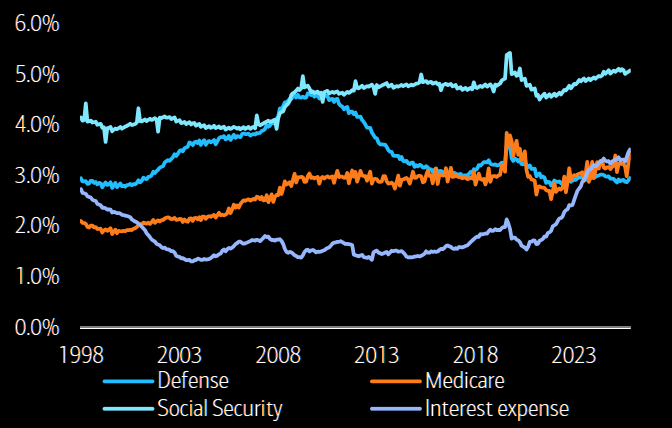
Paying the interest

The problem with borrowing $2 trillion a year is, surprise surprise, that you have to pay interest on it.

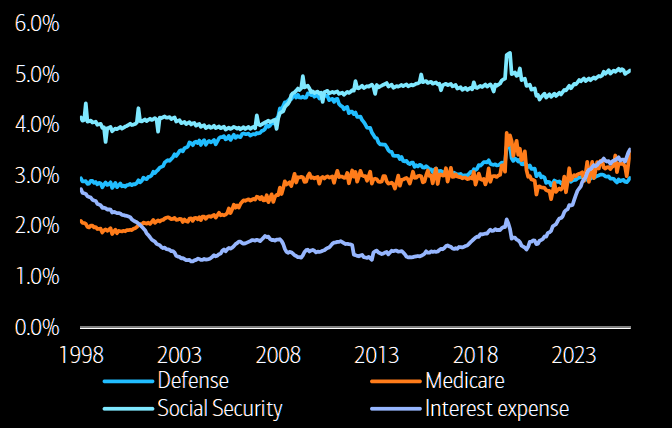
US net interest expense has now overtaken both defense and Medicare as a share of GDP.

Source: US Treasury

…………………

Double

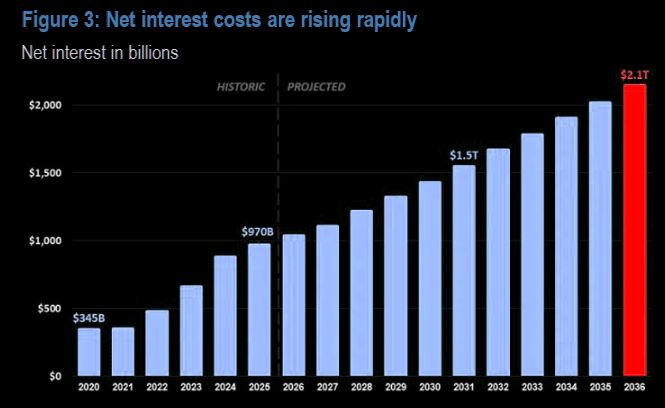
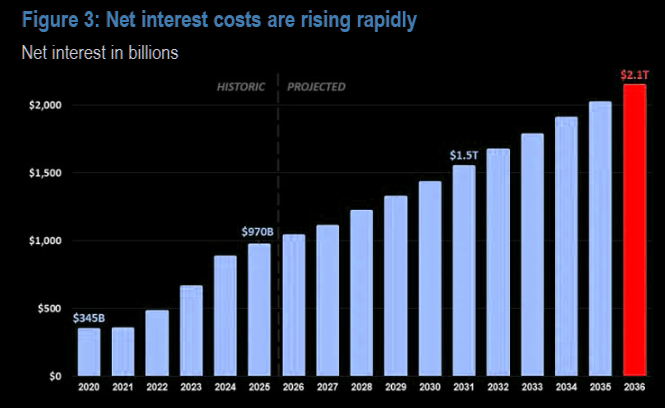
US net interest costs are expected to double from ~$1trn today to $2.1trn by 2035, nearly 5% of GDP.

Source: JPM

………………..

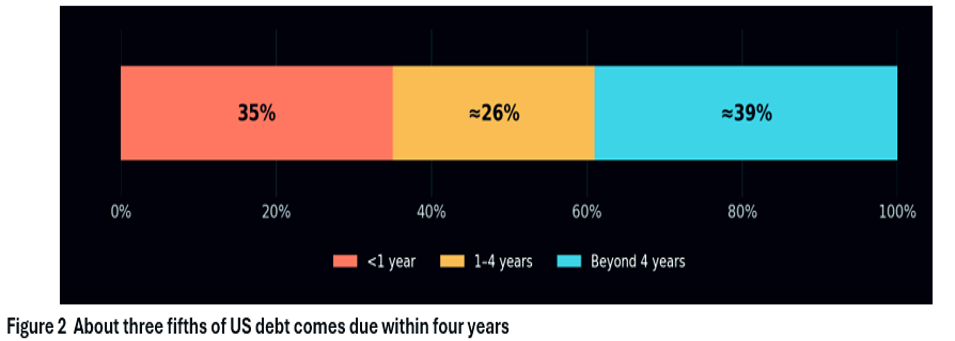
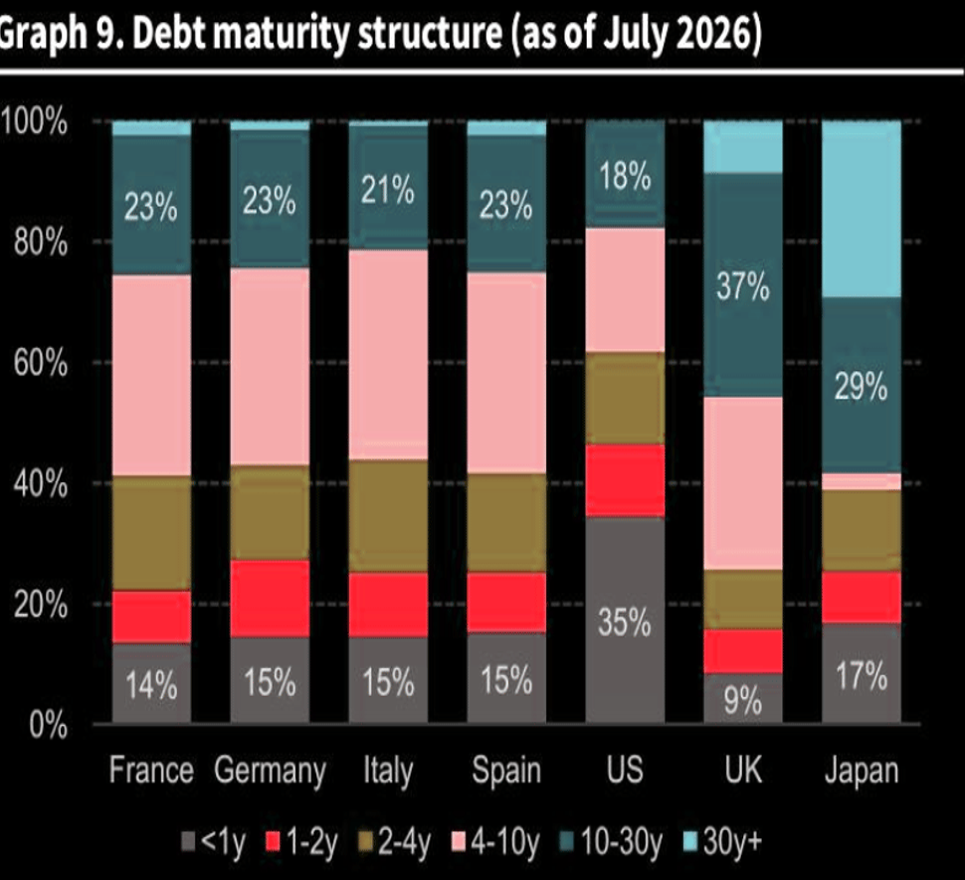
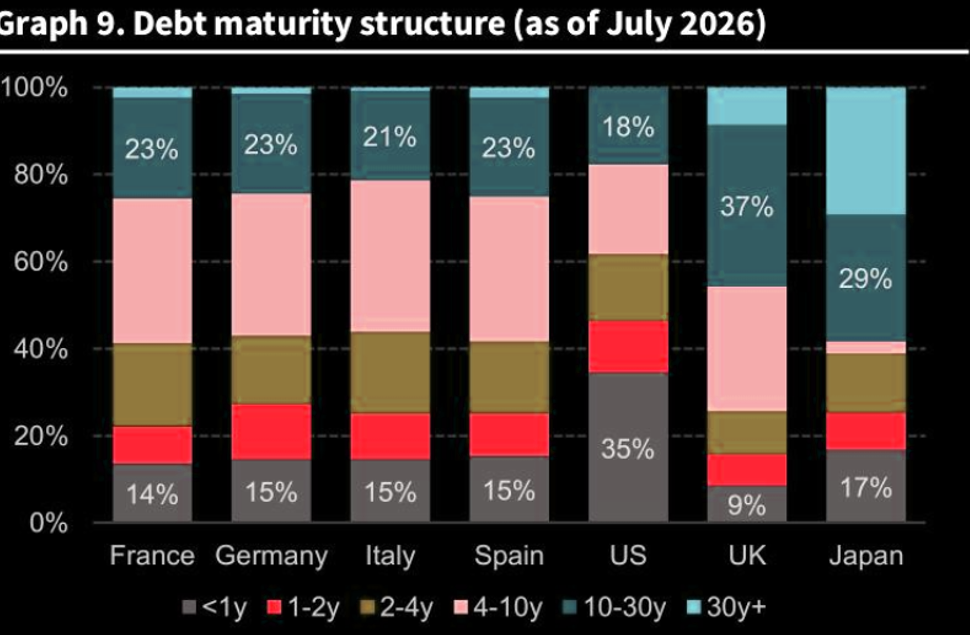
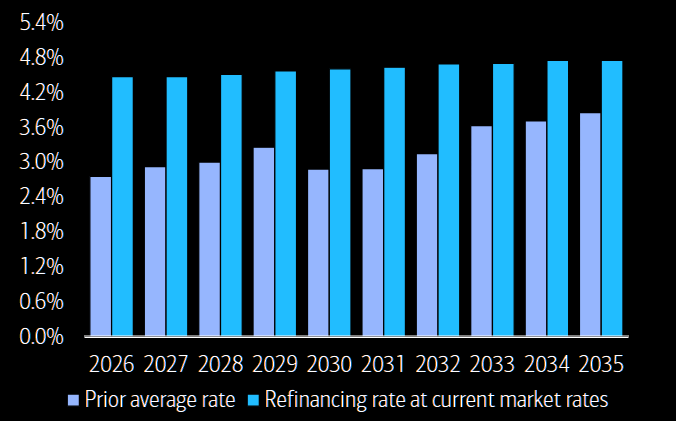
The refinancing machine

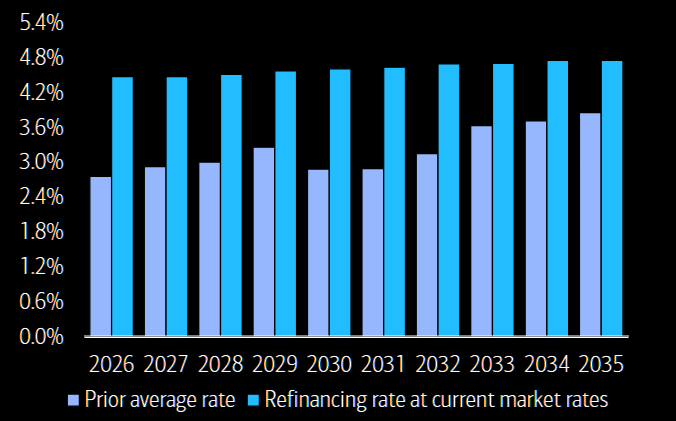
Much of America’s debt still carries coupons from the cheap-money era.

As that debt matures, it is steadily being refinanced at today’s much higher rates. The fiscal pain arrives with a lag.

Source: BofA Global Research

………..

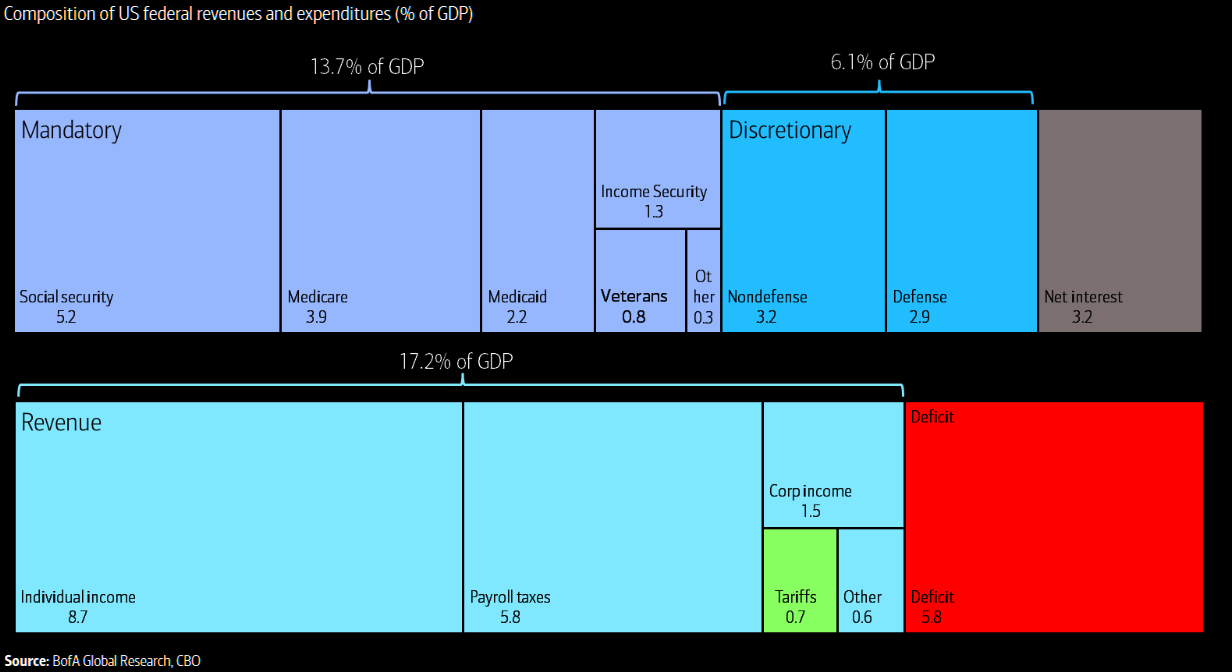
Entitled – Cutting a few government programs won’t solve this.

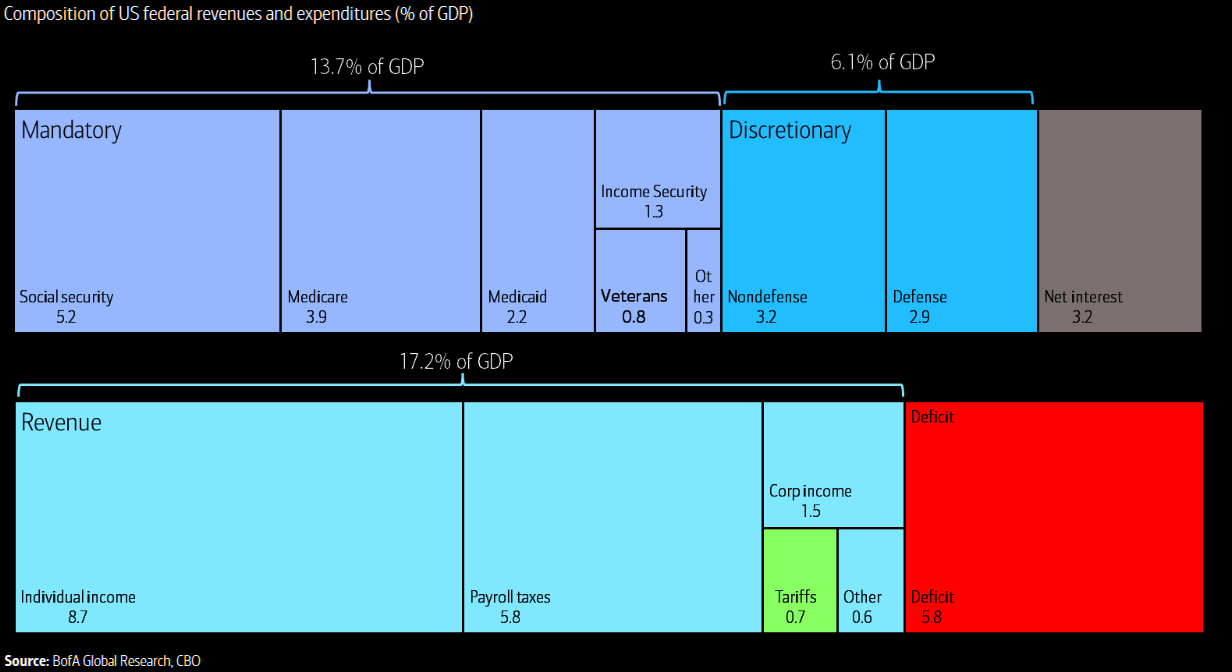
Roughly 70% of US federal spending is driven by entitlements. Meaningful fiscal consolidation ultimately requires entitlement reform, higher taxes — or another way out.

Source: BofA

___________________________

There is precisely one plan in America with the raw power to bring everything back under control.

The Leviticus 25 Plan – An Economic Acceleration Plan for America

$95,000 per U.S. citizen – Leviticus 25 Plan 2027 (68879 downloads )

Federal Budget Deficits – A “Bipartisan Hex on Growth”

No Secretary Bessent, We Aren’t Magically Growing Our Way Out Of Debt

ZeroHedge, Sep 12, 2026 – Authored by Vincent Cook via The Mises Institute,

Excerpts:

The most basic objection to Bessent’s argument (and indeed to the older versions of “supply-side” voodoo as well) is that it doesn’t make any fundamental difference in the physical quantity of capital goods if private savings are consumed by higher deficits instead of being consumed by higher taxes….Giving a tax break to encourage greater investment without corresponding decreases in government spending is self-defeating, since increased deficits divert the additional savings away from private businesses towards the government and its clients and minions.

………….

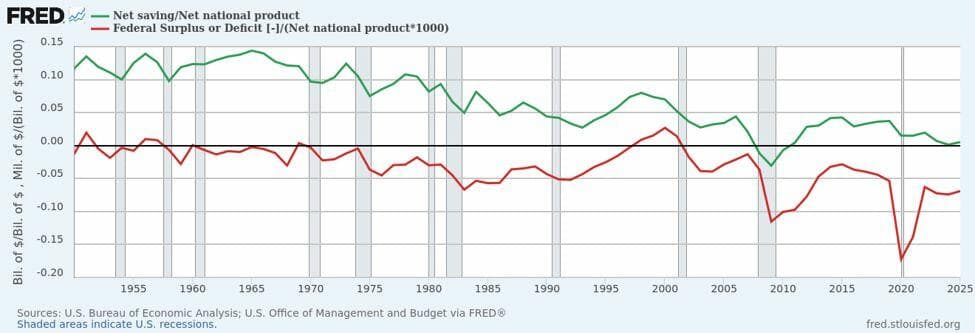
Figure 1 shows these amounts as fractions of net national product (NNP, a measure of what was actually earned by Americans at home and abroad) over the past seventy-five years, with the green line representing net saving and the red line representing federal surpluses and deficits.

Figure 1: Net saving, federal surpluses/deficits as fractions of net national product, 1950-2025

Source: BEA and OMB via FRED®

During the first twenty-four years, net saving varied between ten percent to fifteen percent of NNP, while the federal budget was close to being balanced. However, net saving peaked in 1965, and has since declined to very nearly zero percent in the 2020s. This sixty-year decline in net saving coincides with the emergence of steadily worsening federal deficits, which started becoming particularly acute in the 1980s and early 1990s at around 5 percent of NNP (roughly comparable to the New Deal deficits of the 1930s).

…………..

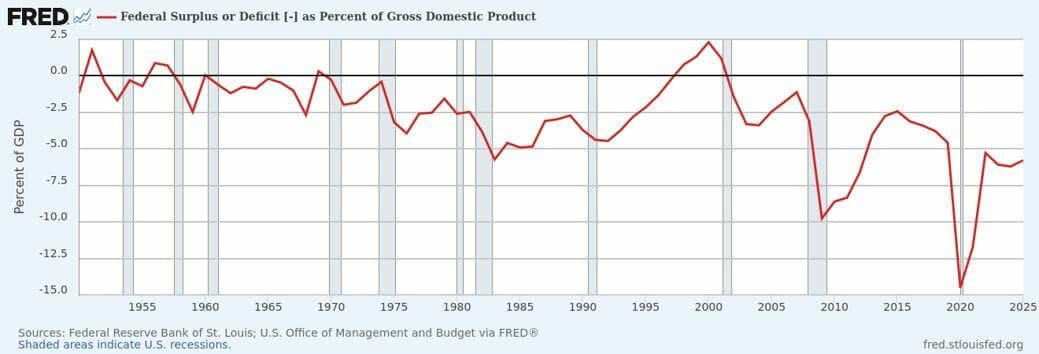
So what are we to make of Bessent’s contention that everything is fine because GDP is growing faster than deficits are? The deficit/GDP ratio referenced by Bessent (figure 2) did decrease from 6.2 percent in 2024 to 5.8 percent in 2025, but such a tiny improvement is barely noticeable when viewed over a seventy-five year perspective.

Figure 2: Federal surpluses/deficits as a fraction of GDP, 1950-2025

Source: BEA via FRED®

The deficit-GDP ratio in figure 2 looks very similar to the red line of figure 1, the main difference being that GDP is somewhat larger than NNP because it includes capital depreciation expenses (which makes “gross” metrics bigger than “net” metrics), offset slightly by the overseas earnings of Americans (which makes “national” metrics smaller than “domestic” metrics). GDP has grown slightly faster than NNP over this period, but it is NNP that is the better proxy of the income tax base, since depreciation expenses are not taxable while overseas income is taxable.

……………

The accelerating creation of fiat dollars out of thin air by the Federal Reserve and the creation of fractional reserve dollar deposits and other dollar-denominated substitutes out of thin air by the banking system – that is, accelerating inflation and faster inflation-caused price increases – are what temporarily boost GDP, what permanently increase trust fund obligations via statutory cost-of-living adjustments, and what fuel wasteful boom-bust cycles characterized during the bust phase by burgeoning deficits, severe declines of net saving due to intensified government interventions, and the writing off of massive quantities of malinvested capital.

This sort of monetary hocus-pocus never makes tax revenues catch up with soaring expenditures over the long run; inflation can “solve” the federal liabilities problem only by utterly destroying the purchasing power of the dollar and thereby making all dollar-denominated obligations worthless. Whatever one may think about the efficacy of the central bank’s monetary wizardry and the Treasury’s fiscal sorcery, none of their spell-casting, witchery’s brews, or prestidigitations are equivalent to private restraint of present consumption by Americans making more labor and natural resource inputs available for growing the physical quantities of sustainably-productive factories, equipment, and farm structures in America. The green line in figure 1 demonstrates that such growth has virtually halted; over the decades Republicans and Democrats alike have put a bipartisan hex on growth.

_______________________________

The Leviticus 25 Plan – The most powerful economic acceleration plan in the world:
* $37.303 billion federal budget surpluses annually, 2027-2031;
* State and local budgets – positive rebalance dynamics;
* Real economic growth – long term cycle;
* Enhanced savings, restored financial security for millions of American families.

The Leviticus 25 Plan is a dynamic economic initiative providing direct liquidity benefits for American families, while at the same time scaling back the role of government in managing and controlling the affairs of citizens.  It is a comprehensive plan with long-term economic and social benefits for citizens and government.

The inspiration for this plan is based upon Biblical principles set forth in the Book of Leviticus, principles tendering direct economic liberties to the people.

The Leviticus 25 Plan – An Economic Acceleration Plan for America

$95,000 per U.S. citizen – Leviticus 25 Plan 2027 (68879 downloads )

Global Monetary Expansion, A World Bleeding Red, and a Powerhouse Economic Acceleration Plan to Revitalize Main Street America.

The Reckoning Of 2028: Civilization’s Ledger Is Bleeding Red

ZeroHedge, Sep 07, 2026 – Authored by Milan Adams via Prepp Group / WordPress,

Excerpt:

Walk through the financial districts of London, New York, or Singapore at six in the evening, and you’ll catch the last act of a performance that grows harder to maintain by the quarter.

We’ve built an elaborate choreography around the idea that currency holds its value…….. The purchasing power hasn’t just eroded; it’s evaporated, and official metrics barely capture the half of it.

The arithmetic is brutal when you look at it directly. Global debt has climbed to roughly $315 trillion. That’s not a percentage point on a chart. That’s a claim on future labor so vast it would take several generations working at full capacity just to service the interest, never mind the principal. In Washington, the federal government now borrows about $5 billion every twenty-four hours to keep the lights on. Weekends included. No holidays. The interest alone will swallow roughly $2 trillion this fiscal year. That’s more than the entire defense budget. More than all discretionary spending combined. These figures come from the Treasury Department itself, buried in reports that few bother to read.

Since 2008, and with terrifying acceleration during the pandemic years, monetary expansion has become the silent thief in everyone’s pocket. The Federal Reserve’s balance sheet hovered below $1 trillion in 2008. By 2022, it had ballooned to nearly $9 trillion. Even after some reduction, it sits above $7 trillion. This wasn’t money earned or produced. It was conjured through digital ledger entries, diluting every existing dollar in circulation. Official inflation numbers – those seven to nine percent figures you see in headlines – exclude the categories that actually determine whether families make it to the end of the month. Add housing, energy, and food back in, and you’re looking at fifteen to twenty percent erosion of purchasing power over five years. Ask any wage earner. They’ll tell you the official numbers feel like fiction.

__________________________________

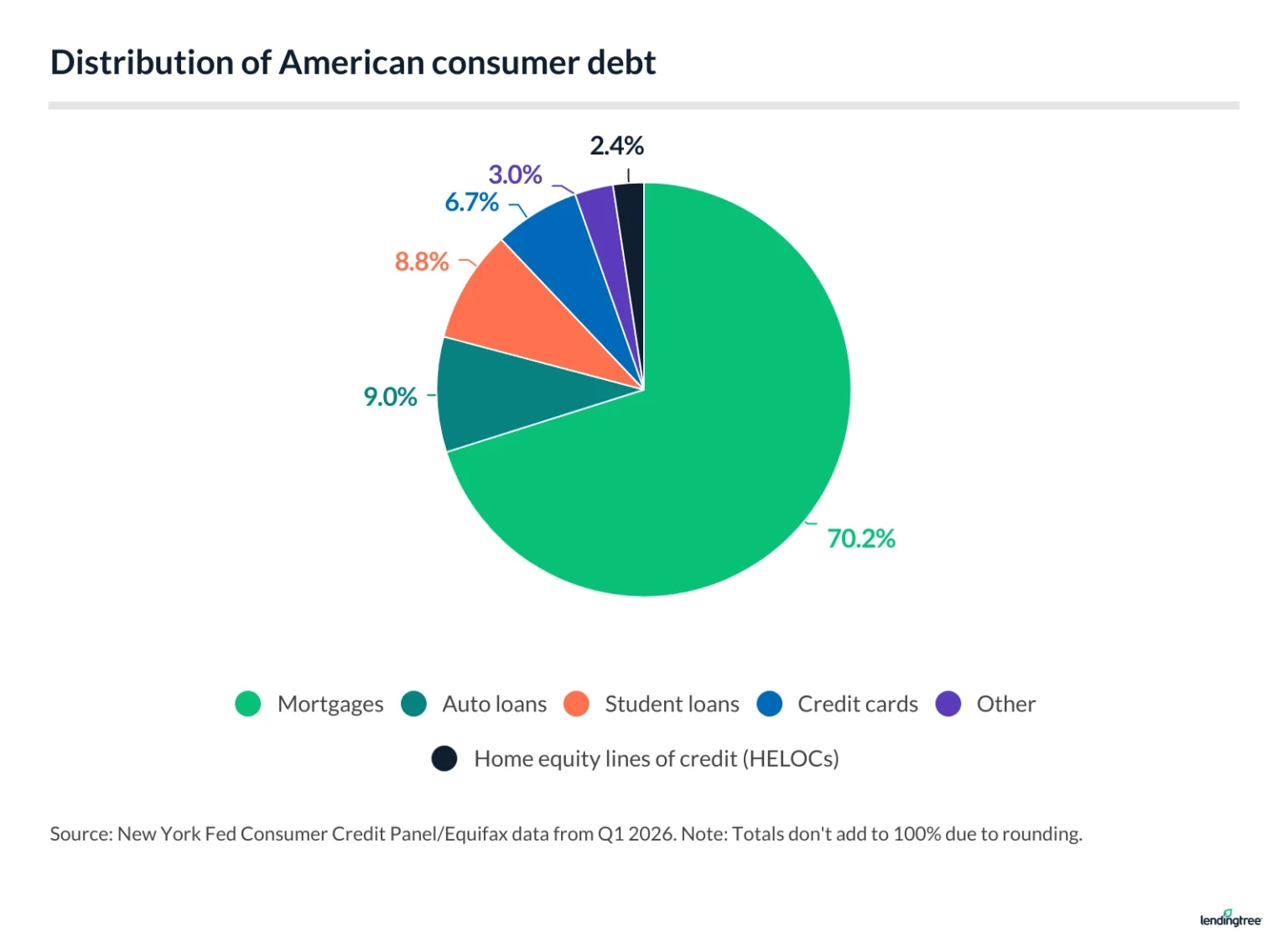
Main Street America – 2026 Household Debt and Interest Expense Charges

This image has an empty alt attribute; its file name is image-3-1024x749.png

Key Mortgage Loan Statistics

  • Total Mortgage Debt: $13.19 trillion, which makes up 70.2% of all U.S. consumer debt.
  • Active Accounts: 86.97 million open mortgage accounts nationwide.
  • Average Balance: $151,673 per active mortgage account.

Since mortgage interest payments are amortized over the life of the loans, there are no exact statistics for the total annual amount of interest costs for borrowers.

A lowball average of 5% on $13.19 trillion would result in annual mortgage interest charges across 86.97 million open mortgage accounts of $650 billion.

…………………………………………………….

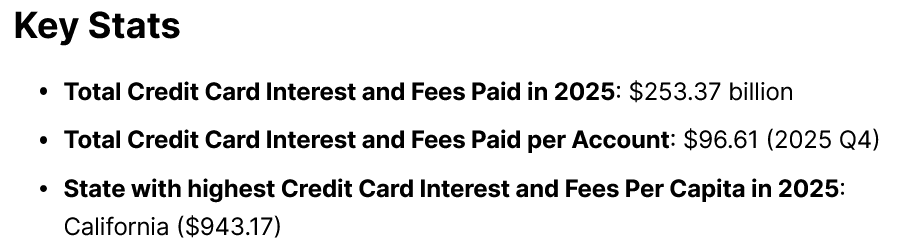
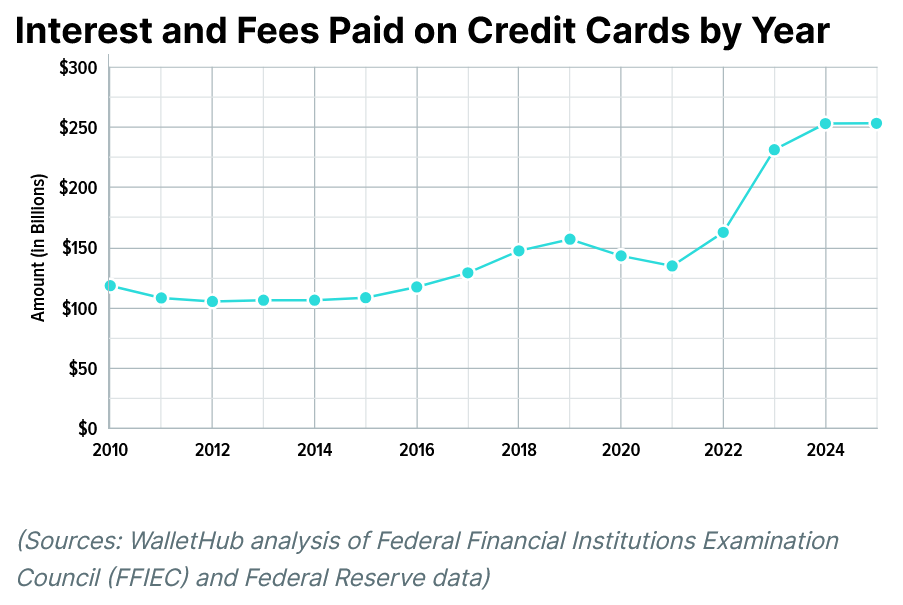
Credit Card Interest and Fees Paid per Month

How Much Americans Pay in Credit Card Interest and Fees

WalletHub – April 9, 2026

…………………………………..

Auto Loan Interest Costs per Month – AI Overview

The National Impact

When looking at the entire country collectively, the figures are staggering:

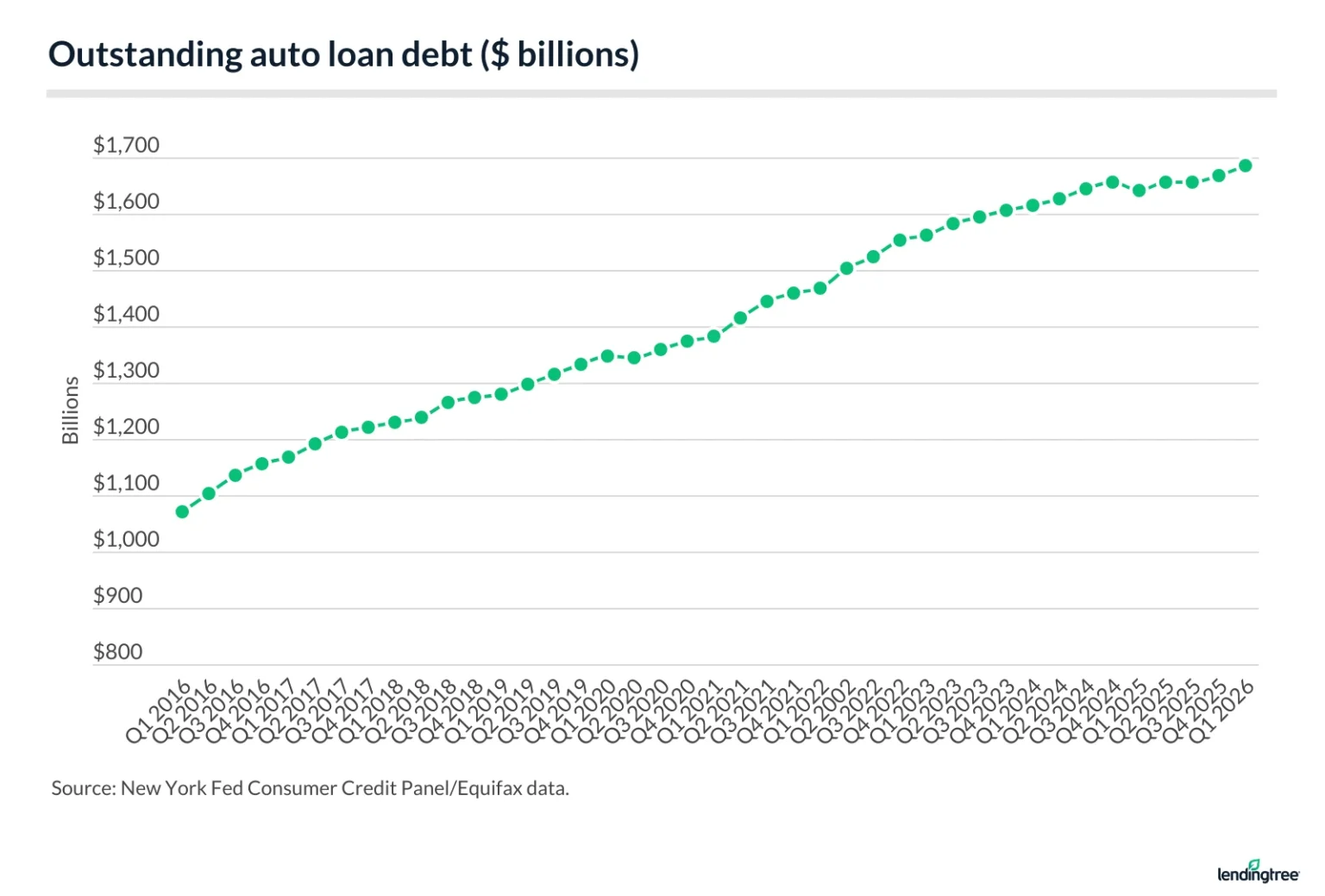
  • Total outstanding U.S. auto loan debt has reached $1.685 trillion.
  • Assuming a blended nationwide interest rate across all active new and used car loans, the American population pays an estimated $11 billion to $12 billion in total auto loan interest every single month.

Annual auto loan interest costs: $138 billion

Average Car Payment and Auto Loan Statistics: 2026 – LendingTree

…………………………

Student Loan Interest Costs per Month

Key Student Loan Borrower Facts

  • Total Borrowers: Roughly 42.6 to 42.7 million individuals hold active federal student loan balances.
  • Total Debt Owed: The cumulative U.S. student loan debt (federal and private combined) stands at approximately $1.86 trillion.
  • Federal vs. Private: Federal loans make up about 91% of all student debt, with private loans accounting for the remainder.
  • Average Balance: The average federal student loan debt balance per borrower is $40,467
  • The average American borrower pays approximately $120 to $200 per month in student loan interest alone..

Student Loan borrowers are currently on the hook for $6.39 billion worth of interest charges per month. This calculates out to $76.68 billion per year.

___________________________________

The Leviticus 25 Plan has the raw power to generate $37.303 billion federal budget surpluses during of each of the first five years of activation (2027-2031) – which would eliminate approximately $328 billion in new interest expense over the 5-year period.

The Plan would also create the opportunity for major budget-balancing dynamics for state and local government entities.

The Leviticus 25 Plan would restore financial security for the millions of American families who have hounded by inflation pressures over the past five years.

The Leviticus 25 Plan would make it possible to eliminate vast amounts of household debt for all qualifying Americans who choose to participate – with the potential to wipe out enormous interest expense payments annually on home mortgages ($650 billion); credit card interest and fees ($253.37 billion); auto loan interest costs ($138 billion); student loan interest costs ($76.68 billion).

This powerful plan is loaded up and ready to launch.

The Leviticus 25 Plan is a dynamic economic initiative providing direct liquidity benefits for American families, while at the same time scaling back the role of government in managing and controlling the affairs of citizens.  It is a comprehensive plan with long-term economic and social benefits for citizens and government.

The inspiration for this plan is based upon Biblical principles set forth in the Book of Leviticus, principles tendering direct economic liberties to the people.

The Leviticus 25 Plan – An Economic Acceleration Plan for America

$95,000 per U.S. citizen – Leviticus 25 Plan 2027 (68003 downloads )

“The Danger of an Unreformed Entitlement State.” One Climactic Plan to Turn the Tide: Ready for Launch…

Truths And Omissions As US Hits $40 Trillion In Debt

ZeroHedge, Aug 28, 2026 – Authored by Veronique de Rugy via The Epoch Times,

The U.S. national debt just crossed the $40 trillion threshold, doubling in less than a decade. Washington politicians have responded with their favorite fiscal game: blaming the other party. Democrats say Republican tax cuts are the culprit. Republicans say Democratic spending is the root cause. But both parties are responsible, with both hiding behind a lie of omission. And if we let them, they’ll keep driving us into the same wall together.

Sen. Patty Murray (D-Wash.) recently called Republican tax cuts “the single biggest driver” of the debt across the last 25 years. The number uses an unrealistic 2001 baseline that projected endless surpluses, as if the late-1990s revenue windfall would last forever. The Brookings Institution’s Jessica Riedl makes a more honest comparison by lining up the actual budget in 2000 against 2026. Tax cuts have reduced revenue by roughly 2 percent of gross domestic product. Spending rose by 5.7 percent, nearly three times as much.

Tax cuts can be great, especially when structured to move us toward a better overall tax code. But they are not free and often do not pay for themselves, largely because they come with lots of nonproductive handouts to special interests.

Yet the fact of the matter is that despite every tax cut since 2001, revenue today sits near its long-run average as a share of the GDP. With spending climbing nearly six points, we know exactly where the problem lies.

The Congressional Budget Office projects federal spending to rise further, from 23.3 percent of GDP this year to 24.4 percent in 2036. For those paying attention, the drivers won’t come as a surprise: entitlement programs and interest payments. Discretionary spending, defense included, is poised to shrink relative to GDP. Revenue holds near its average.

But while Republicans blame Democrats for expanding spending, they have joyfully participated. As David Stockman documented in his 1986 book, “The Triumph of Politics,” the Reagan Revolution failed to truly reform welfare and entitlement spending because Republicans were active in their expansion in the decades before.

More recently, Republicans who spent years complaining about Obamacare have failed to abolish it, let alone reform its finances. Today, you don’t hear a peep out of Republicans about reforming Social Security and Medicare, though they have made some cosmetic adjustments to Medicaid and SNAP as they were cutting taxes.

This is not new. About 26 years ago, Social Security’s trustees were already projecting the trust funds to run dry in 2037, after which payroll taxes would cover only 72 percent of benefits. Today, the trustees expect the old-age fund to be depleted by around 2032, covering about 77 percent of benefits thereafter. And we have always known why: longer lives, lower birth rates, fewer workers per retiree. Maintaining these benefits without crushing taxes was always going to mean a lot of debt.

Medicare’s Hospital Insurance fund is estimated to run dry around the same time. But as the Hoover Institution’s Tom Church notes, Medicare’s real fiscal problem is that we now rely on general revenue to cover more than half of its outlays. This amounts to roughly $10 trillion over 2026-2035, mostly from Part B (a medical insurance program for outpatient and doctors’ visits). That’s huge, but it’s not news, either….

…..

Here’s what the low-rate crowd never understood, and what this decade’s inflation should have taught everyone: Government debt is a promise to run future surpluses. The market expects no less, and thus, the debt’s real value depends on whether investors believe that promise.

When Washington dropped roughly $5 trillion in pandemic dollars into the economy with no plan to pay for any of it, investors reappraised this promise and the price level adjusted. The inflation of 2021 and 2022 was not an unlucky storm. It was the market’s response to a government taking on debt it didn’t have fiscal backing for. Higher interest rates followed, and we are still living with them.

That’s the risk Washington is not pricing into its complacency. The danger of an unreformed entitlement state is about more than interest payments crowding out the rest of the budget. It’s that bondholders will stop believing future surpluses will materialize, and the adjustment comes through the price level again. Unfunded Social Security and Medicare promises are, in effect, a standing commitment to more debt and future inflation.

So, the question is whether the politicians who claim to be alarmed by the crossing of this threshold will stand up and turn the tide of red ink heading our way.

_________________________________________

Highlights – review:

1. “For those paying attention, the drivers won’t come as a surprise: entitlement programs and interest payments.”

Resolved: The Leviticus 25 Plan will reform entitlement spending through positive incentives – and slash interest payments:  
Food Stamp (SNAP) Clean Up Time – Lifting People Up Out of Poverty the Right Way, and Saving America Billions…

The Leviticus 25 Plan Generates $37.303 Billion Federal Budget Surpluses Annually (2027-2031). Part 4: Interest Expense Recapture

2. “Medicare’s Hospital Insurance fund is estimated to run dry around the same time [as the Social Security trust fund].”

Resolved: The Leviticus 25 Plan will restore Citizen-centered Health Care in America – and recapitalize the Medicare Insurance fund: World Class Health Care Solved: The Leviticus 25 Plan

Medicare Part D Prescription Drug Benefit – A Dynamic New Funding Model: The Leviticus 25 Plan.

ObamaCare: Soaring Premiums, Phantom Enrollees. Ready for Launch: America’s Powerhouse, Vote-Winning Health Care Solution – The Leviticus 25 Plan.

3. “Government debt is a promise to run future surpluses””.The danger of an unreformed entitlement state is about more than interest payments crowding out the rest of the budget. It’s that bondholders will stop believing future surpluses will materialize, and the adjustment comes through the price level again.

Resolved: The Leviticus 25 Plan – Surpluses begin now: $37.303 Billion Federal Budget Surpluses Annually (2027-2031): The Leviticus 25 Plan.

Enhanced Supplementary Leverage Ratio for GSIBs – and The Leviticus 25 Plan

………………………………………………

The Leviticus 25 Plan is a dynamic economic initiative providing direct liquidity benefits for American families, while at the same time scaling back the role of government in managing and controlling the affairs of citizens.  It is a comprehensive plan with long-term economic and social benefits for citizens and government.

The inspiration for this plan is based upon Biblical principles set forth in the Book of Leviticus, principles tendering direct economic liberties to the people.

The Leviticus 25 Plan – An Economic Acceleration Plan for America

$95,000 per U.S. citizen – Leviticus 25 Plan 2027 (67389 downloads )