With DOGE disbanded more than a year ago, and tariffs struck down by the Supreme Court, the US is no longer even pretending that there is any hope to normalize spending, or any kind of happy ending to the US debt trajectory.
At 2pm today the US Treasury published the latest, September, monthly budget deficit data, which was also the last month of fiscal 2026, and it will again come as no surprise to anyone that things are looking ever worse.
Total US receipts for the month were $558 billion, a modest 2.6% improvement from the $544 billion a year ago, with individual income taxes accounting for $298 billion, or more than half of the total, and the bulk of the balance coming from Social Insurance and Retirement receipts of $149 billion.
On the spending side, things were ugly: total outlays were $585 billion, a 70% deterioration from the $345.7 billion spent a year ago, although like last month, much of that had to do with the calendar impact of tariffs…
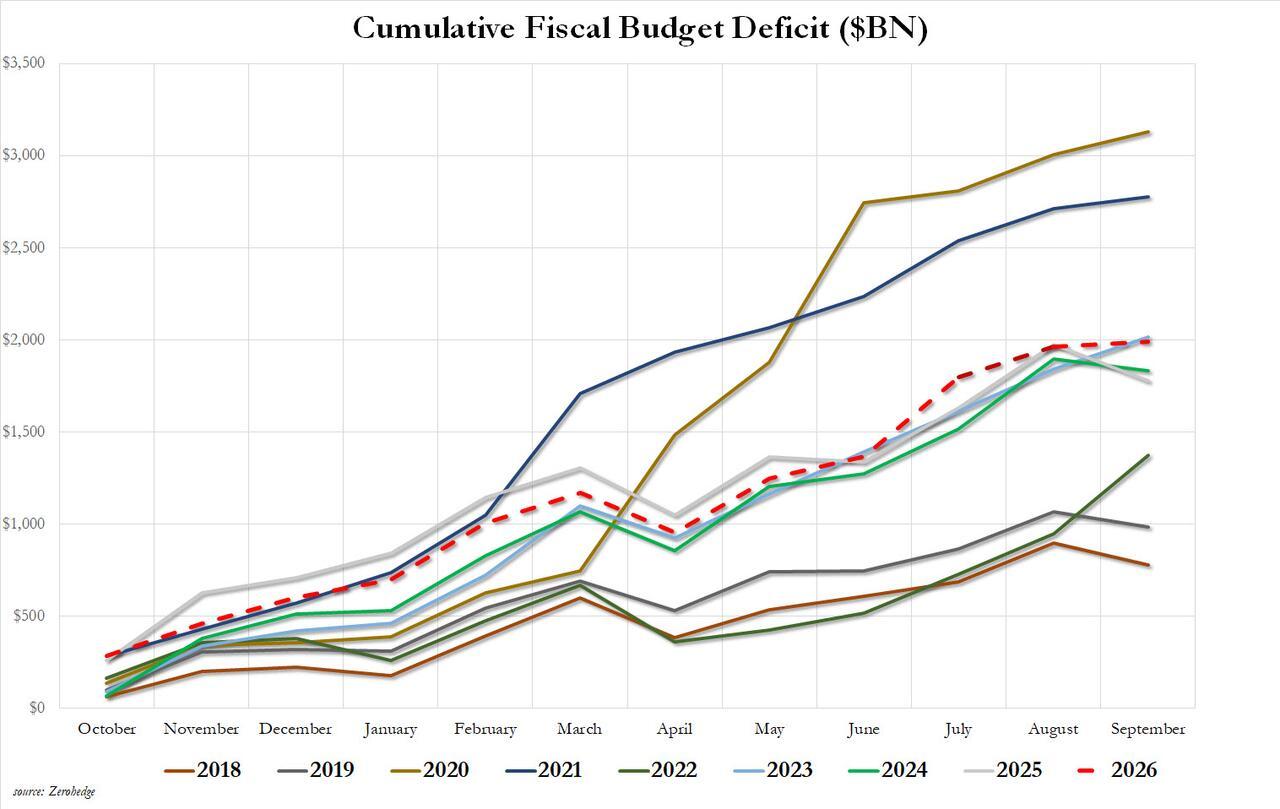
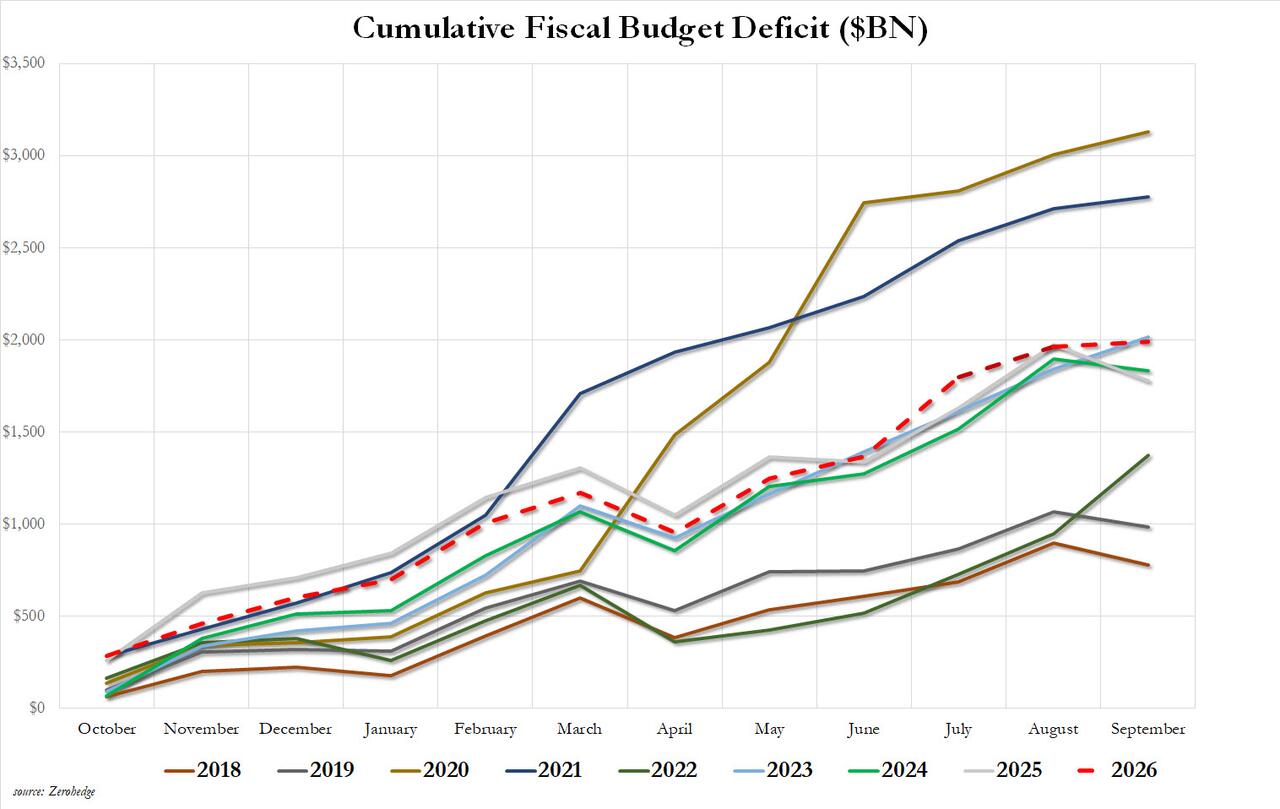
What matters more is that for the full fiscal 2026, total US deficit is closed the year at $2 trillion (technically $1.992 trillion), over $200 billion worse than last year. The silver lining is that contrary to what we said a month ago, when we predicted that “2026 will be about $200bn worse than the previous year when all is said and done, and be the 3rd worst year for the US deficit on record, with just the crisis years of 2020 and 2021 worse”, 2026 was actually just fractionally better than 2023 and its $2.014 trillion deficit.
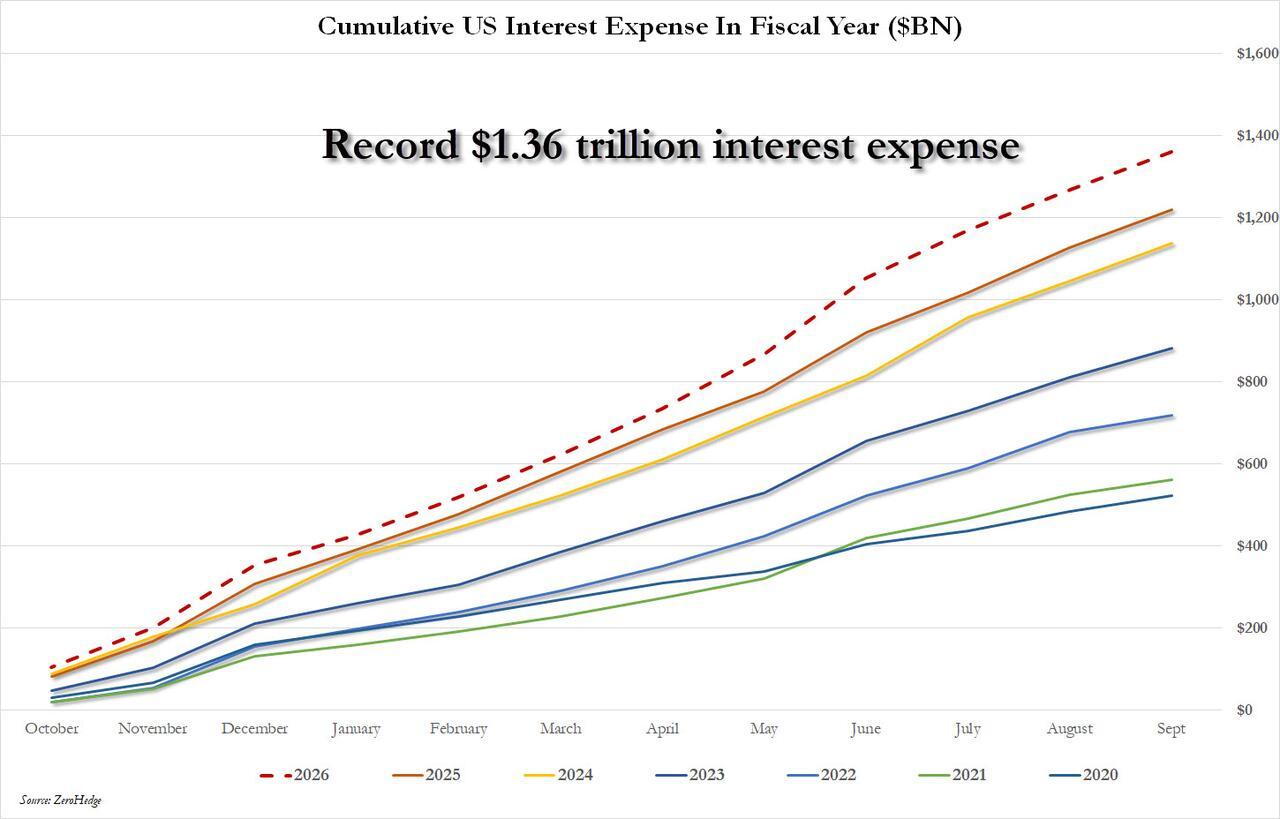
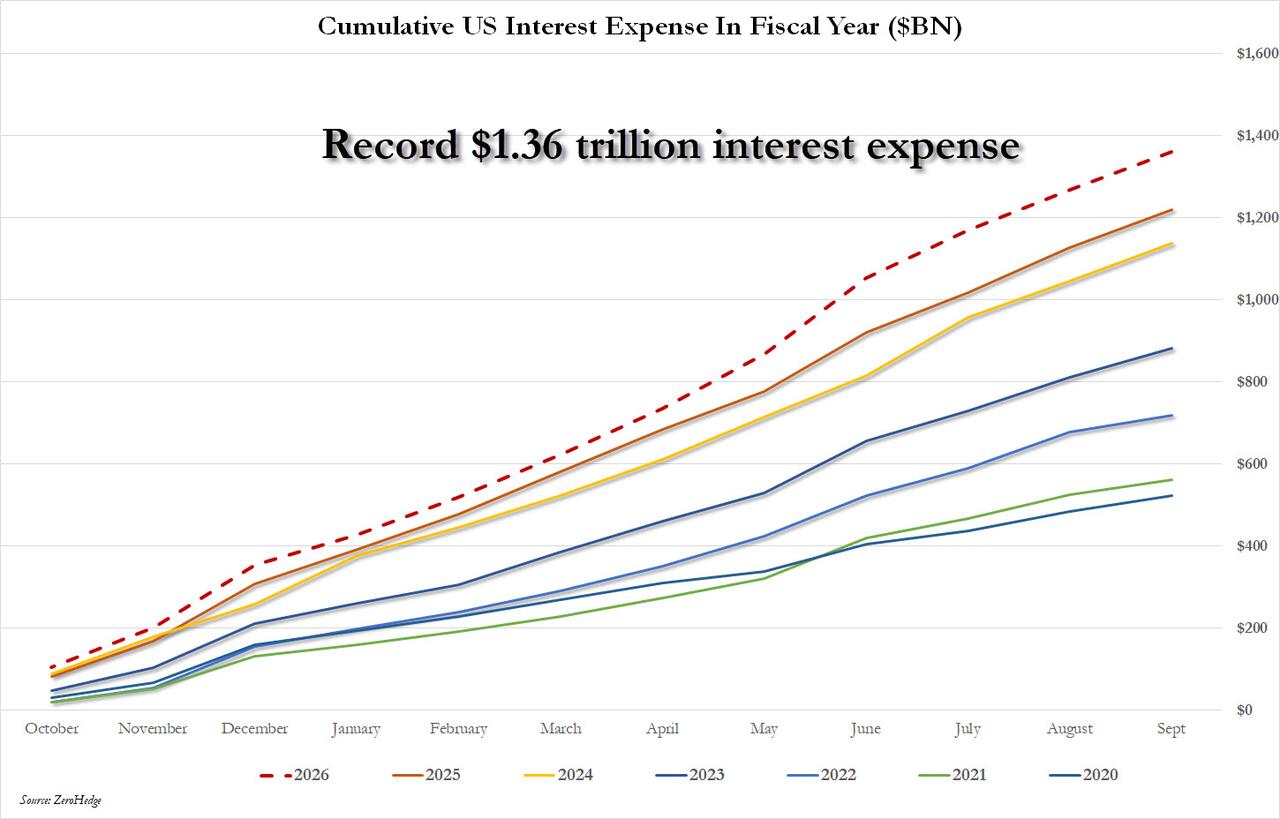
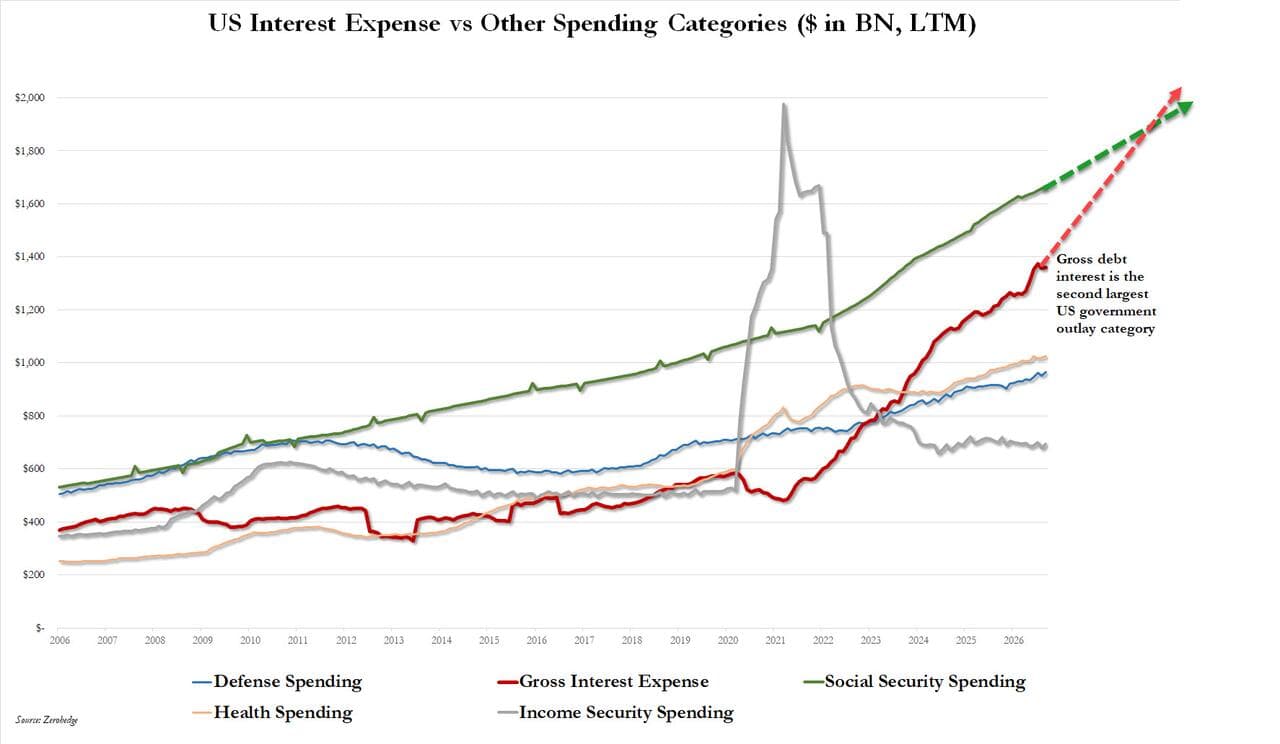
Finally, turning to the elephant in the room, namely interest expense, in September the US spent $92 billion on gross interest expense, which means for all of fiscal 2026, total US interest spending has risen to a record $1.360 trillion, up 12% from a year ago, and the highest on record (as for the net vs gross nazis, in September the US for the first time ever paid net interest of more than a trillion dollars, or $1.05TN to be precise)
Extrapolating the current trend (and with the recent Fed rate hike our estimate may prove conservative), on an LTM basis, total US interest of $1.4 trillion is set to surpass Social Security (which was $1.67 trillion LTM but growing much slower), by the end of 2028.
And since 23% of marketable US debt is now T-Bills, which will see an immediate impact from the recent (and coming) Fed hikes, US interest expense is going to rise even more sharply, signaling that while the debt endgame for the US is guaranteed, the only question is whether Warsh will bring it on even faster.
_________________________________
The most powerful decentralizing, citizen-centered economic acceleration plan in modern history is here:
The Leviticus 25 Plan is a dynamic economic initiative providing direct liquidity benefits for American families, while at the same time scaling back the role of government in managing and controlling the affairs of citizens. It is a comprehensive plan with long-term economic and social benefits for citizens and government.
The inspiration for this plan is based upon Biblical principles set forth in the Book of Leviticus, principles tendering direct economic liberties to the people.
Inflation and the affordability crisis in goods and services garner all the headlines in today’s news feeds… but the ‘interest cost burden’ borne by U.S. Households and the Government sector, as drivers of inflation, are real and far more significant factors in the present crisis than anyone realizes.
…………………………………
AI review of the literature
Household Interest Cost Burden
1. The Statistical Loophole: Interest is Excluded from CPI
The standard Consumer Price Index (CPI)—the most common measure of inflation—completely excludes consumer borrowing costs like mortgage interest rates, credit card APRs, and auto loan interest. [1]
The Reason: Central banks view interest as the cost of money, not the cost of a consumer good or service. [1]
The Irony: When central banks raise interest rates to cool down inflation, they intentionally increase the household debt burden to reduce consumer spending power. [1, 2]
2. The “True” Inflation Impact: Up to 3–4 Percentage Points Higher
Prominent economic research, including a notable National Bureau of Economic Research (NBER) working paper co-authored by former Treasury Secretary Lawrence Summers and IMF economists, sought to recalculate CPI by re-incorporating the cost of money (as was done in the U.S. pre-1983). [1]
They discovered that when interest burdens are factored back in:
The Peak Discrepancy: During aggressive rate-hiking cycles, “true” household inflation peaked roughly 3 to 4 percentage points higher than official CPI reported.
The Sentiment Gap: This statistical gap explains why consumer economic sentiment remains historically low even when official inflation reports show a “return to normal”. To the consumer, a 7% mortgage vs. a 3% mortgage feels exactly like inflation—it is a massive increase in the cost of sustaining their life. [1, 2, 3, 4]
3. Real-World Cost Burdens Placed on Households
While it may not show up in headline CPI, the practical cost burden of elevated interest rates alters household budgets in specific ways:
Debt Category
Real-World Financial Impact
Mortgages
Borrowing costs for a standard 30-year mortgage on a median-priced home add roughly $2,500 more per year (or over $75,000 across the life of the loan) compared to low-rate environments.
Credit Cards
With average credit card APRs hovering near historically high levels (around 19%–20%), carrying a balance rapidly inflates the cost of daily essentials like groceries bought on credit.
Crowding-Out Effect
Research shows that as housing and interest costs spike, consumers are forced into a “crowding-out” trade-off, cutting roughly 39 to 54 cents from essential non-housing consumption for every extra dollar spent on fixed debt costs.
By the time interest rates peak, nearly 9% of U.S. households find themselves severely strained, spending over 40% of their total income just to service debt repayment. [1]
………………….
Government Interest Cost Burden
The government’s interest cost burden does not directly increase standard consumer inflation metrics, but it creates significant secondary fiscal and financial risks that can fuel long-term price pressures. [1]
In macroeconomic modeling, a structural fiscal shock—such as a permanent primary deficit increase of 1% of GDP (which balloons the government’s interest burden)—is projected to generate inflationary pressures. Over a 5-year horizon, this pressure scales to an indirect household purchasing power loss of $300 to $1,250 per family. [1]
The structural relationship between a rising interest cost burden and inflation operates through distinct channels:
1. The Fiscal Dominance Risk (Monetization)
As net interest payments on the federal debt surge past $1 trillion annually (consuming over 14% to 18.5% of federal revenues), the risk of “fiscal dominance” rises. If the government’s borrowing capacity faces constraints, aggressive measures to suppress bond yields may force the Federal Reserve to intervene. If the central bank is eventually forced to monetize the debt by purchasing government bonds to artificially lower borrowing costs, it expands the money supply and directly drives up inflation. [1, 2, 3, 4]
2. High Rates as a Cost-Push Component
While conventional monetary policy utilizes high interest rates as a contractionary tool to squelch aggregate demand, prolonged high interest burdens create a form of sector-specific cost-push inflation for consumers. For instance, the same 1% GDP fiscal deficit shock pushes up mortgage rates in lockstep with the 10-year Treasury, leading to $600 to $1,240 more in annual mortgage interest payments for average households. [1, 2]
3. Deficit Spills and Demand-Pull Pressures
When a government borrows heavier sums to pay the interest on its existing debt, it injects liquidity back into the hands of private creditors and bondholders. In a supply-constrained economic landscape, this expansionary deficit spending can bid up prices. [1, 2]
Conversely, the relationship also loops backwards: every 1.0 percentage point unexpected increase in the baseline inflation rate eventually forces central banks to raise interest rates, adding roughly $230 billion to $350 billion in annual interest costs back onto the government budget, worsening the overall fiscal trajectory. [1, 2]
____________________________________
The Leviticus 25 Plan will provide a powerful and comprehensive reset to the debt-driven interest cost burden smothering U.S. Households, Government, and the overall U.S. economy.
The Leviticus 25 Plan will eliminate the vast majority of the interest cost burden for millions of hard-working American families; it will generate federal budget surpluses, $37.303 billion annually, 2027-2031) – and will pay for itself entirely over the succeeding 10-15 years; it will drive rates lower, across the curve, and spur a powerful new economic growth cycle.
It will undergird long-term strength and stability for the U.S. Dollar across global markets, and preserve its purchasing power for U.S. citizens.
The Leviticus 25 Plan is a dynamic economic initiative providing direct liquidity benefits for American families, while at the same time scaling back the role of government in managing and controlling the affairs of citizens. It is a comprehensive plan with long-term economic and social benefits for citizens and government.
The inspiration for this plan is based upon Biblical principles set forth in the Book of Leviticus, principles tendering direct economic liberties to the people.
The Leviticus 25 Plan – An Economic Acceleration Plan for America
Bank of America has just been charged with “willfully” violating anti-money laundering and sanctions laws, in failing to report more than $5 billion in “suspicious” transactions… more than $1 billion of that was tied to what Treasury calls “priority” national-security risks, including Chinese money-laundering networks and illicit finance along the southwest border.
This is the same Bank of America that received a $45 billion TARP bailout loan from the U.S. Treasury in January 2009. And, another $91.4 billion from the Fed during the great financial crisis…
Bloomberg: Bank of America was the #3 recipient via the Fed’s ‘Secret Liquidity Lifeline’ infusions with $91.4 billion (peak loan amount – 2/26/2009).
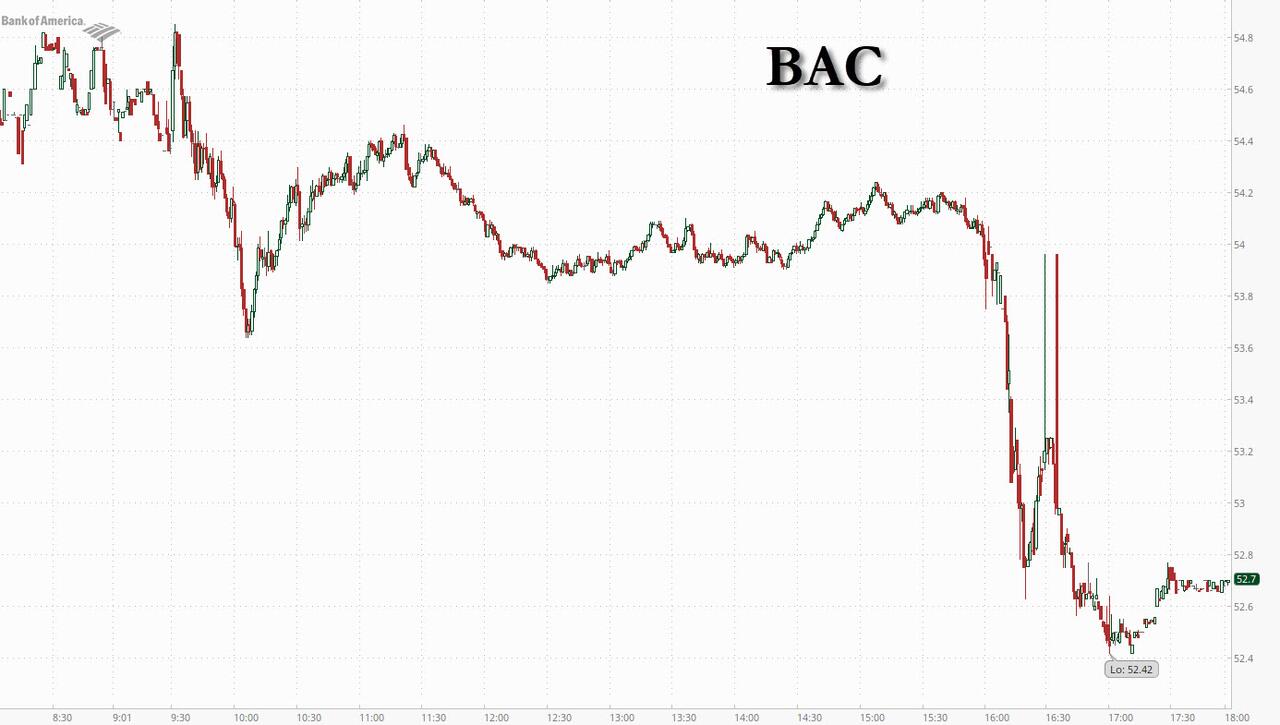
…Just after the close on Tuesday, Treasury announced more than $1.21 billion in penalties against BofA for violating anti-money-laundering and sanctions laws. Treasury calls it the third-largest penalty in its history, and the OCC calls its piece the largest it has ever handed out. The bank admitted it willfully violated the Bank Secrecy Act. It did not report more than $5 billion in suspicious transactions on time, and more than $1 billion of that was tied to what Treasury calls “priority” national-security risks, including Chinese money-laundering networks and illicit finance along the southwest border.
The Financial Crimes Enforcement Network (FinCEN) assessed a $1.2 billion penalty for the Bank’s failure to mitigate and report priority national security risks, including Chinese Money Laundering Networks and illicit finance along the southwest border.
The OCC assessed a $750 million civil money penalty for the Bank’s deficient and ineffective BSA/AML (anti-money laundering) compliance program.
The Office of Foreign Assets Control (OFAC) announced an $11.6 million settlement agreement with the Bank over apparent violations of numerous sanctions programs, including on Iran, Russia, narcotics, and global terrorism….
“Prioritized Its Revenues”
….As these issues arose, Bank of America prioritized its revenues and minimized the impact on its required compliance resources. The nature and extent of the Bank’s resulting reliance on law enforcement inquiries, requests by other financial institutions, and similar interventions over its own internal, automated controls… meant that the Bank effectively outsourced to third parties a substantial portion of its proactive detection and reporting obligations.
Translation: BofA’s money-laundering detection system often amounted to waiting for a subpoena.
Treasury also says the bank “allowed suspicious activity to accumulate uninvestigated for extended periods.” That meant SARs arrived too late to help law enforcement much. Its customer due diligence also “failed to account for customers’ extensive reliance on payments from unknown third parties,” and the bank didn’t act on red flags that included “potential ties to narcotics trafficking proceeds,” even after its own compliance staff raised concerns about trade-based money laundering and fraud.
The OCC’s language was harsher. Its release says the bank’s transaction monitoring “resulted in the Bank failing to properly monitor trillions of dollars in transactions,” that “the Bank knew for years” it was failing to escalate potentially suspicious activity, and that its BSA Officer and staff “lacked sufficient skills and expertise.” Comptroller Jonathan Gould said:
“The second largest bank’s egregious and continued BSA violations warrant the OCC imposing its largest [civil money penalty] ever assessed against a bank.”
………….
OFAC, for its part, found 475 apparent sanctions violations. They included payments routed through blocked banks and designated individuals who were allowed to withdraw funds “due to poor sanctions alert calibration.” OFAC called the violations “non-egregious,” which is the regulatory version of “could have been worse.”
About That 2024 Order
None of this came out of nowhere. On December 23, 2024, the OCC issued a cease-and-desist order against BofA for BSA and sanctions deficiencies, “including a failure to timely file suspicious activity reports and failure to correct a previously identified deficiency related to its Customer Due Diligence processes.” The order itself described a “systemic failure” to set proper transaction-monitoring thresholds. That order came with no fine, a point American Banker noted at the time….
……………………………………………………..
A look back…
Fall 2008: Bank of America – #3 Recipient of Fed’s “Secret Liquidity Lifelines”
Posted on
Bank of America – the story behind the story (Source: Bailout Nation)
June 2005: Bank of America takes a 9 percent stake in China Construction Bank for #3 billion; China’s market tops out in 2007 and then plummets 72 percent.
January 2006: Bank of America acquires MBNA for $35 billion. The world’s largest issuer of credit cards [MBNA] is taken over right before the world’s largest credit crunch occurs and (whoops) just before the worst postwar recession begins.
August 2007: Bank of America invests $2 billion in Countrywide Financial, the nation’s biggest mortgage lender and loan servicer. It is a jumbo loser, dropping 57 percent in a few month’s time
January 2008: Bank of America doubles down and announces a $4.1 billion acquisition of Countrywide. The timing is flawless, and the purchase is announced as the worst housing collapse in modern history is accelerating.
September 2008: Bank of America pays $50 billion for Merrill Lynch, including Merrill’s portfolio of toxic assets (along with some previously unannounced trading desk errors).
……………………………………
Note – following the above cited BofA follies, the Treasury Department and the Federal Reserve stepped up to the plate and kindly dished out billions of dollars (at U.S. citizen taxpayer expense) to Bank of America to keep the big boat afloat.
To recap (Source: Bloomberg Nov 28, 2011 ):Morgan Stanley was the #1 recipient of Fed secret loans at $107 billion (peak loan amount – 9/29/2008).
Citigroup was the #2 recipient of the Fed’s secret lifelines $99.5 billion (peak loan amount – 1/20/2009).
Bank of America was the #3 recipient with $91.4 billion (peak loan amount – 2/26/2009).
Bloomberg Nov 28, 2011: “Bank of America Corp., which got two rounds of U.S. Treasury Department capital injections totaling $45 billion to stay afloat during the credit crisis, borrowed twice that amount in secret from the Federal Reserve. On Feb. 26, 2009, the Charlotte, North Carolina-based bank held $78 billion of loans from the Fed’s Term Auction Facility, $8.65 billion from the Primary Dealer Credit Facility, $4.75 billion from the Term Securities Lending Facility. The financing helped bolster the largest U.S. bank by assets as investors worried its 2008 acquisitions of Merrill Lynch & Co. and Countrywide Financial Corp. might lead to nationalization.”
………………………………………….
A final question: Is there anyone who still believes that it is OK for major Wall Street banking and financial services institutions to receive massive liquidity injections (at taxpayer expense) when their financial viability evaporates … due to their own failed risk management strategies and reckless, yield-driven investment decision-making….
But it is not OK for U.S. citizens to be accorded the same access to direct liquidity extensions?
It is time now to level the playing field… and activate a Federal Reserve / U.S. Treasury pipeline via a U.S. Citizens Credit Facility.
The Leviticus 25 Plan will generate $37.303 billion federal budget surpluses (2027-2031) and pay for itself entirely over the succeeding 10-15 years.
The Leviticus 25 Plan – An Economic Acceleration Plan for America
Socialism leads to the politicization of society. Hardly anything can be worse for the production of wealth.
Socialism, at least its Marxist version, says its goal is complete equality. The Marxists observe that once you allow private property in the means of production, you allow differences. If I own resource A, then you do not own it and our relationship toward resource A becomes different and unequal. By abolishing private property in the means of production with one stroke, say the Marxists, everyone becomes co-owner of everything. This reflects everyone’s equal standing as a human being.
The reality is much different. Declaring everyone a co-owner of everything only nominally solves differences in ownership. It does not solve the real underlying problem: there remain differences in the power to control what is done with resources.
In capitalism, the person who owns a resource can also control what is done with it. In a socialized economy, this isn’t true because there is no longer any owner. Nonetheless the problem of control remains. Who is going to decide what is to be done with what? Under socialism, there is only one way: people settle their disagreements over the control of property by superimposing one will upon another. As long as there are differences, people will settle them through political means.
If people want to improve their income under socialism they have to move toward a more highly valued position in the hierarchy of caretakers. That takes political talent.
Under such a system, people will have to spend less time and effort developing their productive skills and more time and effort improving their political talents.
As people shift out of their roles as producers and users of resources, we find that their personalities change. They no longer cultivate the ability to anticipate situations of scarcity to take up productive opportunities, to be aware of technological possibilities, to anticipate changes in consumer demand, and to develop strategies of marketing. They no longer have to be able to initiate, to work, and to respond to the needs of others.
Instead, people develop the ability to assemble public support for their own position and opinion through means of persuasion, demagoguery, and intrigue, through promises, bribes, and threats. Different people rise to the top under socialism than under capitalism. The higher on the socialist hierarchy you look, the more you will find people who are too incompetent to do the job they are supposed to do. It is no hindrance in a caretaker politician’s career to be dumb, indolent, inefficient, and uncaring. He only needs superior political skills. This too contributes to the impoverishment of society.
The United States is not fully socialized, but already we see the disastrous effects of a politicized society as our own politicians continue to encroach on the rights of private property owners. All the impoverishing effects of socialism are with us in the U.S.: reduced levels of investment and saving, the misallocation of resources, the over-utilization and vandalization of factors of production, and the inferior quality of products and services. And these are only tastes of life under total socialism.
………………………………………
Quotes:
“The inherent vice of capitalism is the unequal sharing of blessings; the inherent virtue of socialism is the equal sharing of misery.” -Winston Churchill
“Socialism means slavery.” -Lord Acton
“Democracy and socialism have nothing in common, but one word, equality. But notice the difference: while democracy seeks equality in liberty, socialism seeks equality in restraint and servitude.” -Alexis de Tocqueville
_____________________________________
Main Street America Republicans do have a plan.
America’s Dynamic ‘Economic Liberty’ Solution: The Leviticus 25 Plan
There is currently one, and only one, comprehensive economic acceleration plan in America that re-targets liquidity flows away from government agencies and corporate middlemen directly to U.S. citizens – and has the power to lift millions of Americans up out of poverty, revitalize self-reliance in America, and reverse the ‘impoverishing effects of socialism.’
The Leviticus 25 Plan will: 1) Reignite powerful, long-term economic growth; 2) Eliminate trillions of dollars in Household debt and restore financial security for millions of U.S. citizen families; 3) Generate trillions of dollars in new general tax and payroll tax revenue; 4) Generate Federal Budget surpluses (2027-2031) and rebalance state and local government budgets; 5) Rebuild a world class, citizen-centered health care system across America.
The Leviticus 25 Plan is a dynamic economic initiative providing direct liquidity benefits for American families, while at the same time scaling back the role of government in managing and controlling the affairs of citizens. It is a comprehensive plan with long-term economic and social benefits for citizens and government.
The inspiration for this plan is based upon Biblical principles set forth in the Book of Leviticus, principles tendering direct economic liberties to the people.
The Leviticus 25 Plan – An Economic Acceleration Plan for America