August Federal Budget Deficit “Explodes”… Meanwhile, Elon Musk is Wrong, Government is NOT “Unfixable.”

The most powerful economic acceleration plan in the world is queued up and ready to roll: 1) Eliminating federal and state budget deficits; 2) Restoring financial security for all participating U.S. citizens; and 3) Revitalize economic liberty for all Americans.

…………………………………..

US Deficit Explodes In August Despite Rising Tariff Revenues As Government Spending Soars

ZeroHedge, Sep 11, 2025 – Excerpts:

[H]ere is a look at the latest Treasury Income Statement for the month of August, published earlier today. 

First, the good news: for the fifth month in a row, the US government benefited from outsized tariff revenues, which as shown in the chart below, continue to rise and in August hit just under $30BN – or about $360BN annualized – at the current tariff rate. 
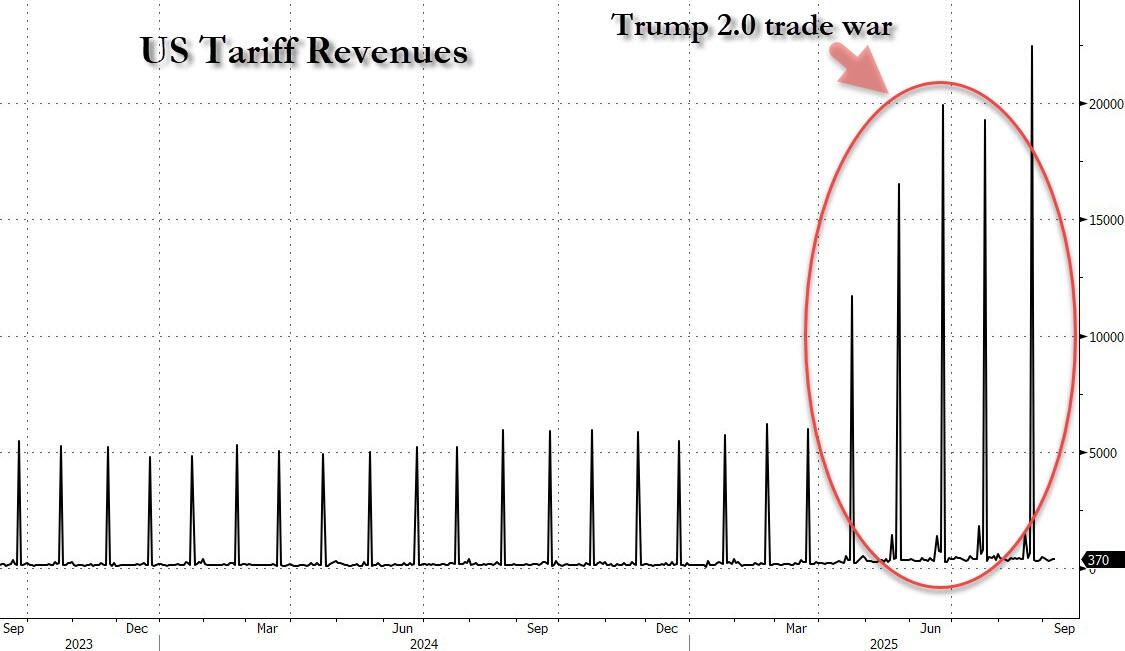
But while the tariff revenue in June was sufficient to tip the overall US Treasury budget into a (very rare) surplus…

According to the latest Monthly Treasury Statement, in August the US government spent $689 billion, up 0.4% from the $686.6 billion a year ago, and the highest monthly spending total of fiscal 2025 which ends next month. So much for the cost-cutting efforts of DOGE.
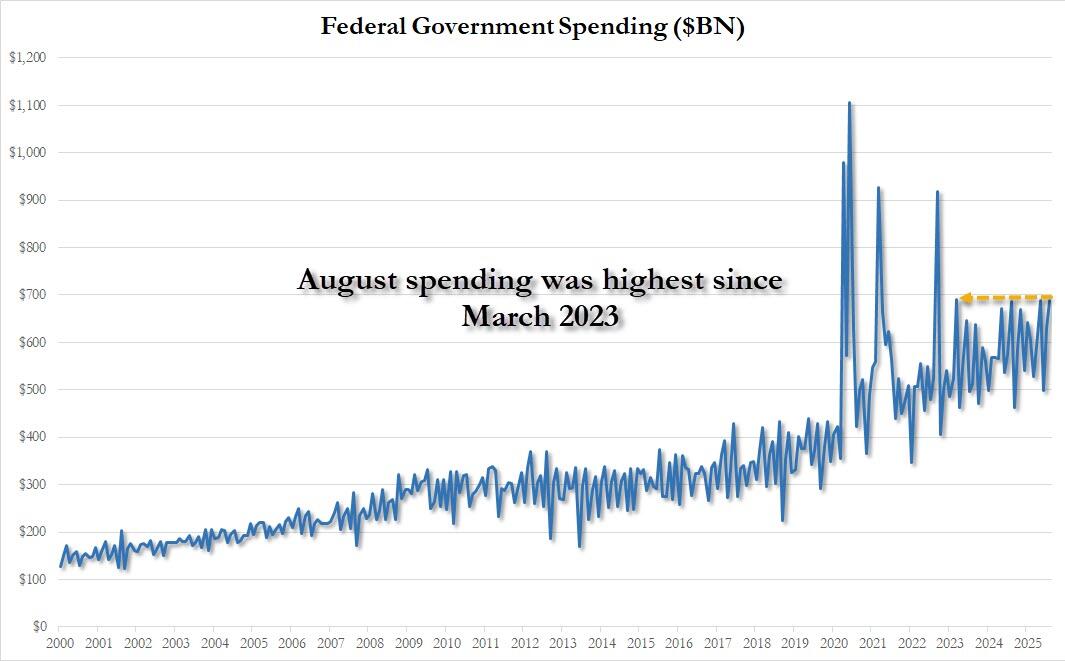
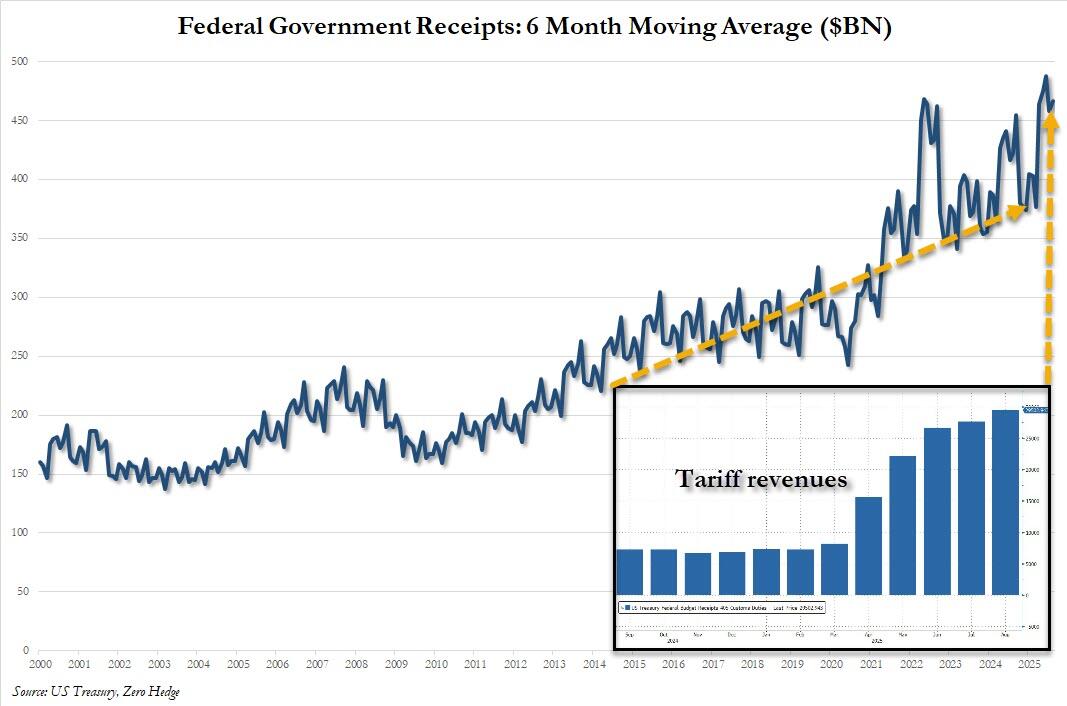
And while the huge monthly spending was somewhat offset by a 12.3% increase in revenues, which increased from $306.5 billion to $344.3 billion, this included the $29.5 billion in tariff revenues noted above. Take that out and government income would have been flat YoY. 
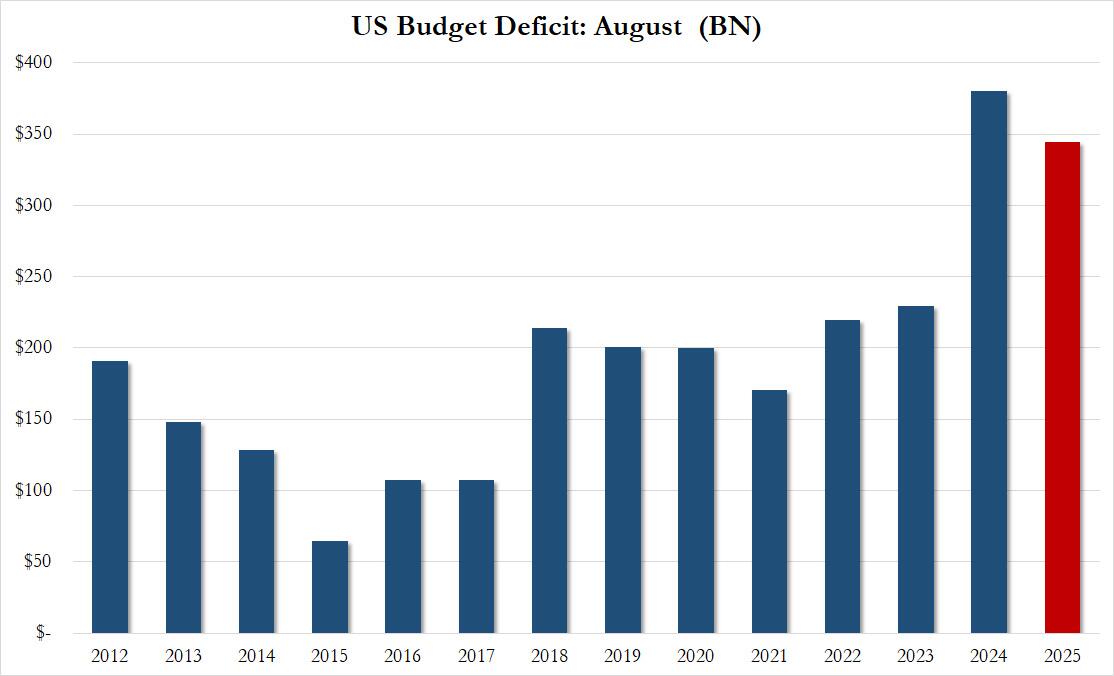
Combining the latest receipts and spending data, and we get an August deficit of $345 billion, a substantial deterioration from the $291 billion deficit in July, and the highest monthly deficit of calendar 2025. It was also the second worst August deficit in US history, with just last year’s pre-election blowout of $380 billion higher, which as readers will recall, was a kitchen sink month for the Biden admin, which flooded the economy in a last-ditch effort of boosting the economy ahead of the presidential elections.
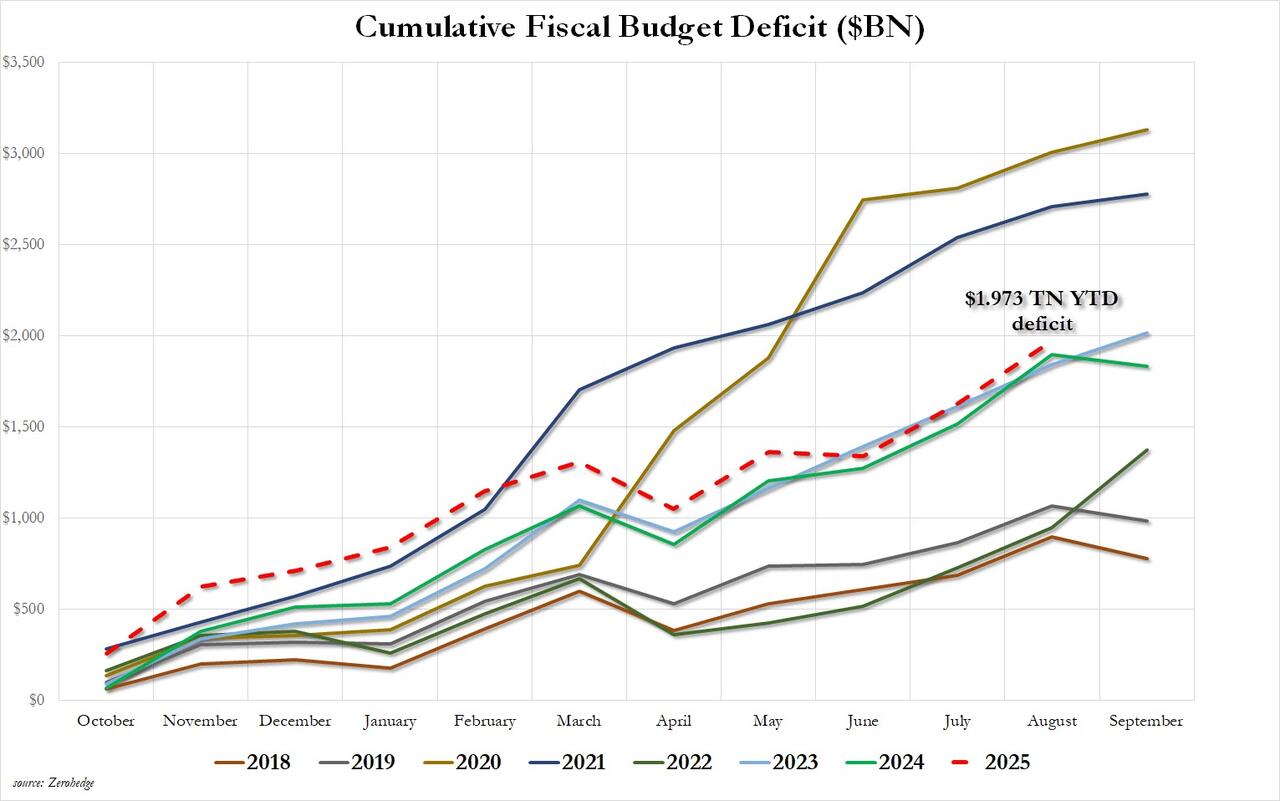
Looking at the deficit on a cumulative basis, we find that after June’s improvement, the deficit took another lunge in the past two months, and in August – just one months before the fiscal year end – it hit $1.974 trillion, up 4% from the $1.897 trillion a year ago. That means that with just one month to go, 2025 is shaping up as the third worst year in US history for the budget deficit, with just the covid years 2020 and 2021, worse.
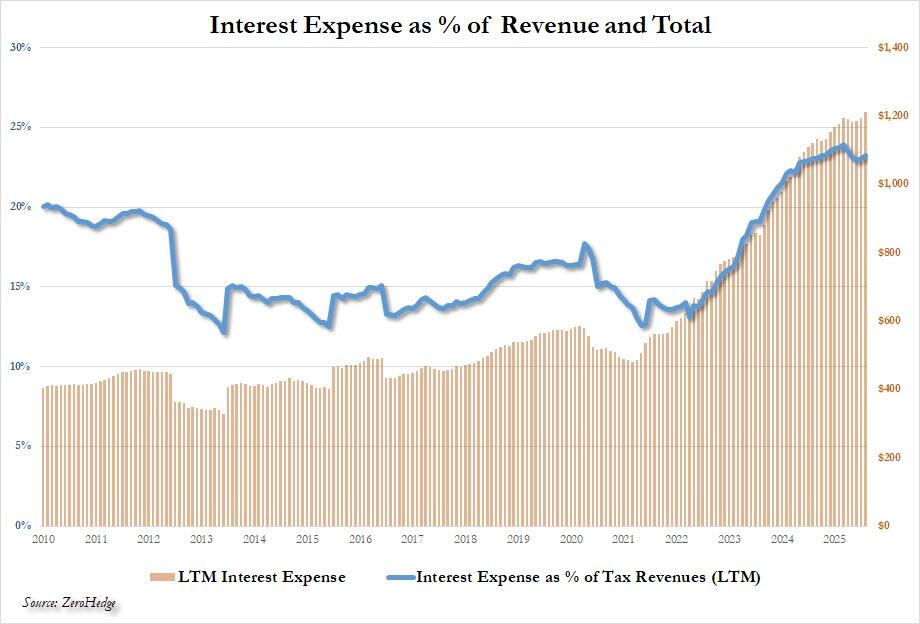
Last but not least, the epic disaster that is US gross interest spending continues to rise, and in August the US spent $111.5 billion on interest, pushing the total for the eleven months of the fiscal year to a record $1.124 trillion, and on pace to surpass $1.2 trillion for the full year. 

With total debt rising by about $1 trillion every 100 days, it means that interest will keep growing too, and unless revenue grows in line, we will reach a point where every taxed dollar goes to pay down US debt. As of today, interest expense eats up just over 23% of all government tax revenues, just shy of the non-wartime record high.
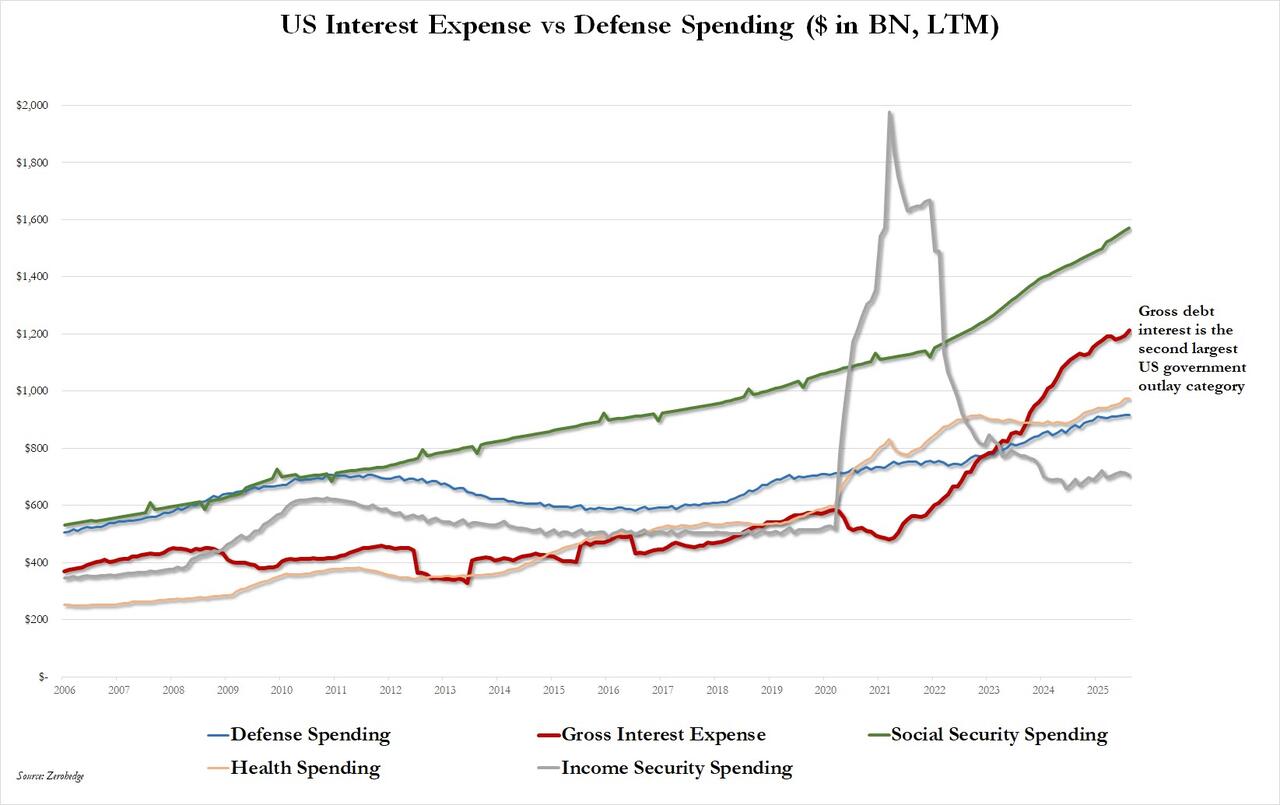
It also means that, as we first showed over a year ago, gross interest remains the second highest spending category for the US, well above defense, income security and health spending, and only Social Security remains a larger outlay category (although it is unclear for how much longer). 
Bottom line: after a brief period of irrational hope in early 2025 when Musk’s obsession with DOGE and cutting spending, we are again at square zero one and back on the fast-track to the debt-death of the United States. No wonder why in his most recent public commentary, Musk fully agrees with us: the government is unfixable.

_____________________________________

You are wrong, Mr, Musk. Government IS “fixable.”

The Leviticus 25 Plan will restore economic power to U.S. citizens – where it rightly belongs. And it will generate $37.303 billion federal budget surpluses during each of its first five years of activation (2027-2031), and pay for itself entirely over the next 10-15 years.

Economic Scoring:

* The Leviticus 25 Plan 2027 Generates $37.303 Billion Federal Budget Surpluses Annually (2027-2031). Part 1: Overview, Deficit Projections (CBO)

* The Leviticus 25 Plan Generates $37.303 Billion Federal Budget Surpluses Annually (2027-2031). Part 2: Federal Income Tax Recapture; Economic Security / Means-Tested Welfare Recapture.

* The Leviticus 25 Plan Generates $37.303 Billion Federal Budget Surpluses Annually (2027-2031). Part 3: Medicaid, Medicare, VA, TRICARE, FEHB, SSDI Recapture

* The Leviticus 25 Plan Generates $37.303 Billion Federal Budget Surpluses Annually (2027-2031). Part 4: Interest Expense Recapture

* The Leviticus 25 Plan Generates $37.303 Billion Federal Budget Surpluses Annually (2027-2031). Part 5: Economic Scoring – Summary Totals

·______________________________________ 

The Leviticus 25 Plan is a dynamic economic initiative providing direct liquidity benefits for American families, while at the same time scaling back the role of government in managing and controlling the affairs of citizens.  It is a comprehensive plan with long-term economic and social benefits for citizens and government.

The inspiration for this plan is based upon Biblical principles set forth in the Book of Leviticus, principles tendering direct economic liberties to the people.

The Leviticus 25 Plan – An Economic Acceleration Plan for America

$95,000 per U.S. citizen  –  Leviticus 25 Plan 2026 (35909 downloads ) 

Website:  https://leviticus25plan.org/
Free Money to Banks – 2023 Report

Note: The ‘Free Money” giveaways referenced in this report are but a ‘blip’ on the radar screen, compared to the massive liquidity flows pumped out to major Wall Street financial institutions (foreign and domestic) through various Fed-initiated ‘credit facilities’ (‘Secret Liquidity Lifelines’) during the 2008-2010 financial meltdown.

……………………………………….

How Much Free Money is the Fed Giving Banks and Financial Institutions?

July 29, 2023, MishTalk – Economics

Excerpts:

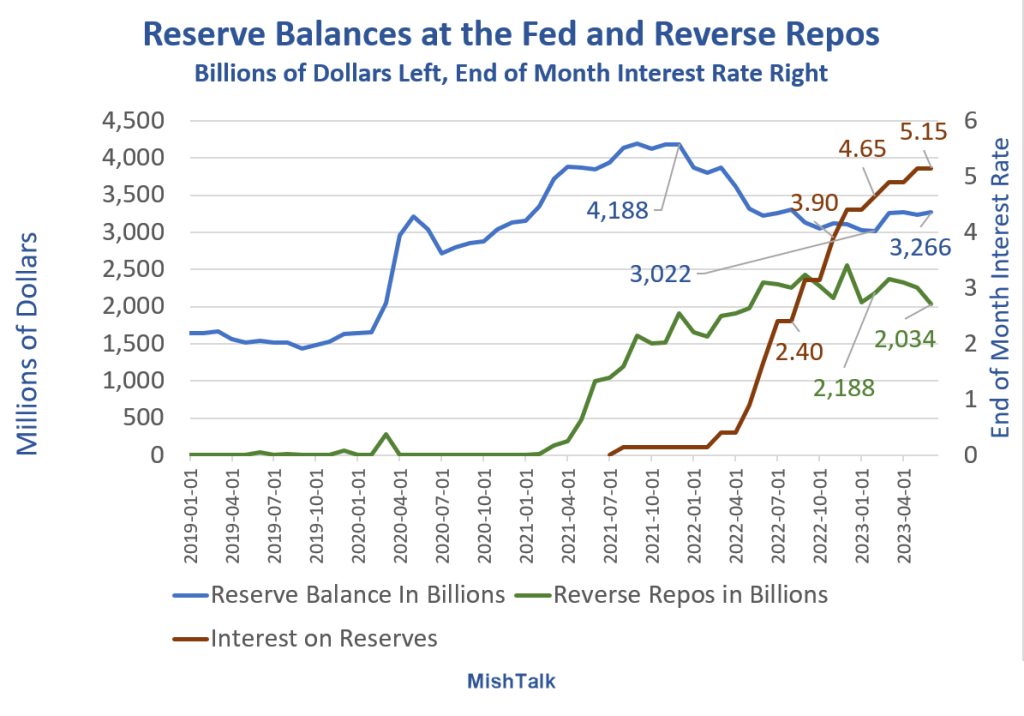
The Fed pays interest to banks on all reserves… How much free money is that?

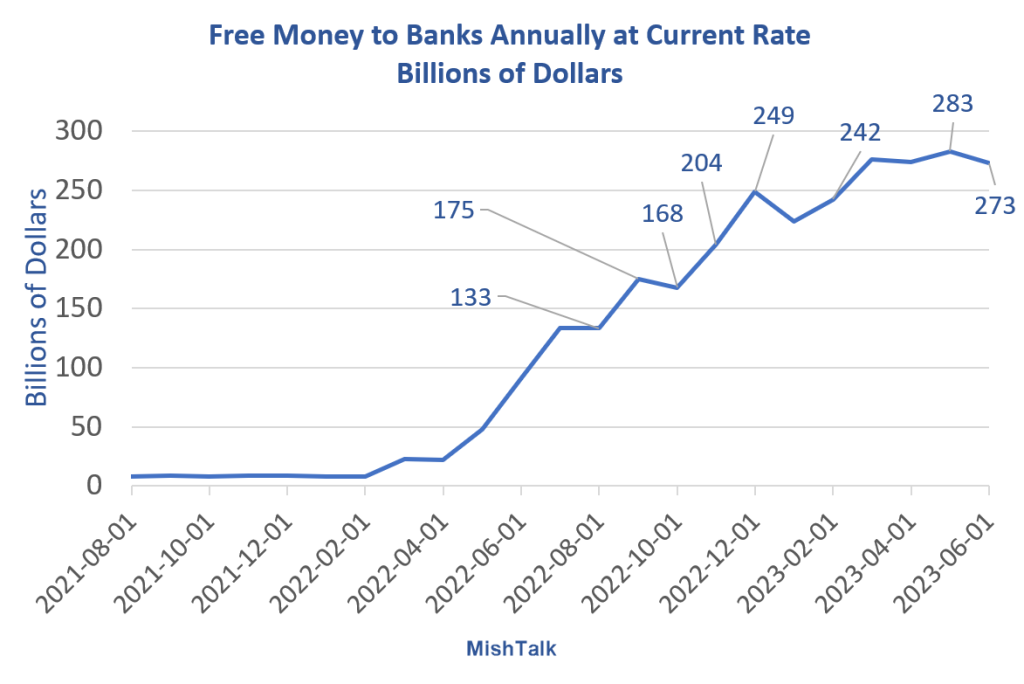
Free money to banks based on reserves, reverse repos, and current interest rate paid by the Fed. Chart and calculation by Mish.

Understanding Reserves – The Fed used to pay banks interest on “excess reserves”. Excess reserves are total reserves minus required reserves.

As announced on March 15, 2020, the Board of Governors reduced reserve requirement ratios on net transaction accounts to 0 percent, effective March 26, 2020. This action eliminated reserve requirements for all depository institutions. 

Since there are no reserve requirements on either checking or savings deposits, all reserves are effectively excess reserves, and the Fed pay banks interest on everything. That includes free money crammed down banks throats via QE.

Reverse Repos – The Fed also pay interest on reverse repos. A reverse repurchase agreement (RRP, or reverse repo) is a short-term agreement to sell securities in order to buy them back at a slightly higher price. The primary recipient of reverse repo interest are the money market funds….

Target Fed Funds Rate – The New York Fed explains: The New York Fed conducts repo and reverse repo operations each day as a means to help keep the federal funds rate in the target range set by the Federal Open Market Committee (FOMC).

In order to suppress a free market in interest rates and to help control the mess the Fed created via Quantitative Easing (QE), now Quantitative Tightening (QT), the Fed is handing out free money left and right.

To calculate free money, we need to watch three things: Interest rates, reserves, and reverse repos.

Reserve Balances at the Fed, Reverse Repos, Interest Rate

Understanding the Free Money Forces

  • In isolation, rising interest rates add to the free money given to financial institutions.
  • QT reduces bank reserves and thus free money.
  • Reverse Repos are now slowly declining. This also reduces free money payouts.

The net impact of these forces has been pretty stable for about six months, roughly between $250 billion and $280 billion in free money given to banks at an annual rate.

Free Money at Taxpayer Expense – My numbers are approximate, using end of month interest rates and monthly average balances. In practice, this is all calculated daily. But within a few billion dollars, the Fed is giving banks about $273 billion annually at the current rate.

It’s important to note that free money that should be going to taxpayers. Instead the Fed gives it to banks because its QE/QT programs made a huge mess out of monetary policy.

_________________________________

These ‘free money’ Fed giveaways to financial institutions can be easily balanced back out with a properly incentivized, comprehensive economic acceleration plan that retargets liquidity extensions – to include U.S. citizens.

The Leviticus 25 Plan is a dynamic economic initiative providing direct liquidity benefits for American families, while at the same time scaling back the role of government in managing and controlling the affairs of citizens.  It is a comprehensive plan with long-term economic and social benefits for citizens and government.

The inspiration for this plan is based upon Biblical principles set forth in the Book of Leviticus, principles tendering direct economic liberties to the people.

The Leviticus 25 Plan – An Economic Acceleration Plan for America

$95,000 per U.S. citizen – Leviticus 25 Plan 2026 (35017 downloads )

2010 Affordable Care Act Led to 35% Spike in ‘Annual Expenditures for Health Insurance Per Household Unit.’

Did ObamaCare ‘Work’?

ZeroHedge, Dec 07, 2023 – Via Political Calculations blog, | Excerpts:

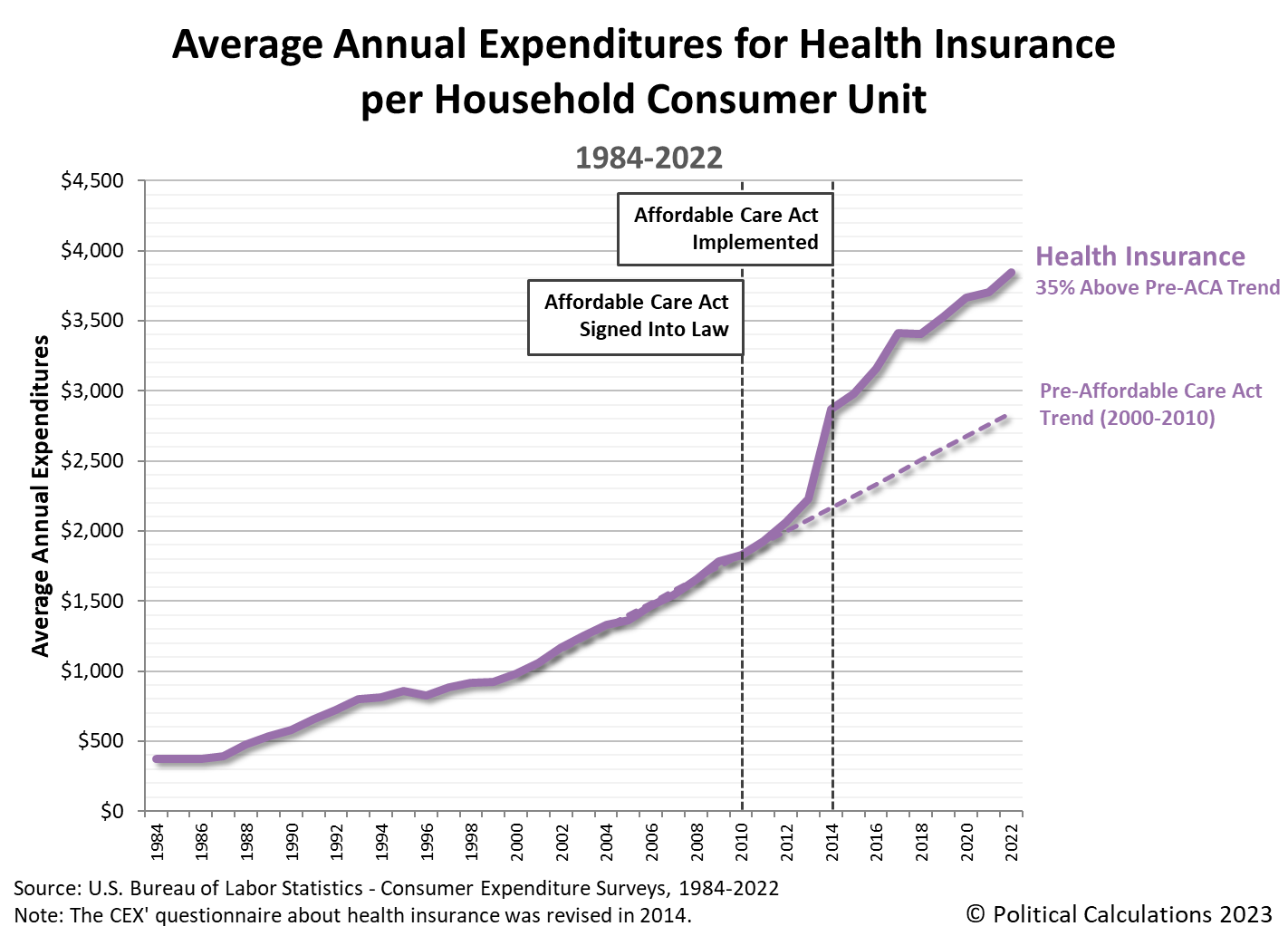
The Affordable Care Act was signed into law in 2010. It was slowly implemented, going into full effect in 2014. One of the main goals of the law was to make health insurance more affordable for Americans, but has it worked?

One way to answer that question is to see how much Americans are paying for health insurance since the ACA became law and to compare that how much American households would otherwise have paid if the preceding trend for health insurance costs remained in place.

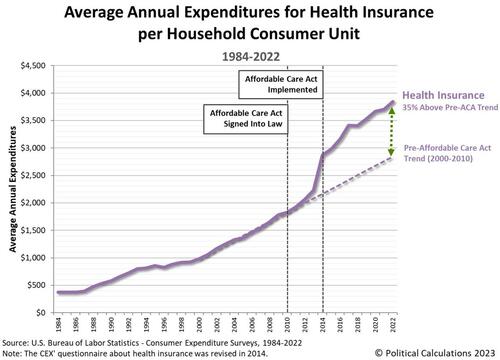
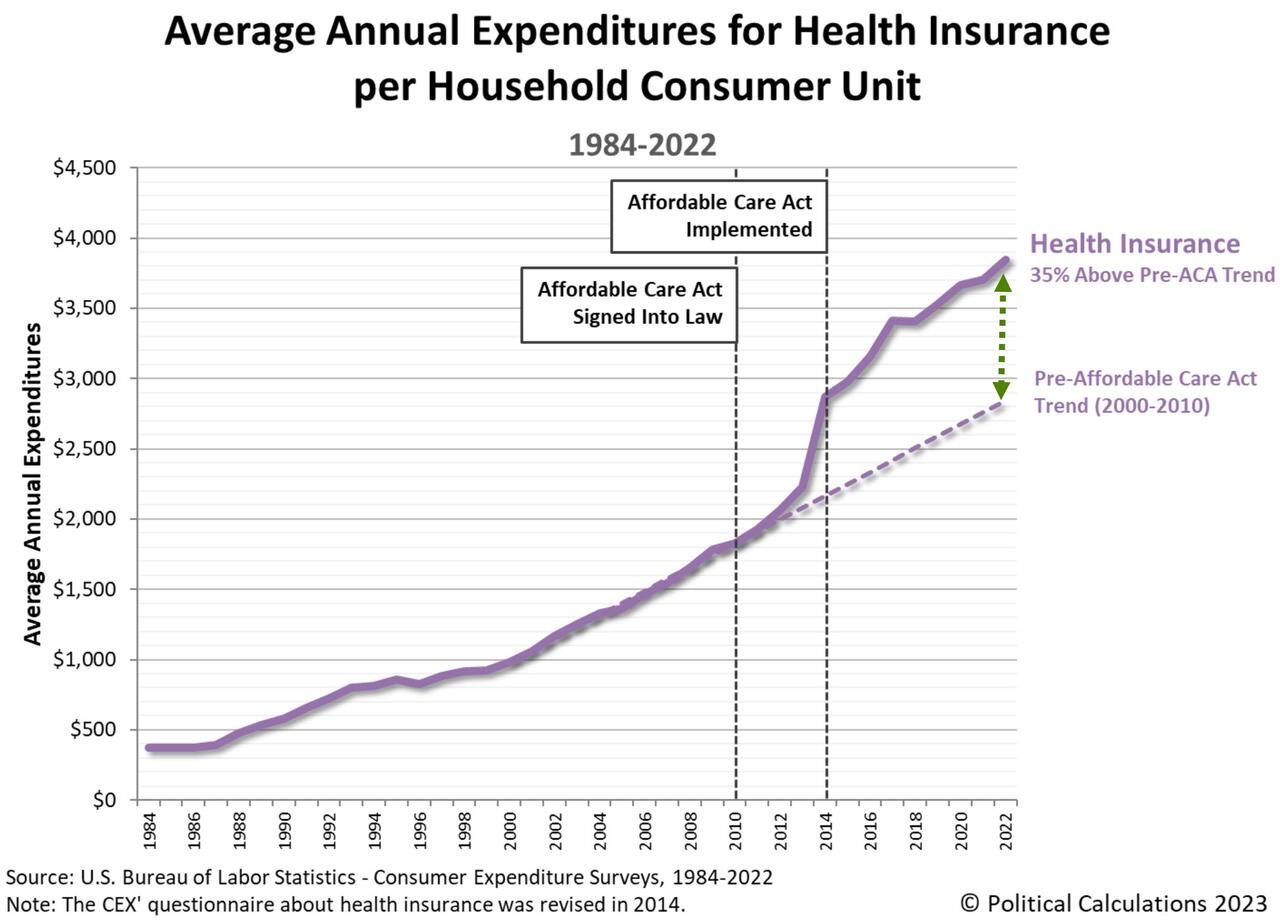
We can make comparison using data from the U.S. Census Bureau’s annual Consumer Expenditure (CEX) Survey. The CEX has reported how much an average “consumer unit”, which roughly corresponds to an American household, has paid for health insurance in each year from 1984 through 2022. It compares those data points with the trend based on the actual expenditures for health insurance from 2000 through 2010. Here’s the chart:

Compared to the pre-Affordable Care Act trend from 2000 through 2010, Americans household consumers paid 35% more on average for health insurance in 2022 than they would otherwise have paid based on the trend for these costs from 2000 through 2010.

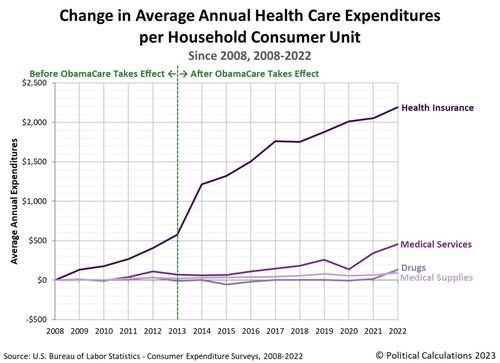
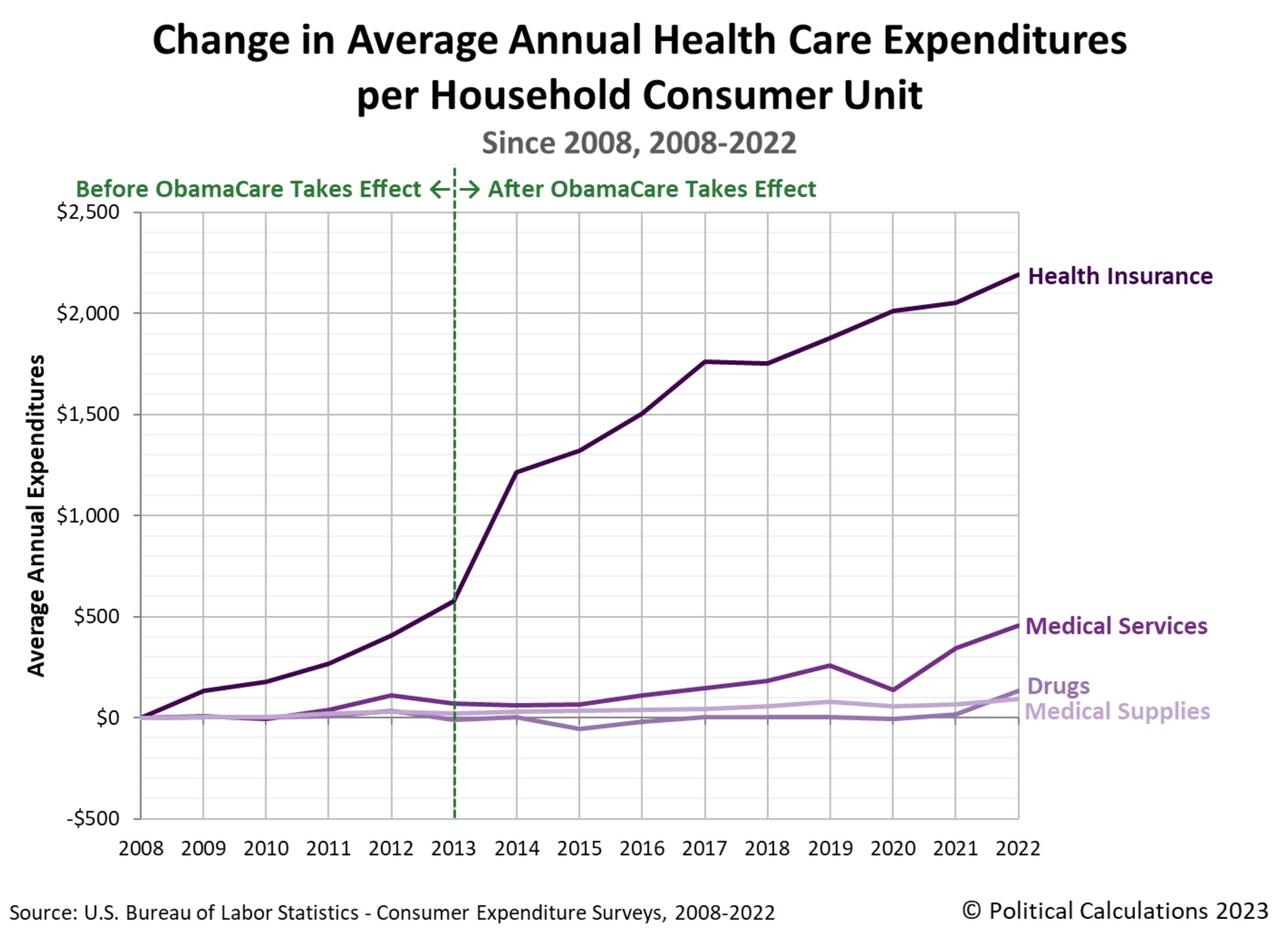
How does that compare with the household consumers’ other major health care expenditures? The chart is adapted from an older version and narrows in on the period from 2008 through 2022 to track the change in the average expenditures per American consumer unit for several health care expenditure categories. These categories include health insurance, medical services, drugs, and medical supplies.

Through 2022, what American household consumers pay for drugs and medical supplies has changed very little, with medical supplies within $95 and drugs within $133 of their cost in 2008.

Expenditures for medical services has seen more growth over time. In 2013, the year before the Affordable Care Act took full effect, Americans paid just $69 more for medical services than they did in 2008. By 2019, that increased to $257, which then dipped to $137 in the pandemic year of 2020. What American consumer households pay for medical services has risen rapidly since, as of 2022 they reached $457 more than they paid in 2008.

But what Americans pay for health insurance has relentlessly risen in all but one year (2017). In 2013, just before the Affordable Care Act became fully operational, Americans paid $576 more for health insurance than they did in 2008. That jumped immediately to $1,215 in 2014, and has since risen to be $2,190 more than what American consumer units paid for health insurance in 2008.

2022 is the most recent year for which we have figures available. The Census Bureau will collect the data for 2023 in March 2024 and will crunch the numbers for several months before reporting it all sometime in September 2024.

______________________

The U.S. Health Care Freedom Plan, an integral component of The Leviticus 25 Plan, will restore citizen-centered health care and summarily reduce ‘annual expenditure for health insurance’ by eliminating bureaucratic bloat, unfriendly and complicated medical access pathways, cumbersome, drawn-out claims processing, and rapidly shrinking reimbursements for physicians, pharmacists, and other health practitioners.

The U.S. Health Care Freedom Plan offers a powerful new access strategy for patients receiving medical and pharmaceutical services, home medical equipment, and home care services.

The Plan grants citizens the freedom to pay directly, in person, for their week-to-week health care purchases. It cuts out layers of bureaucracy and middlemen … simplifies access to health care and restores genuine ‘patient-provider’ relationships.

The U.S. Health Care Freedom Plan is the only comprehensive, citizen-centered health care plan in America.  It ‘resets’ the health care industry to present a clean, efficient and responsible system.  Most importantly, this plan restores individual citizen-centered health care for all participating Americans.

The U.S. Health Care Freedom Plan is available to each and every U.S. citizen – with no coverage mandates. Each U.S. citizen who wishes to participate will be granted a full and complete exemption from the ACA.

Each participating U.S. citizen shall receive a credit extension, through a special Federal Reserve / U.S. Treasury Citizens Credit Facility of $30,000, electronically deposited into a Medical Savings Account (MSA) – for direct allocation toward family health care needs.

Private insurance – Families shall be allowed to enroll in high-deductible major medical plans, that include basic, ‘no frills’ medical plans which best suit their individual needs and desires. These streamlined plans would lower premium costs for employees and employers, encouraging employers to cost-share savings with employees through incentive-based employer MSA contributions.

Those with extraordinary medical issues may be included in a high-risk category, with such plans being eligible for a government subsidy (similar to current Medicare Advantage).

Federal / state programs – Individuals enrolled in Medicare / Medicaid / VA / TRICARE / FEHB programs would maintain their covered status, with an annual deductible of $6,000 per year per enrolled family member, for a period of five years for those benefits. The dedicated MSA funds would fully fund the offset for the higher ($6,000) deductible feature for that five-year period. MSA funds could also be used to pay Medicare supplement premiums and other potential co-pay obligations.

Where health care services paid by patients directly with MSA funds, providers would not be bound by federal / state rules pertaining to Electronic Medical Records (EMRs), and other unnecessary administrative burdens.

………………………………….

The Leviticus 25 Plan activation period is slated for the 5-year period beginning in 2026 and ending in 2030.

The Leviticus 25 Plan – Each participating U.S. citizen will receive a $60,000 deposit into a Family Account (FA) and a $35,000 deposit into a Medical Savings Account (MSA).

Qualification: All U.S. citizens residing in the United States are eligible to participate, contingent upon meeting qualification standards and agreement to specified recapture provisions. Participants (other than ‘custody account’ applicants) must prove stable credit history, stable job history, no recent drug/felony convictions.

These general recapture provisions include:

  • Waiving all federal income tax refunds for a period of 5 years.
  • Waiving benefits from income security programs, select benefits from means-tested welfare programs, SSI, and SSDI for a period of 5 years.
  • Enrollees in the Medicare, Medicaid, VA Healthcare system, Federal Employees Health Benefits (FEHB), and TRICARE will be subject to a $7,000 deductible for primary care and outpatient services annually for a period of 5 years. (See full plan for more details)

The Leviticus 25 Plan generates $37.303 billion federal budget surpluses annually during each of its first five years of activation (2027-2031), and pays for itself entirely over a 10-15 year period.

………………………………….

The Leviticus 25 Plan is a dynamic economic initiative providing direct liquidity benefits for American families, while at the same time scaling back the role of government in managing and controlling the affairs of citizens.  It is a comprehensive plan with long-term economic and social benefits for citizens and government.

The inspiration for this plan is based upon Biblical principles set forth in the Book of Leviticus, principles tendering direct economic liberties to the people.

The Leviticus 25 Plan – An Economic Acceleration Plan for America

$95,000 per U.S. citizen – Leviticus 25 Plan 2026 (34114 downloads )

A Look Back… “Inflation Reduction Act Comes for Medicare”

WSJ: The Inflation Reduction Act Comes for Medicare

It will cut benefits and increase premiums, upsetting millions of elderly voters.

By Casey B. Mulligan and Tomas J. Philipson

Nov. 21, 2022 – Excerpt:

President Biden has accused Republicans of scheming to cut Medicare. In fact it is his signature legislation, the Inflation Reduction Act, that will lead to benefit cuts and premium increases for seniors. Medicare’s popular drug-coverage program is headed for a painful amputation.

The private plans participating in Medicare’s prescription-drug program, known as Part D, currently draw on three sources of revenue to finance prescriptions: out-of-pocket payments from patients, premium payments made by plan members, and subsidies from the federal government. In 2025, under the Inflation Reduction Act, both government subsidies and out-of-pocket payments by patients are scheduled to be cut sharply. The difference will have to be made up by premiums. But the statute inhibits this third revenue source, which is also subsidized, from increasing more than 6%. That’s hardly enough to cover inflation, let alone compensate for the other two revenue losses.

We estimate that beginning in 2025, plan subsidies—specifically, the reinsurance subsidies for the beneficiaries with the most drug spending—will be cut $30 billion, out of revenue that currently totals about $110 billion. With $30 billion less to finance prescription benefits, something will have to give. Plans currently have far too little profit to span the chasm that the Inflation Reduction Act opens between expenses and revenue.

Existing plans have room to cut benefits, although the original Part D statute limits their ability to do so. As plans are under no obligation to take a loss, their other choice is to exit the market, which from the patient’s perspective means that all the benefits disappear. In essence, the Inflation Reduction Act statute may prohibit Part D plans from being economically viable, even if it doesn’t explicitly ban them.

We see a last resort. Seniors might find drug coverage in Medicare Part C even as the Biden administration unwittingly amputates stand-alone drug plans from the Medicare program. These plans, known as Medicare Advantage, cover drugs, hospitalization and physician visits. They will also be losing the same two drug-revenue sources, but the Inflation Reduction Act gives them room to compensate with higher premiums, reduced drug benefits (with fewer drugs covered and more constraints on accepted claims), or cuts to nondrug benefits such as dental or mental-health coverage. They will likely do all three, which will be undesirable for seniors but at least be economically viable. The best part of the last resort? The plans won’t go away.

Roughly half of Medicare beneficiaries currently have traditional Medicare coverage rather than Medicare Advantage plans. These are the beneficiaries relying on stand-alone Part D drug plans, which are the ones that may be run out of business by the Inflation Reduction Act. Traditional Medicare members face a difficult choice in 2025: Either take drastic cuts in drug coverage, or switch to Medicare Advantage plans that cover prescriptions but may not cover the hospitals and doctors who are currently providing them care.

Welcome to the fiscal and regulatory nightmare known as government-provided health care, where those writing the rules don’t understand the consequences of what they do. Democrats hate that Medicare Advantage has been available as a pseudo-private alternative to original Medicare’s single-payer arrangement. Yet they have (unwittingly?) passed a law that so thoroughly disrupts traditional Medicare as to render it the worst of the Medicare options.

From a political perspective, Democrats couldn’t have scheduled Medicare’s amputation for a worse time. With Congress so evenly divided, a short-term legislative fix may be impossible. By September 2024, the presidential campaign will be in high gear at the same time that beneficiaries begin to consider their 2025 Medicare enrollments. That’s when the Inflation Reduction Act will thoroughly upset tens of millions of elderly voters, all while the authors of the statute ask the country to vote for their presidential nominee. By then, America will have no doubt which party is cutting Medicare.

Mr. Mulligan, an economics professor at the University of Chicago and a fellow with the Committee to Unleash Prosperity, was chief economist for the White House Council of Economic Advisers, 2018-19. Mr. Philipson, an economist at the University of Chicago, was a member of the White House Council of Economic Advisers, 2017-20, and its acting chairman, 2019-20.

______________________________

It is time to shift from ‘government-provided health care’ to ‘citizen-centered health care.’

The Leviticus 25 Plan – An Economic Acceleration Plan for America

$95,000 per U.S. citizen – Leviticus 25 Plan 2026 (33715 downloads )

Big Government Health Care – Huge Obamacare 2025 Rate Hikes Rolling In.

America needs a comprehensive plan to de-centralize health care. And there is just such a plan, loaded up and ready to launch…

……………………………………..

Insurers Request Huge Obamacare Rate Hikes, Many Over 20%

ZeroHedge, Jul 20, 2025 – Authored by Mike Shedlock via MishTalk.com,

Excerpt:

Medical care costs are surging already. A big leap is coming.

Health Care Shock Coming

The Wall Street Journal reports Obamacare Insurers Seek Double-Digit Premium Hikes Next Year

If you buy your own health insurance, you are probably going to pay more next year—a lot more.

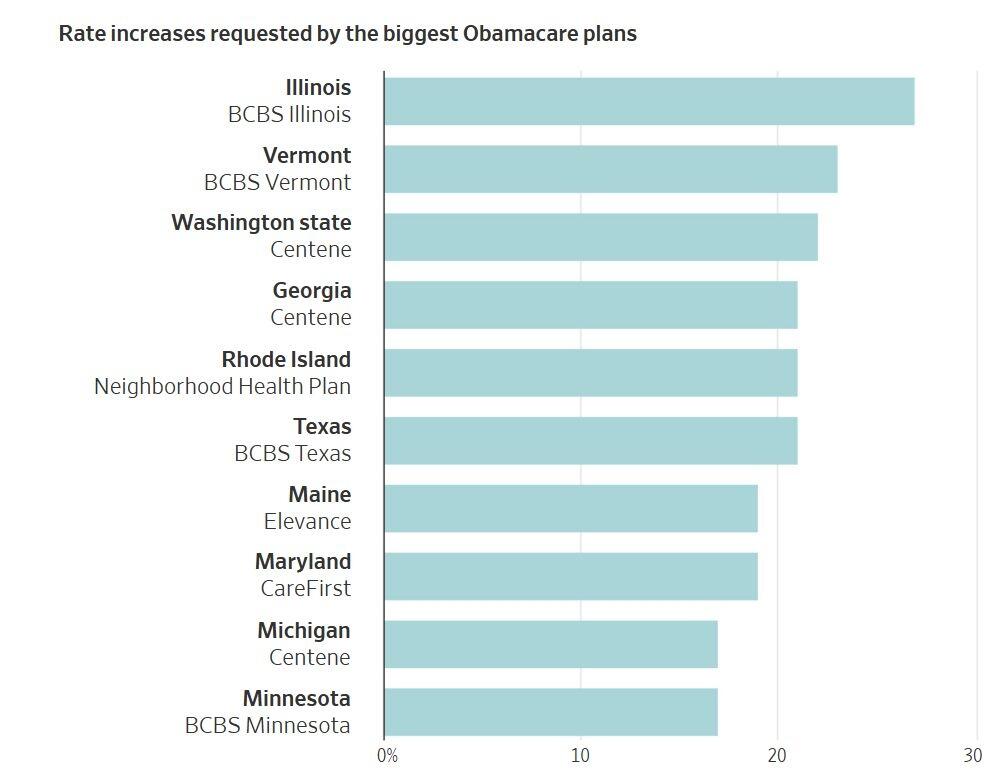
Insurers are seeking hefty 2026 rate increases for Affordable Care Act marketplace plans, the coverage known as Obamacare. Blue Cross & Blue Shield of Illinois wants a 27% hike, while its sister Blue Cross plan in Texas is asking for 21%. The largest ACA plans in Washington state, Georgia and Rhode Island are all looking for premiums to surge more than 20%.

The companies say the big increases are needed because of higher healthcare costs and changing federal policy, including cuts to subsidies that help consumers pay for plans. The higher premiums would come after years of enrollment growth and mostly single-digit rate increases in the Obamacare market, where individuals and families buy insurance for themselves. About 24 million people have ACA plans.

At the request of The Wall Street Journal, the health-research nonprofit KFF analyzed the rate requests for the largest ACA plans by enrollment in 17 states where the insurers’ filings have already become public, as well as the District of Columbia. They showed that some of the biggest national ACA players, including Centene and Elevance Health, are seeking double-digit increases in several states. The Blue Cross & Blue Shield plans of Texas and Illinois are both owned by Health Care Service, a giant nonprofit.

Most Obamacare enrollees’ monthly insurance bills will go up substantially next year because of reductions in federal subsidies that help pay for their coverage. Enhanced payments passed by Congress in 2021 will lapse at the end of December. The drop-off in subsidies is both helping to drive higher premiums and making it harder for many consumers to pay them.

Some people “are going to be hit with this double whammy” of bigger monthly insurance bills and losing the subsidy that blunts their cost, said Cynthia Cox, a vice president at KFF.

___________________________________

The U.S. Health Care Freedom Plan, an integral component of The Leviticus 25 Plan, restores citizen-centered healthcare by eliminating governmental bureaucratic bloat, skyrocketing premiums, unfriendly and complicated medical access pathways, cumbersome, drawn-out claims processing, and rapidly shrinking reimbursements for physicians, pharmacists, and other health practitioners.

The U.S. Health Care Freedom Plan offers a powerful new access strategy for patients receiving medical and pharmaceutical services, home medical equipment, and home care services.

The Plan grants citizens the freedom to pay directly, in person, for health care plan premiums, and for their week-to-week health care purchases. It cuts out layers of bureaucracy and middlemen … simplifies access to health care and restores genuine ‘patient-provider’ relationships.

The U.S. Health Care Freedom Plan is the only comprehensive, citizen-centered health care plan in America.  It ‘resets’ the health care industry to present a clean, efficient and responsible system.  Most importantly, this plan restores individual citizen-centered health care for all participating Americans.

The U.S. Health Care Freedom Plan is available to each and every U.S. citizen – with no coverage mandates. Each U.S. citizen who wishes to participate will be granted a full and complete exemption from the ACA.

Each participating U.S. citizen shall receive a direct credit extension, through a special Federal Reserve / U.S. Treasury Citizens Credit Facility of $30,000, electronically deposited into a Medical Savings Account (MSA) – for direct allocation toward family health care needs.

Private insurance – Families shall be allowed to enroll in high-deductible major medical plans, that include basic, ‘no frills’ medical plans which best suit their individual needs and desires. These streamlined plans would lower premium costs for employees and employers, encouraging employers to cost-share savings with employees through incentive-based employer MSA contributions.

Those with extraordinary medical issues may be included in a high-risk category, with such plans being eligible for a government subsidy (similar to current Medicare Advantage).

Federal / state programs – Individuals enrolled in Medicare / Medicaid / VA / TRICARE / FEHB programs would maintain their covered status, with an annual deductible of $6,000 per year per enrolled family member, for a period of five years for those benefits. The dedicated MSA funds would fully fund the offset for the higher ($6,000) deductible feature for that five-year period. MSA funds could also be used to pay Medicare supplement premiums and other potential co-pay obligations.

Where health care services paid by patients directly with MSA funds, providers would not be bound by federal / state rules pertaining to Electronic Medical Records (EMRs), and other unnecessary administrative burdens.

………………………………….

The Leviticus 25 Plan activation period is slated for the 5-year period beginning in 2026 and ending in 2030.

The Leviticus 25 Plan – Each participating U.S. citizen will receive a $60,000 deposit into a Family Account (FA) and a $35,000 deposit into a Medical Savings Account (MSA).

Qualification: All U.S. citizens residing in the United States are eligible to participate, contingent upon meeting qualification standards and agreement to specified recapture provisions. Participants (other than ‘custody account’ applicants) must prove stable credit history, stable job history, no recent drug/felony convictions.

These general recapture provisions include:

  • Waiving all federal income tax refunds for a period of 5 years.
  • Waiving benefits from income security programs, select benefits from means-tested welfare programs, SSI, and SSDI for a period of 5 years.
  • Enrollees in the Medicare, Medicaid, VA Healthcare system, Federal Employees Health Benefits (FEHB), and TRICARE will be subject to a $7,000 deductible for primary care and outpatient services annually for a period of 5 years. (See full plan for more details)

The Leviticus 25 Plan generates $37.303 billion federal budget surpluses annually during each of its first five years of activation (2027-2031), and pays for itself entirely over a 10-15 year period.

The Leviticus 25 Plan – An Economic Acceleration Plan for America

$95,000 per U.S. citizen – Leviticus 25 Plan 2026 (33715 downloads )

WSJ: “Give Medicaid Dollars Directly to Patients.” There is a much better plan: The U.S. Health Care Freedom Plan

A Wall Street Journal editorial several years ago by Justin Haskins and Michael Hamilton of the Heartland Institute was a step in the right direction.  At the same time, it was weighed down by several major flaws…

…………………………………….

Give Medicaid Dollars Directly to Patients – WSJ

Apr 12, 2017: As Republicans take another crack at devising a plan to replace ObamaCare, here’s an idea they should consider: Give each Medicaid patient a health savings account—and put $7,000 in it every year.

Under ObamaCare, Medicaid has become the only option for millions of Americans. But that doesn’t mean much if the doctors in their communities don’t accept new patients through the program—and 30% of physicians don’t.

Full article accessed via Lux Llibertas:

_______________________

“Give Medicaid Dollars Directly to Patients” – shortcomings:

This plan does nothing to offer exemptions from ObamaCare.

This plan does nothing to benefit working families NOT on Medicaid.

It does nothing to untangle and change the complexion of other government health care programs like Medicare, Medicaid/CHIP, VA, FEHB, TRICARE.

This plan is an ongoing, open-ended cash-based subsidy.

There is a better way.

The U.S. Health Care Freedom Plan, an essential component of The Leviticus 25 Plan, is the only comprehensive, citizen-centered health care plan in America.  It ‘resets’ the health care industry to present a clean, efficient and responsible system.  Most importantly, this plan restores individual freedom and liberty for all participating Americans.

The Plan:

  1. The U.S. Health Care Freedom Plan is available to each and every U.S. citizen who wishes to participate – with no coverage mandates. Each U.S. citizen who wishes to participate will be granted a full and complete exemption from the ACA.
  2. This plan offers freedom of choice and equal justice for all. Those Americans who might wish to stay with the ACA may stay (‘If you like your ObamaCare, you can keep your ObamaCare’).
  3. Each participating U.S. citizen shall receive a credit extension, through a special Federal Reserve Citizens Credit Facility, of $35,000, electronically deposited into a Medical Savings Account (MSA) – for direct allocation toward family health care needs.
  4. Each participating U.S. citizen will then have a $7,000 deductible for each of the five years of activation (2027-2031) for primary health care claims related to Medicare, Medicaid, VA, TRICARE, FEHB.
  5. Private insurance – Families shall be allowed to enroll in high-deductible major medical plans. These streamlined plans would lower premium costs for employees and employers, encouraging employers to cost-share savings with employees through incentive-based employer MSA contributions.
  6. Policies would not be automatically loaded with expensive government healthcare mandates.
  7. Those with extraordinary medical issues may be included in a high-risk category, with such plans being eligible for a government subsidy (similar to current Medicare Advantage).
  8. Federal / state programs – Individuals enrolled in Medicare / Medicaid / VA / TRICARE / FEHB programs would maintain their covered status, with an annual deductible of $6,000 per year per enrolled family member, for a period of five years for those benefits. The dedicated MSA funds would fully fund the offset for the higher ($6,000) deductible feature for that five-year period. MSA funds could also be used to pay Medicare supplement premiums and other potential co-pay obligations.
  9. Where health care services paid by patients directly with MSA funds, providers would not be bound by federal / state rules pertaining to Electronic Medical Records (EMRs), and other unnecessary administrative burdens.

Benefits:                                                                                 

Lower health care costs – With the elimination of millions of minor insurance claims across the nation over the course of each month, system-wide efficiency would improve, medical costs would drop significantly, and the direct patient-provider relationship would be restored. Medical professionals would not have to answer to HMOs, insurance companies, or government agencies in providing basic day-to-day healthcare access for their patients.

Scoring – if 240 million U.S. citizens were to participate in the plan, the total dollar transfer into family-based Medical Savings Accounts (MSAs) would amount to $8.4 trillion.

The potential cost savings from the $7,000 deductible provision for the approximate 173.5 million people currently enrolled in Medicare (69.6 million), Medicaid / CHIP (77.0 million), VA (9.2 million), TRICARE (9.4 million), and FEHB (8.3 million) would amount to just under $5.25 trillion over the first 5 years (or, 62.5% of the $8.4 trillion initial roll out cost).

Summary:

This plan would generate trillions of dollars in cost savings from streamlining, vastly improved efficiency, and reductions in waste and fraud.

This plan would improve quality and ease of access to health care for all participating Americans.

 For patients: It would dramatically lower the cost of health care, while improving quality and access for all who chose to participate.

 For providers:  It would streamline payment dynamics and improve reimbursement for services, and restore the patient-provider relationship, and significantly reduce massive cost and time burdens imposed by a centralized system.

 The U.S. Health Care Freedom Plan is an integral feature of a larger, comprehensive economic plan: The Leviticus 25 Plan.

The Leviticus 25 Plan 2027 – An Economic Acceleration Plan for America

$95,000 per U.S. citizen – Leviticus 25 Plan 2026 (32591 downloads )

U.S. Mortgage Debt: $12.80 Trillion. Massive Lifetime Interest Charges Paid Out.

The Fed and U.S. Treasury Department dealt out massive debt relief benefits and credit guarantees to major U.S. and foreign banks during the great financial crisis (2008-2010) and the Covid-19 crisis (2020-2021).

It is now time to deal out major mortgage debt relief for 50 million American families.

The Leviticus 25 Plan: Millions of debt-burdened mortgage holders will experience immediate debt relief. Delinquent loans will become instantly current. Financial health restored restored across Main Street America.

Lending institutions will instantly become cash-rich competitive bidders on treasury debt, municipal debt, consumer debt, and small business loans.

…………………………………………………

Mortgage Debt Lifetime Interest: A study by CNBC found that someone purchasing a median-priced home with a typical 20% down payment could owe $142,614.31 in interest over the life of their 30-year mortgage. 

………………………………………………..

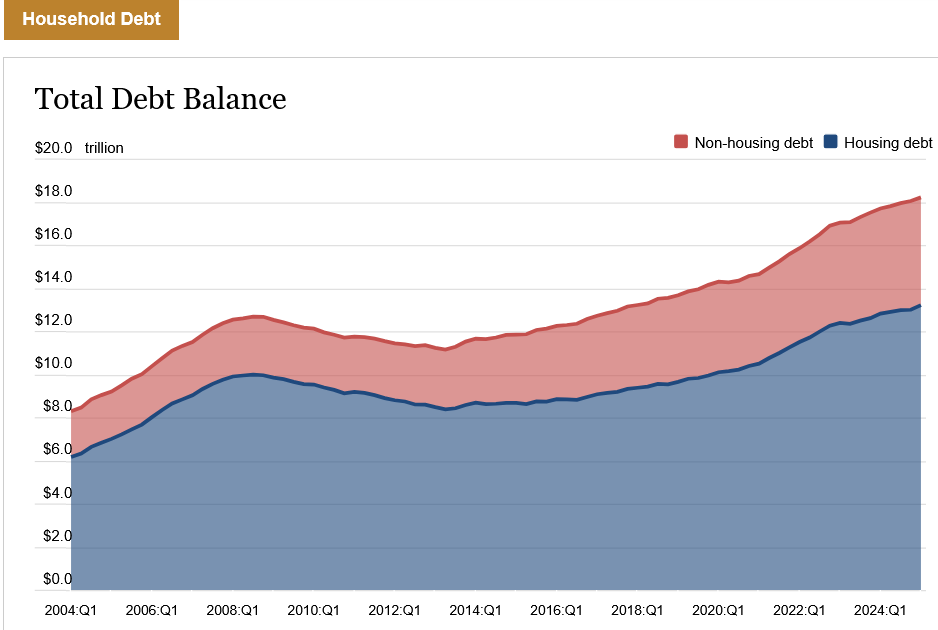
Mortgage balances shown on consumer credit reports grew by $199 billion during the first quarter of 2025 and totaled $12.80 trillion at the end of March. (The change between 2024Q4 and 2025Q1 was elevated because of a gap in reporting mortgage balances in 2024Q4.) Balances on home equity lines of credit (HELOC) rose by $6 billion, the twelfth consecutive quarterly increase. There is now $402 billion in outstanding HELOC balances, $85 billion above the low reached in the first quarter of 2022.

……………………………………………………………

Source: National Mortgage Database (NMDB)

Total mortgage loan value in the USA: There are currently 51.1 million outstanding mortgages with a loan value of $12.80 trillion dollars.

Average interest rate on all outstanding residential mortgages: The average interest rate on all outstanding residential mortgages in the USA is 4.2% as of Q3 2024. This average is based on the contract interest rate at origination of the loan. Of these loans 2.3% are mortgages with adjustable rates which would be impacted by changes in interest rates.

Average monthly payment on all outstanding residential mortgages: The average monthly payment is $1,869 which is a combination of the average principal, interest, and escrow (where applicable). When looking at mortgage data the average tends to be skewed by expensive homes. Therefore, it is important to also consider the median monthly payment which is $1,606 as of Q3 2024.

Average age of outstanding loans: All of the outstanding loans in the USA have an average loan age of 72 months or 6 years. This is the average number of months since the loans origination. The average mark-to-market ltv of outstanding mortgages in the USA is 46.60%. This is the ratio of unpaid principal to the current property value. This means that the average home has 53.40% equity in the home from both payments of principal and increases in property value.

___________________________________

The Leviticus 25 Plan is a dynamic economic initiative providing direct liquidity benefits for American families, while at the same time scaling back the role of government in managing and controlling the affairs of citizens.  It is a comprehensive plan with long-term economic and social benefits for citizens and government.

The inspiration for this plan is based upon Biblical principles set forth in the Book of Leviticus, principles tendering direct economic liberties to the people.

The Leviticus 25 Plan – An Economic Acceleration Plan for America

$95,000 per U.S. citizen – Leviticus 25 Plan 2026 (32415 downloads )

America 2025: $1.21 Trillion Credit Card Debt; Average Interest Rate: 24.33%. Solution: The Leviticus 25 Plan – Loaded Up and Ready to Launch.

Vast numbers of Americans, buried under stifling credit card debt loads, are facing rising credit card balances and high interest rates:

  • Total debt: Americans owed a record $1.21 trillion on their credit cards as of February 2025.
  • Average household debt: The average household carries about $8,940 in credit card debt as of early 2025.
  • Average individual debt: Among cardholders with unpaid balances, the average debt was $7,321 in Q1 2025, according to LendingTree.
  • People aged 50-59 have the most credit card debt in total at $0.21 trillion,

Americans shelled out a hefty $163.89 billion in credit card interest and fees in 2022 when interest rates were far lower. Current estimates put that figure up at a shocking $180 billion annually.

………………………..

Average Credit Card Interest Rate in America Today – LendingTree, June 5, 2025

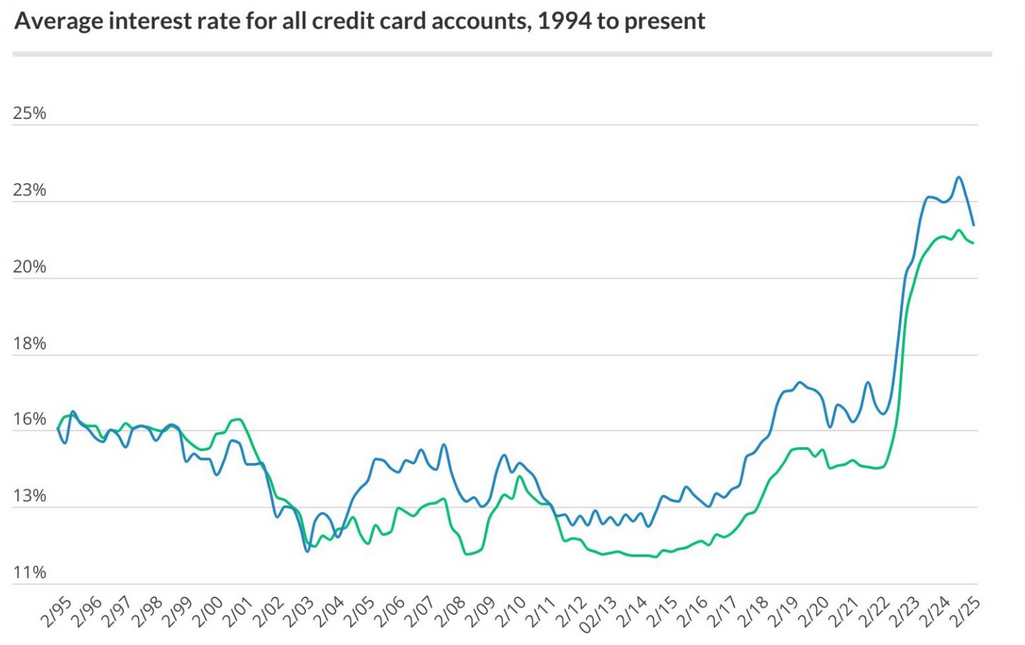
Excerpt: The average credit card interest rate in America is 24.33%, the highest since December, after a third straight monthly increase.

_______________________________

The Federal Reserve and U.S. Treasury Department unleashed massive liquidity flows and credit guarantees to Wall Street banks and insurers during the great financial crisis (2008-2010) to help restore them to ‘financial health.’

The beneficiaries: Morgan Stanley, Bank of America, CitiGroup, Goldman Sachs, AIG, JP Morgan, Merrill Lynch, Wells Fargo, State Street, UBS, Barclays, Deutsche Bank, Royal Bank of Scotland, BNP Paribas, and others..

It is now time to restore U.S. citizen families to positions of ‘financial health’ with the same direct liquidity extensions that were extended to Wall Street heavyweights.

The Leviticus 25 Plan will eliminate massive amounts of Credit Card Debt, Mortgage Debt, Student Loan Debt, Consumer Installment Debt.

It will lift millions of Americans up out of poverty and massively reduce entitlement spending.

The Leviticus 25 Plan will generate $36.568 billion federal budget surpluses each of its first five years of activation (2026-2030), and help get state and local budgets back into balance all across the U.S..

The most powerful economic acceleration plan in the world. Loaded up and ready to launch:

The Leviticus 25 Plan is a dynamic economic initiative providing direct liquidity benefits for American families, while at the same time scaling back the role of government in managing and controlling the affairs of citizens.  It is a comprehensive plan with long-term economic and social benefits for citizens and government.

The inspiration for this plan is based upon Biblical principles set forth in the Book of Leviticus, principles tendering direct economic liberties to the people.

The Leviticus 25 Plan – An Economic Acceleration Plan for America

$95,000 per U.S. citizen – Leviticus 25 Plan 2026 (32387 downloads )

“Washington’s Fiscal Doomsday” – Publicly Held Debt on Track to Grow by $102 Trillion over Next Three Decades.

There is precisely one economic acceleration plan in the world with the raw power to eliminate America’s colossal public and private load – and get the country back on track for long-term economic growth and fiscal solvency. The Leviticus 25 Plan.

……………………………………………………………………………….

Stockman: Washington’s Fiscal Doomsday

Authored by David Stockman via The Brownstone Institute, Wednesday, June 24, 2025

Excerpt:

If you don’t think Washington is in the maws of a Fiscal Doomsday Machine, think again. And the place to start is with the 30-year CBO projections, expressed as the dollar increase from the current $29 trillion level of publicly held US Treasury debt.

If Washington does nothing except leave current tax, spending, and structural deficit policies in place (i.e. baseline policy), the publicly-held debt will grow by $102 trillion over the next three decades, reaching a staggering 154% of what would be $85 trillion of GDP by 2054.

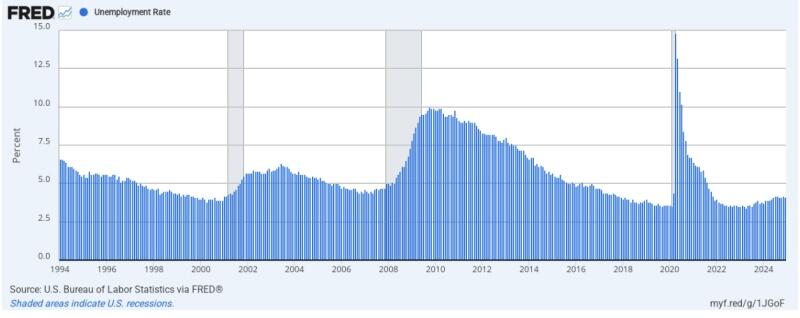
Moreover, that outcome assumes that [the CBO) Rosy Scenario does not lose her footing for even a moment through the middle of the century. Stated differently, the underlying CBO projections presume that there will be no recession during the 34-year span from 2020 to 2054, and that, in fact, there will be perpetual full employment at about 4% from here on out.

Of course, during the last 30 years there have been three recessions (shaded area) and no such full-employment perfection was even remotely achieved. The short spells of 4% unemployment or under, in fact, were few and far between—in stark contrast to the CBO baseline which presumes 4% unemployment year after year until 2054.

Monthly Unemployment Rate, 1994 to 2024

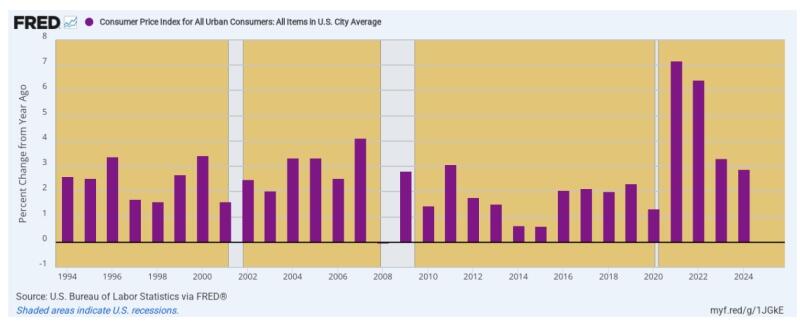
The CBO projections also assume that inflation stays strictly in its Fed-prescribed lane at around 2.0% for the next 30 years, as well. That hasn’t remotely happened during the last 30 years, when the inflation rate has exceeded the 2.0% mark during 17 years, and frequently by substantial amounts.

Y/Y Change In CPI 1994 to 2024

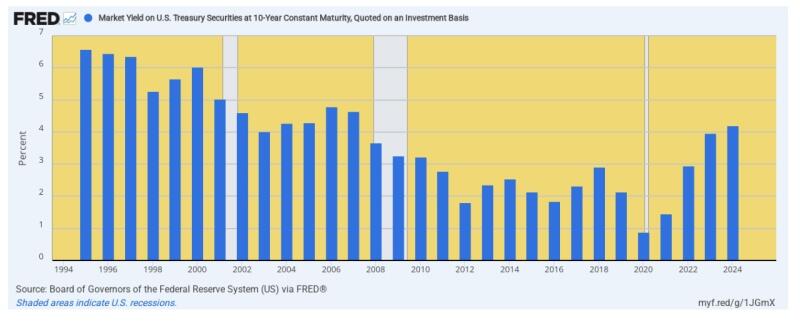
Likewise, it assumes that the bond pits will have no problem funding more than $100 trillion of new Treasury debt at yields which average just 3.6% over the next 30 years. Of course, the actual weighted average yield in the Treasury market today stands at 4.2% and the fulcrum 10-year note has been cycling around 4.4%, albeit at this point the prospective debt inundation is just getting started.

Again, judging by the last 30 years of history, the odds that interest rates will be pushed down into the mid-3% range and remain there for 30 years running would not seem very compelling, either.

Indeed, during the past 30-year period shown in the graph below the bond pits had the Fed’s big wind at their back as the latter monetized upwards of $8.5 trillion of US Treasury and GSE paper by the 2022 peak. Even then, yields were well above the CBO 3.6% assumption half the time, and were pushed lower only by the massive money-printing spree between 2008 and 2022—a feat not likely to be repeatable again without fueling even more inflation and speculation than we already have.

Read full article: https://brownstone.org/articles/washingtons-fiscal-doomsday/

________________________________________

The Leviticus 25 Plan is a dynamic economic initiative providing direct liquidity benefits for American families, while at the same time scaling back the role of government in managing and controlling the affairs of citizens.  It is a comprehensive plan with long-term economic and social benefits for citizens and government.

The inspiration for this plan is based upon Biblical principles set forth in the Book of Leviticus, principles tendering direct economic liberties to the people.

The Leviticus 25 Plan – An Economic Acceleration Plan for America

$95,000 per U.S. citizen – Leviticus 25 Plan 2026 (31409 downloads )

Message for America, 2025 – Monsignor Fulton J. Sheen

Monsignor Fulton J. Sheen – 1931 essay:

“America, it is said, is suffering from intolerance – it is not.  It is suffering from tolerance. Tolerance of right and wrong, truth and error, virtue and evil, Christ and chaos. Our country is not nearly so overrun with the bigoted as it is overrun with the broadminded.”

“Tolerance is an attitude of reasoned patience toward evil … a forbearance that restrains us from showing anger or inflicting punishment. Tolerance applies only to persons … never to truth. Tolerance applies to the erring, intolerance to the error … Architects are as intolerant about sand as foundations for skyscrapers as doctors are intolerant about germs in the laboratory.

Tolerance does not apply to truth or principles. About these things we must be intolerant, and for this kind of intolerance, so much needed to rouse us from sentimental gush, I make a plea. Intolerance of this kind is the foundation of all stability.”

“The refusal to take sides on great moral issues is itself a decision. It is a silent acquiescence to evil. The Tragedy of our time is that those who still believe in honesty lack fire and conviction, while those who believe in dishonesty are full of passionate conviction.”

______________________________________