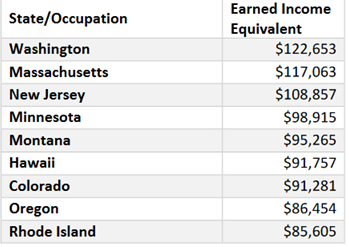
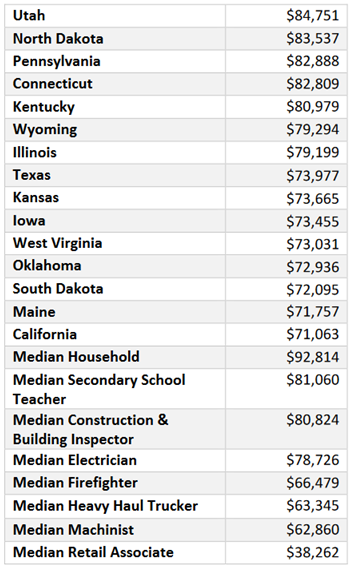
WSJ: How Welfare Left Americans Poorer

Washington Democrats are delighted to be able to ramp up transfer payments and groom more Americans into a state of dependence on government.

Washington Republicans pay lip service to opposing Democrats… but they have no credible, politically feasible strategy to change the dynamic. They have no plan to get America back on track: (1) reigniting a long-term economic growth cycle; (2) generating massive public and private debt reduction; (3) and restoring economic liberty and financial health for American Families.

…………………………………………………….

WSJ: How Welfare Left Americans Poorer

A Census Bureau report shows the high cost of transfer payments.

By The Editorial Board, Sept. 13, 2022 – Excerpts:

The Census Bureau released its 2021 income report Tuesday, and the political spin is that unprecedented pandemic transfer payments lifted millions out of poverty. It’s more accurate to say that most Americans are worse off than before the pandemic owing in part to . . . unprecedented transfer payments.

Lifting government lockdowns last year should have caused millions of Americans to return to work and raised average incomes. That didn’t happen. Real median pre-tax household income fell $402 last year to $70,784 and was $2,024 lower than in 2019. The total number of workers didn’t budge between 2020 and 2021.

Millions of Americans whose hours were cut during lockdowns did return to full-time work, but many laid-off Americans stayed home. The number of full-time, year-round workers increased by 11.1 million last year, but their real median earnings declined 4.1%.

Rising prices … may have reduced the incentive to work as the purchasing power of paychecks declined. But the Census report also underscores the outsize effects of the March 2021 $1.9 trillion spending bill, which helped drive the “supplemental” poverty measure (which accounts for transfer payments) to a record low even though the official poverty rate didn’t improve.

The $300 a week unemployment benefit boost finally lapsed last September, but transfer payments on the whole grew last year. These included the $3,600 child tax credit; $1,400 payments for each adult and child; food stamps averaging about $230 a person a month; expanded Affordable Care Act (ACA) premium subsidies, and more.

… Adding up all of last year’s government largesse, a lower-income family with two young children would have received nearly $24,000 in “free” cash, which doesn’t even include the cost of government health coverage.

We’ve written about how a March 2020 law restricts states from ending Medicaid for people no longer financially eligible as long as the national pandemic emergency is in effect. The same law suspended food stamp work requirements and raised benefits. When leisure pays as much as work, fewer work.

Democrats highlight the Census Bureau’s finding that 1.1 million fewer Americans were without health insurance last year than in 2020. But the bigger story was the shift from private to government health coverage. The number of people with private plans fell by 1.5 million while enrollment in Medicaid increased by 3.2 million and Medicare by 1.7 million.

This underscores warnings that Medicaid and ACA subsidy expansions might induce small employers to drop coverage, especially as they have to pay more to attract workers. Medicaid spending has increased by about a third during the pandemic and amounted to $33,000 last year for each new Medicaid enrollee.

Government had to support struggling Americans when government shut down the economy in 2020. But Democrats used Covid to expand the welfare state long after the crisis has passed. Americans are paying for it via inflation that has eroded their incomes.

Real median post-tax income including transfer payments declined last year by 1% for all households, 2.9% for those without children and 4.2% for seniors. Most Americans are worse off than they would have been had that $1.9 trillion bill never passed.

________________________________________

Main Street Republicans across America do have a plan. Loaded up and ready to launch.

The Leviticus 25 Plan is a dynamic economic initiative providing direct liquidity benefits for American families, while at the same time scaling back the role of government in managing and controlling the affairs of citizens.  It is a comprehensive plan with long-term economic and social benefits for citizens and government.

The inspiration for this plan is based upon Biblical principles set forth in the Book of Leviticus, principles tendering direct economic liberties to the people.

The Leviticus 25 Plan – An Economic Acceleration Plan for America

$90,000 per U.S. citizen – Leviticus 25 Plan 2023 (5388 downloads)

Big-pocketed Investors buying mobile home parks, spiking rents – with backing from Fannie Mae, Freddie Mac.

The Leviticus 25 Plan has the power to fix these ‘imbalances’…

…………………………………………..

Rents spike as big-pocketed investors buy mobile home parks

MICHAEL CASEY and CAROLYN THOMPSON

July 25, 2022

LOCKPORT, N.Y. (AP) — Excerpts:

Nationwide…  institutional investors, led by private equity firms and real estate investment trusts and sometimes funded by pension funds, swoop in to buy mobile home parks. Critics contend mortgage giants Fannie Mae and Freddie Mac are fueling the problem by backing a growing number of investor loans.

The purchases are putting residents in a bind, since most mobile homes — despite the name — cannot be moved easily or cheaply. Owners are forced to either accept unaffordable rent increases, spend thousands of dollars to move their home, or abandon it and lose tens of thousands of dollars they invested.

“You’re putting people in a snare and a trap, where they have no ability to defend themselves,” he added.

Driven by some of the strongest returns in real estate, investors have shaken up a once-sleepy sector that’s home to more than 22 million mostly low-income Americans in 43,000 communities. Many aggressively promote the parks as ensuring a steady return — by repeatedly raising rent.

There’s also a growing industry, featuring how-to books, webinars and even a mobile home university, that offers tips to attract small investors.

“You went from an environment where you had a local owner or manager who took care of things as they needed fixing, to where you had people who were looking at a cost-benefit analysis for how to get the penny squeezed lowest,” Bellus said. “You combine it with an idea that we can just keep raising the rent, and these people can’t leave.”

George McCarthy, president and CEO of the Lincoln Institute of Land Policy, a Cambridge, Massachusetts-based think tank, said parks containing about a fifth of mobile home lots nationwide have been purchased by institutional investors over the past eight years.

McCarthy singled out Fannie Mae and Freddie Mac for guaranteeing the loans as part of a what the lending giants bill as expanding affordable housing. Since 2014, the Lincoln Institute estimates Freddie Mac alone provided $9.6 billion in financing for the purchase of more than 950 communities across 44 states.

A spokesman for Freddie Mac countered that it had purchased loans for less than 3% of the mobile home communities nationwide, and about 60% of those were refinances.

___________________________________

Note – Fannie Mae and Freddie Mac, were bailed out in the fall of 2008 to the tune of $187 billion from the U.S. Treasury Department, which was in turn receiving massive support via direct ‘Treasury debt’ purchases from the Federal Reserve (funded by freshly created electronic money).

And now we have Fannie Mae and Freddie Mac backing “big-pocketed investors,” scheming for profits by spiking the rents of mobile home park residents.

There is a way to ‘fix’ these types of imbalances.

Allow individual U.S. citizens the opportunity to upgrade their standard of living by moving out of mobile home parks and into their very own ‘rent-to-own’ homes – funded by direct liquidity extensions from a Federal Reserve Citizens Credit Facility.

Fannie Mae and Freddie Mac paid back their $187 bailout bonanza over the course of the following 10 years.

U.S. citizens, under the provisions of The Leviticus 25 Plan will also pay back their liquidity extensions – over the ensuing 10-15 years.

The Leviticus 25 Plan is a dynamic economic initiative providing direct liquidity benefits for American families, while at the same time scaling back the role of government in managing and controlling the affairs of citizens.  It is a comprehensive plan with long-term economic and social benefits for citizens and government.

The inspiration for this plan is based upon Biblical principles set forth in the Book of Leviticus, principles tendering direct economic liberties to the people.

The Leviticus 25 Plan – An Economic Acceleration Plan for America

$90,000 per U.S. citizen – Leviticus 25 Plan 2023 (5005 downloads 

WSJ: Government Subsidies “Feed Inflation” and the “Fat Cats.”

WSJ: Subsidies Only Feed Inflation

Even if they ostensibly go to consumers, they end up enriching companies by enabling higher prices.

By Tomas J . Philipson

The Wall Street Journal – Sept. 15, 2022

President Biden insists he is fighting inflation by making things more affordable for middle-class American households. To that end, his administration and Congress trotted out big-dollar subsidies for consumers of green energy, drugs and higher education last month. But the bulk of that federal cash will likely end up in the pockets of companies, not consumers. August may go down as an epic month of feeding the fat cats.

In a normal market, sellers receive the price buyers pay. If you have a garage sale where your chair sells for $100, you get all $100. But there are virtually no such markets in the U.S. anymore because taxes and subsidies jam a wedge between what buyers pay and sellers receive. Companies pay more for workers than workers take home because of income and payroll taxes. Poor patients pay less than what hospitals receive because of Medicaid subsidies.

Economists recognize that government intervention in a market results not in a single price but two—a “demand price” paid by buyers and a “supply price” received by sellers.

When a market is subsidized, buyers and sellers both typically benefit through a rise in the supply price and a fall in the demand price. Companies get more but consumers pay less, courtesy of taxpayers. But which party the law designates as the recipient of a subsidy—consumers or companies—doesn’t determine who gains from the subsidy. That’s determined by the structure of subsidies and market forces, which is why the consumer subsidies launched in August will likely amount to a generous corporate-welfare program.

Consider the new regulations accompanying the student-loan forgiveness program. The Biden administration is heavily expanding income-driven repayment, which caps what borrowers pay each month. The implication seems to be that students can borrow more at no additional cost. “Most of these plans cancel a borrower’s remaining debt once they make 20 years of monthly payments,” according to the White House. Universities can raise tuition (the supply price) without affecting the total loan payment by students (the demand price). Or the student can borrow more than necessary and invest the money with no intention of ever paying back the loan, reducing the effective tuition further. Unfortunately, the gift from taxpayers will likely go to the most expensive schools and the ones with the largest endowments.

Likewise, the administration pitched many of the green-energy subsidies of the Inflation Reduction Act as a relief to consumers. Subsidies for heat pumps, rooftop solar panels and electric air conditioners will supposedly make homes more energy-efficient and therefore cheaper to maintain. Tax credits for electric vehicles are meant to hasten the transition away from gasoline, but manufacturers are already raising supply prices by the exact amount of the subsidies, with demand prices remaining constant. This is the predicted result of a subsidy when suppliers have market power—as the electric-vehicle oligopoly does—and when there is excess demand for the product. When markets are more competitive, companies pass the value of the subsidies on to consumers because if they don’t, a competitor will.

The Inflation Reduction Act’s caps on copays in the Medicare drug program ensure further distortions to that already convoluted market. The maximum demand price at the pharmacy—$2,000 starting in 2025 under the Inflation Reduction Act—will show up for consumers as higher premiums, but taxpayers already subsidize 75% of those. The bottom line is that demand prices will be further decoupled from increased supply prices.

Mr. Biden may genuinely believe these consumer subsidies will help take the inflationary pressure off the household budgets of middle-class Americans. But the hard truth is that market forces decide who benefits from government subsidies. That’s why supply-side competition is often the best way to protect consumers from higher prices.

Mr. Philipson is an economist at the University of Chicago. He served as a member of President Trump’s Council of Economic Advisers and was acting chairman, 2019-20.

______________________________________ 

The Leviticus 25 Plan is a powerful economic acceleration plan that restores free market dynamics and supply-side competition through the direct allocation of resources by participating citizens.

Rather than ‘feeding inflation’ and ‘feeding the fat cats’ through ongoing big-government subsidies – which serve primarily to perpetuate the ever-growing dependence on government-based entitlement programs and pump hundreds of billions of dollars of additional debt into America’s annual budget deficits….

The Leviticus 25 Plan will substantially reduce citizen dependence on government. It will strengthen the labor force by re-incentivizing work, reduce the size of government and the scope of governmental control over the daily affairs of citizens.

The Leviticus 25 Plan will strengthen the financial security of U.S. citizens, and it will generate $583 billion budget surpluses annually over the initial five years of activation (2023-2027).

The Leviticus 25 Plan is a dynamic economic initiative providing direct liquidity benefits for American families, while at the same time scaling back the role of government in managing and controlling the affairs of citizens.  It is a comprehensive plan with long-term economic and social benefits for citizens and government.

The inspiration for this plan is based upon Biblical principles set forth in the Book of Leviticus, principles tendering direct economic liberties to the people.

The Leviticus 25 Plan – An Economic Acceleration Plan for America

$90,000 per U.S. citizen – Leviticus 25 Plan 2023 (0 downloads)

National Debt: $31 trillion; Household Debt: $16 trillion; Corporate Debt: $12.5 trillion. America’s Debt-slayer: The Leviticus 25 Plan

Household Debt in America has now surpassed the $16 trillion mark. Corporate Debt (non-financial) has climbed over $12.583 trillion. The National Debt has reached $31 trillion.

America has an inflation problem. But America’s debt crisis is far and away more serious.

Our Washington politicians, Democrats and Republicans, have no politically viable plan to deal with this crisis.

Main Street America’s Republicans do have a plan – the most powerful debt-busting economic acceleration plan on the face of the earth…

…………………………………………………

US National Debt Blows Past $31 Trillion

ZeroHedge, Wednesday, Oct 05, 2022 – Excerpts:

…”So many of the concerns we’ve had about our growing debt path are starting to show themselves as we both grow our debt and grow our rates of interest,” said Michael Peterson, CEO of the Peter G. Peterson Foundation, in a statement to the NY Times. “Too many people were complacent about our debt path in part because rates were so low.

Higher rates could add an additional $1 trillion to what the federal government spends on interest payments this decade, according to Peterson Foundation estimates. That is on top of the record $8.1 trillion in debt costs that the Congressional Budget Office projected in May. Expenditures on interest could exceed what the United States spends on national defense by 2029, if interest rates on public debt rise to be just one percentage point higher than what the C.B.O. estimated over the next few years.

Michael Maharrey of SchiffGold notes;…

[T]here is no end to the borrowing and spending in sight. In August alone, the US government ran a massive $219.6 billion budget deficit.

While spending has slowed somewhat with the end of pandemic-era programs, the Biden administration continues to burn through roughly half-a-trillion dollars every single month. With one month left in the fiscal year, the government has spent just over $5.35 trillion.

And there is more spending coming down the pike.

The US government is still handing out COVID stimulus and it wants more.  Congress recently pushed through another massive spending bill. Meanwhile, the US continues to shower money on Ukraine and other countries around the world. And we haven’t begun to see the impact of student loan forgiveness.

On top of increased spending, rising interest rates will balloon the debt even more.

Every increase in interest rate raises the federal government’s interest expense. So far in fiscal 2022, the US Treasury has forked out $471 billion just to fund the government’s interest payments.

To put that number into context, at this point in fiscal 2021 the Treasury’s interest expense stood at $356 billion. That represents a 30%  year-on-year increase. Interest expense ranks as the sixth largest budget expense category, about $250 billion below Medicare. If interest rates remain elevated or continue rising, interest expenses could climb rapidly into the top three federal expenses. (You can read a more in-depth analysis of the national debt HERE.

According to the Congressional Budget Office, this is exactly what will happen. It projects interest payments will triple from nearly $400 billion in fiscal 2022 to $1.2 trillion in 2032. And it’s worse than that. The CBO made this estimate in May. Interest rates are already higher than those used in its analysis.

……..

The Problem of Debt

In the first place, a large national debt stunts economic growth.

According to the National Debt Clock, the debt to GDP ratio is 125.12%. Studies have shown that a debt-to-GDP ratio of over 90% retards economic growth by about 30%. This throws cold water on the conventional “spend now, worry about the debt later” mantra, along with the frequent claim that “we can grow ourselves out of the debt” now popular on both sides of the aisle in DC.

More immediately, the national debt is a big problem for the Federal Reserve as it drives up interest rates hoping to tame inflation.

The US government can’t keep borrowing and spending without the Fed monetizing the debt. It needs the central bank to buy Treasuries to prop up demand. Without the Fed’s intervention in the bond market, prices will tank, driving interest rates on US debt even higher.

paper published by the Kansas City Federal Reserve Bank acknowledged that the central bank can’t slay inflation unless the US government gets its spending under control. In a nutshell, the authors argue that the Fed can’t control inflation alone. US government fiscal policy contributes to inflationary pressure and makes it impossible for the Fed to do its job.

______________________________________

Note again this key acknowledgement from the Kansas City Federal Reserve Bank: “…the central bank [Fed] can’t slay inflation unless the US government gets its spending under control.

The Leviticus 25 Plan will allow for an enormous reduction in outlays, and it will generate massive new tax revenue gains for federal, state, and local government entities.

It will generate $583 billion surpluses at the federal level each of its first five years of activation (2023-2027), and it will completely pay for itself over the next 10-15 years.

It will revitalize economic growth, ramp up productivity, re-establish a citizen centered health care system in the U.S., and restore economic liberty.

The Leviticus 25 Plan is loaded up and ready to launch.

The Leviticus 25 Plan is a dynamic economic initiative providing direct liquidity benefits for American families, while at the same time scaling back the role of government in managing and controlling the affairs of citizens.  It is a comprehensive plan with long-term economic and social benefits for citizens and government.

The inspiration for this plan is based upon Biblical principles set forth in the Book of Leviticus, principles tendering direct economic liberties to the people.

The Leviticus 25 Plan – An Economic Acceleration Plan for America

$90,000 per U.S. citizen – Leviticus 25 Plan 2023 (1146 downloads)

WSJ: Mounting National Debt Closing in on “Doom Loop.” America’s Powerhouse Solution: The Leviticus 25 Plan

The Silent Price You’ll Pay for Our Mounting National Debt – WSJ

The cost of borrowing is near untenable levels. If we aren’t already in a ‘doom loop,’ we’re getting close.

By Red Jahncke – President, Townsend Group International, LLC

WSJ, Sept. 29, 2022 – Excerpts:

… The gross interest expense on the national debt hit $88 billion in August, according to the Monthly Treasury Statement. That’s $1.06 trillion a year.

Interest on the national debt is exploding and heading toward what economists refer to as a “doom loop”—the vicious circle in which the government’s borrowing to pay interest generates yet more interest and yet more borrowing.

Net interest expense (gross expense minus the interest received) hit $63 billion in August, or $756 billion a year. That’s a lot of money in the context of a $6 trillion federal budget and a $25 trillion economy.

The August numbers barely reflect the impact of the Fed’s interest-rate hikes between March and July, much less last Wednesday’s increase and the additional 1.25% by year’s end implied by the Fed’s new guidance. It’s highly likely that gross interest expense will rise well above $1 trillion a year and surpass Social Security as the largest item in the federal budget.

The Fed’s more hawkish guidance calls for “higher rates for longer,” even if it brings on recession. The central bank is also shrinking its holdings of Treasurys under its quantitative-tightening policy, requiring the Treasury Department to find alternative buyers. Weak demand will likely push rates higher, if not destabilize the Treasury market to some degree.

Yet even if the Fed backs off, or recession intervenes, that won’t relieve pressure on Uncle Sam.

Treasury debt has reached record levels, and higher federal interest expense is already baked in. That will constrain Washington’s capacity to deliver fiscal stimulus to a struggling economy during the next recession. Constrained or not, the government will doubtless attempt to do so. That means issuing more debt, since the federal budget is in perpetual deficit.

That is exactly what has happened in the past 2½ years: Uncle Sam issued $7 trillion of new debt during the Covid pandemic, which took publicly held national debt to its present $24 trillion up from $17 trillion in February 2020.

… In principal amount, the national debt has exploded and the cost of debt service is escalating, too. The current $756 billion annual net interest expense on the $24 trillion of publicly held debt implies a required economic growth rate of more than 3% in a $25 trillion economy in order for the debt “not to matter.” The average forecast for economic growth in calendar year 2022 is less than 1%, and many economists expect negative growth—i.e., recession—in 2023.

Not only are rising interest rates driving up federal interest expense dramatically; inflation is propelling growth in government spending. Social Security benefits are adjusted based on the average of the consumer-price index reports for July, August and September each year. We have reports for two months and don’t need the third to know that benefits will increase next year to roughly $1.3 trillion from $1.2 trillion (or more than 8%).

Healthcare costs always exceed the rate of inflation, too. That guarantees double-digit growth next year in Medicare from about $710 billion in fiscal 2022 based on the first 11 months, and in the other government healthcare programs categorized as “health” in the Monthly Treasury Statement, which amounted to $915 billion in fiscal 2022. Assuming only 10% healthcare inflation, these two categories combined will grow by $163 billion.

Naturally, if we do slip—or plummet—into a serious recession, federal income-tax revenue will erode. Even before recession, the past nine months of declining stock and bond prices virtually assure an almost complete collapse in capital-gains-tax revenue come tax time next April. Loss of that category alone—which averages about 12% of federal individual income-tax revenue—will necessitate hundreds of billions in borrowing to replace lost revenue.

Inflation and interest rates are inflicting painful damage today. Yet seemingly without notice the national debt is working like a cancer sapping the nation’s long-term economic vitality.

Whether we reach the “doom loop,” or just become mired in stagflation, unchecked government spending and mounting national debt will drain all growth potential from the national economy sooner rather than later.

___________________________________ 

America’s Powerhouse Solution:

The Leviticus 25 Plan will generate $583 billion federal budget surpluses for each of the first 5 years of activation (2023-2027), and completely pay for itself over the next 10-15 years.

The Leviticus 25 Plan is a dynamic economic initiative providing direct liquidity benefits for American families, while at the same time scaling back the role of government in managing and controlling the affairs of citizens.  It is a comprehensive plan with long-term economic and social benefits for citizens and government.

The inspiration for this plan is based upon Biblical principles set forth in the Book of Leviticus, principles tendering direct economic liberties to the people.

The Leviticus 25 Plan – An Economic Acceleration Plan for America 2023

Economic Scoring links:

·  The Leviticus 25 Plan 2023 – $583 billion Federal Budget Surpluses (2023-2027), Part 1: Overview, Deficit Projection

·  The Leviticus 25 Plan 2023 – $583 Billion Federal Budget Surpluses Annually (2023-2027), Part 2: Federal Income Tax and Means-Tested Welfare Recapture Benefits.

·  The Leviticus 25 Plan 2023 – $583 Billion Federal Budget Surpluses Annually (2023-2027), Part 3: Medicaid/CHIP and Medicare Recapture Benefits

·  The Leviticus 25 Plan 2023 – $583 Billion Federal Budget Surpluses Annually (2023-2027), Part 4: VA, TRICARE, FEHB, SSDI Recapture Benefits

·  The Leviticus 25 Plan 2023 – $583 Billion Federal Budget Surpluses Annually (2023-2027), Part 5: Subtotals, Interest Expense Savings, Summary

Full Plan:Leviticus 25 Plan 2023 (3958 downloads)  

Website:   https://Leviticus25Plan.org

__________________________________________ 

Preview 1:

The Leviticus 25 Plan provides a $90,000 credit extension, direct from the Federal Reserve, to every participating U.S. citizen:  $60,000 into a Family Account (FA) and $30,000 into a Medical Savings Account (MSA).

Example:  Qualifying family of four would receive $240,000 in their FA, and $120,000 in their MSA.

Primary goals:  Massive debt elimination at family level: mortgage debt, consumer debt, student loan debt.  Federal budget surpluses.

Eligibility:  U.S. Citizen.  Job history, credit history requirement (similar to traditional credit checks for bank loans).  Clean recent drug history.  Clean crime history.

Requirements:  Forego all federal and state tax refunds for 5-year period.

Forego selected means-tested welfare benefits – for minimum 5-year period.

Forego all income security program benefits – for minimum 5-year period.

Forego new federally-subsidized ‘Family Medical Leave’ benefits – for minimum 5-year period.

Forego Child Tax Credit benefits – for minimum 5-year period.

Forego enhanced federal rental forbearance/assistance – for minimum 5-year period.

Forego SSI and SSDI for minimum 5-year period.

New $6,000 deductible on primary care access to: Medicare, Medicaid, VA, TRICARE, FEHB – for minimum 5-year period.

The Plan assumes that the elite-wealthy will not participate, because their refunds are too valuable to give up over the requisite 5-year period.

The Plan also assumes that many who heavily depend on social welfare benefits will also choose not to participate, because the overriding value of those benefits, vs foregoing them, over the 5-year period.

WSJ: Republicans Should Stand for More Than Simply Opposing Radical Democrat Policies and Initiatives.

Republicans Should Stand for More Than Opposing Democrats

They need to develop specific policies and programs in time for the 2024 presidential election.

By Joseph Epstein

The Wall Street Journal, Aug. 30, 2022 – Excerpts:

“… Democrats seem always on the political offensive; with their general principles, the Republicans on the defensive, seeing it as their chief task to block costly Democratic bills and other attempts at radical change….

…What the Republicans had going for them in the midterms was opposition to inflation, the obvious madness (and sadness) of our open southern border, the crime openly rampant in big-city streets, the wobbly foreign policy of an American president who in this realm and others seems well over his head.

However worthy of attack these things are, they leave the Republicans in the respectable but limited position of loyal opposition. What, apart from this opposition, does the party stand for that American voters can get behind in the passionate way that wins elections?

The lack of positive policies or programs leaves Republicans open to the old argument that the party stands for little more than the defense of rich and the maintenance of the status quo. In this scheme—or, as we say nowadays, narrative—the Democrats stand for progress, they are the party of the people, holding the torch of social justice high, while the Republicans stand for regress, the continual enrichment of the 1%, a deep insensitivity to injustice and suffering.

If Republicans were to promote policies and programs formed from their principles, it would have the not-trivial benefit of putting give-and-take back at the heart of the two-party system. A politics that encouraged the parties to argue over rivaling ideas would invite the intelligent participation of a great number of Americans.

_________________________________ 

What our Washington Republicans have not done is “promote policies and programs” that are forged from their defining principles and core beliefs, programs what will (1) Get the federal budget back under control, (2) Reduce government control over the daily affairs of citizens, (3) Formalize a long-term robust economic growth plan, and (4) Restore financial security for American families.

Main Street Republicans, the very hard-working, tax-paying, God-fearing U.S. citizens, who comprise the back-bone of America, have just such a formal plan.

The Leviticus 25 Plan will (1) Generate $583 billion budget surpluses, (2) Reduce government control over the daily affairs of citizens, (3) Reign in out-of-control entitlement spending, (4) Provide massive debt elimination and newfound financial security for millions of American families, (5) Revitalize a citizen-centered health care system, (6) Promote economic liberty and free market dynamics for the U.S. economy, (7) Provide long-term strength and stability for the U.S. Dollar and steer America clear of a freedom-robbing Fed-based Central Bank Digital Currency (CBDC).

The Leviticus 25 Plan – An Economic Acceleration Plan for America

$90,000 per U.S. citizen – Leviticus 25 Plan 2023 (4165 downloads)

Biden’s $10,000 College Loan Debt Forgiveness – What the Republican Response Should Have Been….

The Biden administration has announced that it will “forgive up to $20,000 in federal student loan debt for tens of millions of Americans, a move that will provide unprecedented relief for borrowers:..”  – The Wall Street Journal, Aug 24, 2022.

Continuing –  “The Penn Wharton Budget Model estimates that canceling $10,000 for borrowers earning up to $125,000 will cost about $300 billion. The Pell grant addition could increase this by as much as $270 billion. The four-month freeze on payments will cost $20 billion on top of the roughly $115 billion it already has.”

That’s a cool $590 billion.

“Worse than the cost is the moral hazard and awful precedent this sets. Those who will pay for this write-off are the tens of millions of Americans who didn’t go to college, or repaid their debt, or skimped and saved to pay for college, or chose lower-cost schools to avoid a debt trap. This is a college graduate bailout paid for by plumbers and FedEx drivers.”

Meanwhile, “The combined actions could render up to 20 million borrowers free of student debt, according to the White House.

“It’s hard to wrap your head around how life changing this is going to be for so many people. It is almost cosmic in scale,” said the Debt Collective, an activist group that has pushed for broad cancellation.”

__________________________________ 

It is hard to overstate how important and beneficial this type of debt relief is for millions of recent college graduates, who are now dealing skyrocketing rents and higher food and fuel costs – and how it will be viewed, politically, by the nearly 20 million beneficiaries.

And what was the Republican response?  Did the Washington Republicans have a better plan for America?

Answer:  No.

“GOP lawmakers quickly criticized the idea, with the Republican National Committee calling the plan ‘Biden’s bailout for the wealthy.’”  –The Wall Street Journal, Aug 25, 2022.

Republicans in Washington, by the way, do not have any type of broadly-defined ‘Vision for Restoring the American Dream,’ and never have a superior alternative to offer the American people when Biden and the Washington Democrats push to expand big-government’s budget-blowing powers benefiting politically-malleable special interest groups.

What the Washington Republican response should have been:

“We Republicans offer to the American people a comprehensive economic plan that is far superior to the Biden Administration’s $10,000 college loan forgiveness plan.

Our plan will provided direct access to liquidity and a path to massive debt relief for all U.S. citizens – which includes millions of past college graduates who have worked hard and repaid their loans, and the millions of tax-paying Americans who did not go to college (but are now subsidizing Biden’s college loan forgiveness plan).

Our plan will not strap taxpayers with a $590 billion addition to the national debt.  Our plan will instead generate $583 billion budget surpluses each of the first five years of activation (2023-2027).

Our plan will not continue to make citizens ever more dependent on federal government programs. It will instead will allow citizens to become less dependent and less controlled by government.  It will rebuild the foundations of freedom in America.

Our plan will re-vitalize free market dynamics in America, lower inflation, usher in a grand new long-term economic growth cycle, and ‘raise all boats’ with enhanced financial security for all Americans.

Our plan:

The Leviticus 25 Plan provides a $90,000 credit extension, direct from the Federal Reserve, to every participating U.S. citizen:  $60,000 into a Family Account (FA) and $30,000 into a Medical Savings Account (MSA).

Example:  Qualifying family of four would receive $240,000 in their FA, and $120,000 in their MSA.

Primary goal:  Massive debt elimination at family level:  mortgage debt, consumer debt, student loan debt

Eligibility:  U.S. Citizen.  Job history, credit history requirement (similar to traditional credit checks for bank loans).  Clean recent drug history.  Clean crime history.

Requirements:  Forego all federal and state tax refunds for 5-year period.

Forego all means-tested welfare benefits – for minimum 5-year period.

Forego all income security program benefits – for minimum 5-year period.

Forego new federally-subsidized ‘Family Medical Leave’ benefits – for minimum 5 year period.

Forego Child Tax Credit benefits – for minimum 5-year period.

Forego enhanced unemployment benefits – for minimum 5-year period.

Forego enhanced rental forbearance/assistance – for minimum 5-year period.

Forego SSI and SSDI for minimum 5-year period.

New $6,000 deductible on primary care access to: Medicare, Medicaid, VA, TRICARE, FEHB – for minimum 5-year period.

The Plan assumes that the elite-wealthy will not participate, because their refunds are too valuable to give up over the requisite 5-year period.

The Plan also assumes that many who heavily depend on social welfare benefits will also choose not to participate, because the overriding value of those benefits, vs foregoing them, over the 5-year period.

The Leviticus 25 Plan grants the same direct access to liquidity, through a Fed-based Citizens Credit Facility, similar to the credit facilities that were created by the Fed to transfuse trillions of dollars in direct transfers and credit extensions to Wall Street’s major banks, credit agencies and insurers during the great financial crisis. 

The following facilities were created and activated by the Fed for this massive Wall Street bail out operation: Term Auction Facility (TAF), Primary Dealer Credit Facility (PDCF), Term Securities Lending Facility (TSLF), currency swap agreements with several foreign central banks,  Commercial Paper Funding Facility (CPFF), Asset-Backed Commercial Paper Money Market Mutual Fund Liquidity Facility (AMLF), Money Market Investor Funding Facility (MMIFF), and the Term Asset-Backed Securities Loan Facility (TALF), and access to the Fed’s Discount Window.

Additional perspective:  SIGTARP, the oversight agency of the Troubled Asset Relief Program (TARP), in its July 2009 report, vetted by Treasury, noted that the U.S. Government’s “Total Potential Support Related to Crisis” (page 138) amounted to $23.7 trillion. While this figure represents a backstop commitment, not a measure of total potential loss, it is nonetheless an astounding degree of support, in the form of liquidity infusions, credit extensions and guarantees, various other forms of assistance for financial institutions and other business entities affected by the financial crisis.

The Leviticus 25 Plan is a dynamic economic initiative providing direct liquidity benefits for American families, while at the same time scaling back the role of government in managing and controlling the affairs of citizens.  It is a comprehensive plan with long-term economic and social benefits for citizens and government.

The inspiration for this plan is based upon Biblical principles set forth in the Book of Leviticus, principles tendering direct economic liberties to the people.

The Leviticus 25 Plan – An Economic Acceleration Plan for America

$90,000 per U.S. citizen – Leviticus 25 Plan 2023 (4161 downloads)

WSJ: Official IRS audits show “record of incompetence.” Superior strategy for America: The Leviticus 25 Plan

A fresh Wall Street Journal review of IRS audits…

This is Your IRS at Work

Official audits show a record of incompetence. Democrats are still giving the tax agency an $80 billion raise.

By The Editorial Board | Aug. 19, 2022

The new Inflation Reduction Act has many damaging provisions, but for sheer government gall the $80 billion reward to the Internal Revenue Service stands out. The money will go to hire 87,000 new employees, doubling its current payroll. This is also doubling down on incompetence, as anyone can see in the official reports of the Treasury Inspector General for Tax Administration (Tigta).

We’ve read those reports for the last several years so you don’t have to, and the experience is a government version of finding yourself in a blighted neighborhood for the first time. You can’t believe it’s that bad. The trouble goes beyond the oft-cited failures like answering only 10% of taxpayer calls, or a backlog of 17 million unprocessed tax returns. The audits reveal an agency that can’t do its basic job well but will terrorize taxpayers whether deserving or not.

***

Consider the agency’s chronic mishandling of tax credits. By the IRS’s own admission, some $19 billion—or 28%—of earned-income tax credit payments in fiscal 2021 were “improper.” The amount hasn’t improved despite years of IRS promises to do better.

A January Tigta audit found that an estimated 67,000 claims—totaling $15.6 billion—for the low-income housing tax credit from 2015 to 2019 “lacked or did not match supporting documentation due to potential reporting errors or noncompliance.”

A May audit found that 26% ($1.9 billion) of its American opportunity tax credits for education expenses were improper in fiscal 2021, and 27% ($541 million) of its net premium tax credits (ObamaCare) were improper in fiscal 2019 (the most recent year it estimated). The same May audit said the IRS acknowledged that 13% ($5.2 billion) of its enhanced child tax credit payments were improper.

• How did it handle $1,200 stimulus checks, the sick and paid family leave credit, or the employee retention tax credit? Unknown, since the agency didn’t estimate failure rates—for which Tigta rapped its knuckles.

A September 2021 audit found the IRS in 2020 issued 89,338 notices to taxpayers insisting that “balances were owed even though the taxes were not actually due.” Why? Because the feds had extended the filing deadline amid Covid but the IRS apparently didn’t notice.

• A February audit found the IRS department responsible for ensuring retirement-plan tax compliance suffered a 23% decline in the quality of its examinations from fiscal 2018 to fiscal 2020. In the past seven months, Tigta has issued searing reports on IRS mismanagement of everything from its partial-payment program for delinquent taxpayers, to its auditing of partnerships, to its struggle to handle internal employee misconduct.

• This ineptitude extends to programs Democrats insist will now raise revenue—those targeting higher earners. In 2010 Congress passed the Foreign Account Tax Compliance Act, which was supposed to identify wealthy Americans using undisclosed foreign accounts. Congress’s Joint Committee on Taxation said this would raise some $9 billion in revenue by fiscal 2020. Yet an April Tigta audit noted that while the IRS has spent $574 million to implement the law, the agency has drummed up only $14 million in compliance revenue.

• A July 2021 audit related the failure of the IRS small-business/self-employed division’s strategy, which began in 2010 to examine more returns from “high-income individual taxpayers.” The IRS defines high earners as those with income greater than $200,000. Yet from fiscal 2015 to the end of fiscal 2017 (when the strategy was shut down), 73% of returns targeted by the strategy fell below $200,000.

Democrats say a turbocharged IRS won’t pursue taxpayers earning less than $400,000, but don’t believe it. Middle-income Americans are easier marks, as they are more likely to write a check than engage in years of costly litigation.

***

The Tigta site shows the IRS is good at one thing: punishing those who resist its demands. A March audit chastised the IRS for using lien foreclosure suits to confiscate “principal residences” from delinquent taxpayers, a process that does “not provide [taxpayers] the same legal protections as seizures.”

A March 2017 report related the agency’s crackdown on businesses flagged as potentially evading a law that requires financial institutions to report currency transactions exceeding $10,000. The IRS took to seizing property from its targets before even conducting interviews. Tigta reports that even when interviews were conducted, the IRS failed to advise the accused of their rights or the purpose of the interview, and failed to consider “realistic defenses or explanations.” Tigta found that “most” of those targeted (owners of gas stations, jewelry stores, scrap-metal dealers, restaurants) had not committed crimes, though many were never able to regain their property.

This is the IRS that Democrats are now arming with more money and manpower to unleash on Americans. The $80 billion is a demonstration of their priorities, and further proof of the rule that failure in government is invariably rewarded with a bigger budget.

____________________________ 

Republicans in Washington, who, by the way, do not have any type of broadly-defined ‘Vision for Restoring the American Dream,’ and never seem to have a superior alternative to offer the American people when Washington Democrats push to expand big-government’s power to expropriate wealth and limit freedoms for working-class Americans – should sit up and take notice….

The Leviticus 25 Plan is a powerful, and manifestly superior, plan to expanding IRS powers – and defining a bright new vision for America.

All U.S. citizens participating in The Leviticus 25 Plan will forego their tax refunds for the initial five year activation period (2023-2027).

Benefits – Federal Income Tax Recapture
The scoring model assumes that 80% of U.S. citizens will participate in The Plan.
Participants must give up their tax refunds through the Plan’s recapture provisions for the 5-year target period (2023-2027).

According to 2021 IRS Filing season statistics, through Dec 3, 2021: 129,841,000 total refunds were paid out for a total of $365.499 billion. The estimated refund total
for the full year, through December 31st: $365.5 billion.

The Leviticus 25 Plan would reduce the number of refunds each year (2023-2027) by 80%, effectively dropping the gross number of refunds in need of processing, reviewing, and potentially auditing, from approximately 130,000,000 down to about 26,000,000.

The IRS would NOT need to hire the additional thousands of employees, and they would NOT be put in the bind of having to pay $3.3 billion in interest payments on unprocessed refunds.

And the IRS would NOT need “$45.6 billion for “enforcement,” including “litigation,” “criminal investigations,” “investigative technology,” “digital asset monitoring” and a new fleet of tax-collector cars.

The Leviticus 25 Plan, by virtue of its Federal Income Tax Recapture provisions, will increase U.S. Treasury Department net tax collection revenue by $1.592 trillion over a 5-year period – all without spending one additional dollar on IRS collection efforts.

The Leviticus 25 Plan – Federal Income Tax Recapture

The scoring model assumes that 80% of U.S. citizens will participate in The Leviticus 25 Plan.

Participants must give up their tax refunds through the Plan’s recapture provisions for the 5-year target period (2023-2027).

According to 2021 IRS Filing season statistics, through Dec 3, 2021: 129,841,000 total refunds were paid out for a total of $365.499 billion.  The estimated refund total for the full year, through December 31st:  $365.5 billion.

Refund totals have increased by ~$44 billion over the past five years, from $323.9 billion (2017) to a current (estimated) $365.5 billion (2021), representing an average increase of $8.32 billion / year. 

A conservative estimated average of $8 billion per year (2023-2027) will be used for this recapture calculation.

2021: $365.5 billion

2022: $374 billion

2023: $382 billion

2024: $390 billion

2025: $398 billion

2026: $406 billion

2027: $414 billion

Total: $1.990 trillion

Total recapture X 80%:  $1.990 trillion X .8 = $1.592 trillion

Total recapture per annum (2023-2027): $1.592 trillion / 5 = $318.4 billion

Source: https://www.irs.gov/newsroom/filing-season-statistics-for-week-ending-december-3-2021 

The Leviticus 25 Plan is a dynamic economic initiative providing direct liquidity benefits for American families, while at the same time scaling back the role of government in managing and controlling the affairs of citizens.  It is a comprehensive plan with long-term economic and social benefits for citizens and government.

The inspiration for this plan is based upon Biblical principles set forth in the Book of Leviticus, principles tendering direct economic liberties to the people.

The Leviticus 25 Plan – An Economic Acceleration Plan for America

$90,000 per U.S. cirizen – Leviticus 25 Plan 2023 (4158 downloads)

Act 2: Buffett and Gates Convert their free paper money into…. Farmland

A perfect trade – ‘paper’ for ‘farmland.’

And farmland is the gift that keeps on giving, with the types of government subsidies which particularly benefit billionaires.

………………………………………………….

MarketWatch – Mar 13, 2021:

Bill Gates and Warren Buffett should thank American taxpayers for their profitable farmland investments

By Vincent H. Smith and Eric J. Belasco

Bill Gates is now the largest owner of farmland in the U.S. having made substantial investments in at least 19 states throughout the country. He has apparently followed the advice of another wealthy investor, Warren Buffett, who in a February 24, 2014 letter to investors described farmland as an investment that has “no downside and potentially substantial upside.”

There is a simple explanation for this affection for agricultural assets. Since the early 1980s, Congress has consistently succumbed to pressures from farm interest groups to remove as much risk as possible from agricultural enterprises by using taxpayer funds to underwrite crop prices and cash revenues.

Over the years, three trends in farm subsidy programs have emerged.

The first and most visible is the expansion of the federally supported crop insurance program, which has grown from less than $200 million in 1981 to over $8 billion in 2021…

The second trend is the continuation of longstanding programs to protect farmers against relatively low revenues because of price declines and lower-than-average crop yields….

The third, more recent trend is a return over the past four years to a 1970s practice: annual ad hoc “one off” programs justified by political expediency with support from the White House and Congress. These expenditures were $5.1 billion in 2018, $14.7 billion in 2019, and over $32 billion in 2020, of which $29 billion came from COVID relief funds authorized in the CARES Act. An additional $13 billion for farm subsidies was later included in the December 2020 stimulus bill.

If you are wondering why so many different subsidy programs are used to compensate farmers multiple times for the same price drops and other revenue losses, you are not alone.

Our research indicates that many owners of large farms collect taxpayer dollars from all three sources. For many of the farms ranked in the top 10% in terms of sales, recent annual payments exceeded a quarter of a million dollars.

Farms with average or modest sales received much less. Their subsidies ranged from close to zero for small farms to a few thousand dollars for averaged-sized operations.

Thus for almost all farm owners, and especially the largest 10% whose net equity averages over $6 million, as Buffet observed, there is little or no risk and lots of potential gain in owning and investing in agricultural land. 

While many agricultural support programs are meant to “save the family farm,” the largest beneficiaries of agricultural subsidies are the richest landowners with the largest farms who, like Bill Gates and Warren Buffet, are scarcely in any need of taxpayer handouts.

Vincent H. Smith is director of agricultural studies at the American Enterprise Institute, a Washington, D.C. think tank, and professor of economics at Montana State University. Eric J. Belasco is a visiting scholar at AEI.

_______________________________________

Mr. Buffett also used a sizeable portion of his funds to buy into the mobile home sector… and this has not been working out so well for many of the mobile home owners in America.

Warren Buffett, Slumlord – Predatory Loans, Kickbacks & Preying On The Poor  

ZeroHedge, Apr 6, 2015 – Excerpts:                                                                  

Buffett’s mobile-home empire promises low-income Americans the dream of homeownership. But Clayton [controlled by America’s second richest man, billionaire Warren Buffet], relied on predatory sales practices, exorbitant fees, and interest rates that can exceed 15 percent, trapping many buyers in loans they can’t afford and in homes that are almost impossible to sell or refinance, an investigation by The Seattle Times and Center for Public Integrity has found.

___________________________________

The Leviticus 25 Plan will balance the books on these matters – by granting U.S. citizens the same direct access to liquidity that was so generously provided by the Federal Reserve and U.S. Department of Treasury to Wall Street’s wealthy elites during financial crisis years, 2008-2010.

The Leviticus 25 Plan is a dynamic economic initiative providing direct liquidity benefits for American families, while at the same time scaling back the role of government in managing and controlling the affairs of citizens.  It is a comprehensive plan with long-term economic and social benefits for citizens and government.

The inspiration for this plan is based upon Biblical principles set forth in the Book of Leviticus, principles tendering direct economic liberties to the people.

The Leviticus 25 Plan – An Economic Acceleration Plan for America

$90,000 per U.S. citizen – Leviticus 25 Plan 2023 (4156 downloads)

Act 1: Fed’s 2008-09 Bailout Bonanza Flowed into the Financial Coffers of Billionaires Warren Buffet and Bill Gates

Thank you, Hank Paulson, Tim Geithner, and Ben Bernanke, from the bottom of Warren Buffett and Bill Gates’ hearts.

The U.S. government responded to critical liquidity shortages within Wall Street’s financial sector and a crumbling U.S. economy during the 2008-09 financial crisis, by funneling trillions of dollars in direct cash transfers, emergency loans, credit guarantees, and balance-sheet-clearing toxic mortgage debt purchases – to many of America’s premier financial institutions.

Billionaire Warren Buffett lobbied hard for the massive bailouts…. and with good reason. At least eight of these companies receiving billions of dollars of taxpayer bailouts were owned by Mr. Buffett’s Berkshire Hathaway.

…………………………………………………

Buffett’s Betrayal: Rolfe Winkler | Reuters /

Aug 4, 2009 – Excerpts:
A good chunk of his [Warren Buffett’s] fortune is dependent on taxpayer largess. Were it not for government bailouts, for which Buffett lobbied hard, many of his company’s stock holdings would have been wiped out.

Berkshire Hathaway, in which Buffett owns 27 percent, according to a recent proxy filing, has more than $26 billion invested in eight financial companies that have received bailout money. The TARP at one point had nearly $100 billion invested in these companies and, according to new data released by Thomson Reuters, FDIC backs more than $130 billion of their debt.

To put that in perspective, 75 percent of the debt these companies have issued since late November has come with a federal guarantee.

[Note – the figures below are the dollar value in millions. Example – Berkshire Hathaway holdings in Goldman Sachs: $8,800,000,000]

Without FDIC’s debt guarantee program, even impregnable Goldman would have collapsed.

And this excludes the emergency, opaque lending facilities from the Federal Reserve that also helped rescue the big banks. Without all these bailouts, the financial system would have been forced to recapitalize itself.

Banks that couldn’t finance their balance sheets would have sold toxic assets at market prices, and the losses would have wiped out their shareholder’s equity. With $7 billion at stake, Buffett is one of the biggest of these shareholders.

…………………………………………………………….

Mr. Bill Gates, who joined the Berkshire Board of Directors in 2004, also benefited handsomely during the period immediately following these bailouts – by virtue of his own Berkshire holdings (91.9 million shares):

Bill Gates – Berkshire Hathaway, Inc. – Class B

Source:  https://stockcircle.com/portfolio/bill-gates/brk.b/transactions

……………………………………

Summary:  The Fed ‘created’ trillions of dollars in ‘new money’ in their “Secret Liquidity Lifelines” to bail out Wall Street’s financial sector – ‘lathering up’ not only the ultra-wealthy, upper-level management teams of these American and European banking behemoths, but also their major billionaire shareholders like Warren Buffett and Bill Gates.

____________________________________

It is now high time to level the playing field – by granting U.S. citizens the same direct access to liquidity that was so generously provided to the likes of Goldman Sachs, Bank of America, Citigroup, Wells Fargo, Morgan Stanley JP Morgan, State Street, Barclays, Deutsche Bank, UBS AG, BNP Paribas, Royal Bank of Scotland… and others.

The Leviticus 25 Plan – An Economic Acceleration Plan for America

$90,000 per U.S. citizen – Leviticus 25 Plan 2023 (4155 downloads)