CAPITAL MARKET LOSES Global Markets fall from $62.6 trillion [10/31/07] to $25.5 trillion [Mar 9 ’09] losing $37.1 trillion or 59.2%:
DJIA falls 54.6% from 14,279 to 6,469.95 [10/11/07 – Mar 6 ’09] S&P 500 falls 57.7% from 1,576 to 666.79 [10/11/07 – Mar 6 ’09] NASDAQ falls 55.7% from 2,861 to 1,265.52 [10/31/07 – Mar 9 ’09].
MSCI EuropeIndex falls 61.8% from 1,388 to 529 [7/13/07 – Mar 9 ’09] MSCI Pacific Index falls 59.5% from 173.1 to 70.13 [11/1/07 – Mar 10 ’09] S&P Latin America 40 falls 68.2% from 5,862 to 1,862.84 [5/20/08 – Nov 20, 2008] S&P Emerging Middle East & Africa falls 52% from 307.73 to 146.30 [11/7/07 – Mar 9, 2009] S&P BRIC falls 71% from 466.90 to 135.25 [10/31/07 – Oct 27, 2008]
Japan’s NIKKEI Index falls from 18,297 [6/20/07] to 6,994.90 Oct 28, 2008 – a 61.7% fall. Germany’s DAX Index falls from 8,131 [6/20/07] to 3,588.89 Mar 9 ’09 – a 55.8% fall. Britain’s FTSE Index falls from 6,754 [7/13/07] to 3,460.71 Mar 9 ’09 – a 48.7% fall. France’s CAC Index falls from 6,168 [6/1/07] to 2,465.46 Mar 9 ’09 – a 60.0% fall. Canada’s TSX Index falls from 15,154 [6/6/08] to 7,479.96 Mar 6 ’09 – a 50.6% fall.
____________________________________________
The effects of the 2007-2010 Financial Crisis were devastating for millions of Americans.
“Nearly 9 million American workers lost their jobs during the Great Recession. Unemployment in the U.S. peaked at 10 percent in late 2009.” -MarketPlace.org, 12-19-19
“Nearly 10 million homeowners lost their homes to foreclosure sales in the U.S. between 2006 and 2014. The effects of the subprime mortgage crisis are not only still being felt today, they have indelibly changed the way Americans view homeownership and the way we live.” -MarketPlace.org 12-17-18.
Question: Does the government have any formal, structurally competent plan in place to prevent another round of these types of devastating effects from the next economic storm?
Answer: No.
Question: Is there a comprehensive plan that would insulate American families from another round of these devastating effects? And provide for massive debt de-leveraging across all sectors of the U.S. economy? And strengthen the U.S. banking system?
Answer: Yes, there is one such plan.
The Leviticus 25 Plan is a dynamic economic
initiative providing direct liquidity benefits for American families,
while at the same time scaling back the role of government in managing
and controlling the affairs of citizens. It is a comprehensive plan
with long-term economic and social benefits for citizens and government.
The inspiration for this plan is based upon Biblical principles set forth in the Book of Leviticus, principles tendering direct economic liberties to the people.
The Leviticus 25 Plan – An Economic Acceleration Plan for America
Buckminser Fuller: “You never change things by fighting against the existing reality. To change something, build a new model that makes the old model obsolete.”
Nonconforming mortgages are not bad loans in the sense that they are
risky. However, financial institutions dislike them because they are
harder to sell. For this reason, banks will usually command a higher
interest rate.
Although private banks initially write most mortgages, they often end up in the portfolios of Fannie Mae and Freddie Mac. These two government-sponsored enterprises (GSE) buy loans from banks and then package them into mortgage-backed securities (MBS) which sell on the secondary market. An MBS is a type of asset-backed security secured by a collection of mortgages which originated from a regulated and authorized financial institution. While there are private financial companies who will buy, package, and resell an MBS, Fannie and Freddie are the two largest purchasers.
Banks use the money from the sales of mortgages to invest in offering
new loans, at the current interest rate. But Fannie Mae and Freddie Mac
can’t buy just any mortgage product. The two GSEs have federal
rules limits to buying loans which are deemed relatively risk-free.
These loans are conforming mortgages, and banks like them precisely because they will readily sell.
By contrast, mortgages that Fannie Mae and Freddie Mac cannot buy are inherently riskier for banks to write. These unsellable loans must either stay in the bank’s portfolio or sell to entities specializing in the secondary market for nonconforming loans.
Types of Nonconforming Mortgages
There are various borrower situations and types of loans which Fannie and Freddie deem as nonconforming.
The most common nonconforming mortgage is what’s often called a jumbo mortgage. Jumbo mortgages are loans written for an amount more substantial than the Fannie Mae and Freddie Mac limits. In 2018 that limit in most U.S. counties was $453,100, but in some high-cost areas, it can be as high as $679,650.
But mortgages don’t have to be jumbo to be nonconforming. A low down payment can trigger nonconforming status. The threshold varies but could be 10-percent on a conventional mortgage or as little as 3-percent on an FHA loan.
Also, a factor is the buyer’s debt-to-income ratio (DTI), which typically needs to be lower than 42-percent to qualify as a conforming loan. A credit score above 630-650 is also usually required.
The type of property can also determine if a mortgage is nonconforming. For example, buyers of condos often get tripped up when they learn their dream vacation unit is nonconforming because the complex is considered non-warrantable. That includes condo associations where a single entity, such as the developer, owns more than 10-percent of the units. Other pitfalls include if a majority of the units are not owner-occupied, if more than 25-percent of the square footage is commercial, or if the homeowners association (HOA) is in litigation.
U.S. Household debt has breached the $14 trillion mark. Subprime auto loans are surging. and non-conforming mortgage paper is surging. A lot of this debt will eventually ‘unwind,’ and when it does, U.S. citizens will once again be on the receiving end of the inevitable economic whiplash.
It is time now to insulate U.S. citizens with some dynamic debt elimination at ‘ground level.’
The Leviticus 25 Plan is a dynamic economic initiative providing direct liquidity benefits for American families, while at the same time scaling back the role of government in managing and controlling the affairs of citizens. It is a comprehensive plan with long-term economic and social benefits for citizens and government.
The inspiration for this plan is based upon Biblical principles set forth in the Book of Leviticus, principles tendering direct economic liberties to the people.
The Leviticus 25 Plan – An Economic Acceleration Plan for America
Taxpayer money is subsidizing frog mating studies in Panama, Pakistani ‘woke’ films, and a ‘Green New Deal’ in Peru…
Senator Rand Paul is waging battle against waste. In his latest ‘waste report’, the Senator reveals how the government is adding to the $22 trillion national debt by subsidizing all manner of pointless activities, including $48 billion in improper Medicare and Medicaid payments.
The National Science Foundation, a government branch, also spent close to $500,000 studying the difference between frog mating calls in the city and in the forests in Panama. The frogs are not even an endangered species, they just did the study for fun.
It found that city frogs “call at a higher rate”. Good to know. I’m
sure Americans will gladly hand over another half a million. Lets see
how many frogs have turned gay this time, perhaps?
The government also spent a whopping $10 million on Peru’s version of the ‘Green New Deal’,
with the US Agency for International Development committing the money
“to develop new and innovative alliances with the private sector that
advance environmentally-friendly economic development (i.e. green
growth) in Peru.”
Helping out Peruvian gardeners has zero benefit for taxpaying Americans.
Other waste includes $2 million to “promote democracy” in Tunisia.
The report notes that the US State Department has spent more than $1.4
billion on such efforts since 2011 when things went to shit in the
country.
Why is it working Americans’ responsibility to fix a failed nation in Africa when their own infrastructure is crumbling?
________________________________________
If the U.S. Government is is willing to ‘throw away’ billions of hard-earned U.S. taxpayer dollars, ‘hand-over-fist,’ on nonsensical, cockamamie, utterly wasteful projects…
Then it has enough money to spend supporting a major program that restores financial security at the family level in America.
The Leviticus 25 Plan is a dynamic economic
initiative providing direct liquidity benefits for American families,
while at the same time scaling back the role of government in managing
and controlling the affairs of citizens. It is a comprehensive plan
with long-term economic and social benefits for citizens and government.
The inspiration for this plan is based upon Biblical principles set forth in the Book of Leviticus, principles tendering direct economic liberties to the people.
The Leviticus 25 Plan – An Economic Acceleration Plan for America
Ukraine owes Vladimir Putin $3 billion, and Putin is demanding payment.
Bank of America Merrill Lynch reports that the IMF will be stepping in to provide Ukraine with the requisite funds to make Vladimir Putin ‘whole,’ and to de-stress the situation:
The $3bn Russian bond is included in debt restructuring,
but Russia will not participate in debt restructuring and will either be
paid $3bn from reserves in December or there will be a political
decision to agree on an extension, likely without haircuts. We
believe the $3bn bond is likely to be classified as sovereign debt and
the IMF would likely be forced to pay it (as a holdout) in order to
continue the program in December. Source: ZeroHedge 8-28-15 Putin To Get $3 Billion From US Taxpayers After Ukraine Bond Debacle
And so, here we have the U.S. government, funneling U.S. taxpayer dollars through the IMF fire-hose to Russia’s Vladimir Putin … to help restore Putin’s ‘financially health.’
If the U.S. government can spurge on behalf of Vladimir Putin, funds which it will not get back, then the Federal Reserve can also grant U.S. citizens the same access (to their own money) that has been provided to Mr. Putin – to allow U.S. citizens to regain a measurable degree of their own ‘financial health.’
The Leviticus 25 Plan is a dynamic economic
initiative providing direct liquidity benefits for American families,
while at the same time scaling back the role of government in managing
and controlling the affairs of citizens. It is a comprehensive plan
with long-term economic and social benefits for citizens and government.
The inspiration for this plan is based upon Biblical principles set forth in the Book of Leviticus, principles tendering direct economic liberties to the people.
The Leviticus 25 Plan – An Economic Acceleration Plan for America
Questions and criticisms are beginning to mount against Central Bank ‘bubble-blowing’ policies that have done little to underpin legitimate economic growth prospects and promote long-term stability
In recent weeks we have seen a surprising spike in criticism of central banks by establishment figures, in some cases central bankers themselves, most notably Mark Carney who last Friday remarkably admitted that very low interest rates tend “to coincide with high risk events such as wars, financial crises, and breaks in the monetary regime.” This continued yesterday when 7 months after it praised negative rates, the San Francisco Fed pulled a U-turn and warned that the “Japanese experience”, where negative rates dragged down inflation expectations even more, is ground for NIRP caution.
Then, in an even more bizarre interview with the FT,
St Louis Fed president James Bullard made an even more stunning
admission – that the Fed no longer has any idea what is going on. To
wit:
“Something is going on, and that’s causing I think a total rethink of
central banking and all our cherished notions about what we think we’re
doing… We just have to stop thinking that next year things are going
to be normal.”
There was more. In a series of questions aimed at the Fed in this post-Jackson Hole powerless reality, we brought you some rhetorical fireworks from
the head of FX at Deutsche Bank, Alan Ruskin, who lashed out at the
central bank with 20 questions, technically statements, that 10 years
ago would have branded him a tinfoil-wearing conspiracy theorist (we
know, because we asked just these questions back in 2009), among which:
“Will the Fed/ECB buy equities/ETFs? How far are central banks willing to distort underlying value, or is distorting value intrinsic to Central Banking as per the Austrian critique?”
“How much are Central Banks going to be complicit in a collapse in fiscal standards, by buying public sector assets? Will a passive Central bank simply accommodate and facilitate fiscal actions related to MMT?”
“Are we reaching a natural end to the secular decline in inflation and rates that has propelled the asset cycle in the last 40 years. Has asset inflation hidden an even more meaningful deceleration in the natural rate of growth that will evident in the next decade?”
“Is it the Central Banks job to do away with business cycle? And at what price? Are we witnessing the great moderation interspersed with a great collapse in confidence and wilder big credit cycle, and greater long-term misallocation of resources?”
“The Fed did a particularly good job hitting its inflation target in the years before the Great Financial collapse in 2008 – what does that say about inflation targeting creating stability?”
Tying it all together was Bank of America, which in a report meant to recommend buying gold, lashed out at the Fed, warning that “ultra-easy monetary policies have led to distortions across various asset classes”; worse – and these are not our words, but of Bank of America – “it also stopped normal economic adjustment/ renewal mechanisms by for instance sustaining economic participants that would normally have gone out of business”, i.e. a record number of zombie corporations. In addition, as everyone knows, debt levels have continued to increase, making it more difficult for central banks to normalize monetary policy as 2018 showed so vividly (and for Powell, painfully).
Which brought us to BofA’s conclusion:
“We fear that this dynamic could ultimately lead to
“quantitative failure”, under which markets refocus on those elevated
liabilities and the lack of global growth, which would in all likelihood
lead to a material increase in volatility.”
___________________________________________
Central Banks need a dynamic new plan.
The U.S. Federal Reserve needs a new plan – one which ‘re-targets’ liquidity flows into ‘ground-level’ channels where they will generate the most power and precision.
During the last financial crisis, the Fed created various ‘credit facilities’ to ‘secretly funnel hundreds of billions of dollars dozens of major financial institutions to ‘float’ them up out of their capital holes. Bank of America was the #3 recipient of the Fed’s “secret liquidity lifelines”:
Bloomberg Nov 28, 2011: “Bank of America Corp., which got two rounds of U.S. Treasury Department capital injections totaling $45 billion to stay afloat during the credit crisis, borrowed twice that amount in secret from the Federal Reserve. On Feb. 26, 2009, the Charlotte, North Carolina-based bank held $78 billion of loans from the Fed’s Term Auction Facility, $8.65 billion from the Primary Dealer Credit Facility, $4.75 billion from the Term Securities Lending Facility. The financing helped bolster the largest U.S. bank by assets as investors worried its 2008 acquisitions of Merrill Lynch & Co. and Countrywide Financial Corp. might lead to nationalization.”
It is time now for the Fed to create a new “Citizens Credit Facility,” to grant U.S. citizens the same direct access to liquidity that was provided to the likes of BofA, Goldman Sachs, Société Générale, Deutshe Bank, Morgan Stanley… and numerous others.
The Leviticus 25 Plan will eliminate massive tracts of debt across all public and private public sectors, generate sustainable economic growth, produce $465 billion government surpluses – and pay for itself over a 10-15-year period.
The Leviticus 25 Plan – An Economic Acceleration Plan for America
On Tuesday [Jun 25, 2019] after the close, the CFTC announced that Merrill Lynch Commodities (MLCI), a global commodities trading business, agreed to pay $25 million to resolve the government’s investigation into a multi-year scheme by MLCI precious metals traders to mislead the market for precious metals futures contracts traded on the COMEX (Commodity Exchange Inc.). The announcement was made by Assistant Attorney General Brian A. Benczkowski of the Justice Department’s Criminal Division and Assistant Director in Charge William F. Sweeney Jr. of the FBI’s New York Field Office…..
As MLCI itself admitted, beginning in 2008 and continuing
through 2014, precious metals traders employed by MLCI schemed to
deceive other market participants by injecting materially false and
misleading information into the precious metals futures market.
………………………………………………………………..
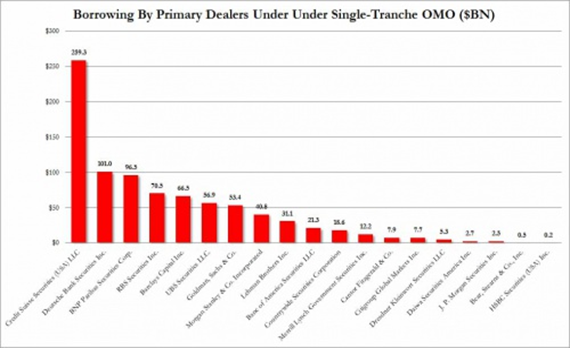
Federal Reserve emergency lending –
Merrill Lynch & Co.
“Merrill Lynch & Co.‘s
stock surged 30 percent after the New York-based securities firm announced an
agreement to sell itself to Bank of America Corp. in September 2008. The deal
didn’t stop the firm’s liquidity from shrinking by about $27 billion in three
days that month, according to internal Federal Reserve Bank of New York
documents. In the ensuing weeks, the firm drew as much as $62.1 billion from
the Federal Reserve’s Primary Dealer Credit Facility, Term Securities Lending
Facility and single-tranche open market operations. After the takeover
closed on Jan. 1, 2009, Charlotte, North Carolina-based Bank of America let
Merrill’s Fed loans roll off while increasing its own liquidity draws from the
central bank.”
Peak amount of debt on
09/26/2008: $62.1B
………………………………………..
Merrill Lynch engaged in a high-stakes leveraged speculation gambit which blew up when the subprime default wave hit and the mortgage backed securities (MBS) warehoused on their balance sheet plunged in value. They were subsequently rescued by the Fed, to the lively tune of $62.1 billion.
Additional background information on some of the investment practices engaged in by ML over
several years immediately preceding the $62.1B secret bailout:
Merrill Lynch “agreed to pay $10
million on Tuesday to settle fraud accusations by securities regulators.”
“The Securities and Exchange Commission had accused
Merrill of fraud, saying that the firm misused private information from its
customers to place trades on its own behalf and that the firm repeatedly
charged its customers trading fees without their knowledge.”
___________________________________
The Leviticus 25 Plan provides a mechanism for U.S. citizens to be granted the same direct liquidity access that was provided to Merrill Lynch and numerous other global financial heavyweights at the height of the financial crisis.
The Leviticus 25 Plan – An Economic Acceleration Plan for America
Major foreign banking interests, with U.S. subsidiaries, enjoyed massive liquidity infusions to help them survive their faltering financial prospects and debt burdens during the great financial crisis 2007-2010.
Bloomberg Nov 28, 2011:“Deutsche Bank AG, Germany’s biggest bank, navigated the financial crisis without capital injections from the German government. The Frankfurt-based bank, which in 2008 reported its first annual loss since World War II, wasn’t so shy about getting liquidity in secret from the U.S. Federal Reserve. The lender tapped the Fed for $66 billion on Nov. 6, 2008 — $28.2 billion from the Term Securities Lending Facility, $21.8 billion from single-tranche open market operations and $16 billion from the Term Auction Facility. John Gallagher, a Deutsche Bank spokesman, declined to say whether the bank took emergency loans during the crisis from other central banks, such as Germany’s Bundesbank.”
Could it be possible that we are on the verge of the next “Lehman Brothers moment”?
Deutsche Bank is the most important bank in all of Europe, it
has 49 trillion dollars in exposure to derivatives, and most of the
largest “too big to fail banks” in the United States have very deep
financial connections to the bank. In other words, the global
financial system simply cannot afford for Deutsche Bank to fail, and
right now it is literally melting down right in front of our eyes. For
years I have been warning that this day would come, and even though it
has been hit by scandal after scandal,
somehow Deutsche Bank was able to survive until now. But after what we
have witnessed in recent days, many now believe that the end is near
for Deutsche Bank. On July 7th, they really shook up investors all over
the globe when they laid off 18,000 employees and announced that they
would be completely exiting their global equities trading business…
It takes a lot to rattle Wall Street.
But Deutsche Bank managed to. The beleaguered German giant announced
on July 7 that it is laying off 18,000 employees—roughly one-fifth of
its global workforce—and pursuing a vast restructuring plan that most notably includes shutting down its global equities trading business.
Though Deutsche’s Bloody Sunday seemed to come out of the blue, it’s
actually the culmination of a years-long—some would say
decades-long—descent into unprofitability and scandal for the bank,
which in the early 1990s set out to make itself into a universal banking
powerhouse to rival the behemoths of Wall Street.
These moves may delay Deutsche Bank’s inexorable march into oblivion, but not by much.
And as Deutsche Bank collapses, it could take a whole lot of others down with it at the same time. According to Wall Street On Parade, the bank had 49 trillion dollars in exposure to derivatives as of the end of last year…
During 2018, the serially troubled Deutsche Bank – which still has a
vast derivatives footprint in the U.S. as counterparty to some of the
largest banks on Wall Street – trimmed
its exposure to derivatives from a notional €48.266 trillion to a
notional €43.459 trillion (49 trillion U.S. dollars) according to its
2018 annual report. A derivatives book of $49 trillion notional puts
Deutsche Bank in the same league as the bank holding companies of U.S.
juggernauts JPMorgan Chase, Citigroup and Goldman Sachs, which logged in
at $48 trillion, $47 trillion and $42 trillion, respectively, at the
end of December 2018 according to the Office of the Comptroller of the
Currency (OCC). (See Table 2 in the Appendix at this link.)
Yes, the actual credit risk to Deutsche Bank is much, much lower than
the notional value of its derivatives contracts, but we are still
talking about an obscene amount of exposure.
And this is especially true when we consider the state of Deutsche Bank’s balance sheet. According to Nasdaq.com,
as of the end of last year the bank had total assets of 1.541 trillion
dollars and total liabilities of 1.469 trillion dollars.
In other words, there wasn’t much equity there at the end of
December, and things have deteriorated rapidly since that time. In
fact, it is being reported that a billion dollars a day is being pulled out of the bank at this point.
I know that most Americans don’t really care if Deutsche Bank lives or dies, but as the New York Post has pointed out, the failure of Deutsche Bank could quickly become a major crisis for the entire global financial system…
But the important fact to remember is that Deutsche Bank traded these
derivatives with other financial firms. So, is this going to be another
Lehman Brothers situation whereby one bank’s problems becomes other
banks’ problems?
Pay close attention to this.
If the situation gets out of hand, the Federal Reserve and other
central banks will have no choice but to cut interest rates even if it’s
not the best thing for the world economies.
In particular, some of the largest “too big to fail banks” in the United States are “heavily interconnected financially” to Deutsche Bank. The following comes from Wall Street On Parade…
We know that Deutsche Bank’s derivative tentacles extend into most of the major Wall Street banks. According to a 2016 report from the International Monetary Fund (IMF), Deutsche Bank is heavily interconnected financially to JPMorgan Chase, Citigroup, Goldman Sachs, Morgan Stanley and Bank of America as well as other mega banks in Europe. The IMF concluded that Deutsche Bank posed a greater threat to global financial stability than any other bank as a result of these interconnections – and that was when its market capitalization was tens of billions of dollars larger than it is today.
Until these mega banks are broken up, until the Fed is replaced by a competent and serious regulator of bank holding companies, and until derivatives are restricted to those that trade on a transparent exchange, the next epic financial crash is just one counterparty blowup away.
As long as I have been doing this, I have been warning my readers to watch the global derivatives market. It played a starring role during the last financial crisis, and it will play a starring role in the next one too.
The fundamental structural problems that were exposed during 2008 and
2009 were never fixed. In fact, many would argue that the global
financial system is even more vulnerable today than it was back during
that time.
And now it appears that the next “Lehman Brothers moment” may be playing out right in front of our eyes.
Now more than ever, keep a close eye on Deutsche Bank, because it appears that they could be the first really big domino to fall.
__________________________________________
Now consider this: If the U.S. Federal Reserve can see fit to bailout Deutsche Bank and dozens of other major banks whose leveraged speculation schemes and worm-holed risk management strategies landed them in cavernous capital holes during the Great Financial Crisis….
And if Deutsche Bank, with its rapidly deteriorating balance sheet, is once again all all wired up in derivatives exposure with the same interconnected cast of global banks….
And the global financial system could be ‘setting up’ once again for another major crisis….
Then it is time, now, for the U.S. Federal Reserve to run their next round of massive liquidity infusions, through a “Citizens Credit Facility,” directly to U.S. citizens – to insulate them from the shock waves that are sure to follow.
The Leviticus 25 Plan is a dynamic economic
initiative providing direct liquidity benefits for American families,
while at the same time scaling back the role of government in managing
and controlling the affairs of citizens. It is a comprehensive plan
with long-term economic and social benefits for citizens and government.
The inspiration for this plan is based upon Biblical principles set forth in the Book of Leviticus, principles tendering direct economic liberties to the people.
The Leviticus 25 Plan – An Economic Acceleration Plan for America
According to the latest IIF Global Debt Monitor released today, debt around the globe hit $246 trillion in Q1 2019, rising by $3 trillion in the quarter, and outpacing the rate of growth of the global economy as total debt/GDP rose to 320%
NEW Global Debt Monitor: Global debt hit $246T in Q1 2019, nearly 320% of GDP.
Debt by sector, Q1 2019 (as % of GDP):
🔹Households: 59.8%
🔹Non-financial corporates: 91.4%
🔹Gov’t: 87.2%
🔹Financial corporates: 80.8% pic.twitter.com/4Qu0ekvpZw
— IIF (@IIF) July 15, 2019
[snip]
The IIF pointed out the obvious, namely that lower borrowing costs thanks to central banks’ monetary easing had encouraged countries to take on new debt. Amusingly, by doing so, this makes rising rates even more impossible as the world’s can barely support 100% debt of GDP, let alone 3x that.
[According to Sonja Gibbs the IIF’s managing director for global policy initiatives] “It’s almost Pavlovian. Rates go down and borrowing goes up. Once they are built up, debts are hard to pay down without diverting funds from other goals, whether that’s productive investment by companies or government spending.”
And that, in a nutshell, is why the world is doomed to a central-bank
created boom-bust cycle, as once there is just too much debt, there
will either by hyperinflation or a wave of global sovereign and
corporate defaults.
________________________________________________
This will not end well. In fact, it will end in financial chaos and economic disaster.
There is a way to clean this mess up, at least for the United States.
The Leviticus 25 Plan is the most powerful and dynamic ‘ground-level’ debt elimination plan on the face of the earth, eliminating massive tracts of household and consumer debt, along with federal, state and local government debt.
The Leviticus 25 Plan, in fact, produces $465 billion in federal government budget surpluses in each of the first 5 years following activation. Source: https://leviticus25plan.org/2019/03/
The Leviticus 25 Plan is a dynamic economic
initiative providing direct liquidity benefits for American families,
while at the same time scaling back the role of government in managing
and controlling the affairs of citizens. It is a comprehensive plan
with long-term economic and social benefits for citizens and government.
The inspiration for this plan is based upon Biblical principles set forth in the Book of Leviticus, principles tendering direct economic liberties to the people.
The Leviticus 25 Plan – An Economic Acceleration Plan for America
July 2019 quote: “Taxation has surrounded itself with doctrines of justification; it had to; no miscreant can carry on without a supporting philosophy. Until recent times this pilfering of private property sought to gain the approval of its victims by protesting the need for maintaining social services. The growing encroachments of the state upon property rights necessarily brought about a lowering of the general economy, resulting in disaffection, and now taxation is advocated as a means of alleviating this condition; we are now being taxed into betterment.” – Frank Chodorov, “Socialism via Taxation” (1946)
_____________________________________________
There is one bright, clean economic solution with the raw power to re-fire America’s free enterprise engines. It will generate massive new tax revenue growth and reduce government social spending obligations. It will restore financial health to ‘ground level’ American families and Main Street America.
There is no other plan like it anywhere in the world.
The Leviticus 25 Plan – An Economic Acceleration Plan for America
As the annual deficits begin to seriously ‘widen’ and the Federal government is forced to ‘float’ more paper, or ramp up its borrowing, there will evidently be a significant shortage of interested purchasers of that paper – at the target rates set by Treasury.
So…. the Federal Reserve will need to step in to ‘fill the gap.’ In other words, they will need to ‘create,’ out of thin air, new money. Lots of new money….
……………………………………………………..
The Daily Shot, Jun 2, 2019:
Rates: The Fed is expected to buy a great deal of Treasury bills as it resumes expanding its balance sheet.
Source:
Deutsche Bank Research
___________________________________________
Escalating fiat currency creation by the Fed, and other Central Banks, is certain to erode the value of money. And that, over the long term, is a threat to liberty – everywhere.
“It is impossible to grasp the meaning of the idea of sound money if one does not realize that it was devised as an Instrument for the protection of civil liberties against despotic inroads on the part of governments. Ideologically, it Belongs in the same class with political constitutions and bills of rights.” – The Theory of Money and Credit (1912), Austrian economist Ludwig von Mises
There is one economic acceleration plan that sets thing back in order. It eliminates vast amounts of public and private debt, balances the federal budget, and restores economic liberty for all Americans.
The Leviticus 25 Plan is a dynamic economic initiative providing direct liquidity benefits for American families, while at the same time scaling back the role of government in managing and controlling the affairs of citizens. It is a comprehensive plan with long-term economic and social benefits for citizens and government.
The inspiration for this plan is based upon Biblical principles set forth in the Book of Leviticus, principles tendering direct economic liberties to the people.
The Leviticus 25 Plan – An Economic Acceleration Plan for America