The Leviticus 25 Plan

An Economic Acceleration Plan for America

The Leviticus 25 Plan

Current U.S. Fiscal Crisis: “$147.1 Trillion in Debts, Liabilities, and Unfunded Obligations.” Solution: The Leviticus 25 Plan

Federal Fiscal Burden Consumes 93% Of America’s Wealth

ZeroHedge, Aug 12, 2024 – Authored by James D. Agresti via The Epoch Times

Excerpts

Based on data from a U.S. Treasury report, the federal government has amassed $142 trillion in debts, liabilities, and unfunded obligations. This staggering figure equals 93 percent of all the wealth Americans have accumulated since the nation’s founding, estimated by the Federal Reserve to be $152 trillion.

Unlike other measures of federal red ink that cover an arbitrary period, extend into the infinite future, or ignore government resources, the figure of $142 trillion applies strictly to Americans who are alive right now and includes the government’s commercial assets. Thus, it quantifies the financial burden that today’s Americans are leaving to their children and future generations.

Complete Versus Incomplete Accounting

Federal law requires the U.S. Treasury to publish an annual report that details the government’s “overall financial position.” In addition to the national debt, the “Financial Report of the United States Government” also includes the government’s explicit and implicit financial commitments, such as:

• federal employee pensions and other retirement benefits like healthcare.

• environmental liabilities like contaminated nuclear sites.

• unfunded obligations for social insurance programs like Medicare.

Such “fiscal exposures,” as explained by the U.S. Government Accountability Office (GAO), “represent significant commitments that ultimately have to be addressed.” Thus, GAO stresses that ignoring them can “make it difficult for policymakers and the public to adequately understand the government’s overall performance and true financial condition.”

Yet, that is precisely what the media does. Although the Treasury published the report in February, Google News indicates that no major media outlet has mentioned it. Meanwhile, the same outlets have frequently reported on the national debt and federal budget, which are incomplete measures of the federal government’s fiscal situation.

The commonly cited national debt and federal budget are mainly based on cash accounting, which is the simplistic process of counting money as it flows in or out. Thus, liabilities like pension benefits for federal workers aren’t measured until they are actually paid, which is often decades after they are promised.

In contrast, the Treasury report mainly uses accrual accounting, which measures financial commitments as they are made. This is how the federal government requires large corporations to report their finances. In the words of the Financial Accounting Standards Board, which is tasked by the U.S. Securities and Exchange Commission to create private-sector accounting rules, accrual accounting is the “most relevant and reliable” way to measure the financial health of pension plans.

The same applies to other retirement benefits like healthcare. The accounting rule that governs such benefits explains that “a failure to accrue” implies “that no obligation exists prior to the payment of benefits.” Since an obligation does exist, failing to account for it “impairs the usefulness and integrity” of financial statements.

The Grand Total

A methodical tally of accrual accounting data in the Treasury report shows that the federal government has amassed $142 trillion in debts, liabilities, and unfunded obligations beyond the value of its commercial assets. This reflects the government’s finances at the close of its 2023 fiscal year on Sept. 30, 2023.

The primary components of this burden, which are unpacked below, include:

• $26.3 trillion in publicly held national debt.

• $16.6 trillion in liabilities that are not accounted for in the publicly held debt.

• $104.2 trillion in unfunded social insurance obligations.

These figures tally to $147.1 trillion in debts, liabilities, and unfunded obligations. Offsetting this is $5.4 trillion in commercial assets owned by the federal government, leaving a grand total shortfall of $141.7 trillion.

Numbers in the trillions are hard to conceive, so it’s revealing to place them in context. The figure of $142 trillion amounts to 93 percent of the net wealth Americans have accumulated since the nation’s founding, estimated by the Federal Reserve to be $152 trillion. This includes all of their assets in savings, real estate, corporate stocks, private businesses, and consumer durable goods like automobiles and furniture.

The government’s $142 trillion shortfall also amounts to:

• $430,252 for every person living in the United States.

• $1,098,087 for every household in the United States.

• 2 times annual U.S. economic output (GDP).

• 30 times annual federal revenues.

Publicly Held Debt

The simplest major item quantified by the Treasury report is the publicly held debt, which is $26.3 trillion. This is the money the federal government owes to non-federal entities like individuals, corporations, state governments, and foreign governments.

Publicly held debt is a partial measure of the national debt that excludes $6.9 trillion the federal government owes to federal programs like Social Security and Medicare. The Treasury report also details these intergovernmental debts and consolidates them with the items below.

Liabilities

Pension and other retirement benefits are a large part of compensation packages for government employees. With these generous benefits included, civilian non-postal federal employees receive an average of 17 percent more total compensation than private-sector workers with comparable education and work experience. Postal workers receive even greater premiums ranging from 25 percent to 43 percent.

In 2022, federal, state, and local governments spent $2.3 trillion on employee compensation, costing each household in the nation an average of $17,299.

The Treasury report shows that the federal government currently owes $14.3 trillion in pensions and other benefits to federal employees and veterans that are not accounted for in the publicly held national debt. To pay the present value of these benefits will require an average of $109,005 from every household in the United States.

The Treasury reports other liabilities of the federal government, such as:

• $124 billion in accounts payable.

• $645 billion in environmental and disposal liabilities.

• $99 billion in insurance and guarantee program liabilities.

Altogether, the Treasury records $16.6 trillion in liabilities that are not accounted for in the publicly held debt.

Social Security & Medicare

A similar but far more expensive situation exists with social insurance programs like Social Security and Medicare. This is because—contrary to popular belief—these programs don’t save workers’ taxes for their retirements. Instead, they immediately spend the vast majority of those taxes to pay benefits to current recipients. Thus, they are called “pay-as-you-go” programs.

In stark contrast, the U.S. Bureau of Economic Analysis explains that “federal law requires private pension plans to operate as funded plans, not as pay-as-you-go plans.” The reasons for this, as explained by the American Academy of Actuaries, are to increase “benefit security” and ensure “intergenerational equity.”

Social Security and Medicare, on the other hand, have levied dramatically increased tax burdens on succeeding generations of Americans, thus creating severe generational inequality. And unless retirement ages are raised or benefits are reduced in some other way, taxes will need to be increased again to keep the programs solvent.

Federal actuaries measure the unfunded obligations of Social Security and Medicare in several different ways, but only one of them approximates accrual accounting. This is called the “closed-group” unfunded obligation, which is the money needed to cover the shortfalls for all current taxpayers and beneficiaries in these programs.

In the words of Harvard Law School professor and federal budget specialist Howell E. Jackson, the closed-group measure “reflects the financial burden or liability being passed on to future generations.” These burdens are $49.8 trillion for Social Security and $53.9 trillion for Medicare. Placing these figures in context:

• Social Security’s unfunded obligations amount to an additional $272,237 from every person who currently pays Social Security payroll taxes.

• Medicare’s unfunded obligations amount to an additional $201,932 from every U.S. resident aged 16 or older.

Those shortfalls are what remain after the federal government has paid back with interest all of the money it has borrowed from Social Security and Medicare.

Social Security and Medicare differ from true pensions because taxpayers don’t have a contractual right to receive these benefits. Nevertheless, paying these benefits is an implied commitment of the federal government, and federal law requires that these programs be included in the Treasury report.

The Treasury report estimates that the combined closed group unfunded obligations of Social Security, Medicare, and some smaller social insurance programs are $104.2 trillion. This figure doesn’t include intergovernmental debt, which is consolidated with other data in the report.

Federal Assets

The Treasury also records the federal government’s commercial assets, such as:

• $922 billion in cash and other monetary assets.

• $1.2 trillion in property, plants, and equipment.

• $1.7 trillion in receivable loans, mainly comprised of student loans.

However, the report doesn’t account for federal stewardship land and heritage assets, such as national parks and the original copy of the Declaration of Independence. While these items have tangible value, the report explains that they “are intended to be preserved as national treasures,” not sold to the highest bidder to cover debts.

In total, the government owned $5.4 trillion in commercial assets at the close of its 2023 fiscal year.

Adding up the federal government’s debts, liabilities, and unfunded obligations and then subtracting the value of its commercial assets yields a fiscal shortfall of $142 trillion.

Root Causes

The first critical step in solving a problem is to understand its root causes. However, scientific surveys show that many voters are misinformed about the root causes of government debt.

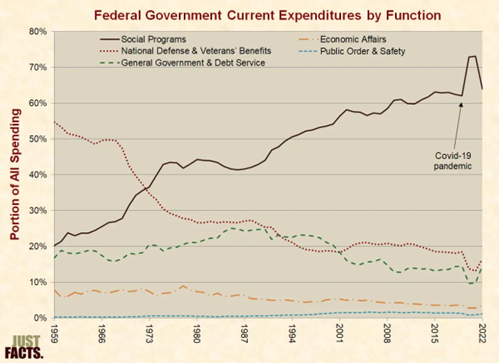
A scientific, nationally representative survey commissioned in 2020 by Just Facts found that 25 percent of voters believe the main driver of the rising national debt is military spending. This accords with the reporting of media outlets that frequently blame the debt on military spending.

In reality, military spending has plummeted from 53 percent of all federal expenses in 1960 to 17 percent in 2022:
The same survey found that another 25 percent of voters believe tax cuts were the main driver of debt, in accord with news stories that blame the debt on tax cuts.

In reality, federal revenues have stayed at a roughly level portion of the U.S. economy for the past 80 years:
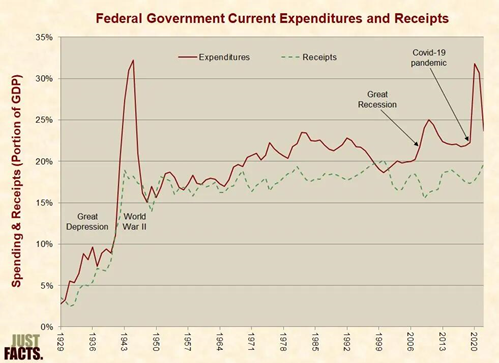
As shown in the charts above, the primary driver of the national debt is increased spending, particularly on social programs. These programs—which provide healthcare, income security, education, nutrition, housing, and cultural services—have grown from 21 percent of all federal spending in 1960 to 64 percent in 2022.

Yet, only 39 percent of voters correctly identify social spending as the primary cause of rising debt.

Moreover, the vast bulk of the government’s unfunded obligations are due to Social Security and Medicare. Thus, the Congressional Budget Office projects that the main drivers of future debt will be Social Security, Medicare, Medicaid, the Children’s Health Insurance Program, Obamacare, and interest on the national debt. Under the weight of these, the publicly held debt is due to soar to unprecedented levels over coming decades….

______________________________________

There is one, and only one, economically viable, politically feasible recovery plan to clean up this exploding debt crisis — and get America back on track.

The Leviticus 25 Plan is a dynamic economic initiative providing direct liquidity benefits for American families, while at the same time scaling back the role of government in managing and controlling the affairs of citizens.  It is a comprehensive plan with long-term economic and social benefits for citizens and government.

The inspiration for this plan is based upon Biblical principles set forth in the Book of Leviticus, principles tendering direct economic liberties to the people.

The Leviticus 25 Plan – An Economic Acceleration Plan for America

$90,000 per U.S. citizen – Leviticus 25 Plan 2025 (21357 downloads )
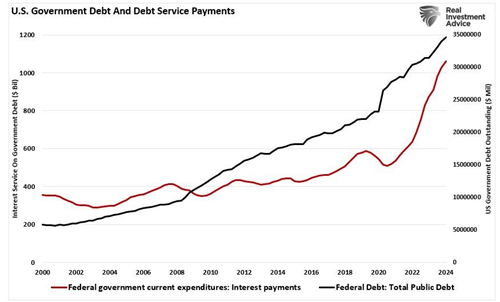
$1.2 Trillion Interest Payments Blowing Up The Federal Budget

A Record $1.2 Trillion Interest Payments Are Blowing Up The Federal Budget

By Diccon Hyatt | Investopedia | Published September 13, 2024

Excerpts:

Key Takeaways

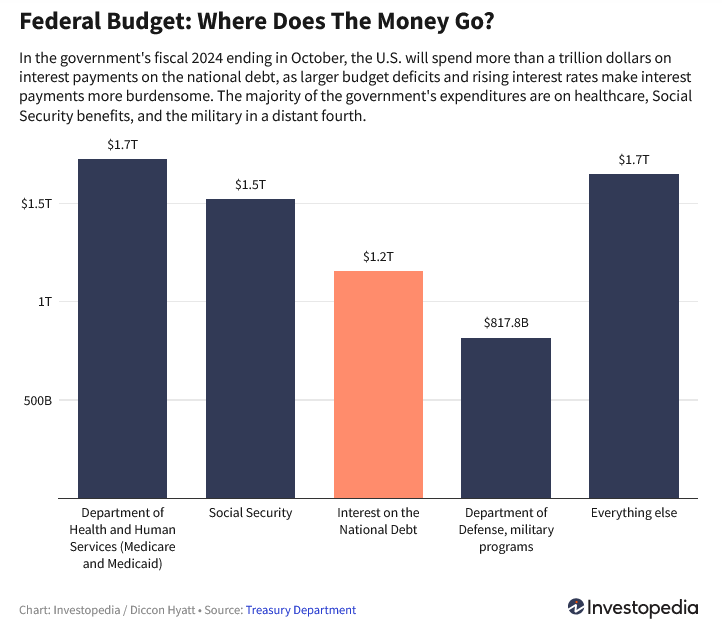
  • The U.S. government will spend a record $1.2 trillion on interest payments in 2024, the highest amount ever recorded.
  • Interest payments are driven by a combination of deficit spending, especially during the pandemic, and the Federal Reserve’s campaign of anti-inflation interest rate hikes.
  • The trajectory of the deficit could be influenced by the election.
  • While both Democrats and Republicans propose new tax cuts and spending that could push up the deficit, Vice President Kamala Harris has proposed tax increases on the wealthy and corporations, to offset them.

The U.S. government is on track to spend more than $1 trillion on interest payments this year, surpassing military spending for the first time in history.

Interest payments on the national debt (held by the public in the form of Treasury securities) will cost the government $1.2 trillion in the government’s fiscal year ending in October, the Treasury Department said in a monthly report on the budget.1 Net interest outlays are the third costliest item in the budget behind Social Security and Medicare benefits.

Economists have grown increasingly concerned about the potential impact of those payments on the U.S. economy. Interest payments took up 2.4% of the entire U.S. gross domestic product in 2023, and The Congressional Budget Office estimates that could swell to 3.9% over the next 10 years.

Why Is The Government Paying So Much Interest? Two major factors have driven those payments skyward. First, the government spent trillions to support households and the economy during the pandemic, paying for it by borrowing rather than raising taxes. Second, the Federal Reserve raised interest rates starting in 2022 to fight inflation, which pushed up how much the government owes for that debt.

____________________________________

America’s billowing federal debt is a dire national security threat.

There is only one plan on the table with the power to reign in America’s ever-expanding debt and generate annual federal budget surpluses.

The Leviticus 25 Plan is a dynamic economic initiative providing direct liquidity benefits for American families, while at the same time scaling back the role of government in managing and controlling the affairs of citizens.  It is a comprehensive plan with long-term economic and social benefits for citizens and government.

The inspiration for this plan is based upon Biblical principles set forth in the Book of Leviticus, principles tendering direct economic liberties to the people.

The Leviticus 25 Plan – An Economic Acceleration Plan for America

$90,000 per U.S. citizen – Leviticus 25 Plan 2025 (21326 downloads )

The Leviticus 25 Plan: America’s Powerful Counter Force to ‘The Great Utopia’ of Socialism.

F.A. Hayek is regarded by many as the greatest economist in the history of the Western world.  In his famous work, “The Road to Serfdom,” Hayek warned about the dangers of national centralization.

_____________________________

F.A. Hayek On “The Great Utopia” | Zero Hedge – Excerpts:

The Great Utopia

There can be no doubt that most of those in the democracies who demand a central direction of all economic activity still believe that socialism and individual freedom can be combined. Yet socialism was early recognized by many thinkers as the gravest threat to freedom.

It is rarely remembered now that socialism in its beginnings was frankly authoritarian. It began quite openly as a reaction against the liberalism of the French Revolution. The French writers who laid its foundation had no doubt that their ideas could be put into practice only by a strong dictatorial government. The first of modern planners, Saint-Simon, predicted that those who did not obey his proposed planning boards would be “treated as cattle.”

Nobody saw more clearly than the great political thinker de Tocqueville that democracy stands in an irreconcilable conflict with socialism: “Democracy extends the sphere of individual freedom,” he said. “Democracy attaches all possible value to each man,” he said in 1848, “while socialism makes each man a mere agent, a mere number. Democracy and socialism have nothing in common but one word: equality. But notice the difference: while democracy seeks equality in liberty, socialism seeks equality in restraint and servitude.”

To allay these suspicions and to harness to its cart the strongest of all political motives—the craving for freedom — socialists began increasingly to make use of the promise of a “new freedom.” Socialism was to bring “economic freedom,” without which political freedom was “not worth having.”

[snip]

Individual freedom cannot be reconciled with the supremacy of one single purpose to which the whole of society is permanently subordinated. To a limited extent we ourselves experience this fact in wartime, when subordination of almost everything to the immediate and pressing need is the price at which we preserve our freedom in the long run. The fashionable phrases about doing for the purposes of peace what we have learned.to do for the purposes of war are completely misleading, for it is sensible temporarily to sacrifice freedom in order to make it more secure in the future, but it is quite a different thing to sacrifice liberty permanently in the interests of a planned economy.

To those who have watched the transition from socialism to fascism at close quarters, the connection between the two systems is obvious. The realization of the socialist program means the destruction of freedom. Democratic socialism, the great utopia of the last few generations, is simply not achievable.

___________________________________

There is one economic plan with the raw power to counter the false utopian promises of security and equality.

The Leviticus 25 Plan is the one and only economic dynamic in today’s world with the power to advance the cause of financial security for U.S. citizens and economic liberty for the whole of America.

The Leviticus 25 Plan provides direct liquidity access for participating American families, while at the same time scaling back the role of government in managing and controlling the affairs of citizens.  It is a comprehensive plan with long-term economic and social benefits for citizens and government.

The inspiration for this plan is based upon Biblical principles set forth in the Book of Leviticus, principles tendering direct economic liberties to the people.

The Leviticus 25 Plan – An Economic Acceleration Plan for America

$90,000 per U.S. citizen – Leviticus 25 Plan 2025 (20778 downloads )

Soaring U.S. Debt, Rising Deficits. Solution: The Leviticus 25 Plan

Japanese Style Policies And The Future Of America

Aug 30, 2024 – Authored by Lance Roberts via RealInvestmentAdvice.com Charts/Excerpts:

…………………

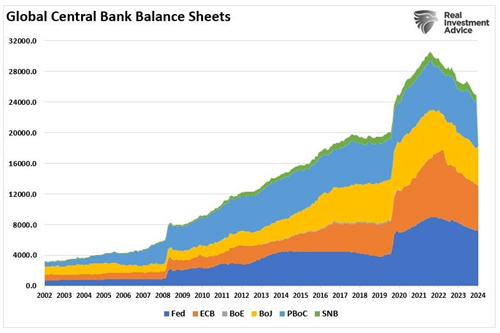
The Failure Of Central Banks

“Bad debt is the root of the crisis. Fiscal stimulus may help economies for a couple of years but once the ‘painkilling’ effect wears off, U.S. and European economies will plunge back into crisis. The crisis won’t be over until the nonperforming assets are off the balance sheets of US and European banks.” – Keiichiro Kobayashi, 2010

Kobayashi will ultimately be proved correct. However, even he never envisioned the extent to which Central Banks globally would be willing to go. As my partner, Michael Lebowitz pointed out previously:

“Global central banks’ post-financial crisis monetary policies have collectively been more aggressive than anything witnessed in modern financial history. Over the last ten years, the six largest central banks have printed unprecedented amounts of money to purchase approximately $24 trillion of financial assets as shown below. Before the financial crisis of 2008, the only central bank printing money of any consequence was the Peoples Bank of China (PBoC).”

………..

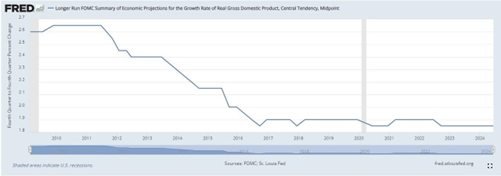
Soaring U.S. debt, rising deficits, and demographics are the culprits behind the economy’s disinflationary push. The complexity of the current environment implies years of sub-par economic growth ahead. The Federal Reserve’s long-term economic projections remain at 2% or less.

………………..

With the current [U.S.] economic recovery already pushing the long end of the economic cycle, the risk is rising that the next economic downturn is closer than not. The danger is that the Federal Reserve is now potentially trapped with an inability to use monetary policy tools to offset the subsequent economic decline when it occurs.

That is the same problem Japan has wrestled with for the last 25 years. While Japan has entered into an unprecedented stimulus program (on a relative basis twice as large as the U.S. on an economy 1/3 the size), there is no guarantee that such a program will result in the desired effect of pulling the Japanese economy out of its 40-year deflationary cycle. The problems that face Japan are similar to what we are currently witnessing in the U.S.:

  • A decline in savings rates to extremely low levels which depletes productive investments
  • An aging demographic that is top-heavy and drawing on social benefits at an advancing rate.
  • A heavily indebted economy with debt/GDP ratios above 100%.
  • A decline in exports due to a weak global economic environment.
  • Slowing domestic economic growth rates.
  • An underemployed younger demographic.
  • An inelastic supply-demand curve
  • Weak industrial production
  • Dependence on productivity increases to offset reduced employment

The lynchpin to Japan and the U.S. remains demographics and interest rates. As the aging population grows and becomes a net drag on “savings,” dependency on the “social welfare net” will continue to expand. The “pension problem” is only the tip of the iceberg.

______________________________

Main Street Republicans have the plan to counter this deepening economic malaise.

This plan features: 1) Massive debt elimination (public/private); 2) Increased savings rates; 3) Free market economic revitalization and robust economic growth; 4) Restoration of economic liberty in America.

The Leviticus 25 Plan is a dynamic economic initiative providing direct liquidity benefits for American families, while at the same time scaling back the role of government in managing and controlling the affairs of citizens.  It is a comprehensive plan with long-term economic and social benefits for citizens and government.

The inspiration for this plan is based upon Biblical principles set forth in the Book of Leviticus, principles tendering direct economic liberties to the people.

The Leviticus 25 Plan – An Economic Acceleration Plan for America

$90,000 per U.S. citizen – Leviticus 25 Plan 2025 (20234 downloads )

Jamestown 1607 – A Model for The Leviticus 25 Plan (2025-2029)

Over 417 years ago socialism failed at Jamestown. Private property rights and free enterprise led to survival and prosperity.

…………………………

CATO: Private Property Saved Jamestown, And With It, America – 1607

May 14, 2007 • Commentary

By David Boaz / The CATO Institute

Four hundred years ago today 105 men and boys disembarked from three ships and established the first permanent English settlement in North America. They built a fort along what they called the James River, in honor of their king.

The land was lush and fertile, yet within three years most of the colonists died during what came to be known as “the starving time.” Only the establishment of private property saved the Jamestown colony.

What went wrong? There were the usual hardships of pioneers far from home, such as unfamiliar diseases. There were mixed relations with the Indians already living in Virginia. Sometimes the Indians and settlers traded, other times armed conflicts broke out. But according to a governor of the colony, George Percy, most of the colonists died of famine, despite the “good and fruitful” soil, the abundant deer and turkey, and the “strawberries, raspberries and fruits unknown” growing wild.

The problem was the lack of private property. As Tom Bethell writes in his book The Noblest Triumph: Property and Prosperity through the Ages, “The colonists were indolent because most of them were indentured servants, expected to toil for seven years and contribute the fruits of their labor to the common store.”

Understandably, men who don’t benefit from their hard work tend not to work very hard.

Over the first two years, more colonists arrived from England, including women. By 1609, there were 500 settlers. And within six months fewer than 100 were still alive. People were desperate. They ate dogs and cats, then rats and mice. They apparently ate their deceased neighbors. And some said that one man murdered and ate his pregnant wife.

By the spring, they had given up. They abandoned the fort and boarded ships to return to England. But miraculously, as they sailed out of Chesapeake Bay, they encountered three ships with new recruits, so they turned around and tried to make another go of it. The additional settlers and supplies kept them alive.

But when a new governor, Thomas Dale, arrived a year after the starving time, he was shocked to find the settlers bowling in the streets instead of working.

Dale’s most important reform was to institute private property. He allotted every man three acres of land and freed them to work for themselves. And then, the Virginia historian Matthew Page Andrews wrote, “As soon as the settlers were thrown upon their own resources, and each freeman had acquired the right of owning property, the colonists quickly developed what became the distinguishing characteristic of Americans – an aptitude for all kinds of craftsmanship coupled with an innate genius for experimentation and invention.”

John Rolfe, the husband of Pocahontas, said that once private property was instituted, men could engage in “gathering and reaping the fruits of their labors with much joy and comfort.”

The Jamestown colony became a success, and people from all over Europe flocked to America.

Private property is essential for economic growth; people don’t work and invest if they can’t reap the fruits of their labors. Property ensures that people will work to better their own condition and that of their families. And that work and investment then benefits the whole society, much more so than the attempt to force people to work directly for the common good.

But property does something else. As the American Revolutionary Arthur Lee, great‐​grandson of a Jamestown colonist, wrote, “The right of property is the guardian of every other right, and to deprive a people of this, is in fact to deprive them of their liberty.” Property is essential to making the government dependent on the people, not vice versa. It divides power, limits government, and protects freedom. No country has ever enjoyed freedom of the press, freedom of religion, or political liberty without secure property rights.

So, on this 400th anniversary, let us remember the original Jamestown settlers, who demonstrated the failure of collectivism. Their suffering during the starving time did more than any book could have done to lay a secure foundation for private property rights and thus for the freedom and prosperity we enjoy today.

___________________________________

The Leviticus 25 Plan is essential for America’s survival today. We must return to a system where citizens retain the right to allocate resources individually, in ways that best meet their personal needs and desires in a free market system.

It is critical that America return to a system of economic liberty and individual freedom and self-reliance. We must eliminate dependence on government.

We must have an economic acceleration plan that returns America to a system of government fiscal restraint, the massive elimination of debt at the personal, and governmental levels, and state and federal budget surpluses.

The most powerful economic acceleration plan in the world is loaded up and ready to go.

The Leviticus 25 Plan is a dynamic economic initiative providing direct liquidity benefits for American families, while at the same time scaling back the role of government in managing and controlling the affairs of citizens.  It is a comprehensive plan with long-term economic and social benefits for citizens and government.

The inspiration for this plan is based upon Biblical principles set forth in the Book of Leviticus, principles tendering direct economic liberties to the people.

The Leviticus 25 Plan – An Economic Acceleration Plan for America

$90,000 per U.S. citizen – Leviticus 25 Plan 2025 (19950 downloads )

Main Street America: A Picture of Failing Financial Health as U.S. Government Blows Through Billions of Dollars in Frivolous Spending…

Main Street America is not currently in good financial health.

ZeroHedge: ‘Worst Since COVID Lockdowns’ – Regional Fed Surveys Plunged In July

…and under the hood, it was a sh#&show!   JUL 23, 2024

…………………………………………..

Nearly Half Of Americans Say They’re Struggling Financially: Poll

Foreclosures on the rise again nationwide — A look at the hardest hit states

Auto Insider Warns More Americans Fall Behind On Car Payments As Repos Soar 23% – “When you think about the costs for rent and shelter and insurance, all those things hit consumers and they have to choose what they will pay.”   JUL 16, 2024

……………………………………..

Meanwhile…

U.S. taxpayers are helping to bail out Egypt (again) through a recently expanded IMF loan of $8 billion (U.S. funds just under 20% of the IMF) and the World Bank $6 billion (U.S. funds 17.25% of the World Bank): “Egypt Teeters On Brink Of Economic Ruin As Public Debt Mounts, Poverty Rate Soars” | ZeroHedge  |  Jul 03, 2024  |  Via Middle East Eye

……………………………………

And U.S. taxpayers fully funded another Middle East adventure in creative mismanagement: Biden’s $320 Million Floating Gaza Pier to be Dismantled After Operating For 21 Days Cristina Laila  TGP  Jul. 9, 2024

…………………………………….

And… How the US Spent $4.1 Billion on Global LGBT Initiatives | AMAC | Nov 7, 2023 From Oct. 1, 2020, through Sept. 30, 2023, the U.S. government issued more than 1,100 grants to fund LGBT-promoting projects around the world, according to a review of a federal spending website. The scope of projects varies widely.Nov 7, 2023

……………………………………..

And another – in Latin America: U.S. to Invest $4 Mil to Reduce Barriers Impeding LGBTQI+ Youth in Latin America,…  | Corruption Chronicles | June 13, 2024

___________________________

Meanwhile… The U.S. government dug deep into its pockets to fund this ‘generous’ outlay: Department Of Defense To Give Troops ‘Economic Hardship’ Bonus Of $20 Per Month ZeroHedge, Jul 23, 2024

_____________________________

Main Street America Republicans have a better plan to eliminate ‘Economic Hardship’ for U.S. troops – and for all working class Americans

The Leviticus 25 Plan is a dynamic economic initiative providing direct liquidity benefits for American families, while at the same time scaling back the role of government in managing and controlling the affairs of citizens.  It is a comprehensive plan with long-term economic and social benefits for citizens and government.

The inspiration for this plan is based upon Biblical principles set forth in the Book of Leviticus, principles tendering direct economic liberties to the people.

The Leviticus 25 Plan – An Economic Acceleration Plan for America

$90,000 per U.S. citizen – Leviticus 25 Plan 2025 (19260 downloads )

F.A. Hayek: The Virtues of a Free Society

“It is true that the virtues which are less esteemed and practiced now–independence, self-reliance, and the willingness to bear risks, the readiness to back one’s own conviction against a majority, and the willingness to voluntary cooperation with one’s neighbors–are essentially those on which the of an individualist society rests. Collectivism has nothing to put in their place, and in so far as it already has destroyed then it has left a void filled by nothing but the demand for obedience and the compulsion of the individual to what is collectively decided to be good.” – Friedrich A. Hayek, The Road to Serfdom

Biden vs Trump – ‘Racking Up the National Debt’

The left’s $7 trillion lie: Biden far outpaces Trump in racking up the national debt

By Stephen Moore and E. J. Antoni – Heritage Foundation Fellows | June 30, 2024

Excerpts:

Projection is blaming someone else for your own bad behavior.

We saw a classic case of projection in Thursday’s presidential debate, when President Biden — who is overseeing annual budget deficits of $2 trillion — asserted that his predecessor, Donald Trump, added more to the federal debt than anyone else….

Debate moderator Jake Tapper joined the chorus of federal finance falsehoods when he claimed Trump had “approved $8.4 trillion in new debt,” while Biden’s actions will increase the debt by (merely) $4.3 trillion over a decade.

Tapper was referencing a recent report by the left-leaning Committee for a Responsible Federal Budget, which twisted and turned the debt statistics in every contortionary way it could to reach its incredible conclusion.

CRFB, by the way, is a group that opposed the successful Trump tax reform in 2017 — yet supported several of Biden’s multitrillion-dollar spending bills…. It’s not nonpartisan, but a front group for the policies of the political left….

Over Trump’s entire term, including the 2020 spate of emergency COVID spending, the debt increased by $7.7 trillion — a staggering total, to be sure.

However, about 15% of that debt total was the result of Treasury’s choice to keep additional cash on hand during the pandemic.

Former Treasury Secretary Steve Mnuchin, unsure how much tax revenue would be collected, borrowed well over $1 trillion — but kept it in reserve, without ever spending it.

Biden, however, spent that reserve, then borrowed another $7 trillion on top of it.

Instead of simply allowing that one-time emergency COVID spending to expire, Biden and the Democratic Congress continued spending at that same COVID-era level, thus institutionalizing multitrillion-dollar deficits.

Accounting for the changes in cash balances at the Treasury, the debt actually rose $6.5 trillion during Trump’s entire term — and is up $7.9 trillion in less than four years of Biden’s tenure.

Worse, the Treasury has announced that it anticipates needing to borrow another $800 billion from July through September of this year, followed by hundreds of billions more from October to December as federal finances further deteriorate.

All told, Biden will likely oversee a net increase in the debt of more than $9 trillion in a single term — a new record.

Biden wanted to spend $2 trillion more in the last year and a half, but conservatives in the House blocked the added bloat. 

You can bet the farm that if the radical left wins the White House and Congress in 2024, that $2 trillion outlay will be first on their legislative agenda. 

Biden’s other big lie, backed by the CRFB analysis, is that extending Trump’s tax reform will drown the economy in debt.

Yet federal tax revenues have increased since that tax reform was enacted — and federal revenues as a share of GDP have not fallen.

All of the increase in today’s debt has been due to massive, out-of-control federal spending — by both parties.

Trump spent and borrowed too much, full stop.

But with a debt headed to $50 trillion if reelected and a political agenda that stifles economic growth, Biden has set America on an unsustainable fiscal path that will lead to financial oblivion.

_____________________________________

Again: “All of the increase in today’s debt has been due to massive, out-of-control federal spending – by both parties.”

There is a new party in town, Main Street America Republicans, with a new federal budget surplus plan – to clean this mess up: $112.6 billion annual budget surpluses covering each of the first five years of activation (2025-2029).

The Leviticus 25 Plan – Summary Details:

·  The Leviticus 25 Plan 2025 Generates $112.6 Billion Federal Budget Surpluses Annually (2025-2029). Part 1: Overview, Deficit Projection

·  The Leviticus 25 Plan Generates $112.6 Billion Federal Budget Surpluses Annually (2025-2029). Part 2: Federal Income Tax Recapture; Economic Security / Means-Tested Welfare Recapture.

·  The Leviticus 25 Plan Generates $112.6 Billion Federal Budget Surpluses Annually (2025-2029). Part 3: Medicaid, Medicare, VA, TRICARE, FEHB, SSDI Recapture

·  The Leviticus 25 Plan Generates $112.6 Billion Federal Budget Surpluses Annually (2025-2029). Part 4: Interest Expense Recapture, Totals Summary

The Leviticus 25 Plan – An Economic Acceleration Plan for America

$90,000 per U.S. citizen – Leviticus 25 Plan 2025 (18455 downloads )

The Bottom 20% of Income Earners and How to Lift Them Up Out of Poverty and Dependence.

The Bottom 20% Do Almost No Work, and You Pay for Them: How the Low-Income Bracket Drains Taxpayer Dollars

Antonio Graceffo, MBA, PhD | June 18, 2024 – Excerpts:

When you pay taxes, remember that the bottom 20% of income earners do almost no work, do not pay taxes, and receive government aid. The next lowest 20% pay minimal taxes but also receive government support.

Considering credits, the bottom half effectively pay about $667 per year. In contrast, the top 1% of income earners contribute roughly 38.8% of all federal income taxes, and the top 10% pay about 70% of the total federal income taxes. Most of the rest is paid by the Middle-income earners.

Households in the bottom 20% of income often pay little to no federal income taxes due to low taxable income and tax credits such as the Earned Income Tax Credit (EITC) and the Child Tax Credit (CTC). According to the Tax Policy Center, about 44% of U.S. households pay no federal income tax, largely because of these credits and deductions.

Many low-income households receive transfer payments from government programs like Medicaid, Supplemental Nutrition Assistance Program (SNAP), Temporary Assistance for Needy Families (TANF), and housing assistance.

In 2023, about 70.6 million Americans received benefits from programs administered by the Social Security Administration (SSA), including Social Security and Supplemental Security Income (SSI). Additionally, millions more benefit from other social safety net programs. For example, in the 2022 fiscal year, approximately 41.2 million people received SNAP benefits.

There is a claim that while low-income households may not contribute significantly to federal income taxes, they do contribute to other forms of taxation such as payroll taxes, sales taxes, and property taxes on their homes. However, these arguments are easily refuted.

The Social Security contributions of the low-income group are minimal because they earn less money and work less frequently. Middle-income and high-income groups pay more into Social Security, with the maximum contribution occurring at an income of $168,000.

Additionally, low-income workers can receive Supplemental Security Income (SSI), a needs-based program that provides cash assistance to disabled adults and children with limited income and resources. SSI is not dependent on work history or contributions to Social Security.

The property tax argument falls apart because the poor are less likely to own a home. Property taxes are used to fund public schools, so people who do not pay property tax can still send their children to schools funded by other people’s property taxes under Title I.

A counter-argument is that renters indirectly pay property taxes through their rent payments, which landlords use to cover property taxes. However, in the old tenement system, there was a building owner who paid property taxes.

In the new system of projects and state housing, the government is the owner, and no property taxes are paid. Therefore, all the funding for local schools must come from other taxpayers in other neighborhoods.

Middle- and high-income earners contribute significantly to payroll taxes, which fund Social Security and Medicare. Self-employed individuals pay both the employer and employee portions of these taxes, effectively paying double.

Middle- and high-income individuals often own businesses and create jobs, contributing to the economy and generating employment opportunities, while also paying the employer’s share of payroll taxes. This entrepreneurial activity supports economic growth and can lead to increased tax revenues….

…..

Research from the Center for Poverty and Inequality Research at UC Davis suggests that a significant portion of children who grow up in poverty and receive public assistance continue to rely on these programs into adulthood.

Approximately one-third to one-half of children who experience poverty for a substantial part of their childhood remain poor as adults. A study by the National Bureau of Economic Research (NBER) found that welfare receipt among parents significantly increases the likelihood of welfare participation among their children. This intergenerational correlation suggests that welfare use is, to some extent, a learned behavior, perpetuating the cycle of dependency.

In short, nearly the bottom half of the population is either paying no taxes, very little taxes, and/or receiving benefits. Every new social program for the non-payers represents a forced transfer of wealth from the working to the non-working and a transfer of government services from the taxpaying to the non-taxpaying.

Full article: here

___________________________________

The Leviticus 25 Plan is the only plan in America with the power to re-balance this debt-ballooning fiscal abomination – and lift millions of American in the bottom 20% of income earners up out of poverty.

In return for the Citizens Credit Facility dynamic liquidity extensions of $90,000 per qualifying U.S. citizen, participants would no longer need, and no longer qualify for, the following programs: Supplemental Security Income (SSI), Earned Income Tax Credit (EITC), Child Tax Credit (CTC), Supplemental Nutrition Assistance Program (SNAP), Temporary Assistance for Needy Families (TANF), and housing assistance.

Millions of Americans in the bottom 20% of income earners would no longer be dependent on federal and state government programs for life’s basic necessities. They would no longer be penalized for engaging in gainful employment. They would become overnight positive contributors to income and payroll tax revenue flows.

The Leviticus 25 Plan is a dynamic economic initiative providing direct liquidity benefits for American families, while at the same time scaling back the role of government in managing and controlling the affairs of citizens.  It is a comprehensive plan with long-term economic and social benefits for citizens and government.

The inspiration for this plan is based upon Biblical principles set forth in the Book of Leviticus, principles tendering direct economic liberties to the people.

The Leviticus 25 Plan – An Economic Acceleration Plan for America

$90,000 per U.S. citizen – Leviticus 25 Plan 2025 (17985 downloads )

_____________________________________

Student Debt Cancellation – The Art of Special Interest Politics (and Pumping Up the National Debt). Main Street America Republicans have an Alternate Plan.

Student Debt Cancellation Is Extremely Unfair – Here Are 10 Reasons Why…

ZeroHedge, Jun 04, 2024 – Authored by Mike Shedlock via MishTalk.com, – Excerpts:

Deeply Unfair – There is something about this “cancel” student debt bill that just feels *deeply* unfair to me.

Why have taxes from plumbers & electricians go towards paying the unpaid bills of college & masters grads?…

10 Reasons Why Student Debt Cancellation is Unfair

  1. It is unfair to those who sacrificed to pay off their student loans and it’s unfair to those who foot the bill.
  2. It is an upward transfer of wealth. The plumber pays for someone  else’s college education.
  3. It encourages going to college when there might be better choices such as learning a trade. And It creates incentive to take on new student loans.
  4. It is blatant election year bribe to college students and college graduates.
  5. It creates creates a moral hazard for college administrators to sell useless degrees creating another overhang of new student debt.
  6. It creates a moral hazard for students who might feel that their debt should be forgiven in the future
  7. It subsidizes poor decision-making such as majoring in useless degrees including gender studies, anthropology, archeology, art history, music, culinary arts, fashion design, philosophy, etc.
  8. The president has no power to forgive student loans. Doing so creates another precedent for presidential rule by decree. This is too big a financial decision not to involve Congress. The current student loan program was authorized by Congress and contains no such authority to the president.
  9. Biden is openly flouting the Supreme court, another dangerous precedent.
  10. Free money is highly inflationary. .

[Note] – As a Senator Biden sponsored a law that made it so student debt could not be discharged  in bankruptcy.

Then he was buying donations from the big banks who run their credit card operations out of Delaware.

Now he is buying votes.

_______________________________________

‘Student Loan Cancellation” schemes also: 1) Add to the national debt; 2) Set a bad political (and economic) precedent for future loan forgiveness schemes; 3) Reward idleness; and 4) Effectively penalize those who persevered through hard work and saving to pay off their student loans.

Main Street America Republicans have a plan that corrects these glaring deficiencies.

The Leviticus 25 Plan provides a far more powerful and comprehensive ‘debt elimination’ liquidity flow, a U.S. Citizens’ Credit Facility, that will benefit all qualifying U.S. citizens. It re-incentivizes work and industriousness, and does not add a dime to the national debt.

The Leviticus 25 Plan will revive free market economics and generate massive new tax revenue flows for federal, state, and local governments, resulting in an annual average of $112.6 billion federal budget surpluses each of the first five years of activation.

The Leviticus 25 Plan – An Economic Acceleration Plan for America

$90,000 per U.S. citizen – Leviticus 25 Plan 2025 (17369 downloads )