Nov 2008: Deutsche Bank AG received $66 billion in ‘secret liquidity’ funding from Fed. In retrospect – a total waste.

A look back…

Deutsche Bank, AG, along with numerous foreign banking interests with U.S. subsidiaries, enjoyed massive liquidity infusions, courtesy of the U.S. Federal Reserve, to help them deal with their faltering financial conditions and mounting debt burdens during the great financial crisis 2007-2010.

Excerpts from:  Bloomberg  Nov 28, 2011:    

Deutsche Bank AG, Germany’s biggest bank, navigated the financial crisis without capital injections from the German government. The Frankfurt-based bank, which in 2008 reported its first annual loss since World War II, wasn’t so shy about getting liquidity in secret from the U.S. Federal Reserve. The lender tapped the Fed for $66 billion on Nov. 6, 2008 — $28.2 billion from the Term Securities Lending Facility, $21.8 billion from single-tranche open market operations and $16 billion from the Term Auction Facility. John Gallagher, a Deutsche Bank spokesman, declined to say whether the bank took emergency loans during the crisis from other central banks, such as Germany’s Bundesbank.”

Peak amount of debt held on 11-6-2008:  $66B  

……………………………………………………………………….

During the two years leading into Deutsche Bank’s financial windfall from the U.S. Fed, it was also engaged in the “Sale of toxic securities leading up to the financial crisis” and a Libor Interest Rate Scam” which defrauded U.S. tax-paying citizens via excessive interest charges on municipal loans. Source: Deutsche Bank’s Five Biggest Scandals

“Deutsche Bank was one of a series of lenders guilty of selling and pooling toxic financial products in the lead-up to the 2007 and 2008 financial crisis.”

The bank signed a $7.2 billion settlement with the US Department of Justice in 2017, after being accused of having sold investors bad mortgage-backed securities between 2005 and 2007…”

Deutsche Bank’s charges involved “espionage, money laundering and interest rate scams,” including:

1. Laundering Russian money – In 2017, Deutsche Bank was fined a total of $630 million (€553.5 million) by US and UK financial authorities over accusations of having laundered money out of Russia.

2. Libor interest rate scam – Deutsche Bank had already been fined a record $2.5 billion dollars bv US and British authorities for its role in an interest scam between 2003 and 2007.

The bank’s London subsidiary pleaded guilty to counts of criminal wire fraud, after it was accused of fixing interest rates like the London Interbank Offered Rate (Libor), used to price a hefty amount of loans and contracts across the world. 

3. “Violating U.S. economic sanctions” involving countries like Iran, Libya, Sudan

___________________________________________

Meanwhile, during the great financial crisis, a Bureau of Labor statistics report showed that between 2008 and 2010, the U.S. economy suffered the worst employment crisis since the Great Depression, losing roughly 8.4 to 8.6 million jobs. Job losses accelerated rapidly in late 2008, peaking with an average of 700,000+ monthly losses from October 2008 to March 2009. Unemployment peaked at 10% in October 2009, with employment not hitting its lowest point until February 2010.

Subprime mortgage lending exploded during 2004-2006, creating the infamous housing market bubble, precipitating the housing market crash, followed by millions of Americans losing their jobs during the fallout… and then losing their homes as millions of foreclosures swamped the housing market.

If the U.S. Federal Reserve can transfuse the likes of Deutsche Bank with $66 billion in ‘secret liquidity funding’…

Then U.S. citizens deserve nothing less than to be granted that same direct access to liquidity to deal with their own “mounting debt burdens.”

The Leviticus 25 Plan generates $37.303 billion federal budget surpluses annually during its first five years of activation (2027-2031) – and pays for itself entirely over the succeeding 10-15 year period.

The Leviticus 25 Plan is a dynamic economic initiative providing direct liquidity benefits for American families, while at the same time scaling back the role of government in managing and controlling the affairs of citizens.  It is a comprehensive plan with long-term economic and social benefits for citizens and government.

The inspiration for this plan is based upon Biblical principles set forth in the Book of Leviticus, principles tendering direct economic liberties to the people.

The Leviticus 25 Plan – An Economic Acceleration Plan for America

$95,000 per U.S. citizen – Leviticus 25 Plan 2027 (50315 downloads )

Andrew Huszar, Federal Reserve Official: QE was “the greatest backdoor Wall Street bailout of all time”

A look back…

………………………………..

Andrew Huszar: Confessions of a Quantitative Easer – WSJ

Nov 11, 2013: Andrew Huszar directed the Federal Reserve’s [QE1] $1.25 trillion agency mortgage-backed security purchase program which kicked off during March 2009.

Here are his after-thoughts…or “confessions”  (Andrew Huszar: “Confessions of a Quantitative Easer”) excerpts: 

“We went on a bond-buying spree that was supposed to help Main Street. Instead, it was a feast for Wall Street

I can only say: I’m sorry, America. As a former Federal Reserve official, I was responsible for executing the centerpiece program of the Fed’s first plunge into the bond-buying experiment known as quantitative easing. The central bank continues to spin QE as a tool for helping Main Street. But I’ve come to recognize the program for what it really is: the greatest backdoor Wall Street bailout of all time. 

Five years ago this month, on Black Friday, the Fed launched an unprecedented shopping spree. By that point in the financial crisis, Congress had already passed legislation, the Troubled Asset Relief Program, to halt the U.S. banking system’s free fall. Beyond Wall Street, though, the economic pain was still soaring. In the last three months of 2008 alone, almost two million Americans would lose their jobs.

The Fed said it wanted to help—through a new program of massive bond purchases. There were secondary goals, but Chairman Ben Bernanke made clear that the Fed’s central motivation was to “affect credit conditions for households and businesses”: to drive down the cost of credit so that more Americans hurting from the tanking economy could use it to weather the downturn. For this reason, he originally called the initiative “credit easing.”

In its almost 100-year history, the Fed had never bought one mortgage bond. Now my program was buying so many each day through active, unscripted trading that we constantly risked driving bond prices too high and crashing global confidence in key financial markets. We were working feverishly to preserve the impression that the Fed knew what it was doing. 

It wasn’t long before my old doubts resurfaced. Despite the Fed’s rhetoric, my program wasn’t helping to make credit any more accessible for the average American. The banks were only issuing fewer and fewer loans. More insidiously, whatever credit they were extending wasn’t getting much cheaper. QE may have been driving down the wholesale cost for banks to make loans, but Wall Street was pocketing most of the extra cash.

Trading for the first round of QE ended on March 31, 2010. The final results confirmed that, while there had been only trivial relief for Main Street, the U.S. central bank’s bond purchases had been an absolute coup for Wall Street. The banks hadn’t just benefited from the lower cost of making loans. They’d also enjoyed huge capital gains on the rising values of their securities holdings and fat commissions from brokering most of the Fed’s QE transactions. Wall Street had experienced its most profitable year ever in 2009, and 2010 was starting off in much the same way.

That was when I realized the Fed had lost any remaining ability to think independently from Wall Street. Demoralized, I returned to the private sector.

Where are we today [2013]? The Fed keeps buying roughly $85 billion in bonds a month, chronically delaying so much as a minor QE taper. Over five years, its bond purchases have come to more than $4 trillion. Amazingly, in a supposedly free-market nation, QE has become the largest financial-markets intervention by any government in world history. 

And the impact? Even by the Fed’s sunniest calculations, aggressive QE over five years has generated only a few percentage points of U.S. growth. By contrast, experts outside the Fed, such as Mohammed El Erian at the Pimco investment firm, suggest that the Fed may have created and spent over $4 trillion for a total return of as little as 0.25% of GDP (i.e., a mere $40 billion bump in U.S. economic output). Both of those estimates indicate that QE isn’t really working.

Having racked up hundreds of billions of dollars in opaque Fed subsidies, U.S. banks have seen their collective stock price triple since March 2009. The biggest ones have only become more of a cartel: 0.2% of them now control more than 70% of the U.S. bank assets.”

_____________________________

Again…

Andrew Huszar – Federal Reserve QE1: “The final results confirmed that, while there had been only trivial relief for Main Street, the U.S. central bank’s bond purchases had been an absolute coup for Wall Street. The banks hadn’t just benefited from the lower cost of making loans. They’d also enjoyed huge capital gains on the rising values of their securities holdings and fat commissions from brokering most of the Fed’s QE transactions.”

The Leviticus 25 Plan redresses Wall Street’s “absolute coup” from the Fed’s 2008-2010 QE1 bond purchases by granting direct liquidity extensions to qualifying U.S. citizens, to achieve massive debt elimination and restored financial health for millions of hard-working, tax-paying families

The Leviticus 25 plan will generate dynamic growth in the U.S. economy and prosperity for the 36.2 million small businesses spread out across Main Street America. 

The Leviticus 25 Plan is a dynamic economic initiative providing direct liquidity benefits for American families, while at the same time scaling back the role of government in managing and controlling the affairs of citizens.  It is a comprehensive plan with long-term economic and social benefits for citizens and government.

The inspiration for this plan is based upon Biblical principles set forth in the Book of Leviticus, principles tendering direct economic liberties to the people.

The Leviticus 25 Plan – An Economic Acceleration Plan for America

$95,000 per U.S. citizen – Leviticus 25 Plan 2027 (50096 downloads )

Doom and Gloom: “Debt Spiral Ends in Dollar Destruction.” Countermand: The Leviticus 25 Plan

“You never change things by fighting the existing reality. To change something, build a new model that makes the existing model obsolete. –R. Buckminster Fuller

The new model for economic revitalization in America: The Leviticus 25 Plan

___________________________

The Debt Spiral Ends In Dollar Destruction: 6 Hard Truths America Can No Longer Ignore

ZeroHedge, Apr 06, 2026 – Authored by Nick Giambruno via Doug Casey’s International Man,

Excerpts:

Observation #1: It’s Politically Impossible To Cut Spending
“Among the biggest expenditures for the US government are so-called entitlements like Social Security and Medicare. It’s unlikely any politician will cut entitlements. On the contrary, I expect them to continue growing….
Here’s the bottom line. The government cannot even slow the spending growth rate, let alone cut it. Expenditures have nowhere to go but up—way up.”

Countermand: The Leviticus 25 Plan will achieve a massive, wide-ranging draw-down in federal and state entitlement spending outlays, to include: Social Security (SSDI), Medicare, Medicaid, Supplemental Nutrition Assistance Program (SNAP), Unemployment Compensation, Supplemental Security Income (SSI), Veterans’ Compensation and Pensions (specifically related to low income benefits), TANF (Temporary Assistance for Needy Families)

………………………..

Observation #2: Ever-Increasing Debt Is the Only Way To Finance Deficits
“When faced with a choice, politicians always choose the most expedient option. In this case, that means issuing more debt rather than making tough budget decisions or explicitly defaulting….In any case, don’t count on increased tax revenue to offset these increases in federal expenditures.
Here’s the bottom line: increasing taxes, even to extreme levels, isn’t going to change the trajectory of this unstoppable trend—even slightly…. no matter what happens, the deficits will not stop growing, nor will the debt needed to finance them. The growth rate is not even going to slow down. It’s going to increase. That means interest expense on the federal debt will continue exploding higher.”

Countermand: The Leviticus 25 Plan will achieve:

  • Immediate $37.303 billion federal budget surpluses annually 2027-2031; self-financed over the succeeding 10-15 years.
  • Immediate, massive budget gains for state and local governments;
  • Immediate, massive debt elimination and restored financial security for millions of hard-working, tax-paying American families;
  • Citizen-centered health care;
  • Revitalized, long-term economic growth, robust growth in payroll taxes (Social Security, Medicare).

……………………………..

Observation #3: Over Half of US Treasury Debt Matures by 2028
“This year, nearly $10 trillion of US Treasuries will mature.
And every bond that comes due has to be refinanced at today’s much higher rates—locking in substantially larger interest costs for years. What used to roll over quietly can now only be rolled over at roughly double the interest cost seen in 2022…”

Countermand: The Leviticus 25 Plan, in concert with the coming change in the enhanced Supplementary Leverage Ratio (eSLR) for banks will be a “bullish catalyst” for treasuries, powering u “lower interest rates across the curve, credit market stability.”

……………………….

Observation #4: An Ever-Growing Interest Expense Fuels the Debt Spiral
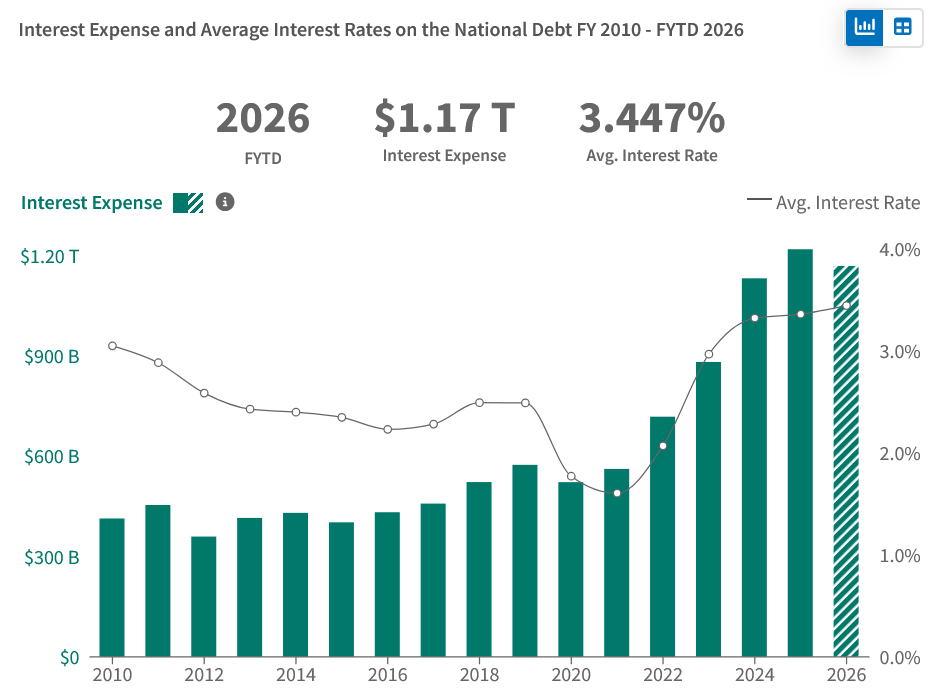
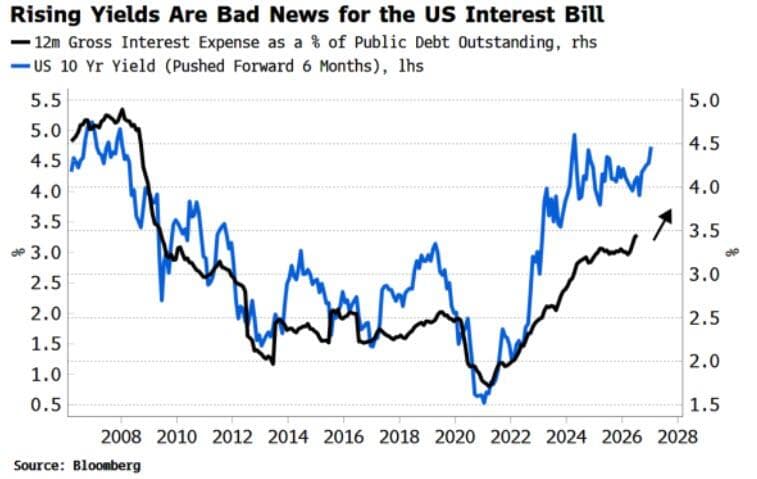
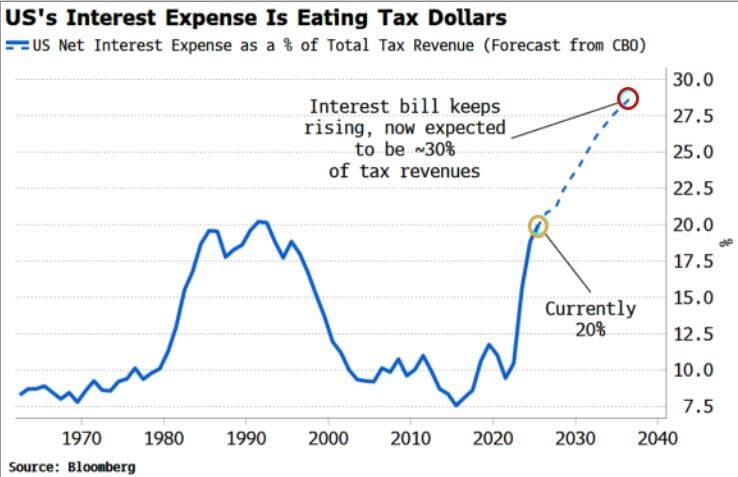
“Annualized interest on the federal debt exceeds $1.2 trillion and is surging higher. That means more than 23% of federal tax revenue is going just to service interest on the existing debt.
…the US government is now borrowing money to pay the interest on the money it has already borrowed… It’s creating a self-perpetuating doom loop…. In short, the skyrocketing interest expense has become an urgent threat to the US government’s solvency.”

Countermand: The Leviticus 25 Plan generates $37.303 billion annual federal budget surpluses each of the first five years of activation (2027-2031), large-scale tax revenue and payroll tax receipts, and credit market stability and long-term federal and state budget item interest cost reductions
The Leviticus 25 Plan will pay for itself entirely over the succeeding 10-15 years.
“Urgent threat to U.S. government solvency” – resolved.

……………………..

Observation #5: Surging Interest Expense Forces Fed To Ease Monetary Policy
“The soaring interest expense threatens the solvency of the US government and forces the Fed to cut interest rates, buy Treasuries, and implement other monetary easing measures to try to control interest costs….The only entity capable is the Federal Reserve, which buys Treasuries with dollars it creates out of thin air.”

Countermand: The Leviticus 25 Plan will restore positive dynamics to the treasury market and counterbalance the looming pressures driving driving the Federal Reserve toward future asset purchases.

………………………..

Observation #6: Ever-Increasing Currency Debasement Is Inevitable
“The skyrocketing interest expense forces the Fed to implement interest cost control policies, which inflate the money supply and debase the currency. As that happens, prices rise. That causes the US government to spend even more on Social Security and welfare to keep up with the cost-of-living increases. The same is true of defense and other government spending, which adjusts upward for rising prices.
This compounds the problem because, as government spending rises to account for rising prices, that increased spending can only be financed with more currency debasement.
That’s why ever-increasing currency debasement is the inevitable outcome of the US government’s debt spiral. It’s a self-perpetuating doom loop from which they cannot escape….”

Countermand: The Leviticus 25 Plan, the most powerful economic acceleration plan in the world, will effectively neutralize, once and for all, currency debasement pressures, and the U.S. economy’s “inevitable… self-perpetuating doom loop”

………………………………………..

The Leviticus 25 Plan is a dynamic economic initiative providing direct liquidity benefits for American families, while at the same time scaling back the role of government in managing and controlling the affairs of citizens.  It is a comprehensive plan with long-term economic and social benefits for citizens and government.

The inspiration for this plan is based upon Biblical principles set forth in the Book of Leviticus, principles tendering direct economic liberties to the people.

The Leviticus 25 Plan – An Economic Acceleration Plan for America
$95,000 per U.S. citizen
Leviticus 25 Plan 2027 (49564 downloads )

Website: https://leviticus25plan.org/

Enhanced Supplementary Leverage Ratio for GSIBs – and The Leviticus 25 Plan

Federal bank regulatory agencies have finalized a rule to modify the Enhanced Supplementary Leverage Ratio (eSLR) standards, effective April 1, 2026 (with optional early adoption on January 1, 2026). The final rule lowers capital requirements for large U.S. banks (GSIBs), reducing the fixed 2% eSLR buffer to a variable amount equal to 50% of a bank’s Method 1 GSIB surcharge, which frees up balance sheet capacity and acts as a complement to strategies aimed at increasing bank participation in low-risk activities, such as Treasury market intermediation.

…………………….

AI Overview
Key Details of the Final Rule:

  • Effective Date: April 1, 2026, with an option for early adoption on January 1, 2026.
  • Targeted Entities: U.S. Global Systemically Important Bank holding companies (GSIBs) and their subsidiary depository institutions.
  • Buffer Reduction: The eSLR buffer for covered depository institutions is capped at 1% above the minimum 3% leverage ratio, rather than the previous 2% buffer, according to Federal Register (.gov) and Office of the Comptroller of the Currency (OCC) (.gov).
  • Purpose: To reduce the punitive capital charges on low-risk activities, such as U.S. Treasury market intermediation, and adjust capital standards based on systemic risk, according to Federal Reserve Board (.gov) and JD Supra.
  • Impact: The changes are expected to lower funding costs and reduce Tier 1 capital requirements for holding companies by an estimated $13 billion, according to Federal Deposit Insurance Corporation (FDIC) (.gov) and JD Supra. 

Source: Regulatory Capital Rule: Modifications to the Enhanced Supplementary Leverage Ratio Standards for U.S. Global Systemically Important Bank Holding Companies and Their Subsidiary Depository Institutions; Total Loss-Absorbing Capacity and Long-Term Debt Requirements for U.S. Global Systemically Important Bank Holding Companies

A Rule by the Comptroller of the Currency, the Federal Reserve System, and the Federal Deposit Insurance Corporation on 12/01/2025

_____________________________   …

The Leviticus 25 Plan would be a perfect complement to this new regulatory change in the Enhanced Supplemental Leverage Ratio (eSLR) for banks.

This regulatory change alone will be “bullish catalyst for treasuries” … allowing “banks to hold more Treasuries on their balance sheets without needing to hold additional capital against them, freeing up the capacity for banks to participate more actively in the Treasury market.” (The Bear Traps Report, Dec 20, 2024)

The Leviticus 25 Plan, through the satisfaction of private sector debt (mortgage debt, student loan debt, household debt, auto loans, credit card debt), would provide a powerful additional enhancement of the eSLR change, with trillions of new dollars flowing into the banking system.  This synergism would allow GSIBs (global systemically important bank holding companies) even greater treasury auction purchasing power, with increased competitive bidding, lower interest rates, and long-term strength and stability for the U.S. Dollar.

The Leviticus 25 Plan would allow the Fed to adjust interest rates in response to price discovery and free market dynamics, rather than reacting to complex statistical evaluations and timing models, not to mention often intense political pressures.

Occasional adjustments over the course of time toward higher rates, to cool sporadic excesses and speculation within the economy, would decrease the likelihood of new ‘bubbles’ popping up in financial markets.  It would be much better tolerated in this new low-debt environment, and it would allow savers to earn millions of dollars in additional interest on their savings.

The Leviticus 25 Plan’s massive public and private debt elimination dynamic will immediately:
1) Generate $37.303 billion federal budget surpluses annually during its first five years of activation (2027-2031), it will pay for itself entirely over the succeeding 10-15 year period, and contribute highly favorable budget gains for state and local government entities;
2) Lower short-term and long-term interest rates;
3) Reduce fraud and waste across many of government’s social insurance sectors;
4) Restore real financial security for millions of American families, rekindle the spirit of self-reliance, and scale back out-of-control government entitlement spending;
5) And generate a long-term economic growth cycle that would benefit all Americans, most notably the 33.2 million small businesses across the U.S..2) Lower short-term and long-term interest rates;

The Leviticus 25 Plan – the most powerful decentralizing economic acceleration plan in the world – is loaded up and ready to launch.

The Leviticus 25 Plan is a dynamic economic initiative providing direct liquidity benefits for American families, while at the same time scaling back the role of government in managing and controlling the affairs of citizens.  It is a comprehensive plan with long-term economic and social benefits for citizens and government.

The inspiration for this plan is based upon Biblical principles set forth in the Book of Leviticus, principles tendering direct economic liberties to the people.

The Leviticus 25 Plan – An Economic Acceleration Plan for America

$95,000 per U.S. citizen – Leviticus 25 Plan 2027 (48914 downloads )

Q4 2025 Household Debt Grew $98.8 billion to Record High $18.8 trillion. America’s Debt-Busting Solution: The Leviticus 25 Plan

A Look back on America’s path to the current $18.8 trillion in Household Debt…

The Federal Reserve’s ‘secret liquidity lifelines’ for major banks 2008-2010:

Bloomberg LP filed a Freedom of Information Act (FOIA) lawsuit on Nov 7, 2008 to gain access to information regarding special emergency lending programs that the U.S. Federal Reserve had been running to help borrower banks deal with cash shortages and collateral deficiencies. The Fed fought the lawsuit, but ultimately lost.

Bloomberg gained access to more than 29,000 pages of previously secret loan documents and Fed spreadsheets, and published the highlights of those programs in late 2011.

According to Bloomberg, the top 15 recipients of Fed’s ‘secret liquidity lifelines’ were the very firms that in large part precipitated the great financial crisis with their subprime lending gambits and insufficient risk management strategies:

Morgan Stanley $107 billion
Citigroup Inc. $99.5 billion
Bank of America Corp $91.4 billion
Royal Bank of Scotland Plc $84.5 billion
State Street Corp $77.8 billion
UBS AG $77.2 billion
Goldman Sachs Group Inc. $69 billion
JP Morgan Chase & Co $68.6 billion
Deutsche Bank AG $66 billion
Barclays Plc $64.9 billion
Merrill Lynch & Co Inc. $62.1 billion
Credit Suisse Group AG $60.8 billion
Dexia SA $58.5 billion
Wachovia $50 billion

The Fed ‘flooded’ the financial coffers of these major U.S. and foreign banks (with U.S subsidiaries) with trillions of dollars in direct cash transfers, credit guarantees, and balance sheet transfers of (often ‘sewage grade’) agency debt and MBS – and the principles of those institutions ended up making out very well.

None of them took a haircut

Meanwhile, U.S citizens out in Main Street America did not fare so well… There were severe financial dislocations; 8.7 million Americans lost their jobs during the financial crisis years; 4.1 million American families lost their homes through completed foreclosures from September 2008 through December 2012, according to CoreLogic.

Tens of millions of American families remain financially oppressed in the aftermath of that crisis.

The time is now to rebalance the books in America…

…………………………………………

NY FED HOUSEHOLD DEBT AND CREDIT REPORT (Q4 2025)

Mortgage balances shown on consumer credit reports grew by $98 billion during the fourth quarter of 2025 and totaled $13.17 trillion at the end of December.

Balances on home equity lines of credit (HELOC) rose by $12 billion, the 15th consecutive quarterly increase. There is now $433 billion in outstanding HELOC balances, $116 billion above the low reached in 2022Q1.

In total, non-housing balances increased by $81 billion, a 1.6% increase from 2025Q3.

Credit card balances rose by $44 billion during the fourth quarter and now total $1.28 trillion outstanding, up 5.5% since last year.

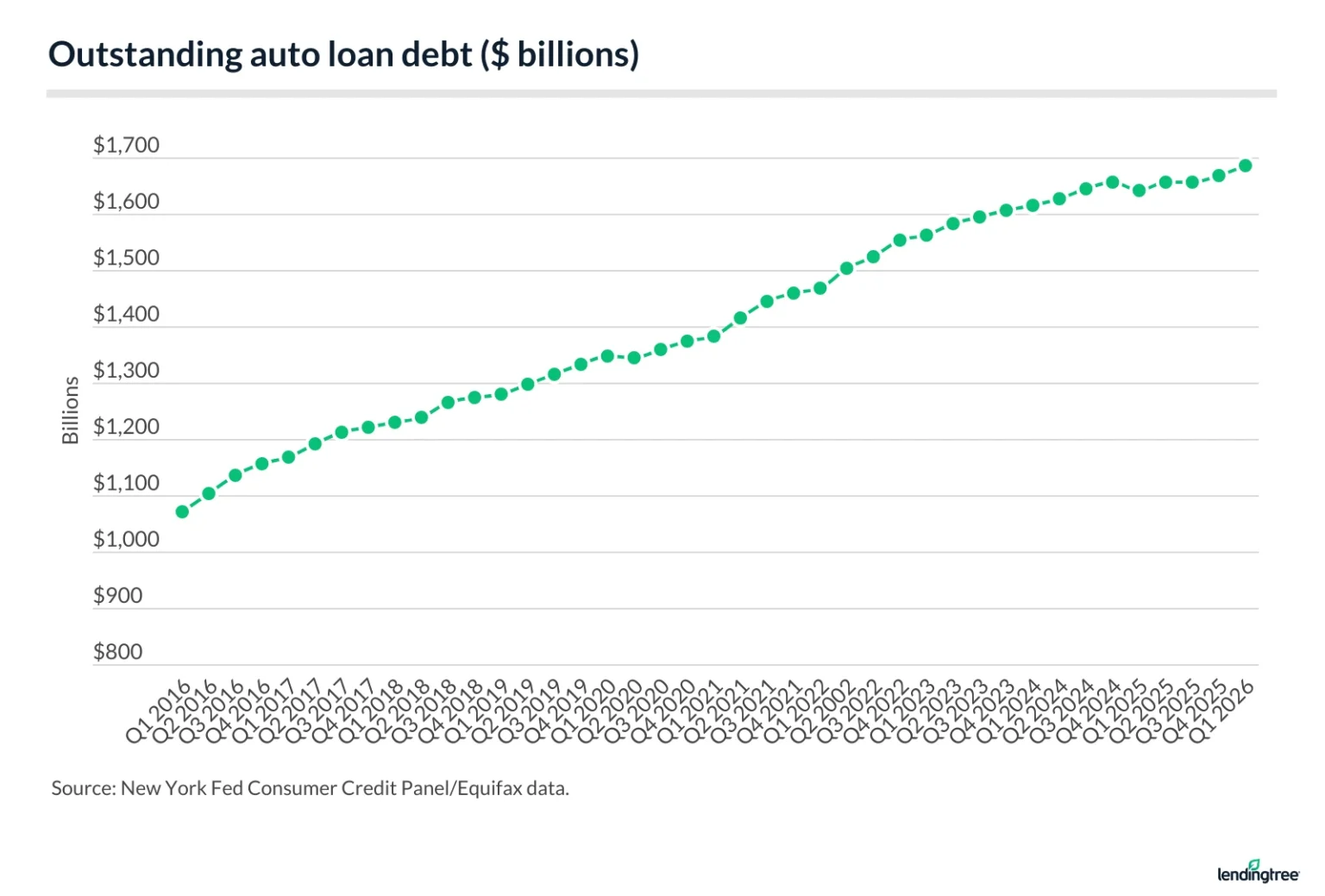
Auto loan balances edged up by $12 billion to $1.66 trillion.

Other balances, which include retail cards and consumer finance loans, rose by $14 billion and now total $564 billion.

Student loan balances increased by $11 billion and now stand at $1.66 trillion.

…………………………………………

AI Overview – DSR

In late 2025, the total household debt service ratio (DSR) reached approximately 11.3% of disposable personal income. This metric reflects the share of after-tax income that U.S. households allocate to required debt payments, including mortgages and consumer loans. 

Current Debt Service Landscape (Late 2025)

The Federal Reserve reported a steady increase in the debt burden throughout the year as total household debt reached a record $18.8 trillion by the end of Q4 2025. 

  • Total Debt Service Ratio (DSR): The ratio stood at 11.32% in the fourth quarter of 2025, up from 11.26% in Q3 and 11.12% in Q2.
  • Mortgage Debt Service: Mortgage payments accounted for approximately 5.92% of disposable income in late 2025.
  • Consumer Debt Service: Payments for non-mortgage debt (such as auto loans and credit cards) represented about 5.40% of disposable income.
  • Historical Context: While the ratio has climbed since 2021, it remains below the 13.2% peak seen before the 2008 financial crisis and is roughly in line with the long-term average of approximately 11.2%–11.3%. 

Key Drivers of the Increase

  • Rising Interest Rates: Higher rates on variable-rate debts and new loans have increased the cost of carrying debt relative to income.
  • Credit Card Balances: Credit card debt reached a record $1.28 trillion by late 2025, with balances growing as consumers managed higher costs of living.
  • Delinquency Trends: The share of debt in some stage of delinquency rose to 4.8% in Q4 2025, up from 4.5% in the previous quarter, signaling growing financial pressure on some households. 

……………………………………………….

Household Debt Statistics – Average Interest Rates

Average interest rates on U.S. household debt vary significantly by type, with credit card APRs averaging over 23%–28%, and new auto loans often over 6%–10%. Total household debt, including mortgages (around 7.18%), remains high, with many Americans struggling with rising payments. 

Key Interest Rate Breakdown (as of 2025-2026):

  • Credit Cards: Average APRs are roughly 23.7% to 28.6%, with many consumers paying over 22%.
  • Mortgages: Average 30-year fixed rates are around 7.18%.
  • Auto Loans: Average interest rates on new cars often exceed 10%.
  • Student Loans: Federal undergraduate loan rates are lower, averaging around 4.99%

Household Debt Trends:

  • Rising Debt: Total credit card balances have risen to nearly trillion, with many households facing high-interest debt.
  • Delinquencies: Serious delinquencies (90+ days) are increasing, particularly for credit cards and auto loans …
  • Debt Service: Households are spending a growing portion of their income on debt payments, with the total debt service ratio at approximately of disposable income in late 2025. 

Note: Interest rates are based on recent 2025-2026 data and can change frequently.
Source: NY Fed Feb 13, 2026

___________________________________

The Leviticus 25 Plan grants the same direct access to liquidity extensions that was so generously provided to major U.S. and foreign banks during the great financial crisis (2008-2010) – the very banks that precipitated the subprime loan-driven crisis.

The Leviticus 25 Plan will pave the way for the colossal economic reset and powerful debt elimination plan that America needs to survive.

The Leviticus 25 Plan will generate $37.303 billion annual federal budget surpluses (2027-2031) along with overwhelmingly favorable budget rebalancing dynamics for state and local governments.

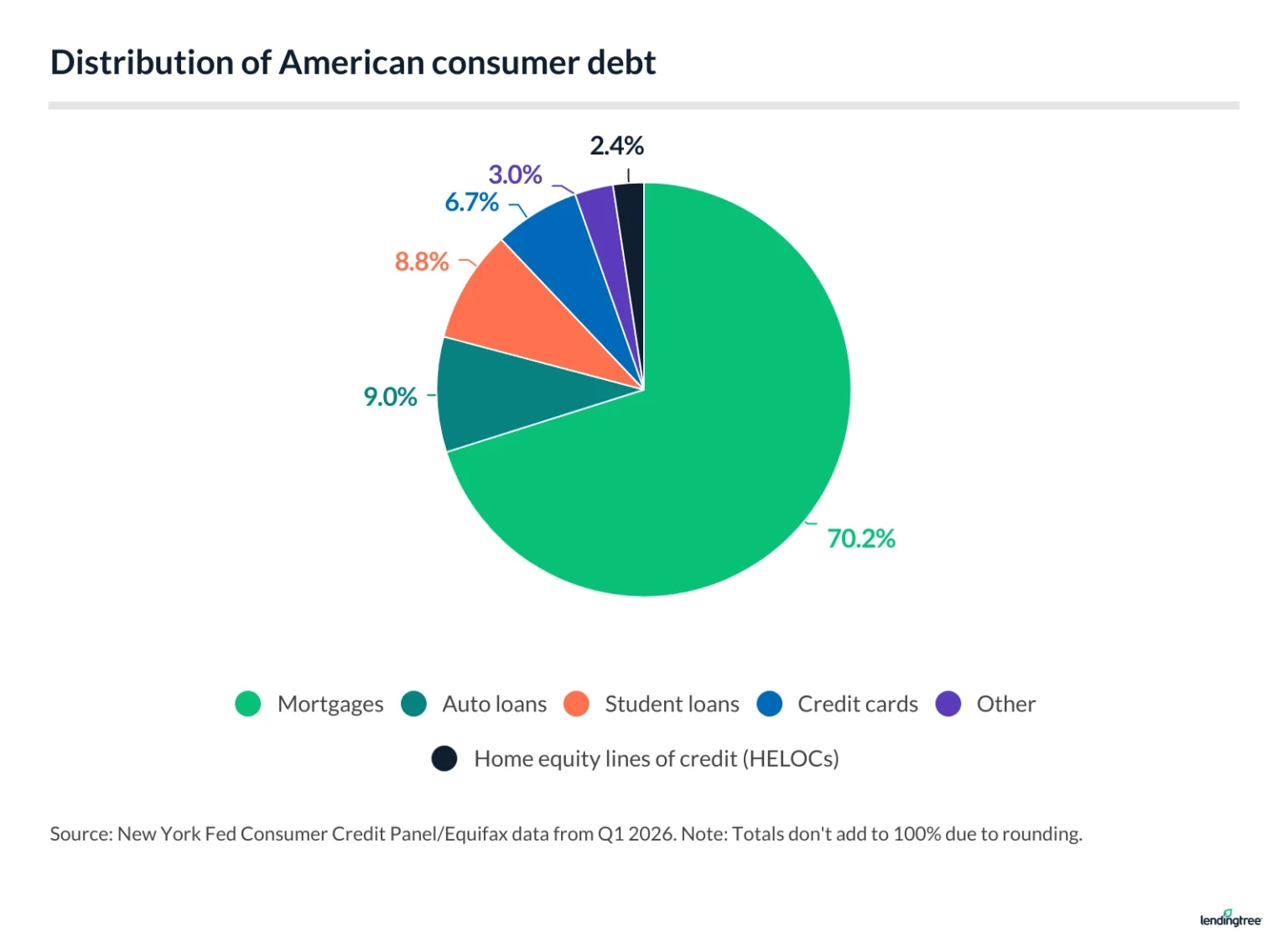
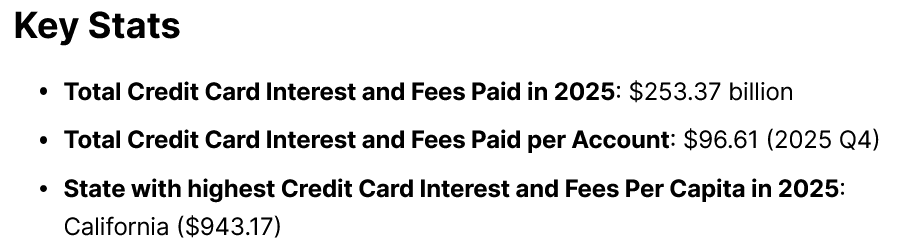
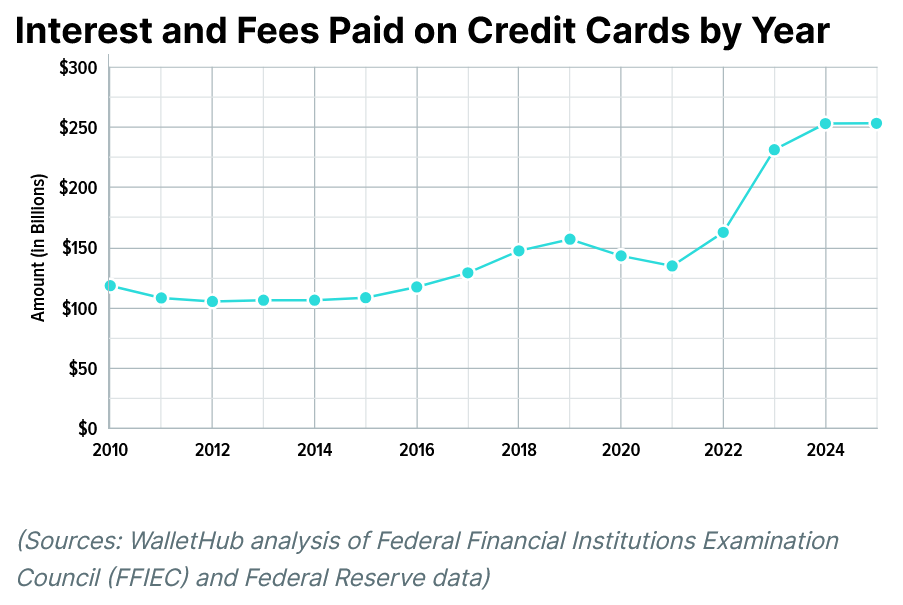
The Leviticus 25 Plan will also pay down, or pay off, trillions of dollars in U.S. Household Debt for all who qualify, and thereby eliminate substantial proportions of Mortgage Debt ($13.17 trillion), HELOC ($433 billion), Auto Loan Balances ($12 billion), Retail Cards / Consumer Finance Loans ($564 billion), Student Loan Balances ($1.66 trillion), Credit Card Balances ($1.28 trillion) and $120 annually in Credit Card Interest and Fees.

The Leviticus 25 Plan is a dynamic economic initiative providing direct liquidity benefits for American families, while at the same time scaling back the role of government in managing and controlling the affairs of citizens.  It is a comprehensive plan with long-term economic and social benefits for citizens and government.

The inspiration for this plan is based upon Biblical principles set forth in the Book of Leviticus, principles tendering direct economic liberties to the people.

The Leviticus 25 Plan – An Economic Acceleration Plan for America
$95,000 par U.S. citizenLeviticus 25 Plan 2027 (48710 downloads )

U.S. Treasury Department Consolidated Financial Statements (FY2025): The U.S. Government is Insolvent. The Good News is….

The good news is – there is a clean and powerful way out of this cavernous debt hole: The Leviticus 25 Plan.

…………………………………………….

The Treasury just declared the U.S. insolvent. The media missed it

Steve H. Hanke | March 23, 2026

Excerpt:

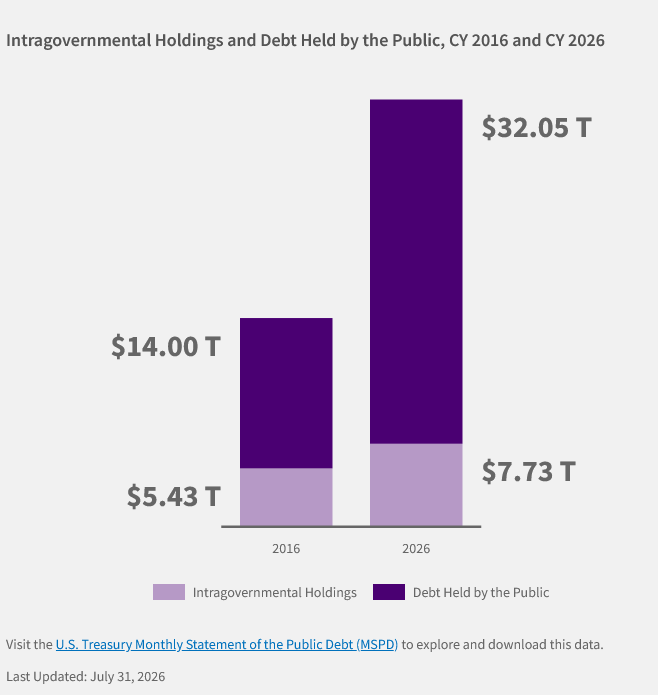
The U.S. government is insolvent. That’s not hyperbole — it’s the conclusion drawn directly from the Treasury Department’s own consolidated financial statements for fiscal year 2025, released last week to near-total media silence. The numbers: $6.06 trillion in total assets against $47.78 trillion in total liabilities as of September 30, 2025.

Importantly, the $47.78 trillion in reported liabilities does not include the unfunded obligations of social insurance programs like Social Security and Medicare — those are disclosed separately in the off-balance-sheet Statement of Social Insurance (SOSI).

The government’s consolidated balance sheet position, excluding the SOSI, deteriorated by nearly $2.07 trillion between FY 2024 and FY 2025, reaching a staggering negative $41.72 trillion. Total liabilities are now nearly eight times the value of reported assets. The largest drivers were a $2 trillion increase in federal debt and interest payable (now $30.33 trillion) and a $438.8 billion increase in federal employee and veteran benefits payable (now $15.47 trillion).

The Off-Balance-Sheet Iceberg

The off-balance-sheet picture is even more alarming. The 75-year unfunded social insurance obligation surged by $10.1 trillion in a single year, rising from $78.3 trillion in FY 2024 to $88.4 trillion in FY 2025 — driven primarily by a $6.9 trillion jump in projected Medicare Part B shortfalls and a $2.5 trillion increase for Social Security. The Treasury’s Statement of Long-Term Fiscal Projections shows the 75-year fiscal gap widening from 4.3% of GDP in FY 2024 to 4.7% in FY 2025.

If the $88.4 trillion in 75-year off-balance-sheet obligations were added to the $47.8 trillion in official balance sheet liabilities, total federal obligations would now exceed $136.2 trillion — roughly five times U.S. annual GDP.

The Government Accountability Office (GAO) issued a disclaimer of opinion on the U.S. government’s FY 2025 financial statements — the 29th consecutive year it has been unable to determine whether the statements are fairly presented. This is primarily due to serious, ongoing financial management problems at the Department of Defense and weaknesses in accounting for interagency transactions.

Not only has the financial press ignored the consolidated financial statements, but most members of Congress and members of the general public will not read the consolidated financial statements….

Congress has clearly lost control of the nation’s finances. America is facing a fiscal catastrophe. The reckoning, long deferred, is becoming impossible to ignore.

________________________________________

There is a compelling economic acceleration plan with the raw power to reign in America’s runaway public and private debt deluge and crush the looming fiscal catastrophe.

The Leviticus 25 Plan will: 1) Achieve massive new tax revenue inflows (federal, state, local): 2) Trigger large-scale, across-the-board reductions in federal income tax refunds, social program outlays, the interest expense budget item; 3) Recapitalize the Medicare and Social Security Trust Funds, the VA Health Care system, TRICARE, and FEHB; 4) Restore financial health for tens of millions of America’s hard-working, tax-paying U.S. citizens; 5) Rejuvenate free market economics and citizen-centered health care across the land.

The Leviticus 25 Plan will generate a $37.303 billion federal budget surpluse annually during each of the first five years of activation (2027-2031), and pay for itself entirely over the succeeding 10-15 years.

The Leviticus 25 Plan is a dynamic economic initiative providing direct liquidity benefits for American families, while at the same time scaling back the role of government in managing and controlling the affairs of citizens.  It is a comprehensive plan with long-term economic and social benefits for citizens and government.

The inspiration for this plan is based upon Biblical principles set forth in the Book of Leviticus, principles tendering direct economic liberties to the people.

The Leviticus 25 Plan – An Economic Acceleration Plan for America

$95,000 per U.S. citizen – Leviticus 25 Plan 2027 (48691 downloads )

Recharging the U.S. Debt-soaked Economy: Fed Rate Cuts vs. The Leviticus 25 Plan

The U.S. economy would benefit very little from Fed rate cuts over the long term, and no one should be pressuring the Fed to ease in our current economic situation – when there is a monumentally better, and more powerful economic acceleration plan loaded up and ready to launch.

What the U.S. needs more than anything is massive public and private debt elimination. The immediate and long-term benefits of a systematic, massive debt elimination plan would dwarf, by orders of magnitude, the limited benefits of any rate-lowering cycle the Fed could ever set in motion.

A rate cutting cycle would have little, if any effect on reducing the $35.5 trillion national debt or the projected $2.0 trillion annual deficits, or the $3.1 trillion of State and Local debt, or the current $18.04 trillion of Household Debt in the U.S..

A rate cutting cycle would do nothing to shrink entitlement spending and reduce the government’s ever-growing footprint across America’s private sector landscape.  It would do nothing to restore real financial security and rekindle the spirit of self-reliance for America’s hard-working, tax-paying U.S. citizens.

It would do nothing to spur a legitimate long-term economic growth cycle, stabilize the credit markets, and strengthen the U.S. Dollar.

A rate cutting cycle at this time would merely be an open door for additional debt accumulation and eventually lead into another rate-tightening phase. And it would penalize savers.

The Leviticus 25 Plan’s massive debt elimination sequence, on the other hand, would
immediately:
1) Generate a series of annual Federal budget surpluses, along with State and Local government surpluses;
2) Reduce fraud and waste across many of government’s social insurance sectors;
3) Restore real financial security for millions of American families, rekindle the spirit of self-reliance, and scale back out-of-control big government social welfare / entitlement spending;
4) And generate a long-term economic growth cycle that would benefit all Americans, and most prominently, the 33.2 million small businesses across the U.S..
5) Lower interest rates across the board, through excess banking sector liquidity / competitive bidding at U.S. Treasury monthly auctions.

The Leviticus 25 Plan will pay for itself entirely over a 10-15 year period.

The Leviticus 25 Plan would allow the Fed to adjust interest rates a function as free market dynamics and price discovery dictated, rather than depending upon complex timing models amid political pressures.

Higher rates would allow savers to earn millions of dollars in additional interest. It would help curb interests in ‘fast money’ and speculation within the economy, and it would decrease the likelihood of new ‘bubbles’ popping up in financial markets.

The Leviticus 25 Plan – loaded up and ready to launch.

The Leviticus 25 Plan – An Economic Acceleration Plan for America

$95,000 per U.S. citizen – Leviticus 25 Plan 2027 (48289 downloads )

America’s ‘Socialism Slayer:’ The Leviticus 25 Plan

“The inherent vice of capitalism is the unequal sharing of blessings;  the inherent virtue of socialism is the equal sharing of misery.”  -Winston Churchill

“Socialism means slavery.”  -Lord Acton

“Democracy and socialism have nothing in common, but one word, equality.  But notice the difference: while democracy seeks equality in liberty, socialism seeks equality in restraint and servitude.”  -Alexis de Tocqueville

…………………………………………..

Why Politicians Win (And Workers Lose) Under Socialism

Authored by Hans-Hermann Hoppe via The Mises Institute,

ZeroHedge, Apr 20, 2017 – Excerpts:

Socialism leads to the politicization of society. Hardly anything can be worse for the production of wealth.

Socialism, at least its Marxist version, says its goal is complete equality. The Marxists observe that once you allow private property in the means of production, you allow differences. If I own resource A, then you do not own it and our relationship toward resource A becomes different and unequal. By abolishing private property in the means of production with one stroke, say the Marxists, everyone becomes co-owner of everything. This reflects everyone’s equal standing as a human being.

The reality is much different. Declaring everyone a co-owner of everything only nominally solves differences in ownership. It does not solve the real underlying problem:  there remain differences in the power to control what is done with resources.

In capitalism, the person who owns a resource can also control what is done with it. In a socialized economy, this isn’t true because there is no longer any owner. Nonetheless the problem of control remains. Who is going to decide what is to be done with what? Under socialism, there is only one way: people settle their disagreements over the control of property by superimposing one will upon another. As long as there are differences, people will settle them through political means.

If people want to improve their income under socialism they have to move toward a more highly valued position in the hierarchy of caretakers. That takes political talent.

Under such a system, people will have to spend less time and effort developing their productive skills and more time and effort improving their political talents.

As people shift out of their roles as producers and users of resources, we find that their personalities change. They no longer cultivate the ability to anticipate situations of scarcity to take up productive opportunities, to be aware of technological possibilities, to anticipate changes in consumer demand, and to develop strategies of marketing. They no longer have to be able to initiate, to work, and to respond to the needs of others.

Instead, people develop the ability to assemble public support for their own position and opinion through means of persuasion, demagoguery, and intrigue, through promises, bribes, and threats. Different people rise to the top under socialism than under capitalism. The higher on the socialist hierarchy you look, the more you will find people who are too incompetent to do the job they are supposed to do. It is no hindrance in a caretaker politician’s career to be dumb, indolent, inefficient, and uncaring. He only needs superior political skills. This too contributes to the impoverishment of society.

The United States is not fully socialized, but already we see the disastrous effects of a politicized society as our own politicians continue to encroach on the rights of private property owners. All the impoverishing effects of socialism are with us in the U.S.: reduced levels of investment and saving, the misallocation of resources, the over-utilization and vandalization of factors of production, and the inferior quality of products and services. And these are only tastes of life under total socialism.

_____________________________________

The Leviticus 25 Plan

There is currently one, and only one, comprehensive economic acceleration plan in America that re-targets liquidity flows away from government agencies and corporate middlemen directly to U.S. citizens – lift people up out of poverty, revitalize self-reliance in America, and reverse the ‘impoverishing effects of socialism.’

The Leviticus 25 Plan is a dynamic economic initiative providing direct liquidity benefits for American families, while at the same time scaling back the role of government in managing and controlling the affairs of citizens.  It is a comprehensive plan with long-term economic and social benefits for citizens and government.

The inspiration for this plan is based upon Biblical principles set forth in the Book of Leviticus, principles tendering direct economic liberties to the people.

The Leviticus 25 Plan – An Economic Acceleration Plan for America

$95,000 per U.S. citizen – Leviticus 25 Plan 2027 (48289 downloads )

Q4 2025 Household Debt and Credit Balances Rise to $18.8 Trillion. Delinquency Rates Turn Sharply Higher.

US Consumer Debt Delinquencies Soar To Highest Since 2017 While Office Delinquencies Hit Record High

ZeroHedge, Feb 10, 2026 – Excerpts:

It will come as a surprise to exactly nobody that the Fed’s latest quarterly Household Debt and Credit report (for Q4 2025) reported total household debt balances increased by $191 billion in the fourth quarter of 2025, a 1% rise from 2025 Q3, to a new all-time high. Balances now stand at $18.8 trillion and have increased by $4.6 trillion since the end of 2019, just before the pandemic recession. 

This is how various debt balances changed through the quarter: 

  • Mortgage balances shown on consumer credit reports grew by $98 billion during the fourth quarter of 2025 and totaled $13.17 trillion at the end of December.
  • Balances on home equity lines of credit (HELOC) rose by $12 billion, the 15th consecutive quarterly increase.There is now $433 billion in outstanding HELOC balances, $116 billion above the low reached in 2022Q1. In total, non-housing balances increased by $81 billion, a 1.6% increase from 2025Q3.
  • Credit card balances rose by $44 billion during the fourth quarter and now total $1.28 trillion outstanding, up 5.5% since last year.
  • Student loan balances increased by $11 billion and now stand at $1.66 trillion.
  • Auto loan balances edged up by $12 billion to $1.66 trillion.
  • Other balances, which include retail cards and consumer finance loans, rose by $14 billion and now total $564 billion.

New debt originations were also solid in the quarter:

  • The volume of mortgage originations, which includes both refinance and purchase originations, increased with $524 billion newly originated in 2025 Q4, an uptick from the $512 billion seen in the previous quarter. It was the highest since 2022 when rates were far lower. 

…..

Taking a closer look at some of the negative changes below the surface, delinquency rates on loans ranging from mortgages to credit cards rose to 4.8% of all outstanding US household debt in the fourth quarter, up 0.3% sine Q3 2025 and the highest level since 2017, driven by higher defaults among low-income and young borrowers.

As Bloomberg notes, while the overall share of loans in some stage of default is near pre-pandemic averages, the rise in delinquencies among the lowest earners adds to evidence of an increasingly K-shaped economy, and nowhere was it more obvious than in the case of student loans – where with the Biden repayment moratorium has been over for the past year – we have seen a tsunami of both early delinquencies, with 16.3% of student-loan debt became delinquent in Q4 the biggest increase on record in data going back to 2004…

______________________________________

The Leviticus 25 Plan will be especially beneficial in substantially reducing, and in millions of cases eliminating student loan debt.

It will eliminate vast amounts of auto loan debt, credit card debt, and consumer loan debt. It will allow millions of working American families to substantially pay down, or pay off, trillions of dollars in mortgage debt.

The Leviticus 25 Plan is the most powerful, debt-busting economic acceleration plan anywhere in the world.

The Leviticus 25 Plan – An Economic Acceleration Plan for America

$95,000 per U.S. citizen – Leviticus 25 Plan 2027 (47205 downloads )

Federal Deficit Hits $1 Trillion Mark Five Months into FY2026. Main Street America Republicans Have the Only Plan to Resolve this Fiscal Crisis and Get America Back on Track.

“He who will not apply new remedies must expect new evils.” – Sir Francis Bacon

………………………………………..

Federal deficit totaled $1 trillion in beginning of FY2026, CBO says

By Andrew Rice | The Center Square

Mar 9, 2026

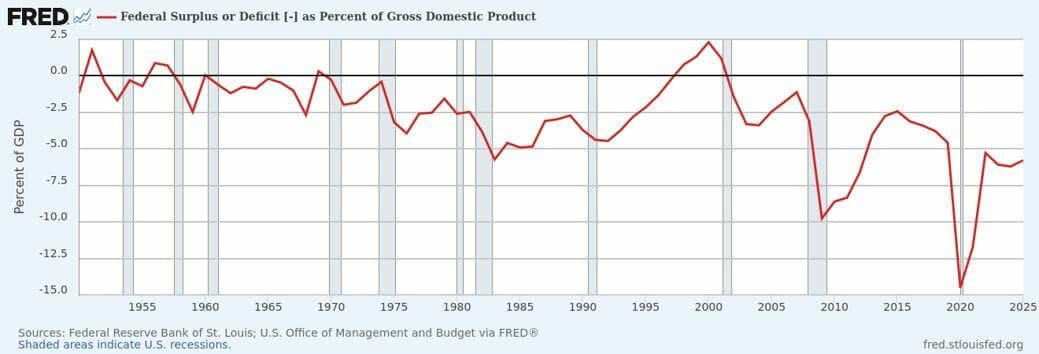
(The Center Square) – The United States federal budget deficit totaled $1 trillion in the first five months of fiscal year 2026, according to the Congressional Budget Office.

The latest federal deficit estimate is $142 billion less than the deficit from this time in the previous fiscal year. The CBO saw tariffs raise the amount of money that came into the federal government during the first five months of the fiscal year.

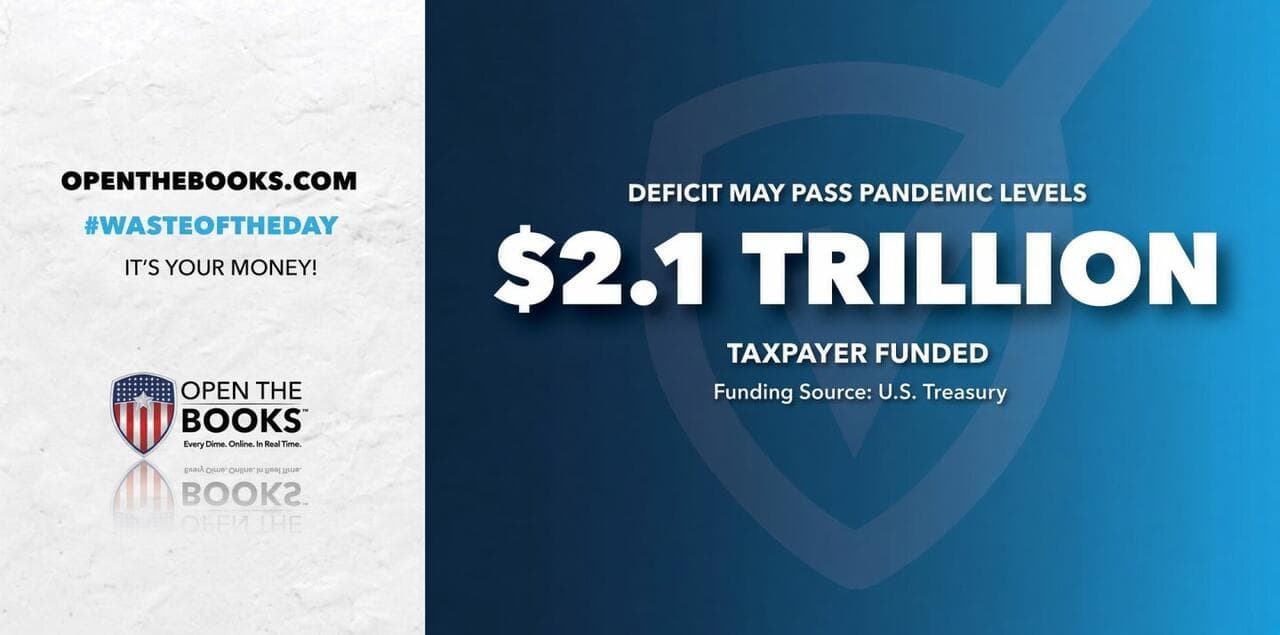
The CBO estimated the government brought in $2.1 trillion in the first five months of the fiscal year, roughly $206 billion more than the same time period last fiscal year.

Maya McGuineas, president of the Committee for a Responsible Federal Budget, called on Congress to decrease federal spending deficits.

“Another month of this fiscal year means another month of borrowing,” McGuineas said. “This cannot be sustainable.”

Collection of customs duties, or money received from tariffs, increased by $109 billion in the first five months of fiscal 2026 compared to the previous fiscal year.

Payments received by corporate income taxes decreased by $33 billion in fiscal year 2026. The government also received a $77 billion increase from income and payroll taxes and a $52 billion increase in withholdings from paychecks.

The government spent $3.1 trillion in the first five months of fiscal year 2026, a $64 billion increase from the same time period last fiscal year.

Spending on Social Security, Medicare and Medicaid made up the largest portions of government expenditures over the last five months. Social Security benefits spending rose by $48 billion, in part due to the enactment of the Social Security Fairness Act that increased payments for certain recipients, beginning in March 2025.

Medicare payments increased by $34 billion, which included a $16 billion settlement for Part D prescription drug plans in November 2025. Medicaid payments increased by $22 billion, due to rising enrollment costs.

February in particular saw a substantial increase in the deficit compared to the same period last year. The federal government took on $308 billion in February 2026, $1 billion more than in February 2025.

The CBO explained this deficit figure would have been substantially larger if payments for the federal government were not changed since Feb. 1 and March 1 fell on weekends. In February, defense spending increased by $6 billion; interest on debt increased by $6 billion; and Social Security increased by $10 billion. 

Overall, CBO projected the government would see a $1.9 trillion deficit for fiscal year 2026, with the debt to surpass records by 2030. MacGuineas called on Congressional leaders to take a firm approach against deficit spending and enact a 3% deficit-to-GDP target.

“Our fiscal problems will not solve themselves,” MacGuineas said. “We need policymakers to come together, agree to reduce deficits – a 3% deficit-to-GDP target would be a great start – and put our national debt on a downward sustainable path as a share of the economy.”

___________________________________

The Leviticus 25 Plan is currently the one and only economically viable, politically expedient economic plan — with the raw power that is critical to resolving America’s burgeoning fiscal crisis.

The Leviticus 25 Plan will generate massive new general tax revenue flows and payroll tax revenue flows, through revitalized economic growth. Increased payroll taxes for the Social Security and Medicare Trust Funds will be substantial.

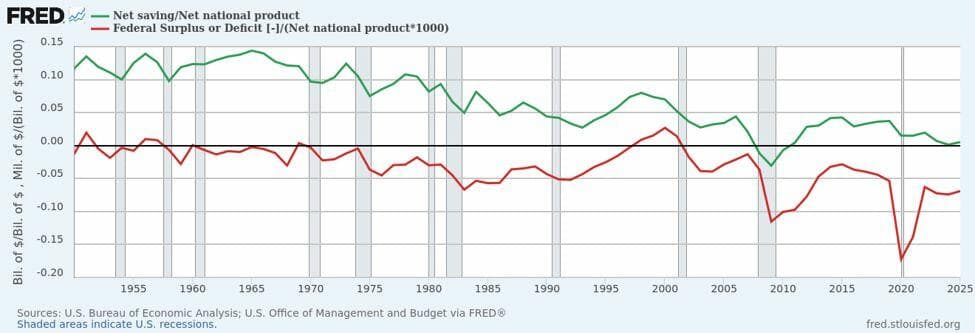
The Plan will save the federal government $1.366 trillion through its income tax recapture benefit, and generate enormous fiscal recovery benefits for state and local governments.

$3.224 trillion in federal government ‘safety net’ program outlays will eliminated with the plan’s direct $60,000 liquidity extension to qualifying U.S. citizens. Additonal savings to state and local government entities will also be substantial.

The U.S. Healthcare Freedom Plan component, allocating $35,000 per qualifying U.S. citizen, restore citizen-centered health care across America. It will lift people up out of poverty and off the Medicaid rolls. And it will also save the federal government trilions of dollars in Medicare, Medicaid, VA, TRICARE, FEHB outlays through the $7,000 annual deductible for primary health care services.

The Leviticus 25 Plan will generate $37.303 billion federal budget surpluses annually during its first five years of activation, 2027-2031

The Leviticus 25 Plan is a dynamic economic initiative providing direct liquidity benefits for American families, while at the same time scaling back the role of government in managing and controlling the affairs of citizens.  It is a comprehensive plan with long-term economic and social benefits for citizens and government.

The inspiration for this plan is based upon Biblical principles set forth in the Book of Leviticus, principles tendering direct economic liberties to the people.

The Leviticus 25 Plan – An Economic Acceleration Plan for America

$95,000 per U.S. citizen – Leviticus 25 Plan 2027 (47204 downloads )