The Impossible Dream: Federal Budget Surpluses, Citizen-Centered Healthcare, Financial Security for Millions of American Families. The Leviticus 25 Plan.

Washington-based Democrats and Republicans have a long-standing record of growing government, creating greater dependence on government among the citizenry, dreaming up new spending programs riddled with inefficiencies, waste and outright fraud. 

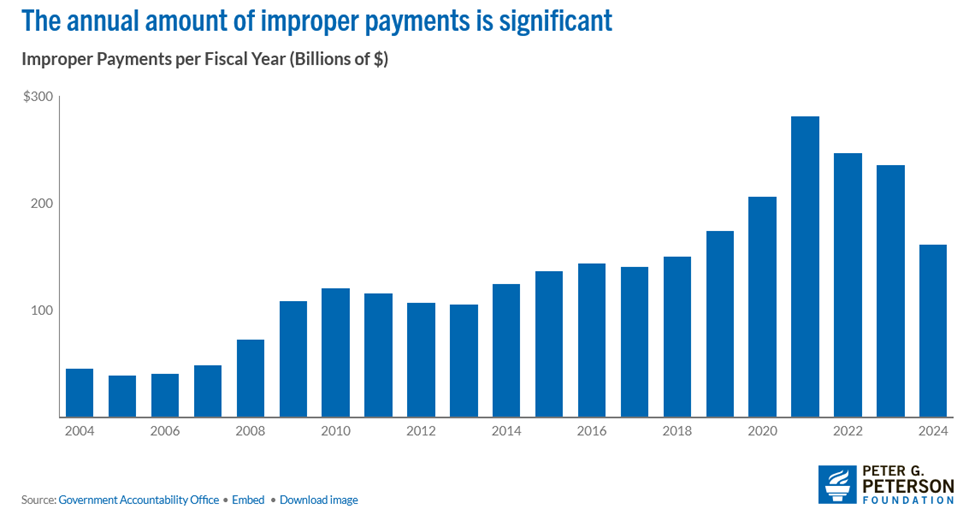
Washington political policy initiatives over the past two decades have impoverished millions of Americans, created record Household Debt burdens, stymied economic growth, and generated soaring, nightmarish federal budget deficits, massive enough to now constitute a national security issue.

Now imagine a future America where millions of U.S. citizens were to be granted equal access to direct liquidity extensions to those which were so generously provided to major Wall Street financial institutions during the great financial crisis (2007-2010) and the Covid economic crisis (2020-2022), including: Morgan Stanley, Citigroup, Bank of America, State Street Corp, Goldman Sachs, Merrill Lynch, JPMorgan Chase, Wachovia, Lehman Brothers, Wells Fargo, Bear Stearns) and major foreign financial institutions (Royal Bank of Scotland, UBS AG, Deutsche Bank AG, Barclays, Credit Suisse. Dexia, BNP Paribas).

Imagine a future America where millions of hard-working, tax-paying U.S. citizens have eliminated massive sums of mortgage debt, paid off auto loans and installment debt, paid off student loans (or were fully reimbursed for previously paid off student loans), and are able to improve their current quality of life and save considerable sums of money toward future plans and dreams. 

Imagine a future America where millions of ‘below-the-poverty-line’ families did not need ongoing government support to cover life’s basic necessities (food, housing, and primary health care expenditures). 

Imagine a future where families did not need two incomes, or additional government assistance to barely cover family-specific expenses like child-care, private education, and federal, state, and local tax burdens.

And now visualize a future America where government spending has dropped precipitously, tax revenues have risen dramatically (without raising taxes), federal (and state) budget surpluses have become an ongoing reality. 

America’s economy – surging into a new, long-term, revitalized, free market growth cycle.

And citizen-centered healthcare largely replacing the current big government / big corporation market-dominating partnerships.

That future is here.

The Leviticus 25 Plan – loaded up and ready to launch.

…………………..

The Leviticus 25 Plan is a dynamic economic initiative providing direct liquidity benefits for American families, while at the same time scaling back the role of government in managing and controlling the affairs of citizens.  It is a comprehensive plan with long-term economic and social benefits for citizens and government.

The inspiration for this plan is based upon Biblical principles set forth in the Book of Leviticus, principles tendering direct economic liberties to the people.

The Leviticus 25 Plan – An Economic Acceleration Plan for America

$90,000 per U.S. citizen – Leviticus 25 Plan 2026 (27484 downloads )

GAO: America’s “Unsustainable Fiscal Path”

THE NATION’S UNSUSTAINABLE FISCAL PATH – Government Accountability Office

Excerpt:

The federal government faces an unsustainable fiscal future. In February 2025, we released our annual report on the nation’s fiscal health, highlighting both short-term and long-term risks. 

Federal debt held by the public (that is, the total amount of money that the federal government owes to its investors) will continue to grow faster than the economy, which is unsustainable.

Federal debt held by the publicpast, present, and future

Federal debt is growing faster than GDP.

Historically, debt has decreased during peacetime and economic expansions. But this pattern has changed in recent decades. Unless current revenue and spending policies change, by 2027 debt will reach its historical high of 106 percent of GDP, according to our simulation. If unaddressed, it will grow more than twice as fast as the economy and reach 200 percent of GDP by 2047.

…………………………………………..

The U.S. Congress’ latest response to resolving the fiscal crisis:

A little or a lot? Conflicting targets for cuts leave budget in limbo

The House of Representatives this week narrowly approved a budget resolution after the Senate did so previously.

By Ben Whedon  |  JusttheNews  |  Apr 11, 2025

While President Donald Trump has suggested he may sign a balanced budget plan during his term, competing estimates and promises on cuts from interested parties appear to signal the government could either come close to achieving its goal or largely fail to make meaningful cuts, with little room for a moderate option.

The House of Representatives this week narrowly approved a budget resolution after the Senate did so previously. Both chambers committed to the basic framework of “one big, beautiful bill” favored by Trump to address both his tax cuts and his border proposals in the same legislation. The reconciliation process, however, will see competing parties quibble over the depth of cuts and what to target.

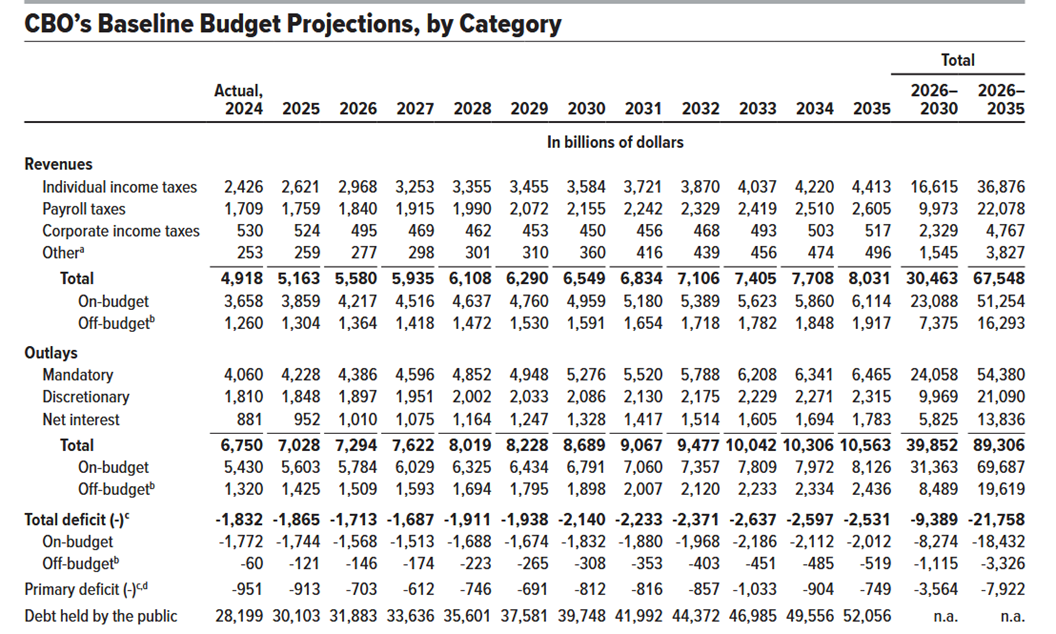
The Congressional Budget Office projected that the federal government would run a $1.9 trillion budget deficit in Fiscal Year 2025 and the Elon Musk-led Department of Government Efficiency (DOGE) had previously vowed to cut $2 trillion in spending to balance the budget. But Musk’s projections have dwindled of late and budget hawks in the House aim to hold Speaker Mike Johnson to his promises of major cuts, setting up a potential leadership change should he fail.

_____________________________________

The most powerful economic acceleration plan in the world is loaded up and ready to launch – and solve America’s debt crisis, once and for all.

The Leviticus 25 Plan – An Economic Acceleration Plan for America

$90,000 per U.S. citizen – Leviticus 25 Plan 2026 (26881 downloads )

Treasury Secretary Bessent: “It’s Main Street’s Turn to Restore The American Dream.”

“It’s Main Street’s Turn To Restore The American Dream” – US Treasury Secretary Warns Wall Street

ZeroHedge, Apr 09, 2025 | Via American Greatness,Excerpts:

U.S. Secretary of the Treasury Scott Bessent laid out President Trump’s financial policy priorities for the American Bankers Association (ABA) on Wednesday, saying that Main Street America will now take priority.

Bessent speaking at the ABA’s Washington Summit, said, “For too long, financial policy has served large financial institutions at the expense of smaller ones— no more.”

The Treasury Secretary stated that, “It’s Main Street’s turn to hire workers, it’s Main Street’s turn to drive investment and it’s Main Street’s turn to restore the American dream.”

Bessent announced the Trump administration’s shift to focusing on helping Main Street businesses and consumers thrive by giving all institutions a chance to succeed, adding, “For the last four decades, basically since I began my career in Wall Street, Wall Street has grown wealthier than ever before, and it can continue to grow and do well.”

Addressing fears of a looming recession, Bessent defended Trump’s agenda of tax cuts, deregulation and trade rebalancing and noting that, 

“We want to de-leverage the government sector, re-leverage the private sector …. we can’t do it all at once, or that will cause a recession.”

Bessent added, 

“What will keep us from having a recession is making sure that the tax bill doesn’t expire, adding back 100% depreciation and then adding some of President Trump’s agenda — no tax on tips, no tax on Social Security, no tax on overtime.”

___________________________________

There is one more step that America needs to take to “re-leverage” the debt-logged private sector and activate the powerful reset that millions of American families and small businesses need – a massive, public and private sector debt elimination plan.

The Leviticus 25 Plan is a dynamic economic initiative providing direct liquidity benefits for American families, while at the same time scaling back the role of government in managing and controlling the affairs of citizens.  It is a comprehensive plan with long-term economic and social benefits for citizens and government.

The inspiration for this plan is based upon Biblical principles set forth in the Book of Leviticus, principles tendering direct economic liberties to the people.

The Leviticus 25 Plan – An Economic Acceleration Plan for America

$90,000 per U.S. citizen – Leviticus 25 Plan 2026 (26840 downloads )

Federal Reserve Interest on Excess Reserves (IOER) vs The Leviticus 25 Plan

The U.S. Federal Reserve pays banks on the required and excess reserves they hold on deposit. The Fed is currently holding $3.262 trillion in the cash reserves.

And it is currently paying 4.40% in interest on that $3.261 trillion…

The current total annual interest payments to banks, therefore, come in at a cool $81.525 billion. And, it would be safe to assume that many or all of the ‘Systemically Important Banks’ listed below (foreign and domestic) are partakers of those generous Fed IOER payments:

_______________________________

Fed IOER payments were initiated in October 2008, “primarily to maintain control over the federal funds rate and facilitate credit market interventions during the financial crisis.”

This monetary tool does nothing, however, to reduce the soaring annual Federal budget deficits, nor does it do anything to insulate hard-working, tax-paying U.S. citizens from the catastrophic effects of future ‘financial crises’ – which are all but inevitable with with America’s snowballing public and private debt burdens.

The Leviticus 25 Plan corrects these imbalances – generating federal budget surpluses and financial security for millions of American families.

The Leviticus 25 Plan is a dynamic economic initiative providing direct liquidity benefits for American families, while at the same time scaling back the role of government in managing and controlling the affairs of citizens.  It is a comprehensive plan with long-term economic and social benefits for citizens and government.

The inspiration for this plan is based upon Biblical principles set forth in the Book of Leviticus, principles tendering direct economic liberties to the people.

The Leviticus 25 Plan – An Economic Acceleration Plan for America

$90,000 per U.S. citizen – Leviticus 25 Plan 2026 (26809 downloads )

Treasury Cash Balance Running Low. Default Issues Loom. America Needs a Powerful New Plan to End these Political Stand-offs.

US Treasury Could Default As Soon As August, CBO Warns

ZeroHedge, Mar 26, 2025 – Excerpt:

Earlier this week we pointed out the striking plunge in the Treasury’s cash balance which had averaged around $800 billion for the past 18 months, and which plunged by $480 billion in the past month.

Treasury cash down $480 billion in the past month. pic.twitter.com/uV4GDNGheO

— zerohedge (@zerohedge) March 25, 2025

Regular readers are aware of the reason for this plunge: ever since the US hit the debt ceiling in the last days of the Biden administration, the US Treasury has been unable to issue new debt and so has been forced to draw down its cash to fund day to day operations.

Obviously, there is a limit to how much longer this can continue: after all, once the cash balance hits 0, the Treasury will have to start prioritizing payments, and eventually, it may even have to delay payments of interest or repayments of principal… better known as default.

Which brings us to the latest report from the Congressional Budget Office published this morning which warned that the federal government could run out of enough money to pay all of its bills on time as soon as August if lawmakers fail to raise or suspend the debt limit, to wit:

The Congressional Budget Office estimates that if the debt limit remains unchanged, the government’s ability to borrow using extraordinary measures will probably be exhausted in August or September 2025. The projected exhaustion date is uncertain because the timing and amount of revenue collections and outlays over the intervening months could differ from CBO’s projections. (source)

On Monday, the Bipartisan Policy Center said that according to public data the Treasury will be forced to start defaulting on obligations sometime between mid-July and early October.

The CBO also cautioned that if the government’s borrowing needs are “significantly greater than CBO projects, the Treasury’s resources could be exhausted in late May or sometime in June, before tax payments due in mid-June are received or before additional extraordinary measures become available on June 30.”

The date is uncertain because of the unpredictable nature of tax receipts, and Rep. Jason Smith of Missouri, chair of the House Ways and Means Committee, said earlier this month that it could come as early as mid-May.

Henrietta Treyz, director of economic policy at Veda Partners, wrote in a Monday note to clients that an earlier “x date” would be beneficial to House Republicans and those rooting for the Trump tax plan to be initiated in a single piece of legislation as soon as possible.

The Treasury Department has been using special accounting maneuvers since Jan. 21 to avoid breaching the $36.1 trillion debt ceiling, which kicked in at the start of the year. But the department has yet to offer specific guidance on when those measures will be exhausted.

Full article: https://www.zerohedge.com/economics/cbo-warns-us-treasury-could-default-soon-august

___________________________

It is time to enact a massive debt-elimination budget clean-up operation. And there is one comprehensive plan with the raw power to make it happen.

The Leviticus 25 Plan is a dynamic economic initiative providing direct liquidity benefits for American families, while at the same time scaling back the role of government in managing and controlling the affairs of citizens.  It is a comprehensive plan with long-term economic and social benefits for citizens and government.

The inspiration for this plan is based upon Biblical principles set forth in the Book of Leviticus, principles tendering direct economic liberties to the people.

The Leviticus 25 Plan – An Economic Acceleration Plan for America

$60,000 per U.S. citizen – Leviticus 25 Plan 2026 (26221 downloads )

Milton Friedman – “Equality, Freedom”

March 2025 quote:  “A society that puts equality — in the sense of equality of outcome — ahead of freedom will end up with neither equality nor freedom. The use of force to achieve equality will destroy freedom, and the force, introduced for good purposes, will end up in the hands of people who use it to promote their own interests.

On the other hand, a society that puts freedom first will, as a happy by-product, end up with both greater freedom and greater equality.  Though a by-product of freedom, greater equality is not an accident.  A free society releases the energies and abilities of people to pursue their own objectives.

It prevents some people from arbitrarily suppressing others.  It does not prevent some people from achieving positions of privilege, but so long as freedom is maintained, it prevents those positions of privilege from becoming institutionalized; they are subject to continued attack from other able, ambitious people.  Freedom means diversity but also mobility.  It preserves the opportunity for today’s disadvantaged to become tomorrow’s privileged and, in the process, enables almost everyone, from top to bottom, to enjoy a fuller and richer life.”   – Milton Friedman

DOGE Won’t Be Enough. America Needs The Leviticus 25 Plan to Perfect the Great Reset.

The Leviticus 25 Plan is the only economically viable, politically feasible plan on the table anywhere in the world — to clean up paralyzing debt burdens and revitalize real, non-debt driven, economic growth.

…………………………………………….

WSJ: DOGE Won’t Be Enough to Get the Federal Budget Under Control

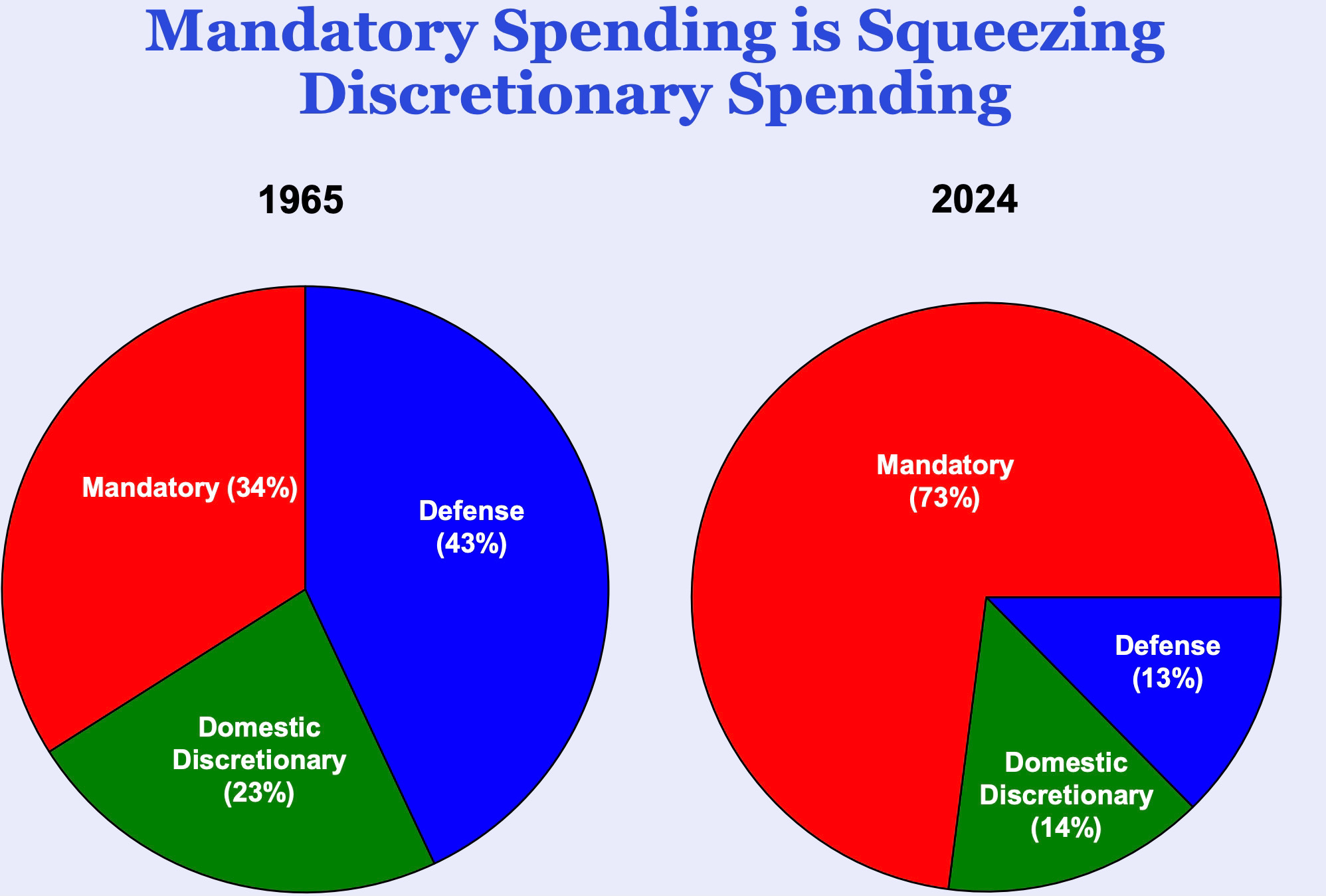
Discretionary spending represents only 16% of the federal budget. We can’t avoid entitlement reform.

By James A. Baker III and John W. Diamond

The Wall Street Journal | Feb. 24, 2025 – Excerpts:

Government debt has exceeded $36 trillion and continues mounting, with no end in sight. This is unsustainable absent dramatic changes in how we allocate our tax dollars.

Budget hawks have been rare in Washington since 2010, when the bipartisan Simpson-Bowles commission put forth a comprehensive plan to reduce spending and increase revenue, only to see it sink. Today, the problem is dire. Our ratio of federal debt held by the public to gross domestic product has grown from 61% in 2010 to 100% this fiscal year. Left uncorrected for another four years, we will surpass the historic high of 106% that America hit at the end of World War II.

It’s little wonder that more Republicans and Democrats are voicing concerns that American global power—backed by economic strength—is threatened by growing budget deficits. It’s time lawmakers seek solutions rather than argue about who’s to blame.

Several factors drive deficit spending, including an aging population and rapidly rising medical costs. But the major reason is reckless spending.

President Trump deserves credit for trying to make the federal bureaucracy more efficient to reduce deficits. His decision to create the Department of Government Efficiency put a much-needed brake on wasteful government spending.

…[T]here are many steps the administration and lawmakers can take. The nondefense discretionary spending that DOGE has focused on is only 16% of the federal budget. If DOGE reaches its goal of reducing spending by $500 billion, the budget deficit for the year will be reduced by about 26%. That’s a good start. But our leaders must also develop plans to control spending on entitlement programs, because those will be the primary source for our deficits in the coming decades.

America can’t achieve a sustainable budget without reforming Social Security, Medicare and other healthcare benefits. Together, these accounted for 49% of federal spending last year, and the share is growing over time.

Meanwhile, these programs are hurdling toward insolvency. Social Security is projected to be insolvent by 2034. Unless Congress and the White House enact reforms by then, there will be a 23% reduction in benefits. Similarly, Medicare Part A is projected to exhaust its trust fund by 2036, requiring an 11% cut in benefits.

….We’re about two presidential terms away from the Social Security and Medicare trust fund exhaustion dates. Fortunately, that’s plenty of time to identify solutions that can attract bipartisan support. Republicans and Democrats must work together to form bipartisan commissions to begin studying solutions.

Given the current political climate in Washington, it would be wise for such commissions to keep their thoughts as confidential as possible until the time comes to release a final set of recommendations. The reasoning for doing so is straightforward: Political foes are quick to use any mention of a potential solution as an immediate campaign slogan.

If America fails to act, debts will grow as deficits add up and interest payments balloon to unprecedented levels. Inflation will surge again. Such an outcome will reduce the nation’s economic vitality, impose a hardship on the least-affluent Americans most affected by inflation, and strip the U.S. of the flexibility needed to respond to economic crises and existential foreign policy challenges.

Mr. Baker served as White House chief of staff (1981-85 and 1992-93) Treasury secretary (1985-88) and secretary of state (1989-92). Mr. Diamond is senior director of the Center for Tax and Budget Policy at Rice University’s Baker Institute for Public Policy.

______________________________

The Leviticus 25 Plan will eliminate enormous sums of Household Debt for millions of American families, at the same time, helping to lift millions of Americans up and out of poverty.

The Leviticus 25 Plan will dramatically reduce federal (and state) government outlays and generate budget surpluses:

 Federal Income Tax recapture during each year of the initial 5-year activation period (2026-2030): $274.8 billion

Means-tested Welfare entitlement spending recapture during the 5-year target period (2026-2030): $3.153 trillion.

Total Medicaid/CHIP recapture (2026-2030): $2.026 trillion.
 
Total Medicare spending recapture (2026-2030):  $1.906 trillion.

VA Healthcare total recapture (2026-2030):  $239.472 billion

TRICARE recapture (2026-2030):  $228.0 billion.

Social Security Disability Income (SSDI) recapture (2026-2030): $633.072 billion.

Total Interest Expense eliminated due to projected operating surpluses (2026-2030): $114.839 billion.

Federal Budget – projected average annual surplus (2026-2030): $36.568 billion per year.

The most powerful economic acceleration plan in the world – loaded up and ready to launch.

The Leviticus 25 Plan – An Economic Acceleration Plan for America

$90,000 per U.S. citizen – Leviticus 25 Plan 2026 (25722 downloads )

Degenerative Disaster of Medicare — and The Leviticus 25 Plan Clean-Up

The Degenerative Disaster Of Medicare

ZeroHedge, Jul 07, 2024 | Via SchiffGold.com,Excerpts:

In 2023, the U.S. spent 1.04 trillion dollars on Medicare, which is over $3,000 per citizen. For an inefficient, problem-ridden program, that number is difficult for Americans to stomach.

Medicare is a health insurance program for seniors and specific disabled individuals. It has provided coverage for millions since it originated in 1965. However, the benefits it offers are far outweighed by its inefficiency and inadequacy, which cost trillions.

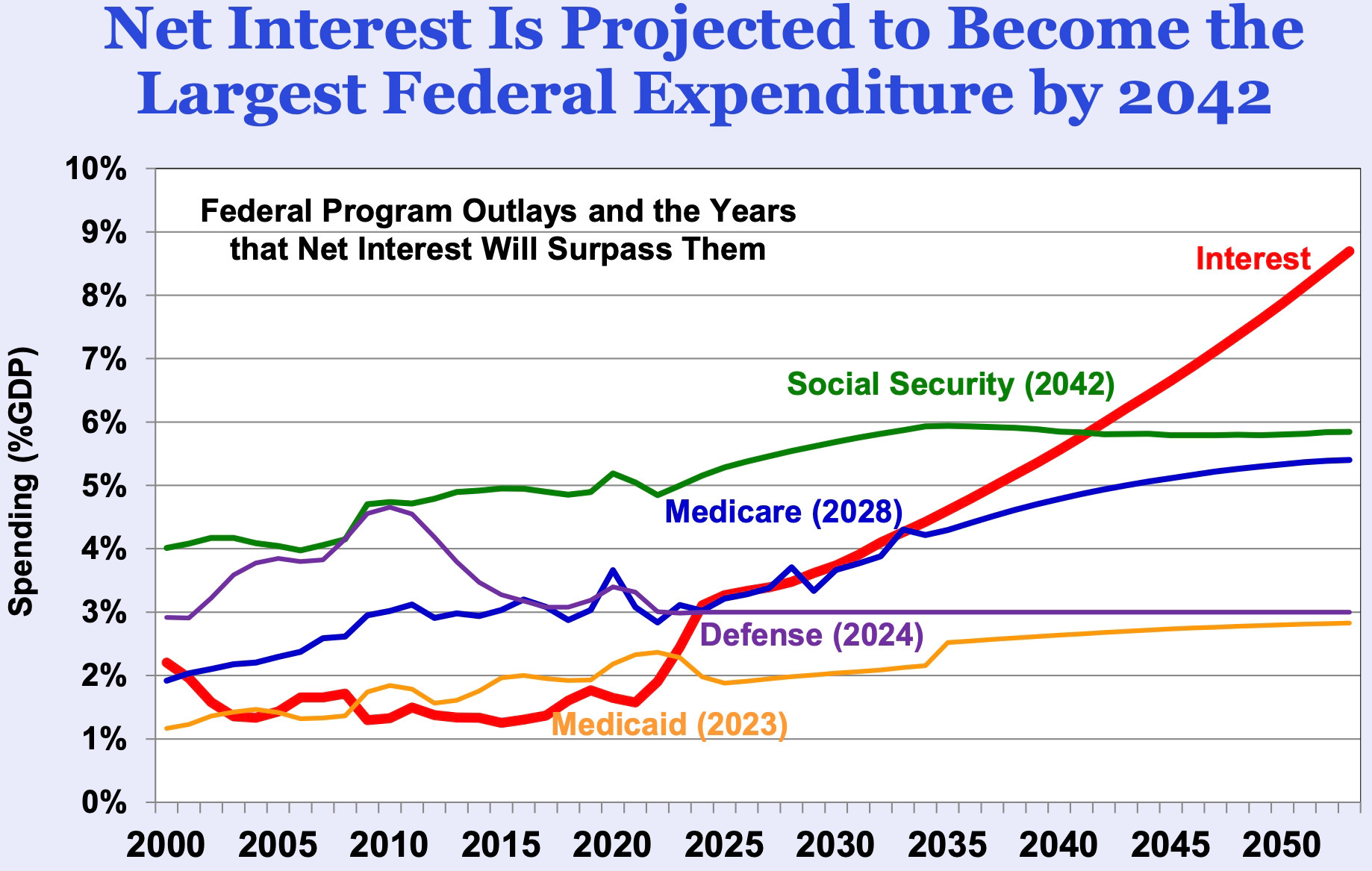
Medicare spending has grown exponentially since its creation under Lyndon B. Johnson. As of 2023, Medicare expenditures comprised 17% of the federal budget. The Congressional Budget Office projects Medicare’s spending will rise to $1.6 trillion by 2032. The Medicare Hospital Insurance Trust Fund, which finances a large percentage of Medicare, is set to be depleted by 2028. This threat of insolvency has the potential to leave millions of seniors without adequate coverage.

The causes of these burgeoning costs have a common thread: government inefficiency. Medicare’s fee-for-service model incentivizes quantity over quality—the program awards medical professionals for unnecessary procedures and artificially inflated costs. The American Medical Association approximates that 25% of Medicare spending, about $250 billion annually, is wasted on overtreatment, care administration inefficiencies, and excessive managerial costs.

Much of these administrative costs are due to the difficulty of complying with Medicare. A 2016 study showed that physicians spend an average of 785 hours per physician per year on Medicare regulatory compliance, costing an annual total of $15.4 billion.

These administrative complexities are due to the program’s intricate rules and regulations which often need to be clarified for both beneficiaries and healthcare providers. This often results in significant delays in care and excessive unnecessary costs. Medicare’s bureaucracy creates numerous obstacles for both physicians and patients which prevent seniors from getting the adequate care that they need.

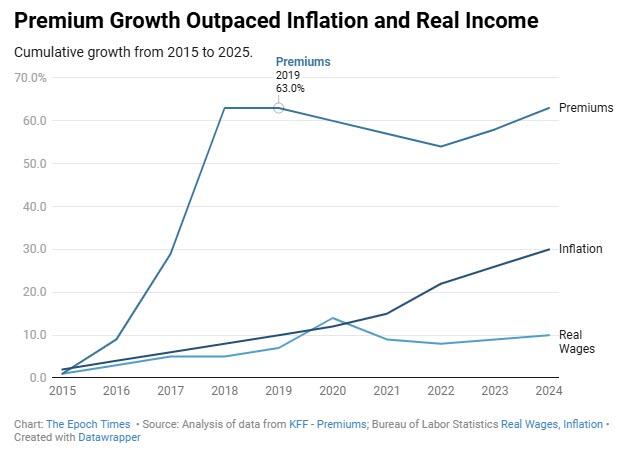
This inefficiency is also passed on to seniors in the form of taxes and fees. Despite the common belief that Medicare is “free,” it comes with numerous hidden costs. The 2021 standard monthly premium for Medicare Part B was $148.50, with recipients with higher incomes paying up to $504.90 every month. Since 2000, these premiums have increased by 226%, far outpacing inflation. Additionally, the Medicare payroll tax is set at 2.9%, with those earning over $200,000 facing an additional 0.9% tax.

The aging of the U.S. population is putting unprecedented strain on Medicare. As the baby boomer generation continues to reach retirement age, the number of Medicare beneficiaries is growing faster than the working-age population that supports the program through payroll taxes. In 2022, there were 65.0 million Medicare beneficiaries, with 57.1 million aged 65 and older. This number is projected to increase substantially in the coming years.

The Medicare Trustees Report projects that Medicare spending will grow from 3.8% of GDP in 2023 to approximately 6% by 2047. This rate of increase is unsustainable, and the increasing ratio of beneficiaries to workers means that either taxes must increase significantly, benefits must be cut, or both.

In addition, Medicare’s current structure limits beneficiary choice and stifles innovation in healthcare delivery. Telemedicine has shown promise in reducing healthcare costs, especially chronic disease management. However, Medicare hasn’t embraced these innovations due to stifling regulatory constraints. A market-based approach would allow for greater experimentation and adoption of cost-effective healthcare solutions, driving innovation and improving care quality for seniors.

The current trajectory of Medicare spending is unsustainable and threatens the fiscal stability of the United States. With projected expenditures reaching $1.04 trillion in 2023, the system requires bold action from Americans and politicians who want to preserve the country’s future.

Healthcare systems will continue to fail as long as the government continues to heavily interfere. A reformed system should prioritize consumer choice, encourage provider competition, and reward innovation in healthcare delivery. This approach would utilize market forces to drive down costs and improve quality while ensuring seniors have access to comprehensive health coverage.

The time for incremental changes has passed. Medicare has cost tens of trillions and is not adequately serving seniors’ needs. Only through bold, market-oriented reforms can we hope to achieve an efficient healthcare solution that benefits both seniors and the rest of the American people.

________________________________________

The Leviticus 25 Plan provides for a $30,000 direct deposit into the Medical Savings Accounts of all qualifying or provisionally qualifying U.S. citizens – to be used for primary health care services and insurance.

This liquidity extension will flow through a Federal Reserve / U.S. Treasury Department Citizens Credit Facility directly to qualifying and provisionally qualifying U.S. citizens electing to participate.

Each participating citizen also enrolled in Medicare, Medicaid, VA Health Care, FEHB and TRICARE will then have a $6,000 annual deductible for primary care services related to those programs for five years.

This will allow participating citizens to allocate health care resources directly and efficiently, eliminating “administrative complexities” related to “intricate rules and regulations.” It will eliminate massive administrative costs for health care facilities and providers.

For Medicare patients, as well as Medicaid, VA, FEHB, TRICARE, the $30,000 deposit will be “tax free.”

The Leviticus 25 Plan will also be a ‘bail-out’ colossus for the Medicare Trust Fund, in that citizens will be paying directly, with cash, for primary health care services – for which there will be no ‘billing and claims filing’ by middle-men.

Imagine the impact if 80% of Medicare Part D’s 1.4 billion prescription events per year were to be paid for in cash.

The Leviticus 25 Plan will clean up Medicare, Medicaid, VA Health Care, FEHB and TRICARE.

And it will bail out Medicare the right way – through the hands of millions of U.S. citizens.

The Leviticus 25 Plan – An Economic Acceleration Plan for America

$90,000 per U.S. citizen – Leviticus 25 Plan 2026 (25669 downloads )

  • to

WSJ: Medicaid Dollars “Directly to Patients”

WSJ: Give Medicaid Dollars Directly to Patients

Each beneficiary could get $7,000 a year in a health savings account.

By Justin Haskins and Michael Hamilton | April 12, 2017

As Republicans take another crack at devising a plan to replace ObamaCare, here’s an idea they should consider: Give each Medicaid patient a health savings account—and put $7,000 in it every year.

Under ObamaCare, Medicaid has become the only option for millions of Americans. But that doesn’t mean much if the doctors in their communities don’t accept new patients through the program—and 30% of physicians don’t.

The GOP’s recently benched health-care bill would have substantially reformed Medicaid by giving the states block grants, along with more flexibility on how to spend the money. But there’s a better model. Republicans should empower Medicaid patients by providing funds to them directly, which would allow them to build a personal safety net that could last a lifetime.

Washington and state governments spent $545 billion in 2015 on 73 million Americans covered by Medicaid and the Children’s Health Insurance Program. Instead lawmakers could take $511 billion of that total, divide it equally among enrollees, and give each one a health savings account with $7,000 a year. This would be real money for the poor, stored in real private accounts.

Recipients could use the deposit to buy health insurance and cover the cost of prescriptions, copays, deductibles and other related expenses. Unspent money would carry over to the following year. Enrollees could share that $7,000 with a sick spouse, sibling, parent or child.

Most recipients would probably use the funds to buy private health insurance, many for the first time. The average annual premium last year for an (overpriced) bronze plan on the ObamaCare exchanges was about $3,100 for a 30-year-old, $3,500 for a 40-year-old, $4,900 for a 50-year-old, and $7,400 for a 60-year-old. After that, at age 65, Americans qualify for Medicare.

Those figures mean that even after paying the premiums, all but the oldest Medicaid recipients would have money left over each year to save or spend on additional health-care costs. Enrollees who are relatively young and healthy soon would build personal safety nets worth tens of thousands of dollars. This would not only be good for them, it would stabilize Medicaid, which has become an enormous and unpredictable burden on state budgets.

Because bronze-plan deductibles are high—a 2017 average of about $6,100 for an individual and $12,400 for a family—some patients, especially those over 59 or with serious health problems, will need more help. Lawmakers could allocate the remaining $34 billion in the Medicaid budget line to assist them.

Under this plan, ObamaCare’s ban on pre-existing conditions should be kept in place for a set period with a firm sunset date. That would give Medicaid recipients time to buy in without penalty. Increasing the number of people enrolled in private insurance would then help spread risk and lower costs.

This plan would be a major improvement on both ObamaCare and the Republican proposal, creating personal safety nets and giving tens of millions access to high-quality health insurance. It might just be popular too.

Mr. Haskins is executive editor and Mr. Hamilton a research fellow at the Heartland Institute.

______________________________

The WSJ $7,000 plan is a small step in the right direction.

The Leviticus 25 Plan’s U.S. Health Care Freedom Plan, however, would be a major, far more powerful, step in the right direction.

1) It would help lift hundreds of thousands of U.S. citizens up and out of poverty, and reduce, by tens of thousands, the number of people even qualifying for Medicare enrollment (due to asset limitations); 2) It would clean up the health care system and restore citizen-centered, market-based health care that would be far more cost-effective, clean, and effective for everyone involved; 3) It would generate federal and state budget surpluses each of its first five years of activation (2026-2030), and pay for itself entirely over a 10-15 year period.

The Leviticus 25 Plan is a dynamic economic initiative providing direct liquidity benefits for American families, while at the same time scaling back the role of government in managing and controlling the affairs of citizens.  It is a comprehensive plan with long-term economic and social benefits for citizens and government.

The inspiration for this plan is based upon Biblical principles set forth in the Book of Leviticus, principles tendering direct economic liberties to the people.

The Leviticus 25 Plan – An Economic Acceleration Plan for America

$90,000 per U.S. citizen – Leviticus 25 Plan 2026 (25667 downloads )

U.S. Budget Deficit Hits New Record $840 Billion over First 4 Months of 2025…

US Budget Deficit Hits A Record $840 Billion In First 4 Months Of 2025; Interest On Debt Hits Record $1.2 Trillion

ZeroHedge, Feb 12, 2025 – Excerpts:

First the good news: Elon Musk’s DOGE is going through government spending with a fine-toothed comb, slashing a million here, a billion there.

The bad news: at the rate it is going, DOGE will need a few hundred years to make a tangible impact, because as the Treasury reported earlier today, in January the US government spent a near-record $642 billion, a 29% increase from the $500 billion in January…

… while it collected just $513.3 billion in tax revenues, a far more modest 7.5% increase YoY…

… which resulted in a $129 billion budget deficit for the month

… the second highest January deficit on record (only the post-covid shock of 2021 was great)…

… and $840 billion so far in fiscal 2025.

This is a problem because as shown in the next chart, the cumulative budget deficit for the first 4 months of fiscal 2025 is the highest on record, surpassing even the fiscal shock from the depths of the post-covid response.

And the punchline is that no matter what Musk does, the USS Titanic is now more or less on autopilot because while a few billions in discretionary spending can be cut, interest on the debt can not be – without a default (it can however be inflated away… and it will be) – and in January, gross interest on the Federal debt hit a record $1.167 trillion in the past twelve months thanks to another $83.6 billion in interest spending.

Another way of looking at it: in the first four months of the fiscal year, the US has spent $392 billion on interest alone, the highest 4 month total ever.

_____________________________________________

There is only one plan in the all the world with the power to clean up this paralyzing debt burden once and for all — a plan with a Biblical precedent.

The Leviticus 25 Plan is a dynamic economic initiative providing direct liquidity benefits for American families, while at the same time scaling back the role of government in managing and controlling the affairs of citizens.  It is a comprehensive plan with long-term economic and social benefits for citizens and government.

The inspiration for this plan is based upon Biblical principles set forth in the Book of Leviticus, principles tendering direct economic liberties to the people.

The Leviticus 25 Plan – An Economic Acceleration Plan for America

$90,000 per U.S. citizen – Leviticus 25 Plan 2026 (25334 downloads )