U.S. Banks: “No Stability, No Investment, No Growth” – More Job Cuts Coming. Solution: The Leviticus 25 Plan

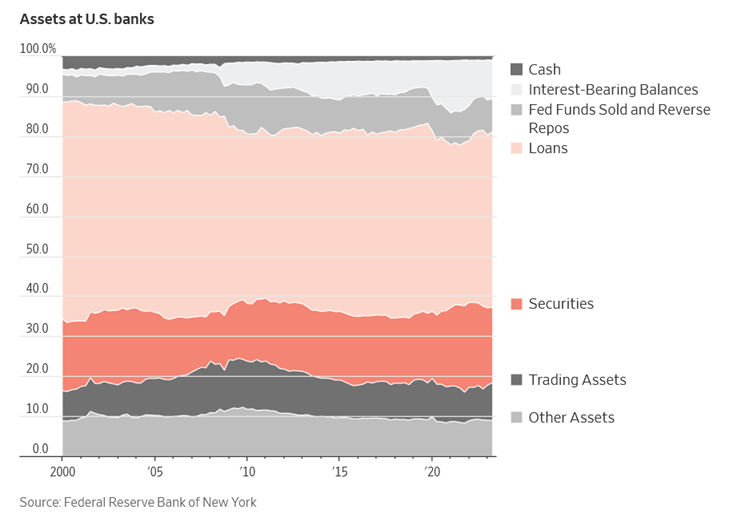
Cash balances at U.S. banks are dangerously thin…

Banking Crisis Plays out at America’s Smallest Lenders  WSJ 12-27-23

………………………………………………………………………………..

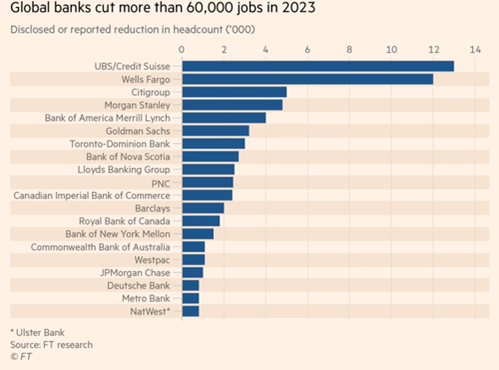
Banks Terminate 60,000 Workers In One Of The Bleakest Years For The Industry Since 2008

ZeroHedge, Dec 27, 2023 – Excerpts:

The collapse of three US regional banks – First Republic Bank, Silicon Valley Bank, and Signature Bank – marked some of the largest failures in the banking system since 2008. Central banks contained the “mini-crisis” earlier this year with forced interventions and the mega-merger of Credit Suisse and UBS. Despite the interventions, global banks still axed the most jobs since the global financial crisis. 

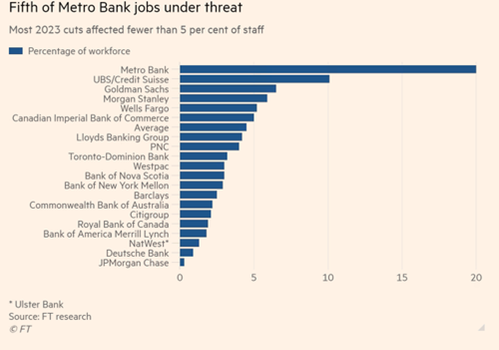
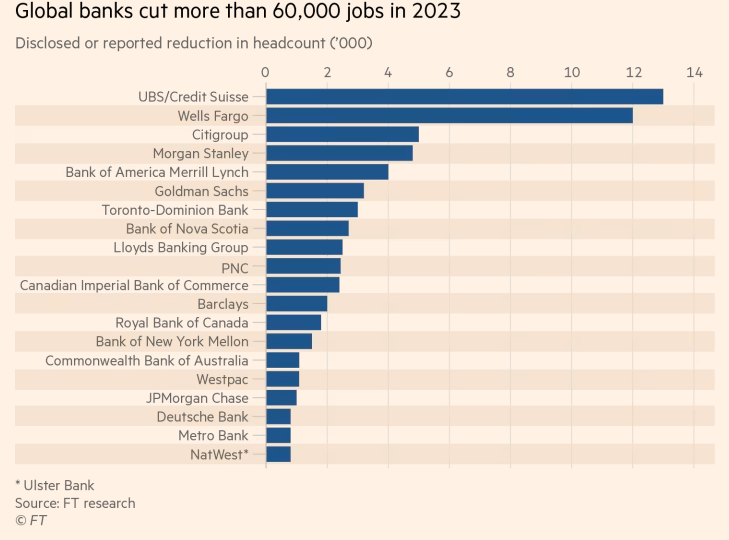
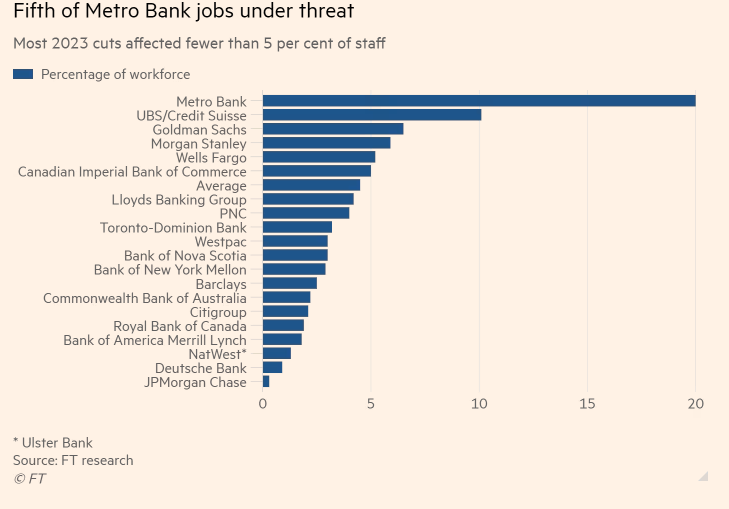
A new report from the Financial Times shows twenty of the world’s largest banks slashed 61,905 jobs in 2023, a move to protect profit margins in a period of high interest rates amid a slump in dealmaking and equity and debt sales. This compared with the 140,000 lost during the GFC of 2007-08.

“There is no stability, no investment, no growth in most banks — and there are likely to be more job cuts,” said Lee Thacker, owner of financial services headhunting firm Silvermine Partners. 

FT noted that corporate disclosure data and its independent reporting did not include smaller regional bank cuts, indicating total job loss could be much higher. 

At least half of the job cuts came from Wall Street lenders struggling with Western central banks’ most aggressive interest rate hikes in a generation. 

The most significant cut of any single bank was at Switzerland’s UBS.

Morgan Stanley reduced jobs by 4,800, Bank of America by 4,000, Goldman Sachs by 3,200, and JPMorgan Chase by 1,000. As a whole, Wall Street cut 30,000 workers this year. 

“The revenues aren’t there, so this is partly a response to overexpansion. But there is also a simpler explanation: political cost-cutting,” said Thacker. 

Gaurav Arora, global head of competitor analytics at Coalition, warned: “We expect full-year 2024 to be a continuation of the story of 2023.”

Arora’s view of further turmoil aligns with our two recent notes: Banks’ Usage Of The Fed’s Bailout Facility Soars To New Record High and Large Bank Deposits Rise As Money-Market Outflows Accelerate, Small Banks Still Stressed

“We see banks getting more conservative,” Arora concluded. 

_______________________________________

Navigating the Waters: The Current State of Distressed Debt

Wilmington Trust, Mar 16, 2023 The macro picture for distress

Many loan market analysts have taken a dim view of the distressed space in the next two years. Fitch, for example, sees a band of 2023 institutional leveraged loan default rates between 2.5%–3.0%. They project $47 billion of defaults in 2023 at the midpoint of their forecast.1

Deutsche Bank is more pessimistic, expecting a 5.6% default rate in the United States and a 3.7% rate in the euro market in 2023. Per their estimates, default rates on U.S. leveraged loans will hit a near-record high of 11.3% in 2024, while defaults on euro-leveraged loans will hit 7.1%.2

Undoubtedly, the economic climate is harsh for borrowers. A complex economic cycle continues to spin. Wilmington Trust’s 2023 Capital Markets Forecast highlights an inflationary vortex driven by labor, China, and energy, which creates structural stress.3 This vortex and the resulting monetary policy are exerting its pull across companies’ capital structures.

Mortgage delinquencies – “About five million U.S. households were estimated to be behind on their last month’s mortgage repayment in June 2023. Homeowners between 40 and 54 years made up over 1.8 million households late on their payment. Second in rank were roughly 1.5 million homeowners between 25 and 39 years” -Statista, Jul 23, 2023

According to Kipplinger, “the delinquency rate for conventional loans increased 21 basis points to 2.5%, while the rate for FHA loans increased 55 basis points to 9.5%. The delinquency rate for VA loans increased 6 basis points to 3.76%.”

__________________________________

The Leviticus 25 Plan provides direct liquidity extensions to qualifying U.S. citizens, through a Fed-based Citizens Credit Facility, for the express purpose of massive ‘ground-level’ debt elimination.

This process will provide the banking system with massive new inflows of liquidity to strengthen cash reserves, solve a majority of banks’ distressed debt and delinquent mortgage issues, allow banks to rectify a significant proportion of their ‘maturity mismatch’ issues with fresh purchase of Treasuries and other high-grade credit instruments yielding significantly higher yields.

The Leviticus 25 Plan will generate federal budget surpluses of $619.5 billion each of the first five years following activation, and pay for itself over a 10-15 year period.

It will generate long-term economic growth – not dependent upon debt issuance.

It will restore financial security for millions of American families – and reduce dependence on government programs.

The Leviticus 25 Plan is a dynamic economic initiative providing direct liquidity benefits for American families, while at the same time scaling back the role of government in managing and controlling the affairs of citizens.  It is a comprehensive plan with long-term economic and social benefits for citizens and government.

The inspiration for this plan is based upon Biblical principles set forth in the Book of Leviticus, principles tendering direct economic liberties to the people.

The Leviticus 25 Plan – An Economic Acceleration Plan for America

$60,000 per U.S. citizen – Leviticus 25 Plan 2023 (10650 downloads)

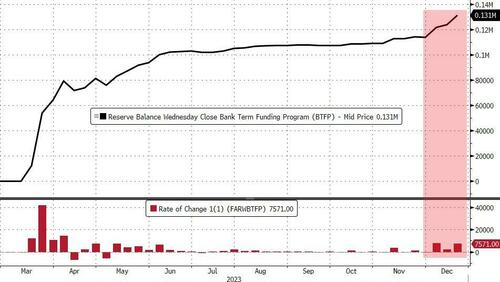
Fed’s ‘Bank Temporary Funding Program’ (BTFP) Hits ‘Record High’ Demand

The BTFP has been running hot for the past 10 months, and is now surging up to new record highs. Banks with accounts at the Fed are also able, in the process, to engage in an arbitrage play by ‘borrowing’ funds and then immediately redepositing them with the Fed to earn ”free interest in the process.

America’s hard-working, tax-paying U.S. citizens should be so fortunate.

………………………………………………………

Banks’ Usage Of The Fed’s Bailout Facility Soars To New Record High

ZeroHedge, Thursday, Dec 21, 2023 – Excerpts:

Usage of The Fed’s BTFP bank bailout facility soared again last week, jumping $7.5BN to $131BN…

Source: Bloomberg

……An arbitrage for banks is growing more attractive thanks to traders who are betting the Fed will aggressively cut interest rates in 2024.

The rate on the Fed’s Bank Term Funding Program – which allows banks and credit unions to borrow funds for up to one year, pledging US Treasuries and agency debt as collateral valued at par – is the one-year overnight index swap rate plus 10 basis points.

That figure is currently 4.88%, down from 5.17% on Dec. 13.

For institutions that have an account at the Fed, they can borrow from the BTFP at 4.88% and park that at the central bank to earn 5.40% – the interest on reserve balances.

The 52bp spread matches the widest level since the Fed introduced the facility to support a struggling banking system after the collapse of California’s Silicon Valley Bank and Signature Bank in New York.

……………………………………….

Bank Term Funding Program: Definition, Why It Was Created

By Adam Hayes, Ph.D., CFA | Investopedia – March 23, 2023 Excerpt:

The Bank Term Funding Program (BTFP) is an emergency lending program created by the Federal Reserve in March 2023 to provide emergency liquidity to U.S. depository institutions. It was established in response to the sudden bank failures of Signature Bank and Silicon Valley Bank, which were the largest such collapses since the 2008 financial crisis.

The program was created to support depositors, such as American businesses and households, by making additional funding available to eligible institutions to help assure that banks have the ability to meet the needs of all their depositors.

The BTFP offers loans of up to one year in length to U.S. banks, savings associations, credit unions, and other eligible depository institutions that pledge U.S. Treasuries, agency debt, mortgage-backed securities (MBS), and other qualifying assets as collateral.

The BTFP is intended as a temporary emergency measure and is set to wind down on March 11, 2024, unless renewed by the Federal Reserve.

_____________________________

Depository institutions remain in serious need of emergency funding.

Main Street America is also in serious need of liquidity – and, neither the Fed or the U.S. Congress has any plan to address those growing needs.

“According to CNBC, while three-quarters of individuals earning $50,000 or less are living paycheck to paycheck, 65% of those earning $50,000 to $100,000 are in the same predicament. Of those earning $100,000 or more, 45% reported living paycheck to paycheck” (Yahoo Finance).

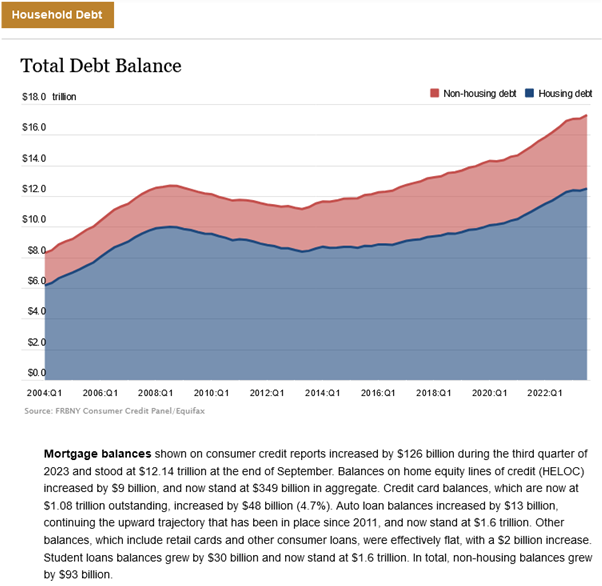
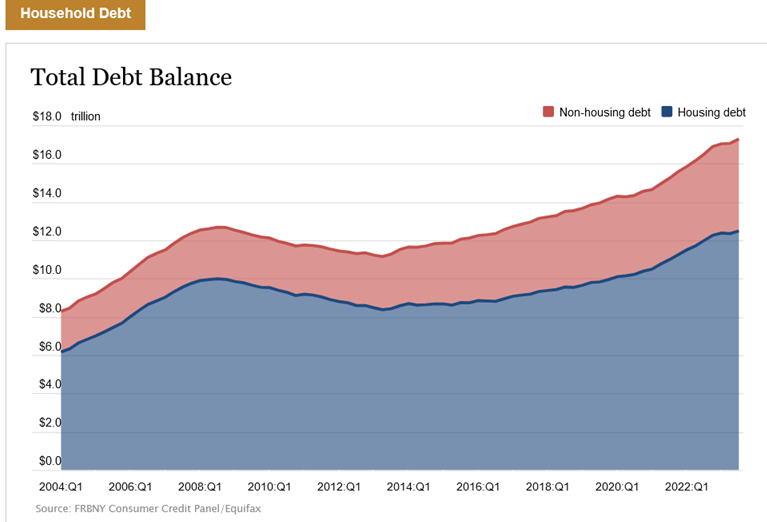
Total Household Debt rose to $17.29 trillion in Q3 2023; Driven by mortgages, credit cards, and student loan balances.

Small business bankruptcies in 2023 have been accelerating.

The Leviticus 25 Plan offers a dynamic economic reset for America – with direct liquidity extensions to qualifying U.S. citizens to eliminate vast expanses of ground-level debt across America, mortgage debt, installment debt, credit card debt, and student loan debt.

Depository institutions will, in the process, receive their much needed liquidity – after it has passed through the hands of U.S. citizens.

The Leviticus 25 Plan is a dynamic economic initiative providing direct liquidity benefits for American families, while at the same time scaling back the role of government in managing and controlling the affairs of citizens.  It is a comprehensive plan with long-term economic and social benefits for citizens and government.

The inspiration for this plan is based upon Biblical principles set forth in the Book of Leviticus, principles tendering direct economic liberties to the people.

The Leviticus 25 Plan – An Economic Acceleration Plan for America

$90,000 per U.S. citizen – Leviticus 25 Plan 2023 (10518 downloads)

Treasury Auctions Set Up: Widening Mismatch Between Supply and Demand

Treasury Borrowing Running At Crisis-Era Levels

ZeroHedge, Nov 06, 2023 – Excerpts:

With the November quarterly refunding announcement now in the rearview mirror, we look to the Treasury’s borrowing outlook in historical context. As a reminder, we already gave our verdict last week…

US To Borrow $1.5 Trillion In Debt This & Next Quarter, After Borrowing A Massive $1 Trillion Last Quarter https://t.co/DYyMGKi5RJ — zerohedge (@zerohedge) October 30, 2023

… Deutsche Bank rate strategist Steven Zeng who on Friday published a chart that takes the numbers from the Treasury’s sources and uses table with adjustments to remove the fluctuations in the TGA. This provides a cleaner comparison of quarter-by-quarter borrowing. For example, the Treasury borrowed $1.01 trillion during Q2’23, with $756bn used for financing the deficit and QT, and $254bn was “saved” in the form of a higher cash balance.

In this light, Zeng notes that the Treasury’s expected borrowing for the current and the next quarter is actually larger than Q3’s, growing by about $10 billion per month. In fact, Treasury borrowing is now on par with levels during the 2020-2021 pandemic with both weaker fiscal positions and Fed QT are contributing factors.

As Zeng puts it, “with a growing view that the Fed may lengthen the duration of QT, and annual deficits projected at around $1.7- $1.8 trillion over the next few years, these issues are unlikely to go away soon.” At the same time, the widening mismatch between supply and demand for Treasuries could exacerbate the issue through increased debt interest expenses.

Goldman has some even more disturbing numbers: according to the bank’s rates strategist Praveen Korapaty, his outlook for Treasury supply in 2024 shows net notional issuance of $2.4 tr, which is inclusive of both bills and coupons. Gross coupon issuance would be much larger, roughly $4.2 tr, which includes issuance to cover maturing debt.

These concerns will remain in the forefront in 2024, with the TBAC highlighting this week the linkage between term premium and fiscal sustainability…

The thing about Wall Street is that if everyone agrees to stick their head in the sand and ignore the elephant in the room, it’s easy to do.

The problem is when someone notices the elephant. That’s what the TBAC did today pic.twitter.com/mJLbzvbpD0 — zerohedge (@zerohedge) November 2, 2023

… and that debt and debt service costs should be a consideration for policymakers.

__________________________________

It is time to kickoff America’s ‘elephant roundup’ ...

The Leviticus 25 Plan will generate, conservatively, $619.5 billion budget surpluses annually in its first five years of activation.

The Leviticus 25 Plan – An Economic Acceleration Plan for America

$90,000 per U.S. citizen Leviticus 25 Plan 2023 (10442 downloads)

158 Secret-voting Republicans Join Democrats to Include Earmarks in Year-end Spendathon.

Net effect of the Earmarks inclusion: $16,012,272,565 of your tax dollars to be spent on 7,509 earmarks.

In the fiscal year 2024 spending bills being debated this fall, the top 63 earmarkers in the U.S. House are Republicans. Eight of the top ten earmarkers in the U.S. Senate are Republican

…………………………………

Earmarks Are Back: House Republicans “Opened the Bar” For the Spendaholics

ZeroHedge, Oct 15, 2023 – Via OpenTheBooks.comExcerpts:

…….Unfortunately, the first thing the GOP did after they took control of the U.S. House – before the new Congress was even sworn in – they held a secret vote on earmarks. Last December, 158 GOP members of Congress voted to include earmarks in the year-end omnibus spending bill.

House Republicans “opened the bar” for the spendaholics.

Those 158 secret-voting members caused $16,012,272,565 of your tax dollars to be spent on 7,509 earmarks.

Not only did those 158 members adopt earmarks, the Republicans spent more of your tax dollars than their Democratic earmarking colleagues.

In the fiscal year 2024 spending bills being debated this fall, the top 63 earmarkers in the U.S. House are Republicans. Eight of the top ten earmarkers in the U.S. Senate are Republicans.

The U.S. House has a bartender at the spendaholics earmark bar – Rep. Kay Granger (R-Texas). She chairs the Appropriations Committee that approves every one of those earmarks. When she was elected to Congress in 1997, the federal debt was $5.4 trillion.

Here are a few examples of what these big spending members of Congress – in both parties – think is more important than the exploding federal debt.

Senator Susan Collins (R-Maine) earmarked $302 million last December and $556 million stuffed inside the 2024 bills. Maine’s population is only about 1.3 million and Collins earmarked $2,640 per family of four. When Collins was first elected in 1997, the federal debt was $5.4 trillion….

Last December, Senator Patrick Leahy (D-Vermont) earmarked $30 million to the University of Vermont Honors College. In May, the trustees renamed the college after Leahy. Leahy earmarked $34 million into the international airport at Burlington. In April, the city council renamed the airport after Leahy. Senator Leahy got his name on buildings after earmarking your tax dollars and every dime of it was borrowed against our national

…………………..

SUMMARY – By embracing earmarks, Republicans fumbled the first opportunity to distinguish themselves from big-spending Democrats. 

Speaker Kevin McCarthy doesn’t request earmarks himself but allowed a secret caucus vote to bring them back.

It’s time for a public, on-the-record, up or down vote on earmarks in the United States House of Representatives. Would all 158 earmark-loving Republicans stick with their secret vote?

…………………..

THE REBIRTH OF EARMARKS IS A STATEMENT FAR MORE DEVASTATING THAN THE NUMBERS:

  • It is a statement of the culture within Congress.
  • A culture that shows no respect for your tax dollars.
  • No respect for the lurking danger the exploding federal debt poses for our country.

IF OUR GREAT COUNTRY IS TO SURVIVE, THE CULTURE WILL HAVE TO CHANGE.

THOMAS W. SMITHChairman, OpenTheBooks.com

ADAM ANDRZEJEWSKICEO & Founder – OpenTheBooks.com

___________________________________

To Washington Republicans: The federal debt is a national security issue. It is discouraging enough to see you joining in with Democrats to indiscriminately run up the national debt another $16 billion round of earmarks…

But what is far worse – you have no politically-feasible strategic plan to get America’s exploding debt load back under control.

You could get your credibility back and give voters a reason to support you if you did have a credible solution to America’s debt crisis.

Main Street America Republicans have that very solution.

The Leviticus 25 Plan – An Economic Acceleration Plan for America 2024

Economic Scoring links:

·  The Leviticus 25 Plan 2023 – $583 billion Federal Budget Surpluses (2023-2027), Part 1: Overview, Deficit Projection

·  The Leviticus 25 Plan 2023 – $583 Billion Federal Budget Surpluses Annually (2023-2027), Part 2: Federal Income Tax and Means-Tested Welfare Recapture Benefits.

·  The Leviticus 25 Plan 2023 – $583 Billion Federal Budget Surpluses Annually (2023-2027), Part 3: Medicaid/CHIP and Medicare Recapture Benefits

·  The Leviticus 25 Plan 2023 – $583 Billion Federal Budget Surpluses Annually (2023-2027), Part 4: VA, TRICARE, FEHB, SSDI Recapture Benefits

·  The Leviticus 25 Plan 2023 – $583 Billion Federal Budget Surpluses Annually (2023-2027), Part 5: Subtotals, Interest Expense Savings, Summary

The Governmental Accountability Office has stated that America’s ongoing debt crisis is unsustainable.

It is time for America to initiate a bold, new plan.  Our future depends upon it.

The Leviticus 25 Plan – loaded up and ready to launch.

The Leviticus 25 Plan is a dynamic economic initiative providing direct liquidity benefits for American families, while at the same time scaling back the role of government in managing and controlling the affairs of citizens.  It is a comprehensive plan with long-term economic and social benefits for citizens and government.

The inspiration for this plan is based upon Biblical principles set forth in the Book of Leviticus, principles tendering direct economic liberties to the people.

The Leviticus 25 Plan – An Economic Acceleration Plan for America

$90,000 per U.S. citizen – Leviticus 25 Plan 2023 (10440 downloads)

Website: https://leviticus25plan.org/

The Lifeblood of the U.S. Economy: 33.2 Million Small Businesses Employing 61.7 Million Americans. Wanted: Financially Healthy U.S. Consumers.

Following the Covid lockdowns, supply chain issues, rising inflation, ‘tapped out’ consumers – America’s Small Businesses are in desperate need of a fresh start.

Bankrate.com, Sep 18, 2023:

  • Statistics vary, but between 55 percent to 63 percent of Americans are likely living paycheck to paycheck.
  • Three in four Americans who earn less than $50,000 are living paycheck to paycheck, compared to roughly two in three of those making $50,000 to $100,000.
  • Paycheck-to-paycheck living can result in missed or late payments, which can cause your credit score to drop — leading to fees, penalties, higher financing costs and difficulty qualifying for future credit.

…………………………………………………………….

Frequently Asked Questions About Small Business 2023

Small Business Office of Advocacy

Mar 7, 2023: There are 33,185,550 small businesses in the United States. Small businesses employ 61.7 million Americans, totaling 46.4% of private sector employees.

From 1995 to 2021, small businesses created 17.3 million net new jobs, accounting for 62.7% of net jobs created since 1995.

Small businesses are the lifeblood of the U.S. economy: they create two-thirds of net new jobs and drive U.S. innovation and competitiveness

………………………….

Pendulummag.com: It’s tough to do business in an environment where the input costs are constantly rising, and revenue is not keeping pace.

At best, it means slimmer margins for business owners. At worse, it means no margins or even being in the red.

A survey conducted last summer that involved 4,392 small business owners with fewer than 50 employees in the United States showed that 47% of these businesses were at risk of closing. Of the various industries surveyed, the most at-risk businesses are those in the retail, construction, and restaurant industries. I think we can agree that the business environment hasn’t improved in 2023, given the stickiness of inflation and how interest rates have continued to go up.

________________________________

The U.S. Department of Treasury, The Federal Reserve, and Washington Democrats and Republicans have no credible plan to reduce America’s staggering debt load, re-ignite economic growth, restore economic liberty, and brighten the future for America’s 33 million small businesses and their 61.7 million employees..

Main Street America Republicans do have a plan – the most powerful economic acceleration plan in the world.\

The Leviticus 25 Plan is a dynamic economic initiative providing direct liquidity benefits for American families, while at the same time scaling back the role of government in managing and controlling the affairs of citizens.  It is a comprehensive plan with long-term economic and social benefits for citizens and government.

The inspiration for this plan is based upon Biblical principles set forth in the Book of Leviticus, principles tendering direct economic liberties to the people.

The Leviticus 25 Plan – An Economic Acceleration Plan for America

$90,000 per U.S. citizen – Leviticus 25 Plan 2023 (9166 downloads)

Round 2: 2.9 Million Borrowers Will Pay Nothing in Democrats’ “Most Generous Ever” Student Loan Repayment Plan.

Washington Republicans, tapping the ‘generosity’ brakes – have no alternative plan.

……………………………………….

2.9 Million Borrowers Pay Nothing In Biden’s ‘Most Generous Ever’ Student Loan Repayment Plan

ZeroHedge, Nov 09, 2023 | Authored by Bill Pan via The Epoch Times (emphasis ours) Excerpts:

Nearly 5.5 million federal student loan borrowers have enrolled in what the Biden administration calls “the most generous” repayment option ever offered, federal officials said on Wednesday.

The repayment plan, dubbed the Saving on Valuable Education (SAVE) plan, went into effect in August as part of President Joe Biden’s regulatory effort to dramatically reduce monthly obligations for student borrowers who aren’t earning very much, with many borrowers seeing their bills shrink to practically nothing.

According to the latest update from the U.S. Department of Education, about 2.9 million of the SAVE plan’s current enrollees have incomes that are low enough that they have monthly payments of $0.

The updated SAVE enrollment figure includes 1.8 million borrowers who have newly signed up for the program, as well as another 364,000 borrowers who were automatically switched to SAVE because they had already been in one of the existing income-driven repayment (IDR) plans that the Biden administration seeks to replace with SAVE….

Overall, borrowers are repaying $300 billion in federal student loans on the plan. That represents about 19 percent of the $1.6 trillion in outstanding debt from the federal student loan portfolio.

One of the biggest differences between the SAVE plan and IDR plans is that the amount of income incurring no charge, or protected income, rises from 150 percent above the federal poverty guidelines to 225 percent. Under the SAVE plan, payment also drops from 10 percent of the difference between earnings and protected income to 5 percent.

In practice, this means a single person who earns less than $32,800 a year is required to pay $0 a month. The same applies to a family of four that has an annual income less than $67,500.

On top of all that, under the SAVE plan, borrowers will see their remaining loan balances wiped out after 10 years of repayments. By comparison, it takes 20 or 25 years under IDR for borrowers to get their remaining debt canceled.

“I’m thrilled to see that in less than three months, nearly 5.5 million Americans in every community across the country are taking advantage of the SAVE Plan’s many benefits, from lower monthly payments to protection from runaway student loan interest,” U.S. Secretary of Education Miguel Cardona said in a statement on Monday, promising to “not rest” in the efforts to “make paying for college more affordable.”

Biden Plan Faces Republican Challenge – The SAVE plan is expected to cost billions in taxpayer dollars, a point Republican lawmakers have been emphasizing since the plan’s announcement.

Estimates vary widely, but one analysis by the University of Pennsylvania’s Wharton School suggests that the plan will cost about $475 billion in a span of 10 years.

“About $200 billion of that cost will come from payment reduction for the $1.64 trillion in loans already outstanding in 2023,” the analysis read.

According to the leading business school, the SAVE plan will be incentivizing college students to collectively borrow billions more dollars every year in the next decade due to the expectation that they may not have to repay the debt.

The remainder of the budget cost, or about $275 billion, comes from reduced payments for about $1.03 trillion in new loans that we estimate will be extended over the next 10 years,” it added.

Citing Wharton’s estimates, a group of 17 Republican senators in September introduced a Congressional Review Act (CRA) resolution against the plan. A CRA resolution does not only nullify an existing rule but bans the federal agency from issuing the same rule again unless Congress later passes a new law authorizing the agency to do so.

“It’s incredibly unfair to those who never incurred student debt because they didn’t attend college in the first place or because they either worked their way through school or their family pinched pennies and planned for higher education,” said Sen. Bill Cassidy (R-La.), ranking member of Senate’s education committee.

“Our resolution protects the 87 percent of Americans who don’t have student debt and will be forced to shoulder the burden of the President’s irresponsible and unfair policy,” he added.

Sen. Cassidy is joined by Sens. John Barrasso (R-Wyo.), Mike Braun (R-Ind.), John Cornyn (R-Texas), Mike Crapo (R-Idaho), Steve Daines (R-Mont.), Joni Ernst (R-Iowa), Chuck Grassley (R-Iowa), Cindy Hyde-Smith (R-Miss.), Ron Johnson (R-Wis.), James Lankford (R-Okla.), Cynthia Lummis (R-Wyo.), Roger Marshall (R-Kan.), James Risch (R-Idaho), Tim Scott (R-S.C.), John Thune (R-S.D.), and Thom Tillis (R-N.C.).

A companion CRA resolution was introduced by Rep. Lisa McClain (R-Mich.) in the lower chamber. Both chambers are expected to vote on the Republican-led resolutions in the coming weeks.

In defense of the repayment plan, Mr. Cardona implored lawmakers seeking to undo it to speak with borrowers who are “drowning in debt.”

“We’re hearing from the American people who are drowning in debt and can’t buy a home in the economy because of college costs,” he said during a Sept. 8 interview on CNN. “Those who are vehemently opposed to it have not spoken to their constituents who are drowning, who need support, who need to make higher education more accessible.”

__________________________________

Student Loan Forgiveness – Round 2

The Democrats’ SAVE Plan will: 1) Help rescue several million college-educated Americans who are “drowning in debt,” 2) Buy votes of millions of college-educated Americans and extended family members for the 2024 election – and years to come; 3) Incentivize college students “to collectively borrow billions more dollars every year in the next decade due to the expectation that they may not have to repay the debt”; (4) Incentivize college students to remain below the income limits after graduation, in order to effectively dodge loan repayment obligations – which will, at the same time, qualify millions of these same college-educated Americans for additional entitlement benefits..

The Democrats’ SAVE Plan will also: 5) Provide NO BENEFITS for those college grads who have worked and saved to pay off their student loan debts; 6) Not only provide NO BENEFITS for young working-class Americans who never went to college, it will also ‘tax’ them to pay the bills on the SAVE Plan for current and future college students; 7) Add hundreds of billions of dollars over the coming 10 years to America’s booming annual deficits.

The Washington Republicans’ resolution against the SAVE Plan will: 1) DO NOTHING to help the millions of college-educated Americans who are “drowning in debt;” 2) DO LITTLE, IF ANYTHING to win votes in 2024 and beyond – and build ‘brand loyalty’ for Republicans; 3) DO NOTHING to reincentivize responsibility to borrowing agreements; 5) DO NOTHING to reduce dependence on government and shrink entitlement rolls; 6) PROVIDE NO TANGIBLE BENEFITS for the millions of college-grads / extended family members who did successfully pay back their student loans, and PROVIDE NO TANGIBLE BENEFITS for the hundreds of millions of working-class Americans who never went to college.

And finally…

The Washington Republicans’ resolution against the SAVE Plan will DO NOTHING to resolve America’s burgeoning debt crisis – in any meaningful way.

………………………….

Meanwhile...

Main Street America Republicans also have a plan.

Once unleashed, this plan will: 1) Provide dynamic tangible financial rewards, and massive debt-elimination benefits for all hard-working, tax-paying U.S. citizens who wish to participate; 2) Build ‘brand loyalty’ and attract voters for 2024 and years beyond; 3) Reduce dependence on government and restore economic liberty in America; 4) Generate $619.5 billion budget surpluses each of the first five years of activation; and 5) Pay for itself entirely over the succeeding 10-25 years.

The Leviticus 25 Plan is a dynamic economic initiative providing direct liquidity benefits for American families, while at the same time scaling back the role of government in managing and controlling the affairs of citizens.  It is a comprehensive plan with long-term economic and social benefits for citizens and government.

The inspiration for this plan is based upon Biblical principles set forth in the Book of Leviticus, principles tendering direct economic liberties to the people.

The Leviticus 25 Plan – An Economic Acceleration Plan for America

$90,000 per U.S. citizen – Leviticus 25 Plan 2023 (8898 downloads)

Massive Debt Across all Sectors. “Unprecedented” Fiscal Doom Loop Getting Worse. Solution: America’s Debt-Buster Behemoth Economic Acceleration Plan Ready to Launch.

This “Unprecedented” Fiscal Doom Loop Is Getting Worse

ZeroHedge, Oct 24, 2023 | Submitted by QTR’s Fringe Finance

Excerpts:

Lawrence Lepard; US FISCAL DOOM LOOP GETS WORSE

In our view, the biggest elephant in the room is the US Fiscal Doom Loop. To refresh: US Government spending is out of control, and there appears to be very little political will to stop it. As the chart below shows, Government spending is up 14% yoy and tax receipts are down 7% yoy.  Fiscal year ended September 2023 is projected to have a deficit of over $2 Billion (or roughly 8% of GDP). In the past, deficits of this magnitude only materialized during significant downturns like the bursting of the Dotcom Bubble, the 2008 GFC and the COVID crisis. It is unprecedented to have deficits of this magnitude with the economy and employment being relatively strong.

One can only imagine where the deficit goes when the FED’s monetary jihad of rapid rate increases tips the economy over. Past economic downturns typically have increased the deficit/GDP ratio by 8-14%.  

So as the economy moves into recession in 2024 (as we believe), the US could be looking at deficits as high as 20% of GDP ($5 Trillion) if the economy slows dramatically. 

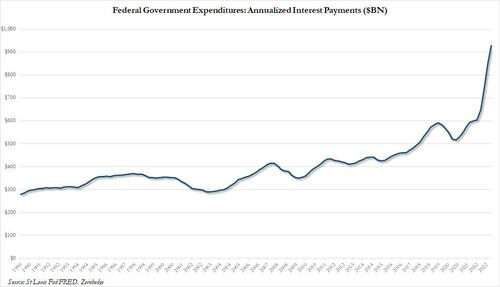
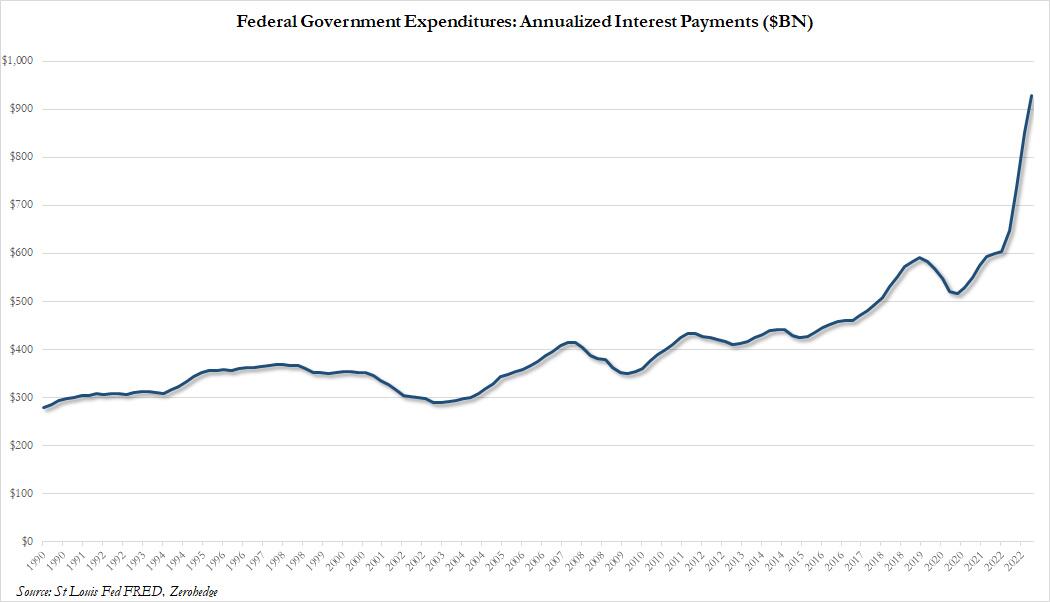
The reason we see it as a “doom loop” is that the current $33.5 Trillion of Federal Debt is continually costing more to service.The Fed’s rapid increase of interest rates, and elimination of Quantitative Easing  (e.g., Fed buying Treasury bonds) has impacted US Treasury interest costs. Note below how interest payments have soared over the past two years.

Interest expense on the Federal Debt now exceeds our substantial annual national defense spending of $816B as well as every other category except Social Security and Medicare.

The Doom Loop occurs as higher interest costs drive higher deficits, forcing the Government to sell more bonds to finance the same. Ceteris paribus, more bond sales lead to higher interest rates which then increase the deficit further. Repeat until there is no market for the bonds. Of course, at that point the Fed is forced to step in and become the buyer of last resort for the bonds to keep the bond market functioning.

The fundamental issue is that without growing the money supply, there is not enough capital to support the inflated bubble valuations. When the Fed chose violence and went on a campaign of rapid rate increases (taking the Fed funds rate from 0.25% in 2021 to 5.25% today), coupled with the sale of some of its bond portfolio (Quantitative Tightening), it increased the cost and reduced the supply of capital necessary to support all financial markets. Government bond sales (which drive rates higher) are crowding out the debt markets. This is going to have to change or the financial markets as we know them are going to collapse. The only issue is the time scale.  The subject is addressed nicely in the chart below by Lyn Alden:

As you can see, when any person, company or government takes on massive leverage, the proceeds better generate productive economic outcomes to support the debt. (e.g., levering to invest in education or nuclear plants has a payback, but if the money is used to finance War, virtually nothing is gained/produced). Thus, to support an over-levered entity, more financing or money supply growth is required. When markets enter chaotic times, like in 2008-2013 and 2018-2021, the Fed is forced to be very aggressive in growing the monetary base via expansion of their balance sheet (money printing). This is what has taken the Fed Balance Sheet Assets from $800B to roughly $8T in the past 15 years. With debt continuing to grow rapidly we see no reason why this will not occur again, perhaps in short order.

The Fed’s recent retrenchment in the Base Money Supply (orange line in the chart above) began in February of 2022. There is a lag effect in terms of its impact on the economy. We believe the lag is now starting to bite hard and that is showing up in the numbers as we will detail below.

EVIDENCE OF ECONOMIC SLOWDOWNDespite recent Wall Street and CNBC cheerleading, we believe the economy is beginning to roll over.

Post COVID, consumers regained confidence and went on a spending spree to maintain their lifestyles despite inflation and rising living costs. They did this by significantly increasing their borrowing on credit cards as seen in the chart below:

What is not shown on this chart is the average interest rate on these credit cards. Five years ago, the average interest rate on these cards was 13%. Today that rate is 22% – a significant burden for consumers carrying credit card balances. These higher costs have had an impact on consumer behavior and as the next chart shows credit card spending dropped sharply in September.

And as the following chart shows, total consumer spending has been dropping significantly year over year in 2023, and the trend is getting worse.

Further, signs of an imminent recession include the level of bank credit growth. The last time it was this negative was in the 2008 GFC. Negative bank credit growth is a very reliable recession indicator.

We believe the economy is very sick. The doctored employment figures are not telling the true story.

___________________________________

America needs a dynamic new, ‘outside-the-box’ resolution to this burgeoning economic crisis, a debt-busting behemoth economic acceleration plan.

The Leviticus 25 Plan is loaded up and ready to launch.

The Leviticus 25 Plan is a dynamic economic initiative providing direct liquidity benefits for American families, while at the same time scaling back the role of government in managing and controlling the affairs of citizens.  It is a comprehensive plan with long-term economic and social benefits for citizens and government.

The inspiration for this plan is based upon Biblical principles set forth in the Book of Leviticus, principles tendering direct economic liberties to the people.

The Leviticus 25 Plan – An Economic Acceleration Plan for America

$90,000 per U.S. citizen – Leviticus 25 Plan 2023 (8623 downloads)

The Fed, Washington Democrats, Washington Republicans – No Credible Plan to Unwind America’s Colossal Debt Burdens. Main Street America Republicans Do Have a Plan – a Monumental ‘Debt-Buster.’

Washington Democrats have an economic plan: Socialism expansion, debase the Dollar, migrate to MMT economics, roll the U.S. economic system into the coming ‘Central Bank Digital Currency’ new world order, and subvert the individual rights and liberties of all Americans.

Washington Republicans have ‘no credible plan’ … other than to lightly ‘tap the brakes’ on the Democrats’ broader socialization mission and goals.

Washington Republicans have priceless opportunity at this very moment to get America’s exploding deficits back under control, solve the ongoing the budget battles / government shutdown deadlines, restore economic liberty, and get America back on track. Shamefully… they have no plan.

Congress Has 5 Days To Avert A Shutdown | Down to the wire once again…  Nov 13, 2023 – ZeroHedge

………..

No Surprise, House Speaker Johnson Proposes Same Plan as McCarthy | There are likely big surprises elsewhere, but there is no surprise in this corner regarding Johnson’s plans to keep the government running.  Nov 13, 2023 – ZeroHedge

_____________________________________ 

The Federal Reserve also has no plan to stabilize the financial system, avert a looming Treasury auction crisis, insure long-term strength and stability for the U.S. Dollar, and reignite economic growth.

The Fed Has No Plan, And Is Just Hoping For The Best | There is no long-term thinking here about building a sound economy, fostering investment, or helping the working man save for retirement. The Fed’s concern is keeping up appearances…   Nov 12, 2023 – ZeroHedge

………………………………………………

There’s A “Crisis Brewing”: Powell & Piss-Poor Auction Spark Chaos In Credit Markets, Crypto Soars | Nov 9, 2023 – “…this is a shitshow, liquidity is disastrous and the auction is the canary in the coalmine…” – ZeroHedge

___________________________

Washington Republicans are once again playing out a ‘losing hand’ with voters in this ongoing game of budget roulette. 

Washington Republicans wasting a golden opportunity, a once in a generation moment, to present a dynamic new winning plan for America – one that would put an end to these revolving-door debt ceiling impasses once and for all – and deliver a powerful debt-elimination strategy across all sectors of the U.S. economy, with major financial security gains for working Americans.  A plan that will strengthen America’s long-term national security interests.

Main Street America Republicans have just such a plan – loaded up and ready to launch.

The Leviticus 25 Plan economic acceleration plan that will provide a dynamic ‘recharge’ to the U.S. economy, generate meaningful budget surpluses, reestablish citizen-centered healthcare, and restore economic liberty in America. 

It will “unleash a new wave of prosperity” in America.

The Leviticus 25 Plan will generate $619 billion federal budget surpluses for the initial 5 years of activation (2024-2028), and completely pay for itself over the succeeding 10-15 years.

The Leviticus 25 Plan is a powerful economic initiative providing direct liquidity benefits for American families, while at the same time scaling back the role of government in managing and controlling the affairs of citizens.  It is a comprehensive plan with long-term economic and social benefits for citizens and government.

The inspiration for this plan is based upon Biblical principles set forth in the Book of Leviticus, principles tendering direct economic liberties to the people.

The Leviticus 25 Plan – An Economic Acceleration Plan for America 2023

Economic Scoring links:

·    The Leviticus 25 Plan – 2024 Generates $619.5 billion Federal Budget Surpluses (2024-2028) Part 1: Overview, Deficit Projection

·    The Leviticus 25 Plan Generates $619.5 Billion Federal Budget Surpluses Annually (2024-2028). Part 2: Federal Income Tax Recapture; Economic Security / Means-Tested Welfare Recapture.

·    The Leviticus 25 Plan Generates $619.5 Billion Federal Budget Surpluses Annually (2024-2028). Part 3: Medicaid, Medicare, VA, TRICARE, FEHB, SSDI Recapture.

·    The Leviticus 25 Plan Generates $619.5 Billion Federal Budget Surpluses Annually (2024-2028). Part 4: Interest Expense Recapture, Totals Summary

____________________________________________________________________ 

The Leviticus 25 Plan – An Economic Acceleration Plan for America 2024

$90,000 per U.S. citizen Leviticus 25 Plan 2023 (8479 downloads)

Website:  https://leviticus25plan.org/

__________________________________________ 

Preview 1:

The Leviticus 25 Plan provides a $90,000 credit extension, direct from the Federal Reserve, to every participating U.S. citizen:  $60,000 into a Family Account (FA) and $30,000 into a Medical Savings Account (MSA).

Example:  Qualifying family of four would receive $240,000 in their FA, and $120,000 in their MSA.

Primary goals:  Massive debt elimination at family level: mortgage debt, consumer debt, student loan debt.  Federal budget surpluses.

Eligibility:  U.S. Citizen.  Job history, credit history requirement (similar to traditional credit checks for bank loans).  Clean recent drug history.  Clean crime history.

Requirements:  Forego all federal and state tax refunds for 5-year period.

Forego Economic Security and selected means-tested welfare benefits – for minimum 5-year period.

Forego enhanced federal rental forbearance/assistance – for minimum 5-year period.

Forego SSI and SSDI for minimum 5-year period.

New $6,000 deductible on primary care access to: Medicare, Medicaid, VA, TRICARE, FEHB – for minimum 5-year period.

The Plan assumes that the elite-wealthy will not participate, because their refunds are too valuable to give up over the requisite 5-year period.

The Plan also assumes that many who heavily depend on Economic Security and social welfare benefits will also choose not to participate, because the overriding value of those benefits, vs foregoing them, over the 5-year period.

Preview 2:

The Leviticus 25 Plan grants the same direct access to liquidity, through a Fed-based Citizens Credit Facility, similar to the credit facilities that were created by the Fed to transfuse trillions of dollars in direct transfers and credit extensions to Wall Street’s major banks, credit agencies and insurers during the great financial crisis. 

The following facilities were created and activated by the Fed for this massive Wall Street bail out operation: Term Auction Facility (TAF), Primary Dealer Credit Facility (PDCF), Term Securities Lending Facility (TSLF), currency swap agreements with several foreign central banks,  Commercial Paper Funding Facility (CPFF), Asset-Backed Commercial Paper Money Market Mutual Fund Liquidity Facility (AMLF), Money Market Investor Funding Facility (MMIFF), and the Term Asset-Backed Securities Loan Facility (TALF), and access to the Fed’s Discount Window.

Additional perspective:  SIGTARP, the oversight agency of the Troubled Asset Relief Program (TARP), in its July 2009 report, vetted by Treasury, noted that the U.S. Government’s “Total Potential Support Related to Crisis” (page 138) amounted to $23.7 trillion. While this figure represents a backstop commitment, not a measure of total potential loss, it is nonetheless an astounding degree of support, in the form of liquidity infusions, credit extensions and guarantees, various other forms of assistance for financial institutions and other business entities affected by the financial crisis.

Preview 3:

The Leviticus 25 Plan website has been accessed on one or more occasions by the following financial enterprises/agencies:  JP Morgan, Goldman Sachs, Morgan Stanley, Bank of America, Citigroup, Wells Fargo, State Street, Merrill Lynch, AIG, Barclays Plc, Royal Bank of Scotland, Deutsche Bank, Société Générale S.A, UBS AG, Credit Suisse, BNP Paribas, The U.S. Department of Treasury, General Accountability Office (GAO), The European Central Bank (ECB), Bank of England (BOE), Swiss National Bank (SNB), Bank of Canada, Bank of Montreal, Bank for International Settlements (BIS).

………………………………………………………..

The General Accountability Office has stated that America’s ongoing debt crisis is unsustainable.

It is time for America to institute a bold, new plan.

The Leviticus 25 Plan is loaded up and ready to launch.  The ‘golden moment’ for Republicans has arrived.

U.S. Taxpayers Funding IMF Subsidies for Russia, China, Iran…

The $650 billion outlay of IMF IOUs backed by the U.S. Treasury—called special drawing rights—sent money to Moscow [$17 billion] while the world watched Mr. Biden abandon Bagram Air Base to the Taliban. Iran gained access to about $4.5 billion through the IMF deal, and China had a windfall of $40 billion.

According to the International Monetary Fund (IMF), “the United States contributes $117 billion to the IMF quota (17.46%). In addition, the United States has contributed $44 billion to funds at the IMF that supplement quota resources.” Mar 8, 2022

………………………………………………………………..

WSJ: No More IMF Subsidies for Dictators

Biden and Yellen pushed to give Russia $17 billion while troops gathered on Ukraine’s border.

By John Kennedy | WSJ, March 22, 2022 – Excerpts:

U.S. European Command warned a year ago that a crisis could be imminent in Ukraine. Vladimir Putin had set up more than 100,000 members of his military to breathe down Ukraine’s neck—the biggest mobilization since Russia annexed Crimea in 2014. As Mr. Putin prepared to invade a sovereign democracy, the Biden administration continued pushing for more than $17 billion in International Monetary Fund allocations for Moscow.

President Biden and Treasury Secretary Janet Yellen ultimately got what they wanted in August, when the IMF doled out more money in one general allocation than ever before. The $650 billion outlay of IMF IOUs backed by the U.S. Treasury—called special drawing rights—sent money to Moscow while the world watched Mr. Biden abandon Bagram Air Base to the Taliban. Iran gained access to about $4.5 billion through the IMF deal, and China had a windfall of $40 billion.

In this case, there were no sanctions to evade because the Biden administration simply handed Vladimir Putin, Ayatollah Ali Khamenei and Xi Jinping the money. The IMF special drawing rights function as subsidies, since countries awarded these tokens can exchange them for hard currency like dollars and euros on demand without having to repay the principal. Immediately after the White House finalized these subsidies, Russia’s foreign reserves hit a new high.

The White House’s most egregious move may be yet to come. The Biden administration purposefully structured the 2021 allocation as a down payment on another flood of special drawing rights this year, totaling $350 billion. Some Democrats asked Ms. Yellen in November to back a tranche of about $2 trillion. In either case, Treasury would again lay tens of billions of dollars at the feet of dictators and terror states. But more free money won’t beget better behavior.

As the new axis of evil grew richer last fall, it grew markedly more belligerent. Russia invaded Ukraine, Iran became more incorrigible in its nuclear-deal demands, and China signaled recently it believes its claim to Taiwan is even stronger than Russia thinks it has to Ukraine.

Mr. Biden and Ms. Yellen can’t say they weren’t warned. I started imploring Ms. Yellen not to subsidize our enemies in the name of Covid relief last March, as did the Journal’s editorial board.

The Biden administration also can’t claim it was forced into the deal by the IMF, given that the U.S. has the largest voting share in the fund. The allocation that lined the pockets of Messrs. Putin and Xi had to have U.S. approval because the world’s largest economy can veto major IMF decisions.

Treasury can’t claim it had no other options. The IMF could have avoided spending the bulk of the $650 billion general allocation on dictators and countries that didn’t need the aid by making the special allocation for the poorest nations. Again, these pages pointed out that Mr. Biden’s objection to a tailored approach was that it would require him to submit to Congress—which he seems generally reluctant to do.

The White House’s eyes were wide open, and its hands weren’t tied. Team Biden knew Mr. Putin was mobilizing against Ukraine and greenlit $17 billion for Russia anyway, while slowing military aid for Ukraine.

China and Iran have been taking notes at every turn. Mr. Biden’s end-run around Congress left rogue leaders emboldened and enriched. His task now is to get America out of Iran-deal negotiations, force Russia out of Ukraine, and keep China out of Taiwan.

He needs to demonstrate resolve. He can start by disavowing future IMF allocations that would pour money into Russia, China, Iran and their like. Let’s shut off the IMF spigot to communists and terrorists and make sure it stays shut.

……………………………………….

WSJ:  IMF Seeks to Allay Doubts Following Data-Rigging Scandal, Move Forward With New Agenda

By Josh Zumbrun | WSJ, Oct. 14, 2021 – Excerpts

Kristalina Georgieva, managing director of the International Monetary Fund, was cleared by the organization’s board for her role in a World Bank report that was manipulated to benefit China— just one of the recent challenges before the IMF.

Following a data-rigging scandal that engulfed its managing director, the International Monetary Fund is working to regain its footing in international financial markets while it works to balance the competing interests of its two main backers, the U.S. and China.

The IMF board cleared the group’s leader Kristalina Georgieva earlier this week for her role in a World Bank report that was manipulated to benefit China, but the scandal remains an active issue for the U.S. Treasury and some American lawmakers. “If the allegations are true that China can intimidate objective economic analysis to get its desired outcomes, that’s concerning,” said Sen. Jim Risch of Idaho, the ranking Republican on the Senate Foreign Relations Committee….

Private investors, new lending facilities of the Federal Reserve, and the rise of China as a lender to other countries have all supplanted some traditional IMF functions. That leaves the organization with a diminished role in global finance and growing skepticism from many in Washington about its future.

The rise of China as a lender presents a particular conundrum. Many U.S. officials have grown concerned that IMF programs can ultimately benefit China. Such concerns emerged clearly when in 2018 Pakistan came to the IMF seeking a bailout, partially because it had taken on too much debt for projects with China’s Belt and Road Initiative. China’s external lending and U.S. concerns have only grown since then. Then-Secretary of State Mike Pompeo criticized the IMF at the time, insisting IMF funds shouldn’t be used to bail out China.

During recent financial upheavals, it was the U.S. Federal Reserve that flooded the global financial system with hundreds of billions of dollars of central-bank liquidity swaps. The Fed provided funds directly to many emerging markets, traditionally the IMF’s domain.

Nearly 100 countries sought loans. Total IMF lending climbed from $74 billion in 2019 to as high as $106 billion at the end of 2020. Loans made on concessional, or zero-interest, terms climbed from $7 billion to $14 billion. The IMF committed at this week’s meeting to boost such lending further.

[During the pandemic] Nearly 100 countries sought loans. Total IMF lending climbed from $74 billion in 2019 to as high as $106 billion at the end of 2020. Loans made on concessional, or zero-interest, terms climbed from $7 billion to $14 billion. The IMF committed at this week’s meeting to boost such lending further….

__________________________________

Again… President Joe Biden along with Janet Yellen ‘greenlit’ the “$650 billion outlay of IMF IOUs backed by the U.S. Treasury—called special drawing rights—sent money to Moscow while the world watched Mr. Biden abandon Bagram Air Base to the Taliban. Iran gained access to about $4.5 billion through the IMF deal, and China had a windfall of $40 billion.

U.S. tax-payer dollars have been flowing freely, through the IMF, to America’s avowed enemies… to provide liquidity and assist them ‘in their time of need.’

And... “During recent financial upheavals, it was the U.S. Federal Reserve that flooded the global financial system with hundreds of billions of dollars of central-bank liquidity swaps.”

There is no better time than right now to ramp up Federal Reserve ‘liquidity flows’ directly to hard-working, tax-paying U.S. citizens to clean up America’s own debt-saturated financial quagmire.

The Leviticus 25 Plan is a dynamic economic initiative providing direct liquidity benefits for American families, while at the same time scaling back the role of government in managing and controlling the affairs of citizens.  It is a comprehensive plan with long-term economic and social benefits for citizens and government.

The inspiration for this plan is based upon Biblical principles set forth in the Book of Leviticus, principles tendering direct economic liberties to the people.

The Leviticus 25 Plan – An Economic Acceleration Plan for America

$90,000 per U.S. citizen – Leviticus 25 Plan 2023 (8284 downloads)

Federal Debt: Bonds Maturing, Rolling Over at Higher Rates. Situation Growing Uglier by the Month. Monetary Debasement ‘Highly Likely.’

“Monetary Debasement” is Highly Likely

ZeroHedge, Oct 26, 2023 – Submitted by QTR’s Fringe Finance Excerpts:

“….we strongly believe that given the system of Governments and Central Banks that we live under that “monetary debasement” is highly likely.  That is the good news.  The bad news is getting the timing right is tough, but when it does happen, we are not talking about small upside. The upside is very outsized.  

We think that it is important to understand how front end weighted the US Federal Debt has become.  This means that the Federal interest expense is very sensitive to the short term interest rate. The next two charts help us to understand this more clearly. 

First, see the chart below.   Note how half of the debt will need to be rolled over within the next 3 years.  

Most of this debt was issued with interest rates that are way below today’s level. 

Then consider the following chart which shows that presently the US Federal Government is paying 2.49% on average on its debt burden.  Consider that US Federal Interest expense is running at a $970B annual rate (see Parts 1 and 2 of this letter).

Further, consider that US Bond interest rates now range between 4.6% and 5.4%, or nearly twice the average that is being paid now.  As the bonds above mature they will need to be rolled over at higher rates.  Total US Federal Debt is $35.5T but it is growing at $2-3T per year (conservatively). 

Let’s say the average interest rate becomes 4.6% over the next few years and deficits run at $2.5T per year.  This means that in two years US Federal interest expense will be $1.9T, or more than double today’s run rate.  All else equal we would add another $1 Trillion to the deficit.  This helps to explain why we are in a debt doom loop.

____________________________________________

America needs a powerhouse new economic acceleration plan to stop the deluge…

The Leviticus 25 Plan is a dynamic economic initiative providing direct liquidity benefits for American families, while at the same time scaling back the role of government in managing and controlling the affairs of citizens.  It is a comprehensive plan with long-term economic and social benefits for citizens and government.

The inspiration for this plan is based upon Biblical principles set forth in the Book of Leviticus, principles tendering direct economic liberties to the people.

The Leviticus 25 Plan – An Economic Acceleration Plan for America

$90,000 per U.S. citizen – Leviticus 25 Plan 2023 (8037 downloads)